The 30th birthday of the Sinclair C5, one of the most unusual vehicles ever to be built in Britain, is being celebrated by the National Motor Museum.
First on display in the museum following its launch on 10th January 1985, visitors can again see this electrically-powered tricycle, which was gifted to the museum by its manufacturer.
Despite failing to catch the public’s imagination at its launch, today the C5 is regarded as an icon of 1980’s design and a pioneer of alternative-fuelled transport, as well as an endearing British failure.
The Sinclair C5, masterminded by inventor and entrepreneur Sir Clive Sinclair, was designed to be an inexpensive and nimble alternative for one person to travelling by car, bus or bicycle. Marketed as ‘a new power in personal transport,’ it had a retail price of £399 and could reputedly be driven for five miles on just one penny’s worth of electricity.


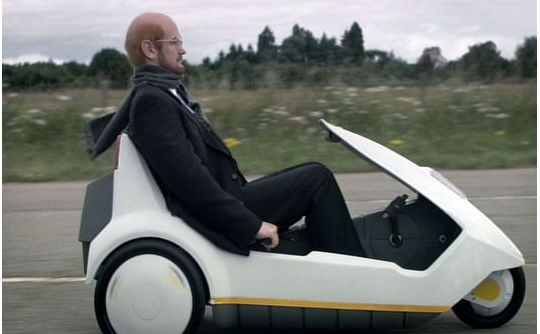
However, the C5 was poorly received by the press and public alike. Its diminutive size – standing just 2’ 7” off the ground – made it vulnerable on the road, while the claimed range of 20 miles on one battery charge was modest, due to the limitations in contemporary battery technology. Even if the ‘weather cheater’ poncho, offered as an accessory, was worn by the driver, the C5’s lack of rain protection also ensured a short production life.
Although Sinclair had expected to sell up to 100,000 units per year, only 9,000 C5s had been built by October 1985, following the end of production and the collapse of the company that Sinclair had set up to produce it.
The C5 utilised both pedal power and an electric motor for propulsion, with the driver sitting exposed to the elements in the open plastic body shell. Handlebars, located beneath the driver’s knees provided controls for steering, braking and acceleration. The design of the three-wheeled backbone chassis, constructed from steel, had been extensively developed by sports-car experts Lotus Cars.
An electric motor powered the left-hand rear wheel, helping the C5 to reach 15mph – its top speed, as restricted by law. Anyone over the age of fourteen was permitted to drive one and no driving licence was required, with only one button needing to be pressed to make it move. Built by Hoover at the firm’s factory in Merthyr, Wales – prompting incorrect rumours that it was powered by a washing machine motor – each C5 was supplied to its new owners in a cardboard box.
By the time that the C5 was launched, Sir Clive Sinclair already had an impressive list of revolutionary designs to his name. As a pioneer of miniaturisation, the reduction in the size of electronic hardware, his creations included the ZX range of affordable home computers, the digital watch, the world’s first slim-line pocket calculator and the world’s first pocket television.
Sinclair had long been fascinated by electric vehicles and experimented with much larger designs before focusing on the single-seater C5. He later claimed that the C5 was intended to fund the development of a much larger, four-seat electric vehicle, which could travel at speeds of up to 80mph. However, the C5’s commercial failure meant that this never happened.
The C5 can be seen as part of a visit to the whole Beaulieu attraction, which also includes Palace House, Beaulieu Abbey and World of Top Gear. For more details, visit www.beaulieu.co.uk.


