Purpose

I will try my best to provide detailed info on various cars and what is like to live with them, I have already produced a few for Jaguar-car-forums, I will do my best to be unbiased, but it will be hard for some cars. I will re-produce press releases and copy from other motoring news.
Showing posts with label mk1. Show all posts

Tuesday, 28 February 2017

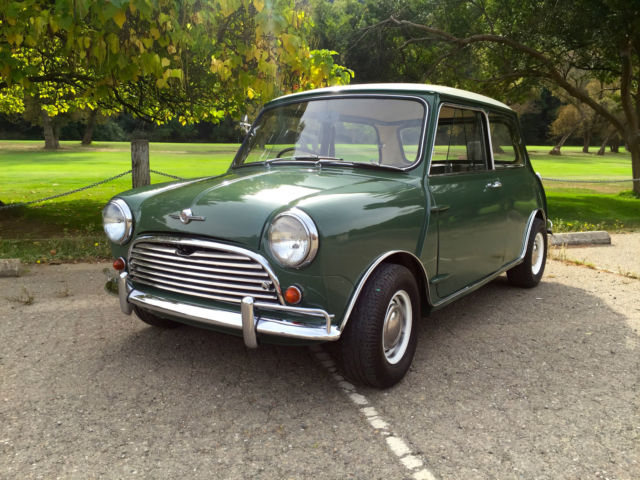
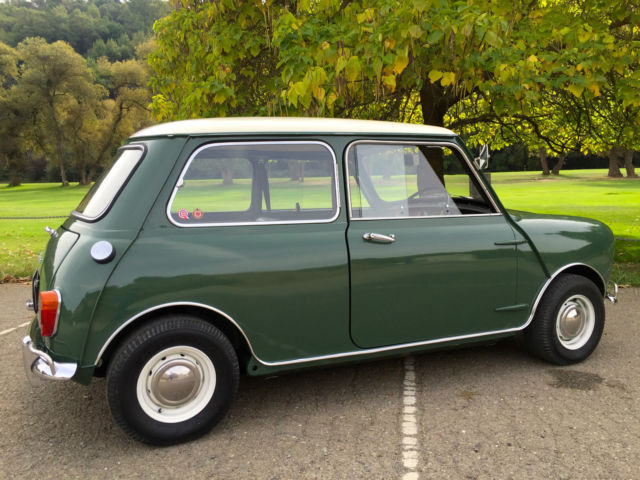
British Motor Heritage now provides a full body shell for the MK 1 Mini, awesome to keep these cars on the road.

The values of MK1 Minis continue to rocket, increasingly justifying the cost of the part or total restorations that will be required for most examples sooner or later. 
British Motor Heritage (BMH) has long since been at the forefront of supplying individual panels for all marks of classic Minis, and complete bodyshells for models from 1976 onwards. 
What’s been missing until now is the Holy Grail, a full replacement shell for the MK1, but the wait is now over!

Mini enthusiasts were given a glimpse of what was to come on BMH’s stand at the NEC Classic Motor Show last November, and the response was universally positive. The first production batch of 15 bodies will therefore commence in April, with deliveries occurring through May and June. The launch price is £9,950 inc. VAT and the company is accepting orders accompanied by a 25 percent deposit.
The early body is markedly different from its later counterparts. The major variances include:
  • Smaller: door aperture with different step profiles; sliding window doors with external hinges; rear window; rear side windows; rear light mountings
  • Different: ‘A’ panels and hinge reinforcements; cant rails; floors; sills; front and rear parcel shelves; switch panel; boot panel, bonnet and inner valences; front valance and number plate mounting
Since creating the prototype body, BMH has commissioned additional tooling to refine the finish and improve the build quality. 
The company is indebted to M-Machine for allowing it to use their MK 1 floors and sills, as the cost of retooling these items would have made the project unviable. BMH has also used the later front bulkhead crossmember assembly as retooling for this non-visual part would have been prohibitive, and opted not to form the rotodip hole in the rear seat squab; recognising that a significant element of demand for the new shells will almost certainly be for historic motorsport.

Thursday, 28 July 2016

What must surely be the best MK1 Ford Cortina from 1963 is up for auction at Historics at Brooklands.

Historics offers for sale arguably the finest remaining 1963 Ford Cortina, that’s travelled an average of one mile-a-day in its 53 years
‘Exclusive’ isn’t a word that best describes the Mk. I Ford Cortina after sales that crested one million.  Nevertheless an early, immaculate, and very original example of the 1500 GT model that comes to sale at Historics at Brooklands major classic car auction near Weybridge on Saturday, August 20th is a wholly different matter, having travelled an average of just one mile a day since it left the Dagenham factory 53 years ago.

Fitted with a tuned 1,498cc engine, the 1500 GT was the top specification model of the day, its  zesty 78bhp sufficient to propel the svelte four-door to 95mph, with a 0-60 acceleration time of just 14 seconds… leaving the Morris Oxford of the day some five seconds in its wake.
Despite its performance, when it appeared in the Ford showroom at a princely £748, this 1963 Cortina 1500 GT would have played second fiddle on the attention stakes to the fleet of Mk.I’s that starred in the saucy ‘Carry on Cabby’ film that screened at the time, helping to secure valuable awareness for Ford’s new model.  
However, since it was first registered on 4th July 1963, the fastidious care and obsessive attention paid to it by its two owners – the last acquiring the car 27 years ago - makes this 19,244 warranted mile car arguably the finest and most original Mk.1 Cortina remaining today.
This multiple concours* winner, ARE 163A, features superb Goodwood Green coachwork, and the interior is utterly as-new. The dashboard, featuring the early strip speedometer and pod-mounted rev counter, has no age-related blemishes and the seating, trim and and original carpets are unmarked.  
Interested parties should note that the car is currently fitted with a period Les Leston Grand Prix steering wheel, and that the original is sold with the car.
The scene under-bonnet is delightful and exactly as it should be, and ditto beneath the car, where the condition is as fine as topside, with the jack and tools - spotless and polished - all present and correct.
The garage owner who has conducted the majority of the MoT tests has re-affirmed the car’s magnificent condition, adding that he recalled a time when the previous owner refused to drive the car home after the test as it was raining, choosing to walk instead. He collected the car three days later… when the roads were dry.
Very substantial interest at the estimate of £24,000-£28,000 is anticipated in acquiring this very rare, superb 1963 Ford Cortina 1500 GT in time-warp condition. 
It is one of the highlights of the sale of 140 fine classic motor cars and motorcycles, across a wide range of values, marques and eras, on Saturday, August 20th by Historics at Brooklands Museum, Surrey, where all consignments can be viewed on the Thursday and Friday prior.
*The current vendor has shown the car at a number of events, unsurprisingly with great success. The following are just some of the awards it has won:
1990 Mk.I Cortina Owners Club - Concours winner
1991 Mk.I Cortina Owners Club - Best GT (National Rally)
1992 Mk.I Cortina Owners Club - Concours winner
Ford 1600E Owners Club, Visitors - Concours winner
Auto-Glym Concours 1960-1970 - Classic saloons winner
1995 Mk.I Cortina Owners Club (National Rally) - Concours winner

Friday, 14 June 2013

30 million and counting, the MK VII Golf celebrates

  • World’s 30 millionth Golf drives off the assembly line in Wolfsburg
  • ‘Car of the Year 2013’ award presented in Wolfsburg
On Thursday, Prof. Martin Winterkorn, Chairman of the Board of Management of Volkswagen AG, also officially accepted the “Car of the Year 2013” award for the Golf conferred by the 60 member international jury for the highly esteemed award. Prof. Winterkorn commented on both of these events: “The history of the Golf is also the history of automotive progress. With technologies such as the safe front-wheel drive of the first Golf, the debut of the TDI in the third Golf, ESC (Electronic Stability Control) and the dual clutch gearbox of the fourth Golf and the standard Automatic Post-Collision Braking System of the new generation, this car has continued to democratise progress. An optimum of safety, comfort and driving fun are no longer a question of money thanks to the Golf. And so our bestseller lives up to the Volkswagen name.” The milestone vehicle will be officially on display for employees of the Wolfsburg plant this coming Saturday at the plant’s open day.

The seven Golf generations that wrote history.
Golf I (1974 to 1983): “It all began in 1974 with a revolution,” is how Klaus Bischoff, Head of Design for the Volkswagen brand describes it. “The step from the Beetle to the Golf was revolutionary. A new vehicle layout was created with the conversion from an air-cooled rear engine to a water-cooled front engine and from rear-wheel drive to front-wheel drive. In terms of the car’s styling, Volkswagen designers switched from round shapes to a rectangular design structure – based on the legendary design study by Giorgio Giugiaro”.
Golf II (1983 to 1991): This was the Golf in which Volkswagen technologies such as the controlled catalytic converter (1984), ABS (1986) and all-wheel drive (1986) were introduced. In this generation, the model series also advanced to become a definitive icon. Marc Lichte, lead exterior designer for Volkswagen recalls: “Back then, one of the key moments in the history of the Golf was the decision by board members to further develop the styling of the Golf I and conceptualise the Golf II based on its “visual DNA”. This set everything into motion, and Volkswagen created the foundation for continuous development of the model series.”
Golf III (1991 to 1997): In 1991, Volkswagen initiated a new era of safety in the third generation. For one, the Golf III was the first model in the series to offer front airbags in 1992; for another, great progress in the area of body manufacturing led to further improvements in crash properties. The first TDI engine of the model series was also introduced in this Golf (1993).
Golf IV (1997 to 2003): Under the direction of the former Head of Design (Group) Hartmut Warkuß, a precise design was created that would pave the way for the future of Volkswagen. Today, experts look upon the Golf IV as a design icon and a pioneer for the series. But this Golf was also an engineering innovator with technologies such as ESC (1998) and the dual clutch gearbox (2002).
Golf V (2003 to 2008): It was the Golf, its comfort, dynamics and above all its quality that left many a competitor of the upper mid-class trailing behind. A value that illustrates the stability of the laser-welded body is the 35 per cent gain in torsional rigidity when the Golf V made its debut in 2003. The first Golf BlueMotion (4.5 l/100 km fuel consumption) – based on the Golf V – was created in 2007.
Golf VI (2008 to 2012): The body, once again welded by laser, was so safe that it performed with flying colours in EuroNCAP crash testing, attaining its maximum five star rating. The triumph of the TSI engines (high-tech petrol engines) and conversion of the turbodiesels (TDI) to the common rail system led to more dynamic performance and better fuel economy. The forerunner was the second Golf BlueMotion, which offered a combined fuel consumption value of just 3.8 l/100 km.
Golf VII (since 2012): Weight was reduced by up to 100 kg in the seventh generation Golf, reversing the much discussed upward weight spiral. Fuel consumption was reduced by as much as over 23 per cent compared to the previous model, depending on the specific engine. The forerunner of this movement is the Golf TDI BlueMotion with a combined fuel consumption of just 3.2 l/100km, and it is also the 30 millionth car produced. The Golf VII will definitely go down in history as the compact model in which an entire armada of new assistance systems made its debut. They are systems such as PreCrash preventive occupant protection and the Automatic Post-Collision Braking System – technologies that were more likely to be offered in the premium class than in the compact class previously. That too signifies a democratisation of automotive progress.