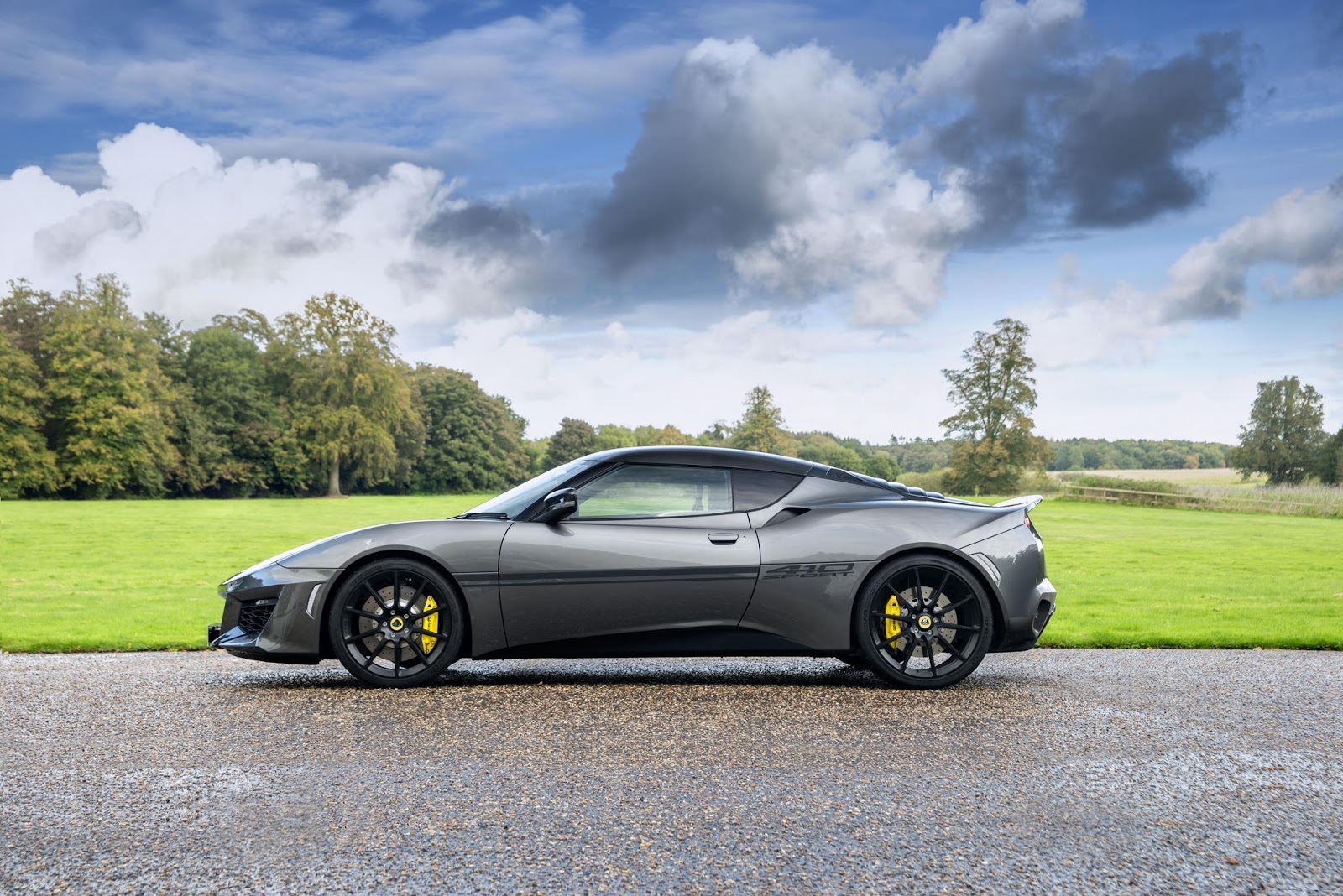
- Most powerful road going Lotus sports car ever
- 0-60 mph in 3.7 secs, 430 hp and 1,258 kg
- 250 kg of downforce at maximum speed of 190 mph
- Just 60 editions planned for worldwide markets
- Available to order now
Following the successful introduction of the Lotus Evora 400 and Evora Sport 410 to global markets, Lotus has unveiled its most powerful road-going model ever – the Evora GT430.
A beautiful and pure combination of elegance and power, Lotus has lavished attention on hand-crafted carbon-fibre components to endow this fully homologated Evora with a level of precision engineering and design unseen before.
This focused evolution of the critically acclaimed Evora has resulted in a landmark model for the famous British manufacturer. Powered by a new development of the 3.5-litre V6 supercharged and charge cooled engine producing 430 hp, and benefitting from a significant hike in downforce, the rare breed Evora GT430 is a class apart from its competitors.


Underpinned by the company’s acknowledged eminence in lightweight engineering, and at a new benchmark weight of 1,258 kg (dry), the Lotus Evora GT430 is the manufacturer’s most powerful and accomplished road car to date. With such performance, and all the marque’s chassis expertise, the new Evora GT430 delivers tremendous real-world speed and handling unheard of in its class.
Given the car’s breath-taking design and phenomenal performance, the Evora GT430 is an instant classic. Just 60 editions of this supreme Evora will be hand built in Norfolk, England, for sale in select markets around the world and, following the popularity of Lotus’ recent limited run editions, it’s already in line to be a true collector’s car.
Marking the return of a famous Lotus badge, and acknowledging the Lotus Esprit V8 GT and the Esprit GT3 from the 1990s, this two-seater encapsulates the company’s approach to fast point-to-point sports cars. 0-60mph is dispatched in just 3.7 seconds and the car’s top speed is 190 mph (305 km/h).
With new and specifically designed body panels, featuring exposed carbon weave sections, front and rear, the Lotus GT430 generates up to 250 kg of downforce through advanced aerodynamics. Larger front apertures, a new carbon fibre splitter, air blades and louvers positioned on top of each front wheel arch clearly illustrate the supercar credentials of the Evora GT430 when viewed head on. At the rear, aero ducts behind each wheel reduce pressure in the wheel arch and offer visibility of the wider Michelin Pilot Sport Cup 2 tyres, and a large rear diffuser provides a sharp visual finish. Both are crowned by the large, profiled carbon wing.
Jean-Marc Gales, CEO, Group Lotus plc said, “The Evora GT430 is a landmark car for Lotus. Lightweight engineering and class-leading handling, paired with Lotus’ aerodynamic expertise, define the Evora GT430 as a legendary Lotus. It’s a truly beautiful car, meticulously finished in hand-crafted carbon, and employing the latest aerodynamics and lightweight materials. This highly developed vehicle perfectly reflects Lotus’ attention to engineering and design. We expect the lucky owners to be blown away by its pure presence and staggering performance.”
Faster, lighter, sharper
Featuring unique bodywork and aerodynamic elements, as well as more power, the Evora GT430 further raises the bar for road-going sports cars. It delivers the balance and finesse for which the marque is famous, combined with blistering pace, supreme composure and agility at the highest speeds.
Every component of the Evora has been evaluated before inclusion to ensure that the car retains only the items essential for performance. Despite the addition of 9 kg increased specification components (lightweight carbon rear wing and larger wheels and tyres), overall dry weight is down by 26 kg, to 1,258 kg, compared to the already super light Evora Sport 410, making this the lightest road Evora to date.
In addition to the unique full carbon front and rear bumpers, which feature exposed visible weave sections, the car is comprehensibly equipped with high-gloss, visible carbon fibre components throughout, including a new front splitter, front access panel, roof panel and full width rear wing. Also at the rear is a beautifully detailed, one-piece carbon tailgate, incorporating a louvered section which, together with composite quarter panels, affords the car an unmistakable profile.
All Lotus cars are regarded as the finest handling sports cars on the market and the new Evora GT430 takes dynamic performance to the next level. Damping is provided by Lotus-tuned, Öhlins TTX two-way adjustable units, with 20 click-adjustment compression and rebound settings and saving 10kg in mass compared to the Evora Sport 410 set-up. New, ultra-lightweight, low-sideload Eibach springs provide an increase in spring rate and the car’s handling is improved further through the use of front and rear anti-roll bars.
Perfect for B-roads, but ballistically fast when needed, the new Evora GT430 can lap the famous Hethel test track in 1 minute 25.8 seconds – a record for an Evora. As fast as the famed Lotus 3-Eleven road car on the same circuit, the GT430’s performance envelope is derived from a combination of clever aero and dynamic developments as well as outright power. As a result, the car is manifest of Colin Chapman’s visionary quote: “Adding power makes you faster on the straights; subtracting weight makes you faster everywhere."
A superb example of this is the removal of critical weight from beyond the front and rear axles of the Evora GT430, reducing the car’s polar moment of inertia, resulting in improved transient response, overall agility and driver feedback.
Retaining a 3.5-litre supercharged and charge-cooled V6, the car’s reconfigured engine produces 430 hp (436 PS) at 7,000 rpm and 440 Nm (325 lbft) of torque from 4,500 rpm. The increase in torque is facilitated through the introduction of an air-to-liquid gearbox cooler as standard, a feature which made its debut on the recently launched North American Evora 400. As standard, the Evora GT430 also features a titanium exhaust, cutting 10 kg from beyond the car’s rear axle and further amplifying the car’s aural presence.
Also fitted as standard, the Evora GT430’s six-speed manual gearbox features a low-inertia, single-mass flywheel, to help ensure swift changes, while a Torsen-type limited slip differential (LSD) gives better traction, and faster exit speeds, when cornering.
The substantial aerodynamic revisions introduce bodywork elements that boost the downforce of the Evora GT430, up to 250 kg at maximum speed of 190 mph (305 km/h) and matching the Evora Sport 410’s maximum downforce of 64 kg at only 90 mph (145 km/h). Developed through motorsport applications, the aerodynamic modifications focus on the management of airflow over, under and around the car. The downforce generated makes its presence felt at even moderate speeds, allowing for higher cornering g-force and providing enhanced high-speed stability.
A new carbon fibre front splitter cleanly separates and speeds airflow under the car, and the two enlarged carbon fibre front ducts, with integrated air blades, efficiently move air though to the front wheel cavities, to help reduce turbulence and drag created by the wheels themselves. The lightweight curved rear edges of the front wheel arch panels channel air along the side of the car and the louvers positioned on top of each front wheel arch reduce pressure above the wheel.
The rear of the Evora GT430 has received the same attention to detail, with the deep, sculpted ducts behind each wheel that vent airflow as quickly as possible from the wheel arches, improving downforce. Dominating all of this is the large, high mounted aerodynamically efficient motorsport carbon wing.
To harness the increased downforce and power, mechanical grip is provided by 10 mm wider Michelin Pilot Sport Cup 2 tyres, with 245/35 R19 at the front and 295/30 R20 at the rear, on one inch wider 10.5J rear wheels. Ultra-lightweight forged aluminium wheels are standard, in either black or silver, with optional finishes available in gloss red or a gloss black machined rim design.
Dynamic stability modes (with ‘Drive‘, ‘Sport’, ‘Race’ and ‘Off’ settings) can be selected, which allow the driver enhanced vehicle control before the system intervenes. The Evora GT430 also includes a newly developed variable traction control function, linked directly to the ECU, which allows the amount of wheel slip to be set by the driver whilst in ‘Race / Off’ setting, with five pre-set traction levels (1%, 3%, 6%, 9%, 12% slip) and ‘Off’ displayed via the instrument cluster.
A fast car requires substantial stopping power, and the Evora GT430 uses two-piece J-grooved and ventilated brake discs at the front, paired with AP Racing four-piston calipers all round, while the rear uses three-piece discs with lightweight aluminium centres saving 2 kg.
“Lotus is famous for using its technical expertise to develop the lightest engineering solutions,” explained Jean-Marc Gales. “Yes, it is hugely powerful but, the GT430 is not about brutal performance. It’s an intricate balance of power, finesse and road holding, no matter the speed, and is a true track-and-back sports car, supremely focused and immensely fast.”
The external theme of carbon continues into the car’s exquisitely crafted cabin, with visible-weave, handmade components as standard. These include Lotus’ beautifully detailed carbon race seats, new carbon door sills and a new lightweight carbon instrument binnacle cover with a new design of graphic on the instrument panel.
Newly-designed carbon-backed Sparco seats with a unique trim design can also be ordered, whilst customers looking for a more race focused cabin can specify an optional driver and passenger four-point harnesses and titanium rear frame.
The steering wheel, dashboard, door panels, transmission tunnel and centre console are all trimmed in a combination of black Alcantara® and perforated leather, with a full leather or full Alcantara® trim option available at no additional cost. All trim choices are complemented by contrast twin colour stitching, in red and white, and matt black interior panels.
An integrated touch-screen infotainment system can be specified, including iPod® connectivity and Bluetooth® functionality, satellite navigation and reversing camera.
Every new Lotus Evora GT430 customer can personalise their vehicle through the increasingly popular Lotus Exclusive programme. Developed by the Lotus Design team, roughly a third of all new Lotus cars now undergo some form of customisation. Conceived to inspire customers, it combines traditional British craftsmanship with the best of modern design, and allows owners to tailor vehicles to their personal taste.
The new, fully homologated, Lotus Evora GT430 is available in two seater configuration only and can be ordered now. A version of the Evora GT430 for the North American market will follow in spring 2018.
Weight reduction in detail
The headline net weight reduction of 26 kg versus the Evora Sport 410 is derived from the standard titanium exhaust (-10 kg), carbon body panels (-4.7 kg), lightweight interior components (-2.5 kg), Öhlins and Eibach adjustable spring and damper assembly (-10 kg) and lightweight rear brake discs (-2 kg). Additionally, careful attention to detail beneath the car’s surface has yielded significant benefits, further stripping out unnecessary mass; for instance, a thinner aluminium undertray (1.5 kg), the introduction of lightweight aluminium brackets (-1.3kg), lightweight polycarbonate backlight glass (-0.5 kg) and a re-profiled fluid fill system (-2.5 kg) all contribute towards the total weight reduction.
This total saving of 35 kg is offset by the addition of wider wheels and tyres (+5 kg) and the new curved profile rear wing (+4 kg).
EVORA GT430 - TECHNICAL SPECIFICATION
PERFORMANCE
|
Evora GT430
|
Max power
|
430 hp at 7,000 rpm (436 PS)
|
Max torque
|
325 lbft from 4,500 (440 Nm)
|
0-60 mph
|
3.7 seconds
|
0-100 km/h
|
3.8 seconds
|
0-100 mph
|
< 8 seconds
|
Max speed
|
190 mph (305 km/h)
|
CO2 emissions
|
249 g/km
|
Kerb weight
|
1,299 kg
|
Dry weight
|
1,258 kg
|
Power-to-weight ratio (dry weight)
|
342 hp per tonne
|
Aerodynamic downforce at maximum speed
|
250 kg
|
Hethel lap time
|
1:25.8 seconds
|
Engine AND Transmission
|
3.5 litre V6, 24 valve, water cooled, all aluminium engine, with Edelbrock supercharger
|
6-speed manual transmission, with gearbox cooler, coupled to Lotus’ precision shift aluminium mechanism
|
Lightweight, single-mass, low inertia fly wheel
|
Torsen Type Limited Slip Differential
|
Baffled sump
|
Titanium exhaust system
|
CHASSIS AND BODY
|
Servo assisted, race-derived, two-piece J-hook ventilated brake discs with ultra-lightweight rear aluminum disc bells and AP Racing four piston calipers (front 370mm x 32mm, rear 350mm x 32mm)
|
Anodised, lightweight aluminium, extruded, epoxy bonded and rivetted high-stiffness chassis
|
Unequal length, high lateral stiffness, forged aluminium, double wishbone suspension with Eibach® tubular front and rear anti-roll bars
|
Lotus-tuned, Öhlins® TTX aluminium two-way adjustable dampers – twenty click adjustment compression and rebound; twin tube design; low internal friction
|
Eibach® ultra-light, low-sideload springs, front and rear
|
Lotus tuned hydraulically-assisted, rigidly-mounted, rack and pinion steering system, with 2.86 turns lock-to-lock
|
Driver selectable ESP modes – Drive/Sport/Race
|
6 position variable traction control, with five pre-set traction levels (1%, 3%, 6%, 9%, 12% slip) and “off” displayed via the instrument cluster
|
Cruise control
|
Tyre pressure monitoring system
|
Lightweight lithium-ion battery
|
EXTERIOR SPECIFICATION
|
Carbon fibre front splitter
|
Carbon fibre front bumper, including drag-reducing air curtain
|
Carbon fibre rear bumper, including venting for wheel arch
|
Carbon fibre front access panel
|
Carbon fibre roof panel
|
Carbon fibre lower A panels
|
Louvered wheel arch vents to reduce aerodynamic lift
|
Carbon fibre rear quarter panels
|
Carbon fibre profiled rear wing
|
Carbon fibre rear diffuser
|
Lightweight carbon fibre tailgate with integrated rear spoiler and louvered backlight
|
Polycarbonate backlight glass
|
Brake calipers – red painted with black AP Racing logo
|
Lotus designed, ultra-lightweight, fully machined, forged aluminium wheels (19" front and 20" rear 10 spoke alloy wheels) in silver or matt black
|
Michelin Pilot Sport Cup 2 tyres (front 245/35 R19, rear 295/30 R20)
|
Spoiler uprights linked to wheel colour choice
|
Bi-xenon headlights
|
LED daytime running lights
|
Powerfold and heated door mirrors
|
Rear parking sensors
|
Thatcham approved immobiliser and remote activated alarm system
|
INTERIOR SPECIFICATION
|
2+0 seat configuration
|
Carbon fibre sports seats, trimmed in black Alcantara® and perforated leather with contrast twin stitching
|
Instrument panel, centre console and door panels trimmed in a combination of black Alcantara® and perforated leather, with contrast twin stitching
|
Carbon fibre binnacle top
|
Lotus developed steering wheel trimmed black Alcantara®
|
Door grab handle in black Alcantara®, gear lever gaiter and hand brake sleeve in black leather
|
Matt black console, door release levers, door grab handles and instrument panel surround finisher
|
Steering wheel finisher and HVAC panel in matt black finish with gloss black finished bezels
|
Lightweight aluminium gear knob
|
Aluminium face level vents and blanking plate surround
|
Dark grey headlining
|
Black carpet
|
Carbon fibre door sills
|
Lightweight driver's footrest
|
Lightweight aluminium pedal pads
|
Unique Evora GT430 build plate
|
OptionS: INTERIOR AND TRIM
|
UK Retail prICE
|
DE RETAIL PRICE
|
GT430 bespoke design, Sparco® sports seats with carbon backs, trimmed in black Alcantara® and perforated leather, with red or black Alcantara® stripes and contrast twin stitching
|
£3,500
|
€4,900
|
Alcantara® Pack: Full black Alcantara® interior, including lower instrument panel, centre console and door panel (replacing perforated leather components)
|
NCO
|
NCO
|
Leather Pack: Full black leather interior, including seats, instrument panel upper and door panel upper (replacing Alcantara® components)
|
NCO
|
NCO
|
Lotus developed steering wheel trimmed in red Alcantara®
|
£500
|
€700
|
OptionS: EXTERIOR AND BODY
|
UK Retail prICE
|
DE RETAIL PRICE
|
Lotus designed, ultra-lightweight, fully machined, forged aluminium wheels (19" front and 20" rear 10 spoke alloy wheels) in gloss black with machined rims (spoiler uprights in black)
|
£900
|
€ 1,250
|
Lotus designed, ultra-lightweight, fully machined, forged aluminium wheels (19" front and 20" rear 10 spoke alloy wheels) in gloss red (spoiler uprights in red)
|
£900
|
€ 1,250
|
Lightweight titanium harness frame and four-point harnesses (can only be specified with standard carbon fibre sports seats)
|
£4,000
|
€5,600
|
OptionS: COMFORT AND COMMUNICATION
|
UK Retail prICE
|
DE RETAIL PRICE
|
Air conditioning
|
£1,500
|
€ 2,100
|
4 Speaker infotainment unit
|
£2,000
|
€ 2,800
|
Sub-woofer and amplifier
|
£400
|
€ 560
|
Sound insulation
|
£500
|
€ 700
|
Cup holder
|
£120
|
€160
|
PAINT and Livery OPTIONS
|
UK Retail prICE
|
DE RETAIL PRICE
|
Signature paint
|
£1,200
|
€ 1,650
|
Metallic paint
|
£1,200
|
€ 1,650
|
LOTUS EXCLUSIVE OPTIONS
|
UK Retail prICE
|
DE RETAIL PRICE
|
Exclusive Paint: Alternative metallic colours
|
£2,400
|
€ 3,300
|
Exclusive Paint: Alternative pearlescent colours
|
£3,500
|
€ 4,900
|
Exclusive Paint: Custom colour choice
|
POA
|
POA
|
Exclusive Paint: Custom wing mirror choice
|
£300
|
€ 400
|
Exclusive Paint: Custom Interior Pack colour choice
|
£650
|
€900
|
Exclusive Leather: Alternative colour
|
£4,000
|
€ 5,600
|
Exclusive Stitch: Alternative colour
|
£500
|
€ 650
|
The above options represent just a sample of what is available through Lotus Exclusive. Further information on the Lotus Exclusive programme, including a comprehensive list of the available customisation options can be found at: www.lotuscars.com/exclusive
|
MARKET
|
Retail prICE
|
UK
|
£112,500 (incl. VAT at 20%)
|
Germany
|
€151,000 (incl. VAT at 19%)
|
France
|
€152,300 (incl. VAT at 20%)
|
Italy
|
€154,900 (incl. VAT at 22% and transport)
|
Japan
|
¥20,850,000 (incl. VAT at 8%)
|