Purpose

I will try my best to provide detailed info on various cars and what is like to live with them, I have already produced a few for Jaguar-car-forums, I will do my best to be unbiased, but it will be hard for some cars. I will re-produce press releases and copy from other motoring news.
Showing posts with label jean-Marc Gales. Show all posts

Friday, 5 May 2017

The ultimate in street legal supercars and the best Lotus Exige yet - if only i could get in one LOL

  • The fastest to, from, and around the race track
  • 0-60 mph in just 3.4 seconds
  • Dry Weight from 1,057 kg
  • Dramatic bodywork revisions boost downforce to 200 kg
  • Limited to 60 editions worldwide, confirming collector status
Without equal and without compromise, the ballistic new Exige Cup 380 coupe provides the perfect balance between fully type approved road car and genuine race car to deliver the ultimate track-and-back street-legal Lotus.
Evolved from the hugely successful and capable Exige Sport 380, this latest Lotus supercar is the purest manifestation yet of the company’s Cup concept for sports cars. Genuinely eligible for competition yet undeniably elegant, just 60 editions of this extreme Exige are planned for worldwide markets – assuring its status as one of Lotus’ most collectable road cars.
With a purity of drive unheard of in road cars, and a power-to-weight ratio of 355 hp per tonne, the Exige Cup 380 delivers genuine race pace, with 0-60 mph in 3.4 seconds (0-100 km/h in 3.6 seconds) and top speed of 175 mph (282 km/h). Key to the Exige Cup 380 reaching its low weight of 1,057 kg is the comprehensive adoption of carbon fibre and extreme engineering. Making their first appearance on a road-going Lotus, heavily revised bodywork elements contribute to the increased downforce of the Exige Cup 380, with the car generating up to 200 kg, 43% more than the Exige Sport 380. Making the most of this aerodynamic downforce and maximising mechanical grip, the Exige Cup 380 features larger rear tyres (285/30 ZR18 Michelin Pilot Sport Cup 2) as standard.
Jean-Marc Gales, CEO, Group Lotus plc said, “Developing the Cup 380 has allowed us to indulge our motorsport ambitions on a car that can be used and enjoyed every single day. This is an Exige that’s not just unbeatable point-to-point but also capable of winning highly competitive races. The biggest surprise for many is that it’s fully road legal – a considerable achievement considering the car’s performance capabilities. Unlike some rivals’ cars, this is something that really can drive to a track, set the fastest lap and take the win, before heading home. It’s supremely usable, yet outrageously fast.”
About the Exige Cup 380
At the heart of the new Exige Cup 380 lies a concept from the core of one of Lotus’ founding principles. With an unrivaled lineage, the new thoroughbred Lotus Exige Cup 380 is endowed with race car sensibilities and road car manners.
Honing the Exige Cup 380’s high speed abilities was paramount in its development, and the inclusion of new wind tunnel developed aerodynamic elements allow this road-going Exige to deliver up to 200 kg of aerodynamic downforce at a top speed of 175 mph.
Located over the wheels, the front louvers equalise the pressure differential within the wheel arches, increasing downforce at high speed and under hard braking, whilst the cut-out sections behind the rear wheels work with the aero blades mounted either side of the race diffuser. Even the Exige’s windscreen wiper has been aero tuned – now resting in a vertical position to avoid disrupting air flow.
To harness the huge hike in downforce, and provide increased mechanical grip, wider 285/30 ZR18 rear tyres are required – a step up from the 265/35 ZR18 as fitted to the Sport 380. With the two elements working in combination, this huge boost in grip allows the car to corner harder and faster which, given with the Exige’s existing reputation as a driver’s car, elevates it to a whole new level.
An integral part of the car’s aerodynamic prowess, the high-gloss, hand-made carbon fibre components include new front splitter, front access panel, bargeboards, roof, diffuser surround, new larger aperture air-intake side pods, a new one-piece tailgate and a straight-cut high efficiency motorsport derived rear wing.
The new design one-piece carbon rear tailgate reduces weight by 6.5 kg and the removal of gas struts deletes 1 kg. The new carbon side pods save a further 0.5 kg.
Inside the Exige Cup 380, the carbon continues with visible-weave, handmade sections including beautifully detailed carbon race seats and door sills as standard. Cumulatively these composites contribute to the Exige Cup 380’s low weight, but every part of the car has been considered, even down to the removal of the boot carpet, to reduce mass. Optional carbon fibre components include one-piece inner door panels, HVAC console and face-level vent surrounds, which together offer an additional 1 kg reduction over the standard car.
In addition to the Exige’s strong, stiff and durable aluminium chassis architecture, the Cup 380 comes with a T45 steel roll over bar as standard. Tremendously strong, yet light compared to alternatives, its cost means that it’s only used in the highest of motorsport applications. Other racing additions include a towing eye at the front and a fabric tow strap at the rear.
Extremely quick off the line, the Exige Cup 380 laps the Hethel track in 1 minute 26 seconds – a record for a road-legal Exige. Packing the same 3.5-litre supercharged V6 engine as the Exige Race 380, the new Exige Cup 380 boasts 375 hp at 6,700 rpm and 410 Nm (302 lbft) of torque at 5,000 rpm.
Available as standard with a close-ratio, six-speed manual transmission, the Exige range features Lotus’ now famous open-gate manual gearbox design.
There are four user selectable ESP modes (Drive, Sport, Race and Off). Sport, Race and Off increase throttle response, lower traction slip thresholds and remove understeer recognition to provide a finer degree of driver control before intervention and utilises an engine exhaust bypass valve which reduces exhaust back pressure at higher engine speeds. In a new development, the Lotus Exige Cup 380 includes a variable traction control function which is linked directly to the ECU and allows the amount of wheel slip to be set by the driver. The six-position rotary switch is located on the steering column and is only available with ESP switched off, with the percentage of target wheel slip from 1% to 12% in five settings and “off”, displayed via the instrument cluster.
The Exige has long been regarded as delivering benchmark handling, but owners of the Exige Cup 380 can configure the set-up, thanks to the Nitron two-way adjustable dampers and Eibach adjustable front and rear anti-roll bars fitted as standard. The substantial Michelin Pilot Sport Cup 2 tyres (285/30 ZR18 rear and 215/45 ZR17 front) are fitted to ultra-lightweight forged alloy wheels, available in red, black or silver as standard. Stopping power is provided by AP Racing forged, four-piston brake calipers and grooved performance two-piece brake discs.
The optional full exhaust system in titanium removes 10 kg from beyond the rear axle, and buyers can specify a number of additions and deletions, including FIA compliant roll cage, full race harness, electrical cut-off and fire extinguisher controls as well as airbag deletion and a non-airbag steering wheel.
Despite its pure performance credentials, the new Lotus Cup 380 retains its dramatic aesthetic thanks to the high-gloss, visible-weave carbon fibre, but complementing this are a range of five hand finished paint options, including Essex Blue, Metallic White, Metallic Silver, Metallic Grey and Metallic Black. Further accentuating its shape, a unique red highlight line defines the Exige’s front access panel, while key details, including the front canard wings, are finished in matt black. Coordinating wheels, spoiler uprights and mirror caps in red, silver or black contrast with the main paint colour, and the whole car is finished with unique Cup 380 badging.
The hand finished nature of the Exige Cup 380 continues inside, with Lotus’ carbon fibre sports seats trimmed in Alcantara®, with leather or tartan as a no cost option, with contrast stitching and an Alcantara® steering wheel. As standard, lightweight carbon fibre sill covers reduce the weight by 0.9 kg and provide easier ingress and egress by up to 10 mm, thanks to their lower profile and contoured finish. The Exige Cup 380’s instrument panel has also received attention, with new graphics making it easier to read.
For owners wanting more, the new Exige Cup 380 can be personalised through the increasingly popular Lotus Exclusive programme. Combining traditional British craftsmanship with modern design, the service inspires customers to spend time tailoring the character of their Lotus with a comprehensive array of options. Since its introduction this has proved increasingly popular, with 25% of all new cars undergoing some form of personalisation.
The Exige Cup 380 is available as a limited production run of only 60 cars and as a coupe only. It can be ordered now, priced £83,000 including VAT (UK) and €109,900 (Germany).

Sunday, 5 March 2017

Lotus celebrates the First Esprit by emulating the Bond Esprit onto an Evora Supercar.

  • Unique, one-off Evora Sport 410 created by Lotus Exclusive
  • Tribute to one of Lotus’ most famous liveries
  • Lotus Sport 410 sales success continues
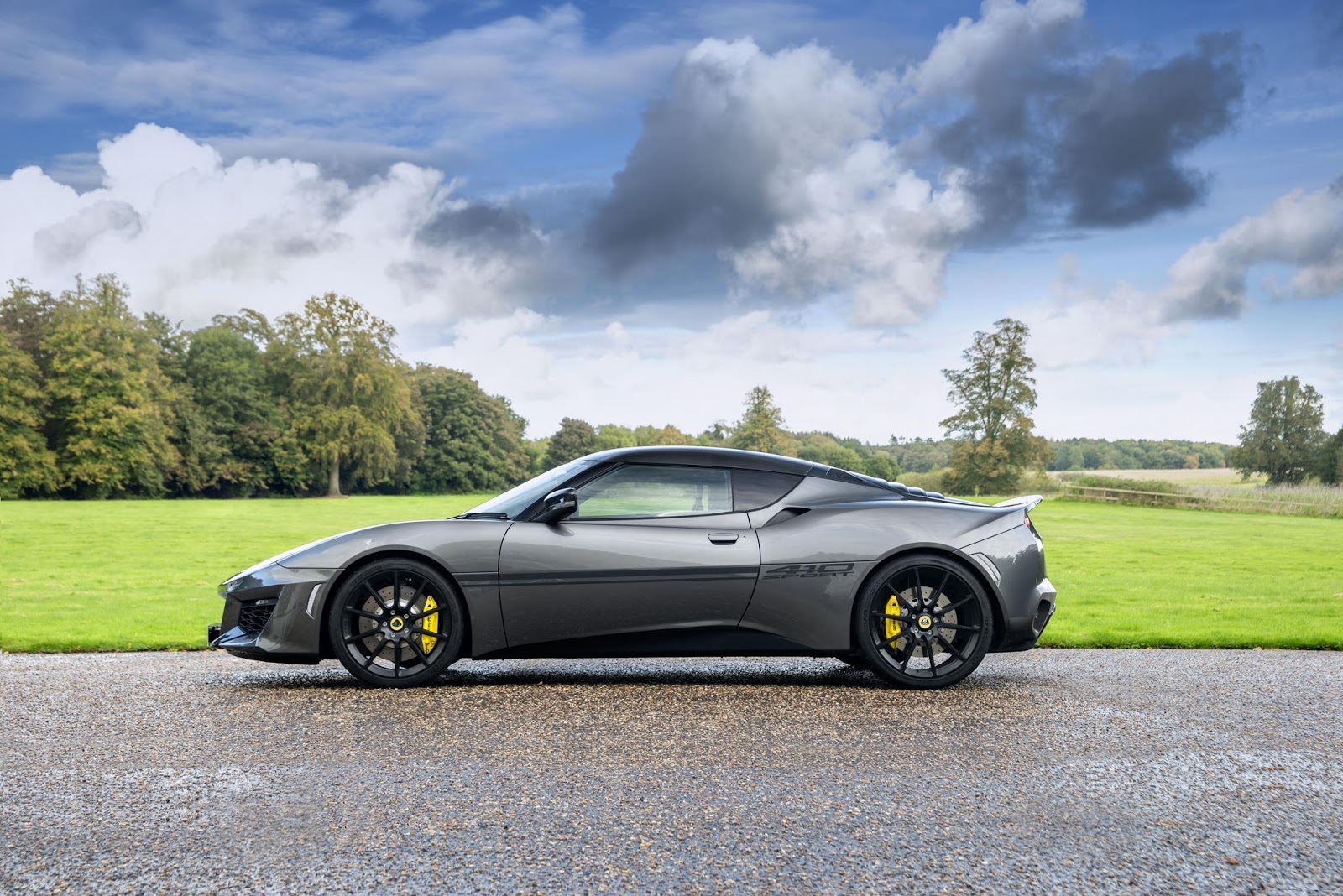
Representing the state of the supercar art, a one-off Evora Sport 410 has been commissioned through Lotus Exclusive as a tribute to one of its most famous ancestors, the Lotus Esprit S1.
Launched in October 2016, the Evora Sport 410 has wowed motoring press and customers with its combination of effortless pace and intuitive handling. With production limited to just 150 examples a year worldwide, the build schedule is filling up fast.
The benchmark was set by the original Lotus Esprit S1 as seen in the Bond film The Spy Who Loved Me, which celebrates its 40th anniversary this year, and Lotus’ in-house personalisation department has crafted a special, one-off Evora Sport 410 in commemoration.
Combining the latest in Lotus engineering with period details, the new pure-bred supercar takes design cues from the iconic Esprit and integrates them into a car with class-leading performance. Packing 410 hp into a car that weighs just 1,280 kg, it sprints from 0-60 mph in just 3.9 secs.
Jean-Marc Gales, CEO, Group Lotus plc said, “So many of us recall the impact of the Lotus Esprit when it hit the big screen in The Spy Who Loved Me, and we wanted to honour that with a special Evora Sport 410. It’s the perfect tribute to such an influential Lotus, but a world away in terms of its abilities and performance. 
Supremely fast and agile, rivals’ cars look overweight and underpowered in comparison. Lotus was founded on the principle of lightweight engineering and, even today, nobody does it better.”
Lotus Exclusive
The work of the in-house personalisation department, Lotus Exclusive, this one-off Evora Sport 410 features many unique design touches. A special, colour-coded bumper modifies the car’s front end, while the one-piece carbon-fibre tailgate is part keyed white to give the illusion of a traditional liftback. In addition to a black coach line, delineating the car’s waist, it sports a bespoke badge script on the B pillar - in the style of the original Esprit’s graphics.
Nods to the Lotus Esprit S1 from The Spy Who Loved Me continue inside, with the insert panels of the carbon-fibre sports seats and door cards trimmed in the popular heritage Tartan, while red contrast stitching complements the Alcantara® dashboard and console finish.
Beneath the personalisation, this unique car retains all the engineering elements that make the Evora Sport 410 so formidable. From the supercharged, 3.5-litre 6-cylinder engine, producing 410 hp at 7000 rpm and 420 Nm of torque at 3500 rpm, to the highly advanced aerodynamics, which deliver up to 64 kg of downforce, it’s designed to deliver both on road and track.
The Evora Sport 410 remains refined on B-roads, but blisteringly fast when needed. The use of hand-made carbon-fibre components has been key in keeping mass to a minimum, with each specifically designed to enhance the car’s performance. Covering the car from nose to tail, they include front splitter, revised front access panel, roof section, tailgate, rear quarter panels, as well as the rear diffuser.
These lightweight carbon components not only reduce the kerb weight of the Evora Sport 410 but also help lower the centre of gravity, allowing for the recalibration of the suspension which, along with re-valved dampers and a reduced ride height, provide better body and roll control - but not at the expense of comfort and composure.
This one-off Evora underlines the work of the increasingly popular Lotus Exclusive service. Combining traditional British craftsmanship with modern design, it inspires buyers to spend time tailoring the character of their Lotus with a comprehensive array of options. Jean-Marc Gales, CEO, Group Lotus plc continued, “Our customers have really embraced the Lotus Exclusive service, with 25% of new cars undergoing some form of personalisation. It is well established that Lotus cars come with benchmark performance as standard.  Now, thanks to the skilled team at Hethel, responsible for hand building all Lotus cars since 1966, you can specify a Lotus that perfectly reflects your personal tastes.”
The Lotus Evora Sport 410 is limited to a global production run of one-hundred and fifty vehicles per year, and is on sale in Europe and rest of world markets now. A Federal version of the Evora Sport 410 for the North American market will arrive this spring.

Tuesday, 8 November 2016

USA - The storming Lotus Evora 400 takes silver at the renown Road and Track group test.

  • Best European sports car bar none
  • 2nd overall in renowned Road & Track group test
  • Almost half the price of outright winner
Beating the best rival performance cars that Europe can muster, the acclaimed Lotus Evora 400 has seized second in Road & Track's celebrated Performance Car of the Year for 2017.
Shunning indirect and stilted systems, the Lotus Evora 400 utilises intelligent engineering to deliver a pure and intuitive driving experience. Lighter, faster and drastically more dynamic than its predecessor, the Evora 400 bested the rest of the Europeans to impress the Road & Track judges and force the final decision to the line - just missing out on first place.

Jean-Marc Gales, CEO of Group Lotus plc, commented: “Lotus will never sacrifice its philosophy. Keeping weight to a minimum, and giving the driver an unrivalled degree of control, has always been paramount to our success. The Evora 400 can rightly be described as one of the greatest Lotus cars ever built – supremely fast with amazing agility. The Road & Track result shows the appetite for our cars in North America, the world’s biggest sports car market.”
Reserved for the best of the best, the annual Road & Track fixture sees only the finest cars compete. Be it measured by outright speed, acceleration or handling: each year the specially selected finalists have been genuine driving giants.
Lotus Cars returned in the North American sports car market earlier this year, with the Evora 400, to critical acclaim. Demonstrating a very real desire for the lightweight and powerful cars which Lotus is world famous for, the Evora 400 was hailed by press and media as a landmark model.
Identified ahead of the Performance Car of the Year group test as the “underdog sleeper pick,” the Evora 400 went on to claim significant scalps, including the Audi R8 V10 Plus, BMW M4 GTS, Jaguar F-Type SVR coupe, McLaren 570S and Porsche 911 Turbo S. Ultimately, it was only beaten by the Acura NSX, as tested a car costing $202,960 - almost twice as much as the tested $103,585 Lotus.
Assessed on the roads of Tennessee and Kentucky, and then two days on track at the NCM Motorsports Park in Bowling Green, Kentucky, Road & Track put all cars through their paces, declaring: “The Lotus is a thrill at any speed. The steering is untouchable in this company; the pedals are weighted to perfection. Feedback is absolute and millimeter-precise.” When it came time to decide the result, it became clear just how well the car performed, with Road & Track stating: "Fully deserving of the ACBC badge on its nose, this brave and charming two-plus-two is perhaps the finest over-the-road enthusiast vehicle available for sale at any price.”
With a heritage of intelligent engineering that spans seven decades, no other car manufacturer can claim a better track record when it comes to honing road and race cars. In its 68th year, Lotus still remains true to the ethos of the company’s founder Colin Chapman, and his approach to design construction and ‘added lightness’.

Friday, 4 November 2016

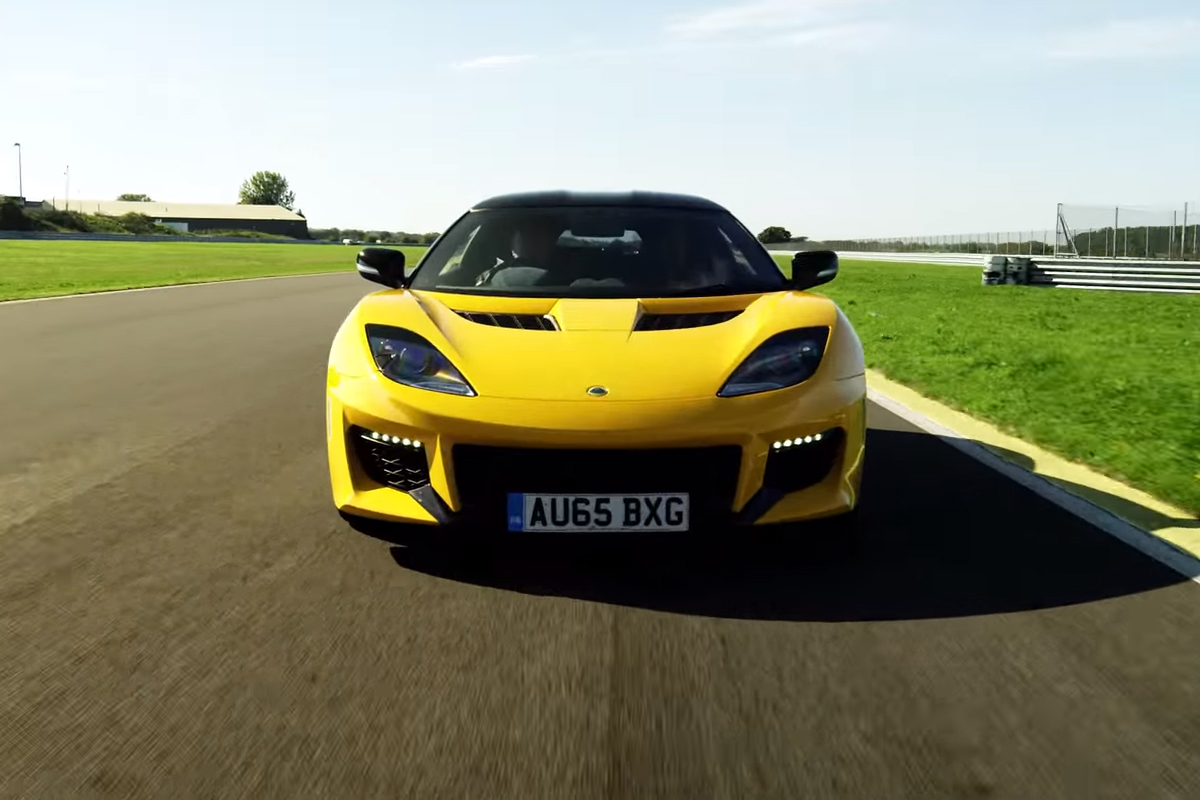
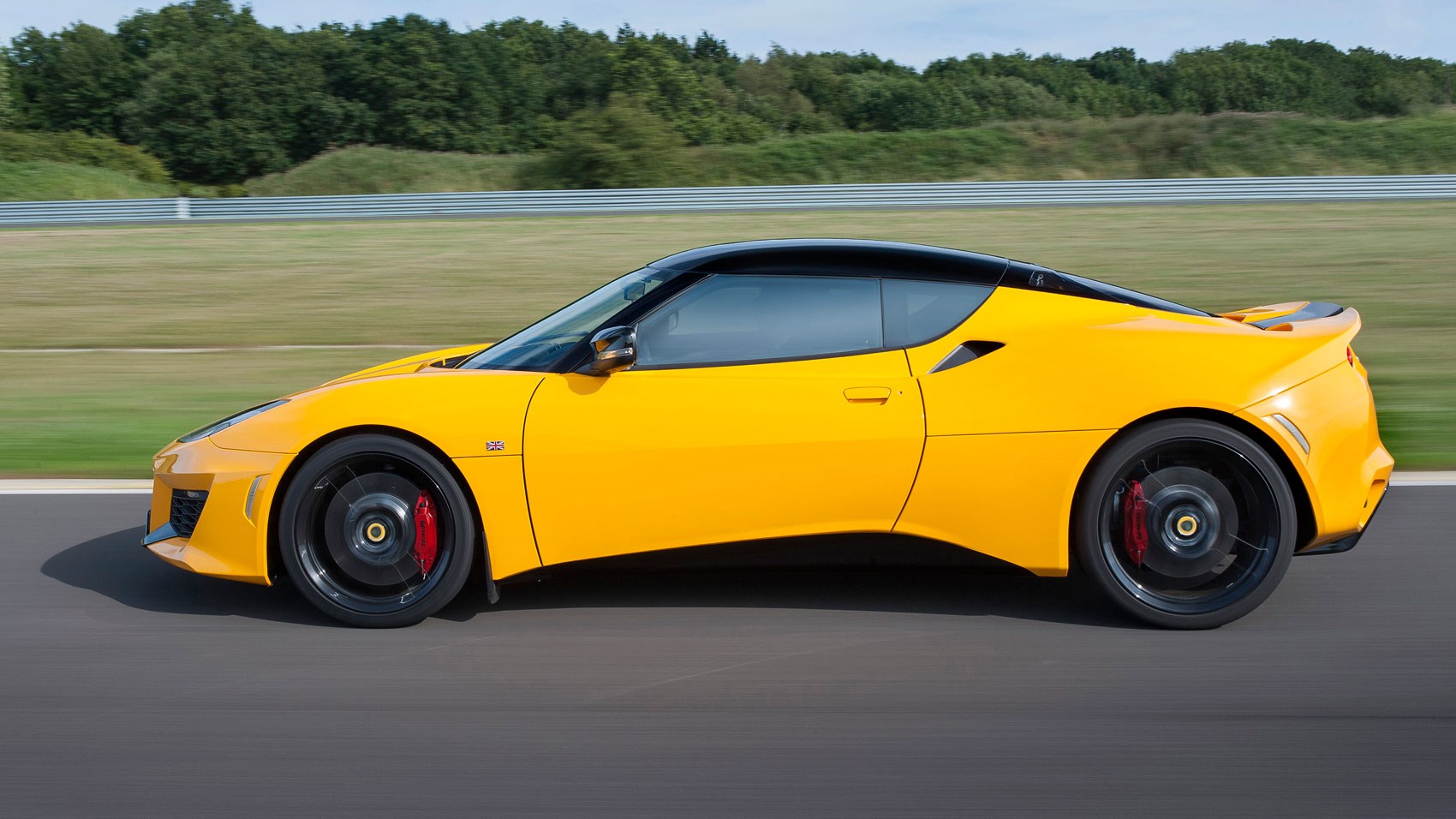
USA - The New Lotus Evora 410, a more focussed variant of the class leading 400 supercar.

• More focused variant of the class-leading Evora 400
• 1,270 kg dry weight through extensive light-weight engineering
• Aerodynamic downforce doubled at higher speeds
• Nose-to-tail carbon fibre components fitted as standard
• 0-60 mph in 3.9 secs and a top speed of 190 mph

Transformed, formidable and without equal, the new, class-leading Lotus Evora Sport 410 has been revealed after an intense development programme following its Geneva debut.
Massively lighter, with more power and huge gains in aerodynamic efficiency, this new generation of Evora is a pure-bred supercar, using Lotus’ DNA to deliver a spiritual successor to the marque’s most iconic models, including the Esprit Sport 300.
The Evora Sport 410 is the result of thousands of hours’ development by Lotus, across every aspect of the car. 

 From the mass of carbon fibre components covering the car from nose to tail as standard, including a revolutionary one-piece tailgate, to the recalibrated and tuned supercharged V6 engine – every inch has been assessed to provide unrivalled performance.

Designed to deliver both on track and on the road, the Evora Sport 410 is truly formidable. The car’s vastly improved aerodynamic configuration delivers an unparalleled level of handing and high-speed stability, and the addition of performance orientated wheels, tyres and critical parts, including the new titanium exhaust, ensures that it draws on Colin Chapman's obsession with simplifying, and adding lightness. However, far from a stripped-out track special, the new model retains excellent road manners, remaining refined and composed on B-roads.
Jean-Marc Gales, CEO of Group Lotus plc, commented, “Lotus has surpassed itself with the Evora Sport 410, and it defines a period in which we are producing our best ever cars. It can sprint from 0-60 mph in just 3.9 secs, and its ballistic pace means that, in the right hands, it’s unbeatable. We have achieved so much in the development of the Evora platform, and the Sport 410 is possibly the most accomplished car we have ever built. It’s nothing short of superb, and delivers the power and precision that Lotus cars are renowned for. We’ve taken the war on weight to a new level, demonstrating perfectly our principle of intelligent engineering.”
A closer look at the Evora Sport 410
Over the last twelve months, Lotus’ engineering teams have brought their unmatched experience of advanced lightweight construction technologies, aerodynamic optimisation, vehicle dynamics and powertrain development to bear. The result is testament to the company’s continuous quest to improve, delivering a car that’s worthy of carrying Lotus’ Sport moniker - reserved for its lightest, most-evolved models.
Drawing from its iconic predecessors, the Evora Sport 410 uses design cues as well as drawing engineering inspiration to provide the context for this new car. The results are due to Lotus’ holistic approach to evaluating every component in isolation, as well as the car as a whole.
Key to the cut in weight, by more than 70 kg, has been the adoption of hand-made carbon fibre components. Rather than just replacing existing parts with lighter versions, each has been redesigned and enhanced in order to make the most of the composite’s properties. Covering the car from front to back, these include front splitter, revised front access panel, roof section, tailgate, rear quarter panels, and rear diffuser. These are joined by race-derived carbon sports seats, which themselves save 9kg each.
In addition to boosting acceleration, the car’s dry weight of just 1,270 kg (1,280 kg without the optional titanium exhaust) results in sharper and more intuitive handling. Lowering the centre of gravity, it has allowed for the recalibration of the suspension – with an improved geometry and revised setup. The re-valved dampers provide an increase in compression and rebound, while the effective rise in spring rate and a reduction in ride height by 5mm provide better body and roll control, yet ride comfort and composure are retained.
Inspired by some of Lotus’ most-famous heritage models, the one-piece carbon tailgate incorporates a louvered section which, together with carbon rear quarter panels, help provide the car with a sleek, fastback silhouette. However, the benefits of this are far more than aesthetic. A significant chunk of the development time was spent honing the car’s aerodynamic performance. The use of the new carbon components, and the careful modelling of air flow over and under the sculptured bodywork has effectively doubled downforce, now up to 64 kg, yet resulted in a slightly lower drag coefficient overall. Increasing stability at high speeds, it cements the Evora’s reputation as a genuine supercar and it joins a select group that can genuinely exceed 190 mph yet remain tractable.
Developed through the Lotus 3-Eleven project, the Evora Sport 410’s engine is a higher-output version of the supercharged, 3.5-litre 6-cylinder unit, producing 410 hp at 7000 rpm and 410 Nm of torque at 3500 rpm. Utilising an integrated water-to-air charge cooler, it’s undergone thousands of hours of development and testing, including performance evaluation at the infamous Nürburgring Nordschleife circuit. Tipping the car well over the 300 hp/tonne benchmark, at 320 hp/tonne it’s a vital contribution to the Evora’s credentials, with the addition of the titanium exhaust silencer improving this figure further still.
As befitting a car of such capability, the Evora Sport 410 is equipped with bespoke, ultra-lightweight forged aluminium wheels and Michelin Pilot Sport Cup 2 tyres. The 10-spoke forged aluminium wheels reduce un-sprung mass and have been produced specifically to work with the Sport 410, while the addition of the high-performance Michelin tyres help provide detailed driver feedback and outstanding traction.
Purists will opt for the Evora Sport 410’s six-speed manual gearbox, which features a low-inertia flywheel, to help ensure swift changes, while a Torsen-type limited slip differential (LSD) gives better traction, and faster exit speeds when cornering. Available as an option, the six-speed automatic transmission utilises an optimised gearbox ECU for ultra-fast changes, while gear selection is made via lightweight aluminium paddles mounted to the steering wheel.
The new Evora Sport 410 also features Lotus’ Dynamic Performance Management (DPM) which, selected via a dashboard switch, provides ‘Sport’ and ‘Race’ settings. Proportionally increasing throttle response, lowering traction slip thresholds and removing understeer recognition, it allows enhanced control before the system intervenes. Sport and Race settings also activate the Evora Sport 410’s variable-pressure exhaust system – sharpening performance and hardening the engine’s note at higher speeds.
Only available in a 2+0 configuration, the Evora Sport 410’s carbon fibre sports seats are trimmed with Alcantara® as standard, along with the steering wheel, lower dashboard, transmission tunnel and centre console. An integrated touch-screen entertainment system can also be specified, including iPod® connectivity and Bluetooth® functionality.
The rest of the Sport 410’s cabin received close attention during its development. In a deliberate nod to the Esprit GT3, the Evora’s interior has subtle design cues, such as the optional colour coded interior components, which reference the car's lineage. Weight saving measures include attractive one-piece door trim panels finished in Alcantara® with contrast stitching, the deletion of door arm rests and stowage pockets, the relocation of tailgate and fuel filler release buttons and the removal of speakers - if an entertainment system is not specified.
Adding an extra dimension to ownership, the new Evora Sport 410 can also be personalised through the increasingly popular Lotus Exclusive programme. Combining traditional British craftsmanship with modern design, the service inspires customers to spend time tailoring the character of their Lotus with a comprehensive array of options.
The Lotus Evora Sport 410 is limited to a global production run of one-hundred and fifty vehicles per year, and is on sale in Europe and rest of world markets now. An adapted version of the Evora Sport 410 for the North American market will follow in summer 2017.
Manufacturer’s Suggested Retail Price
UK (Pound Sterling) £82,000
Germany (Euros) €108,500
Japan (¥ Yen) ¥15,000,000

Technical Specification:
PERFORMANCE
MANUAL
AUTOMATIC
Max power
410 hp (416 PS, 306 kW) at 7000 rpm
Max torque
410 Nm (302 lbft) at 3500 rpm
0-60 mph
4.0 seconds
3.9 seconds
0-100 km/h
4.2 seconds
4.1 seconds
Max speed
190 mph (305 km/h)
177 mph (285 km/h)
Fuel Consumption mpg (l/100 km)

Urban
Extra Urban
Combined
20.8 (13.6)
38.7 (7.3)
29.1 (9.7)
20.0 (14.1)
39.8 (7.1)
29.1 (9.7)
CO2 emissions
225 g/km
230 g/km
Kerb weight
1,325 kg
1,336 kg
Dry weight – without titanium exhaust (with titanium exhaust)
1,280 kg (1,270 kg)
1,291 kg (1,281 kg)
Aerodynamic downforce at 100 mph
18 kg
18 kg
Aerodynamic downforce at maximum speed
64 kg
60 kg