Purpose

I will try my best to provide detailed info on various cars and what is like to live with them, I have already produced a few for Jaguar-car-forums, I will do my best to be unbiased, but it will be hard for some cars. I will re-produce press releases and copy from other motoring news.
Showing posts with label Hannover. Show all posts

Thursday, 11 June 2015

VOLKSWAGEN commercial vehicles shows more growth in May, with worldwide sales of nearly 180,000.

  • Deliveries to customers are up 3.4 per cent in first five months of 2015
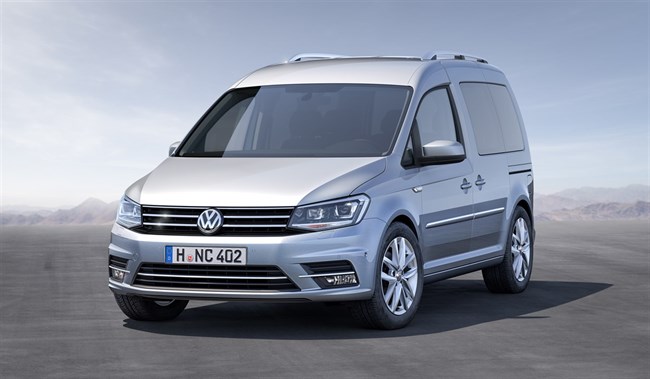
  • New Caddy and T6 shortly before market launch
  • Plants in Poland and Hannover working with full commitment
  • Brand shows increases in Western Europe in May, primarily in Italy, the Netherlands and the United Kingdom
  • Significant growth in Asia and the Middle East as well
From January to May 2015, Volkswagen Commercial Vehicles achieved a 3.4 per cent increase in deliveries with 184,400 vehicles from the T, Caddy, Amarok and Crafter series (January to May 2014: 178,300 units). 
At the same time, Volkswagen Commercial Vehicle plants in Hannover and Poznan, Poland have started production of the new generation Volkswagen Caddy and the new generation Volkswagen Transporter and are working with full commitment.

"After the highly successful launch of the third generation Caddy and T series, we are now retooling our production to new models. Despite this, we are able to achieve significant growth in key sales regions," said Bram Schot, Member of the Board of Management for Sales and Marketing Volkswagen Commercial Vehicles. "Reactions to our new Caddy and our new T-series are very promising," said Schot.
Even during the completed model change for the Transporter and the new Caddy, worldwide deliveries remained largely stable in May at 36,900 vehicles (2014: 37,700: -2 per cent). The brand continued to improve its results in the main sales region of Western Europe with 25,300 vehicles (2014: 25,200: +0.7 per cent). In Western Europe, the markets showing the highest growth in deliveries to customers were Italy (800 vehicles; +50 per cent), the Netherlands (1,300 units; +25.5 per cent) and the United Kingdom (over 4,500 deliveries; +21.2 per cent).
In the Asia/Pacific region, Volkswagen Commercial Vehicles showed considerable gains with 2,100 delivered vehicles; sales were especially strong in Australia with +30 per cent growth to nearly 1,300 units. In the Middle East region (2,600 vehicles; +13.9 per cent), Turkey was a significant growth driver.
In Eastern Europe Volkswagen Commercial Vehicles delivered 2,400 vehicles in May (-23.7 per cent). In the South American region the number of Volkswagen Commercial Vehicles deliveries dropped by 19 per cent to 2,600 units. The African region delivered 1,500 vehicles (-10.9 per cent).

Thursday, 12 March 2015

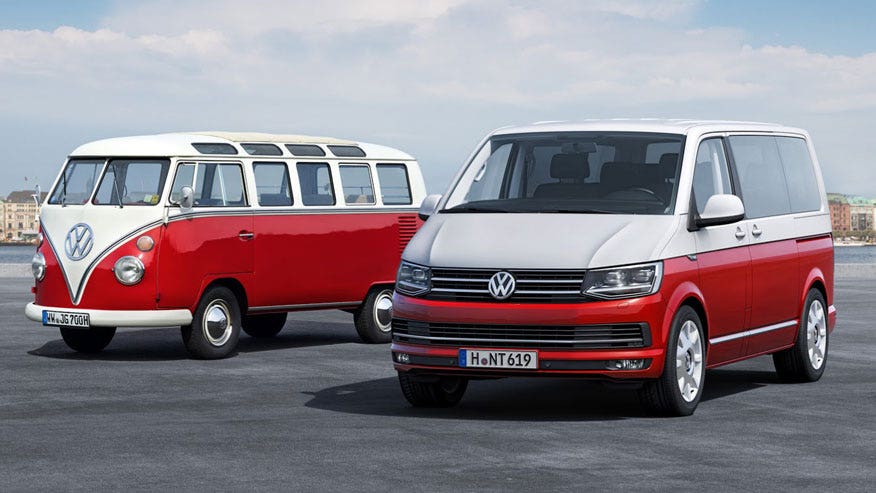
From workforce to legend, the Transporter van celebrates 65 years of growth.

pic 
From work-horse to legend
pic 
Sketches in a notepad are basis for its success story
pic 
11 million T-series vehicles sold worldwide

Some retire at the age of 65 – but this one is just getting started! Production of the first Volkswagen Transporter began 65 years ago and the ‘Bulli’ is still going strong today. 

The first models were built in Wolfsburg before production started at a new facility in Hannover in 1956. This date also marks the beginning of a unique automotive love story:  today, the entire model series has attained cult status. Whether hippy or tradesman – everyone is driving Transporter.

It all began in 1947 with a pencil sketch: the Dutch car importer Ben Pon saw a simple flat-bed vehicle at the Volkswagen plant and, taking it as a basic idea, he sketched the outlines of a Transporter with Beetle DNA in his notebook.

Two years later, Volkswagen Plant Manager, Heinrich Nordhoff, presented four prototypes: two panel vans, a kombi and a small bus. Nordhoff promised that the Transporter would be as uncompromising and robust as the Beetle: ‘These vehicles won't be handled with kid gloves, rather they will be treated roughly.’


Designers used the engine and axles of the Beetle. Instead of a central tubular frame of the popular family car, the bus had a unitized body that was mounted on a ladder frame. The 1.1-litre engine produced 18 kW (24.5PS) at 3300 rpm. The bus could transport up to eight people and the two rear seat rows could be removed easily to free up load space for around 750 kg of payload.

Alfred Haesner, Head of Technical Development of Volkswagen GmbH from 1948 to 1952, said: ‘Accordingly, this type of commercial delivery vehicle can be used for all branches of business, for rush deliveries and freight, e.g. as a small bus, a special-purpose vehicle, postal vehicle, ambulance or mobile station.’

Production began on 8 March 1950, in Hall 1 of the Volkswagen plant in Wolfsburg, and ten vehicles were manufactured per day. 

By the end of 1950, 8001 Transporters had already been built. Demand was enormous, especially since its affordable price made it an attractive option to tradesmen and retail businesses. The unique vehicle quickly became an export hit as well. Volkswagen buses could simply transport anything and everything: rubble and debris, mortar and building stones, breakfast rolls and bees wax, cigars and newspapers.

A Volkswagen bus with a camping box made its appearance in 1951 at the automobile exhibition in Berlin. The delivery van with a rear engine suddenly held the promise of an entirely different type of travel. For the first time, it travelled over the Alps. Later, it was driven to India when hippies discovered the ‘Bulli’ for themselves.

Four years after its production launch, the 100,000th Volkswagen Transporter came off the assembly line in Wolfsburg in 1954. By this point, there were 30 different models of the vehicle. 

Daily production in Wolfsburg was at 80 vehicles but it couldn’t produce more because the plant was already filled to capacity with Beetle production. It became clear that the Transporter needed its own plant.

Construction work began in early March 1955 in Hannover-Stöcken, and the plant was built from the ground up in just one year. In March 1956, the first "Made in Stöcken" Transporters come off the assembly line. This was the beginning of a future symbol of the ‘economic wonder years’. Today, a total of 11 million T-series vehicles spanning five generations have been produced worldwide.

Dr. Eckhard Scholz, Chairman of the Brand Board of Management of Volkswagen Commercial Vehicles, said: ‘The production launch of the T1 represented the beginning of a long success story that has lasted right up to today. In the past, as well as the present, there is market demand for extremely reliable, versatile and individual vehicles. We deliver them in top quality and precisely tailored to every need – whether the vehicle is for trades work, a retail or service business, family or recreation.’

Production of the new generation model, the T6, launches this year. Along with the T-series, the Hannover-Stöcken plant also produces the Amarok pick up. The successful California recreational vehicle is built not far away in Limmer. Around 12,200 people are employed at the Hannover business site of Volkswagen Commercial Vehicles.

The Poznan plant in Poland (5,700 employees) produces the Transporter and the Caddy, and another plant is being built in nearby, Wrzesnia for the new Crafter. Today, a total of around 19,500 employees work for the Volkswagen Commercial Vehicles brand.