- How 10 years of crossover sales success changed the fortunes of Nissan
It’s hard to believe the Nissan Qashqai has been on sale for a decade, but it’s true. It arrived in showrooms across Europe early in 2007 as the pioneer of a new market segment – the urban crossover. Today, it remains the region’s best-seller in that segment.
But launching the Qashqai was not without risk. Here we tell the story of how this innovative new car – a car which has unquestionably changed the face of European motoring – came to be.
-----
The beginnings of the project
When the Renault-Nissan Alliance was formed in 1999, the direction from the new COO (now CEO) Carlos Ghosn was clear. The Japanese brand’s European product portfolio needed to be transformed.
An obvious example was the Almera, Nissan’s C-segment hatchback, which did not sell well in Europe. The COO was clear that its replacement needed to offer customers something better. Planning, design, engineering and manufacturing teams were tasked with going back to the drawing board.
In early 2002, a 25-strong team of Nissan engineers travelled to the brand’s technical centre in Japan. The meeting was the start of a 12-month project to develop the next-generation Almera. The project was to determine the specifics – what would it look like, what engines would it use, how would it perform. Initial ideas were that it would be different to the previous model, with a slightly larger footprint than the previous generation, competing against the likes of the SEAT Altea and Volkswagen Golf Plus.
Difficult decisions
But all was not going well for the team. Nine months into the process, at a meeting on 13 December 2002, its members came to several painful conclusions. The most fundamental were that the new car would not be as profitable as was required, and would not deliver on what customers had come to expect from the company.
Peter Brown was a Vehicle Evaluation Manager at Nissan's European Technical Centre (NTCE), a role he still holds today. He commented: “We had crunched the numbers, and the new Almera just wasn't going to be as competitive as we'd hoped. It didn't reflect Nissan's core values of innovation and excitement, or the direction that the business was taking with products like 370Z and X-Trail.”
Challenging conventions
With Carlos Ghosn’s words ringing in their ears, conversation turned in a different direction – could Nissan come up with something new and unexpected that would challenge the traditional segments?
Peter Brown continued: “We came up with the idea of a sort of mini-Murano, which we believed would break down some of the barriers to SUV ownership. It was a car that would be developed and positioned to challenge the conventional hatchback and saloon volume segments in Europe.”
Back in 2002, Sports Utility Vehicles (SUVs) were rising in popularity. Despite this, there were still considerable barriers to SUV ownership for many hatchback and saloon buyers, who were traditionally quite conservative in their car choice. Nissan customer clinics had highlighted that SUVs were considered too large for around-town manoeuvrability and general everyday usability, plus people didn’t like the poor fuel efficiency and lacklustre interior quality.
Peter Brown explained: “We managed to persuade the business that we could break down some of these barriers by taking the best bits of a family hatchback and adding the elements of SUVs that are most attractive to customers. And so, the idea of the first ‘crossover' was born.”
What followed was a period of research, focused primarily on assessing the viability of creating a vehicle that would be a baby brother to the popular X-Trail – something with the desirability, practicality and versatility of an SUV but with the size, driving dynamics and running costs of a family hatchback. The phrase coined internally to focus everyone’s thoughts was ‘urban nomad’.
A motivated team effort
Nissan design teams around the world were set the challenge of creating an exterior and an interior. As a result of a global collaboration, one proposal put forward by Nissan Design Europe (NDE) became the 2004 Qashqai concept car.
For the production model, the selected exterior came from Nissan’s Global Design Centre in Japan, while the interior was penned by Nissan Design America. Given the Qashqai was initially to be a car for European customers only, both elements were then transferred to NDE for further refinement, to make the designs to perfectly fit the needs of European customers.
Mamoru Aoki is Executive Design Director at Nissan’s Global Design Centre in Japan. He commented: “There was a lot of positive energy around this project. We had recently moved NDE from Munich and Cranfield to London, so there were a lot of new starters. We all felt that this was a chance to prove the value of their work to the global design team. We wanted to show that they could collaborate with everyone, to create a successful product in a new sector.”
Similarly, with the car aimed mainly at European drivers, engineers at Nissan's European Technical Centre (NTCE) in Cranfield, UK, were commissioned to develop an engineering framework.
Peter Brown commented: “This was only the second time ever that NTCE had been commissioned by Japan to lead the development of a model from scratch. We were excited at the prospect of creating something that had never been seen before. The idea itself was very simple - take a traditional SUV model and make it more affordable, more agile and compact.”
Innovating in a new direction
With no precedent to follow, and no direct competitor vehicles to benchmark against, Nissan set about developing a simple set of parameters to help in establishing the dimensions and performance indicators for its first crossover.
Peter Brown explained: “We retained the higher seating position, larger wheels and ground clearance of an SUV, but re-engineering the cabin so the passenger would feel they were sitting inside the car and not on top of it.”
A high arm rest position, high sides and a passenger car-inspired centre console configuration gave Nissan the driver-oriented interior required to appeal to traditional hatchback customers.
Development of the crossover continued throughout 2003 and 2004. NTCE engineers were working with a mule vehicle – to the outside world it looked like a 1.5-litre dCi Renault Scenic – testing the cabin configuration and technologies. Meanwhile, colleagues from product planning crunched early customer clinic data from family hatchback and SUV prospects to get vital feedback and insight.
The Qashqai concept car
The car was unveiled as a concept at Geneva Motor Show on 2 March 2004. It was called the Qashqai, a word derived from the name of an Iranian tribe and linked to the car’s positioning as an ‘urban nomad’. It was greeted with scepticism, with automotive media reluctant to accept there was a market for Nissan's strange new SUV/hatchback hybrid.
Peter Brown explained: “Many of their articles had the same reservations that we'd met from within the business – did a crossover really represent the best of both worlds, or simply fall short of the mark for both hatchback and SUV drivers?”
Henrik Dreboldt is today the Motoring Editor ofBerlingske Tidende, a newspaper in Denmark, but in 2004 he was working for a small local newspaper called Lørdagsavisen.
He commented: “The motoring press was genuinely shaken by the Qashqai concept. Like most of them, I stood and shook my head. But Nissan had obviously looked deeper into the crystal ball than any of us, and today stands as the king of the crossover segment. There weren’t many who predicted that at the time.”
However, Nissan remained confident the Qashqai was the right product. The press release which accompanied the car was remarkably insightful, stating: ‘Nissan is among the first manufacturers to recognise the evolution in customer tastes, which will see consumers increasingly buying cars like the Qashqai.’
Following the Geneva event, development work on the production car continued and the final design and engineering specification were locked. By this time a decision had been taken that the Qashqai would serve as a replacement for both the Almera in the C-segment and Primera in the D-segment. The Primera was a decent enough car, but had low sales compared with the segment’s volume players.
Choosing a factory
In tandem with the Qashqai’s development, a decision had to be taken on where it was going to be built. Nissan’s commitment to building cars in the markets for which they are designed meant NMUK at Sunderland, UK, was one potential choice.
Kevin Fitzpatrick, Nissan Divisional Vice President, European Manufacturing, has worked at NMUK for its entire 30-year life. He commented: “We fought incredibly hard to win the Qashqai for Sunderland back in 2006. It saw NMUK go from a manufacturing plant to a far more integrated part of the business. The project allowed us to connect with engineering and design departments much more than we had done on any other model.”
Customer demand was such that plans to build 120,000 a year were quickly revised, with 160,000 made in the first year alone. Today, the plant has been working three shifts a day for almost six years to keep up with Qashqai orders.
The Qashqai production car
At a behind-the-scenes winter test event, staged in January 2006 in Finland, media got behind the wheel for the first time. It was clear they still viewed the Qashqai as a compact SUV. Looking for a story, they were quick to pick up on the relatively low predictions of 4WD sales, as they considered this feature to be one of the key differences between the Qashqai and traditional C-segment hatchbacks. But Nissan had done its research, and knew that very few SUV drivers ever took their car off-road or made use of the 4WD capability.
Peter Brown commented: “To make the car more affordable and improve fuel efficiency, we wanted to introduce the 1.5-litre diesel and 1.6-litre petrol engines to Qashqai in addition to the 2.0-litre engines we were using on X-Trail.”
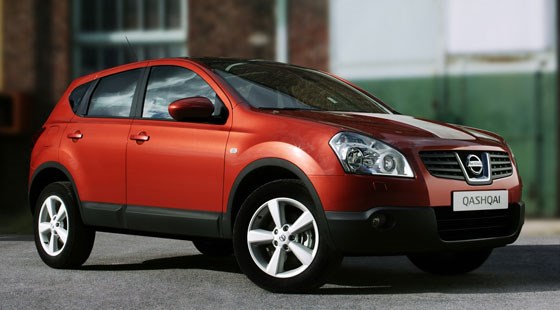
At the 2006 Paris Motor Show, the world’s first urban crossover production car made its debut. Nissan chose to stick with the Qashqai name, despite the many ‘how do we pronounce that?’ protestations.
At the media launch, Nissan’s clear vision of the Qashqai’s position in the market – coupled with the highly refined driving experience – started to win journalists over. But there was still scepticism; one respected UK publication wrote, ‘A good-enough family hatch, but not the convention-shifting car it's sold as.’
February 2007: Qashqai on sale
The Qashqai went on sale in February 2007 and was a hit with customers from the very start. By the end of that year, more than 100,000 Qashqais had been sold in Europe. The biggest market was the UK, which had sold 18,000 of them.
The awards started to flood in, with 14 in the first year alone. They covered everything from SUV and urban car sector wins, to prestigious ‘Car of the Year’ titles and fleet sales honours.
As 2007 became 2008, the motoring world realised Nissan’s commitment to the crossover ran deeper than they first thought. The Qashqai was not a standalone product, and a seven-seat version – the Qashqai+2 – was launched, offering extra practicality for larger families. Key to its appeal was its compact dimensions; the footprint was only 21 cm longer than the Qashqai itself yet there was room for two extra passengers in the rear. Eventually more than 235,000 examples of the Qashqai+2 were sold in Europe.
By 2010, Nissan had sold a staggering 1.2 million Qashqai across Europe, and marked the occasion by launching an updated version, with a range of design and technology enhancements. As well as a fresh new front-end look, Nissan introduced the innovative Around View Monitor 360° parking camera technology – a strong sales point on Nissan cars to this day.
2014: How to improve the class leader
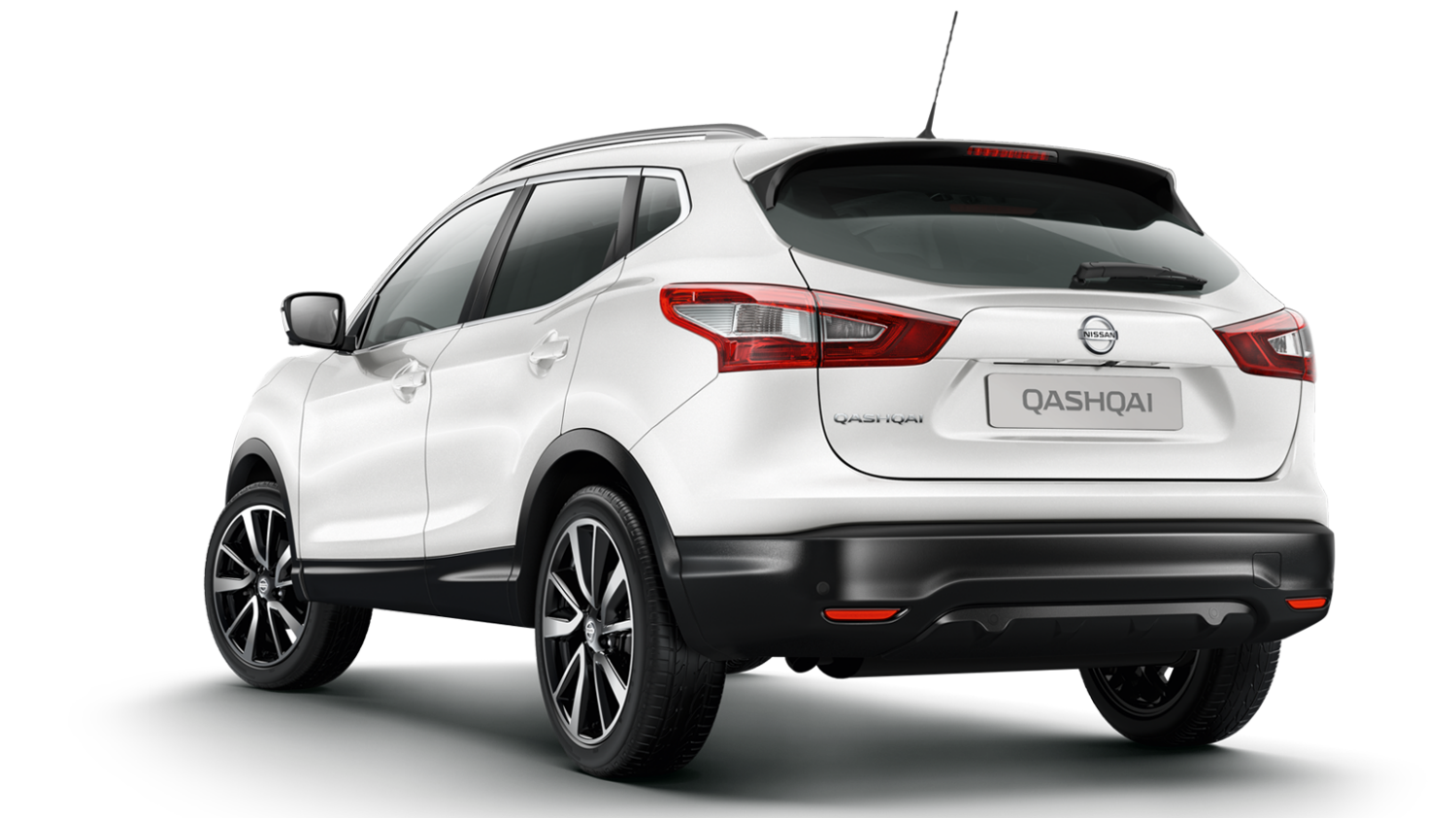
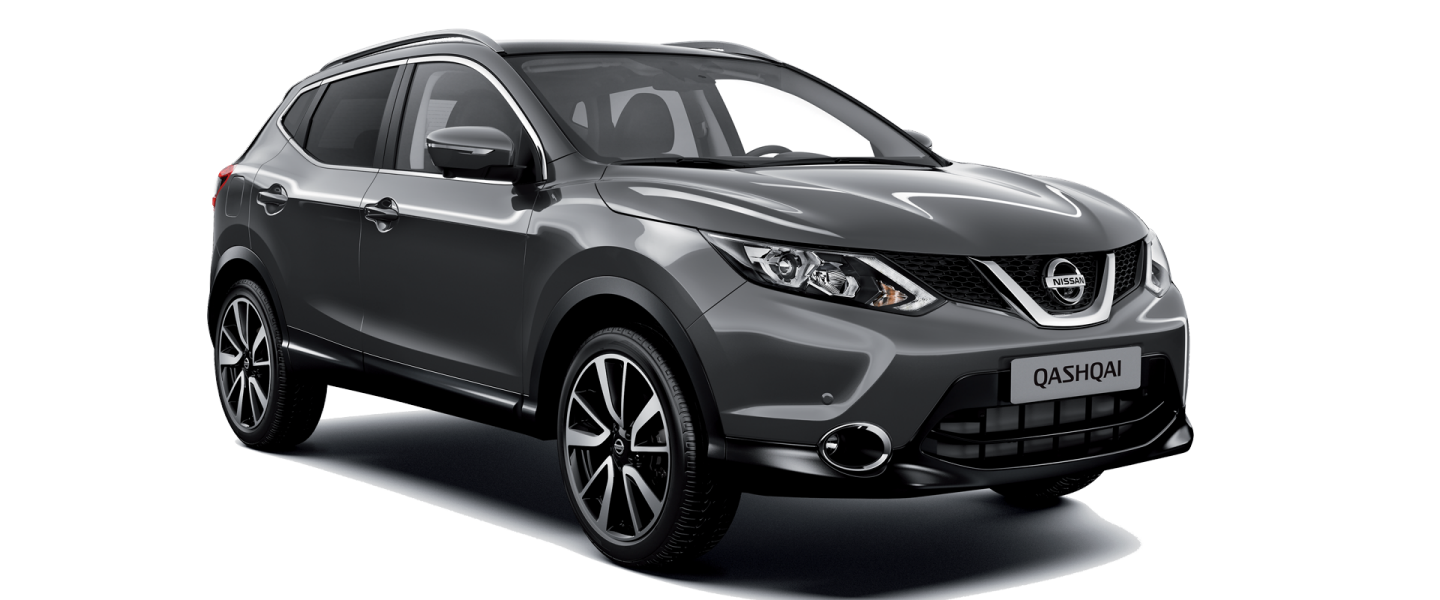
Crossover demand continued to grow and Nissan was already working on all-new version of its pioneering car. The second-generation Qashqai was unveiled at an event in November 2013, and made its motor show debut at Geneva the following March. Almost 5 cm longer than its predecessor, as well as being lower and wider, it featured a far more sleek and athletic exterior design plus a far higher quality interior.
It was the perfect illustration of how Nissan has consistently innovated during the Qashqai’s lifecycle; it maintained its original crossover DNA, elevated driving position and efficient running costs, but added more of what customers required from an everyday family car.
Key to its appeal was the range of new technologies on offer. This included Nissan's Safety Shield systems, which incorporated Forward Emergency Braking, Driver Attention Alert and Traffic Sign Recognition.
The commitment and attention to detail in developing the second-generation Qashqai paid off; in 2014, it won the prestigious ‘Car of the Year’ title from respected UK buying guide What Car?, and was honoured as the Best Small SUV in 2015 and 2016 as well by the same publication. Since 2014 the second-generation Qashqai has sold 700,000 units in Europe.
February 2017: 10 years of crossover leadership
Three new versions of the Qashqai in 10 years, coupled with clear and consistent positioning as the ultimate urban vehicle, has led to sustained sales growth. It’s a car which has defied the convention of product lifecycles, increasing sales by 79% since 2007. Today it remains the class leader with 10.5% share across Europe.
There is a saying in English, that imitation is the sincerest form of flattery. Unsurprisingly, it was not long before rival car manufacturers were launching their own urban crossovers. Today there are 21 direct competitors to the Qashqai.
As other brands played crossover catch-up, Nissan was busy with new products. In 2010, it expanded its pioneering crossover family with the launch of the Juke. Building on the success of the Qashqai formula but reducing the footprint even further, it created another new industry segment. The Juke has gone on to sell more than 775,000 units in Europe alone, and more than 1.2 million globally.
Completing the Nissan crossover family, and incorporating all of the customer feedback and insight learned during development of the Qashqai and Juke, was the all-new third-generation X-Trail. Launched in Europe in 2014, it’s the largest of the trio and builds on the model’s successful heritage as practical transport for adventurous families.
Today the Qashqai is the perfect expression of Nissan’s brand promise – Innovation & Excitement for Everyone. But it was an innovation born out of necessity; Nissan was producing mainstream saloons and hatchbacks which were not winning the hearts and minds of consumers.
Fast-forward through 10 years and Qashqai sales underpin Nissan’s commercial success across Europe. It has remained the most popular crossover because the model proposition has not changed, and that blend of SUV practicality and hatchback efficiency has made it the most successful European model in Nissan's 83-year history.
At the end of 2016, the total number of Qashqai sold in Europe stands at 2.3 million. The car is currently on sale in 99 markets around the world – from Antigua to Australia via Algeria and Angola – and global sales have reached more than 3.3 million since 2007.
It has also been good for the European economy, as Qashqai’s decade of crossover leadership represents a £534 million (€622 million) investment in the region’s design, engineering and manufacturing operations.
The Qashqai is now a firm favourite with media, and has won more than 80 awards since 2007, including 19 ‘Car of the Year’ titles. Steve Fowler, editor-in-chief of UK magazine Auto Express, commented. “The simplest ideas are always the best, and what's not to like about taking the premium, sought-after SUV style and driving position, then applying it to a smaller, more affordable model. The Qashqai has continued to set the standard by which rivals are measured - great to drive and to be in.”






.jpg)


