Purpose

I will try my best to provide detailed info on various cars and what is like to live with them, I have already produced a few for Jaguar-car-forums, I will do my best to be unbiased, but it will be hard for some cars. I will re-produce press releases and copy from other motoring news.
Showing posts with label World Rally Championships. Show all posts

Tuesday, 26 July 2016

Three months after its first outing, Citroën Racing’s 2017 World Rally Car has made its asphalt debut.

Three months after its first outing, Citroën Racing’s 2017 World Rally Car has made its asphalt debut. On the bumpy roads of Aude in southern France, Kris Meeke and Stéphane Lefebvre learnt how the car behaves on this type of surface.
By opting to hold the first development sessions on gravel, the Citroën Racing engineers had given priority to a surface used in the majority of World Rally Championship events. 

“By test-driving the car in the toughest conditions first, we were able to check the reliability of all the components,” explained Citroën Racing Technical Director Laurent Fregosi. “What is more, there isn’t just one type of gravel. Finland and Mexico offer completely different surfaces. 
So we wanted to explore that diversity by testing the car on asphalt, where the operating window is narrower.”
In terms of the regulations, the differences between a WRC car’s gravel and asphalt setups are minimal, but they are vital. “The biggest change is in the suspension,” Fregosi continued. 
“We use lighter parts that allow us to reduce the ground clearance. The drivetrain kinematics are also adapted to the 18″ wheels. Large wheels mean we can increase brake disc diameter and use water-cooled callipers.
"We should also mention the lighter body protection. On the aerodynamic front, we now have the ability to adapt the lower part of the front bumper specifically for asphalt.”
“During this first session, we worked in particular on the programming of the centre differential,” explained the engineer. “The aim is to distribute power between the front and rear axles according to the situation. 
Obviously, the settings will be different from one surface to another. The drivers were also able to assess the effects of mechanical parameters, such as spring stiffness, the anti-roll bar and the differential. 
Overall, the results were positive and we know where we are at. Once again, the car’s reliability allowed us to get plenty of kilometres in.”
“It’s exciting to be driving the WRC on asphalt for the first time,” said Kris Meeke. “Citroën Racing has always made really good cars for this surface and I think this will be no exception. 
On tarmac, you can really feel the changes introduced as a result of the new regulations, such as the higher power, the increased width, the power of the brakes. We are continuing the programme as planned and each run teaches us a little bit more. Every phase of the project is just as exciting as the last.”
Now with two dedicated chassis for development tests, Citroën Racing will be intensifying its testing programme over the next few weeks. On gravel and asphalt alike, the engineers and drivers are focused on their main objective: Rallye Monte-Carlo on 16 January 2017.

Tuesday, 14 June 2016

Citroën Racing chose the roads of Finland for the third development test session of its 2017 World Rally Car.

Citroën Racing chose the roads of Finland for the third development test session of its 2017 World Rally Car. Running at maximum speed on the famous jumps, Kris Meeke and Craig Breen were able to test the car’s aerodynamic performance.
With its large, fast and rolling roads, Finland is among world rallying’s most revered venues. Due to the high speeds and the difficulty to “read” the road, it is one of the toughest terrains to grasp, with the drivers needing to concentrate on the jump approaches that send the cars flying into the air.


It is, therefore, no surprise that this country figures among the priority destinations for the team in charge of developing the Citroën that will compete in the 2017 FIA World Rally Championship. After the rough terrain of southern France and the mud-filled tracks in Portugal, Finland was ideal to continue assessing the car’s reliability and performance.
For this test, the aerodynamics were closely scrutinised by the engineers. “The freedom allowed by the FIA regulations offers us a much larger range of possible solutions than before,” says project manager for the 2017 World Rally Car, Alexis Avril.
“The bodywork of the WRC must entirely cover that of the original model and the maximum width is set at 1875mm. In this framework, we have a lot of freedom to design the wheel arches and bumpers. We can also create air intakes for re-cooling the rear brakes and add on a diffuser. Paradoxically, there are more restrictions for the design of the rear wing than today, but its efficiency will be increased tenfold by its further backed and raised positioning.”
The aerodynamics of a race or rally car must solve the complex equation of attaining maximum down-force, minimum drag and maximum cooling. To achieve this, Citroën Racing’s engineers have adopted what is now a standard methodology.
“We started the work with the CFD calculations, which let us sift through the possible options, continues Alexis Avril. “We collaborated with the Citroën design studio in order for the race car to resemble the characteristics of the production model. From this data, we built a model that was used in the wind tunnel. Between sessions, we carried on with the CFD calculations in enriching the data from the tests, and vice versa.”
With this approach, the expertise gained during the development of the WTCC Citroën Elysée has been widely put to use: “We have made great strides in our understanding of the flow principles and aerodynamic performance since 2013 and the debut of the WTCC programme. We have saved time in utilising the proven solutions. As the disciplines are different not everything was transferable, in circuit racing, there is a form of systematisation that doesn’t exist in rallying. Thus, the compromises are more important.”
While the aerodynamic development itself was done with CFD calculations and wind tunnel tests, the test sessions were used to assess the resilience of various components. “Vulnerability is an essential point in rallying. The dirt, mud, stones and gravel can quickly tear away the element or block the air intakes,” recalls Alexis Avril. “So you have to run in all the conditions to find a compromise between reliability and performance.”

Monday, 23 May 2016

The 2017 Citroen C3 WRC car undergoes another round of testing before the new season starts.

Three weeks after its first outing, Citroën Racing has continued development of its 2017 World Rally Car in the south of Portugal. Faced with varied weather conditions, Kris Meeke and Stéphane Lefebvre racked up the miles during four days of testing.


Fresh from the first test in the south of France, Citroën Racing headed to the Algarve in Portugal for the second session of development testing for its 2017 World Rally Car. The team were treated to rain, hail, fog and even the occasional burst of sunshine as they worked on the new car. Teammates Kris Meeke and Paul Nagle and Stéphane Lefebvre and Gabin Moreau were busy behind the wheel of the prototype produced by the Versailles Technical Centre, as they prepare for Rally de Portugal with the Abu Dhabi Total World Rally Team.
“We were actually quite pleased to have these variable conditions because they meant we could test different set-ups and assess how the bodywork stood up to being loaded with mud,” explained Laurent Fregosi, Citroën Racing’s Technical Director. “During the tests, we have several objectives. Obviously, we want to check the reliability of the various components. The mileage done by each part is noted down to make sure it tallies with the specifications. But our work is also focussed on looking for performance and driver comfort.”
After graduating in Engineering at INSA Lyon, Laurent Fregosi joined Citroën Racing in 1995, when the ZX Grand Raid dominated the Dakar Rally. He has therefore worked on every rally programme since the Xsara Kit-Car. Appointed Chief Engineer, Chassis, in 2005, Laurent took over from Xavier Mestelan-Pinon at the start of the year. Involved for over a year on the 2017 programme, the new Technical Director reflected on the origins of the car.
“Seeing our World Rally Car complete two long test sessions on demanding surfaces without encountering any major problems is very satisfying and just rewards for those who have been working on this project for over a year,” said Laurent Fregosi. “As always, we began by drawing up a set of specifications, based on the FIA regulations and the brand’s marketing goals. Once we had chosen the base model, we retrieved the CAD data in order to define the layout of the main components: engine, transmission, fuel tank, spare wheel, etc. The design of the roll cage stemmed from all these volumes as well as the regulatory position of the crew.”
Called on to produce the initial drawings, the design office then went to work on designing each part: “The approach is always the same: design hard-wearing, light components, whilst implicitly looking to adjust and lower the centre of gravity. The crews, as well as the engineers and technicians that will be running the car, were asked to give their opinion. We still need, for example, to improve the removal of parts that are likely to be replaced in service.”
“As ever, the work done factored in the experience acquired over the last twenty years or so at the highest level of world rallying. But we also added to our knowledge base by completing tests with a DS 3 WRC development mule,” revealed Laurent Fregosi. “Having reduced the pace of its development in 2014, we wanted to try out a few new solutions for the future. We used a Citroën C-Elysée WTCC engine, which meant the car immediately possessed the same power level as we’ll see next year. We also tested the latest suspension systems.”
Built in less than a month, the assembly of the first prototype involved the efforts of various teams:
“It was a critical moment because some components took a long time to manufacture. In the workshops, the technicians adopted a just-in-time approach, so that we would be ready on schedule. Although we have already completed two test sessions, we’ve only just begun the journey. Analysing the data and driver feedback helps us to develop the technical definition whilst selecting the most efficient solutions. As the same time, we are also preparing a second car, which will be shortly used for testing on tarmac. This iterative way of working – which affects all areas, from the chassis to the engine, including the transmission and the aerodynamics – will continue until we need to obtain homologation of the car for the 2017 Rallye Monte-Carlo. That point seems so far away, and yet it’ll be here before we know it!”

Wednesday, 27 April 2016

The 2017 FIA World Rally Championship Citroen C3 has undergone initial testing, this will be the ALL NEW C3.

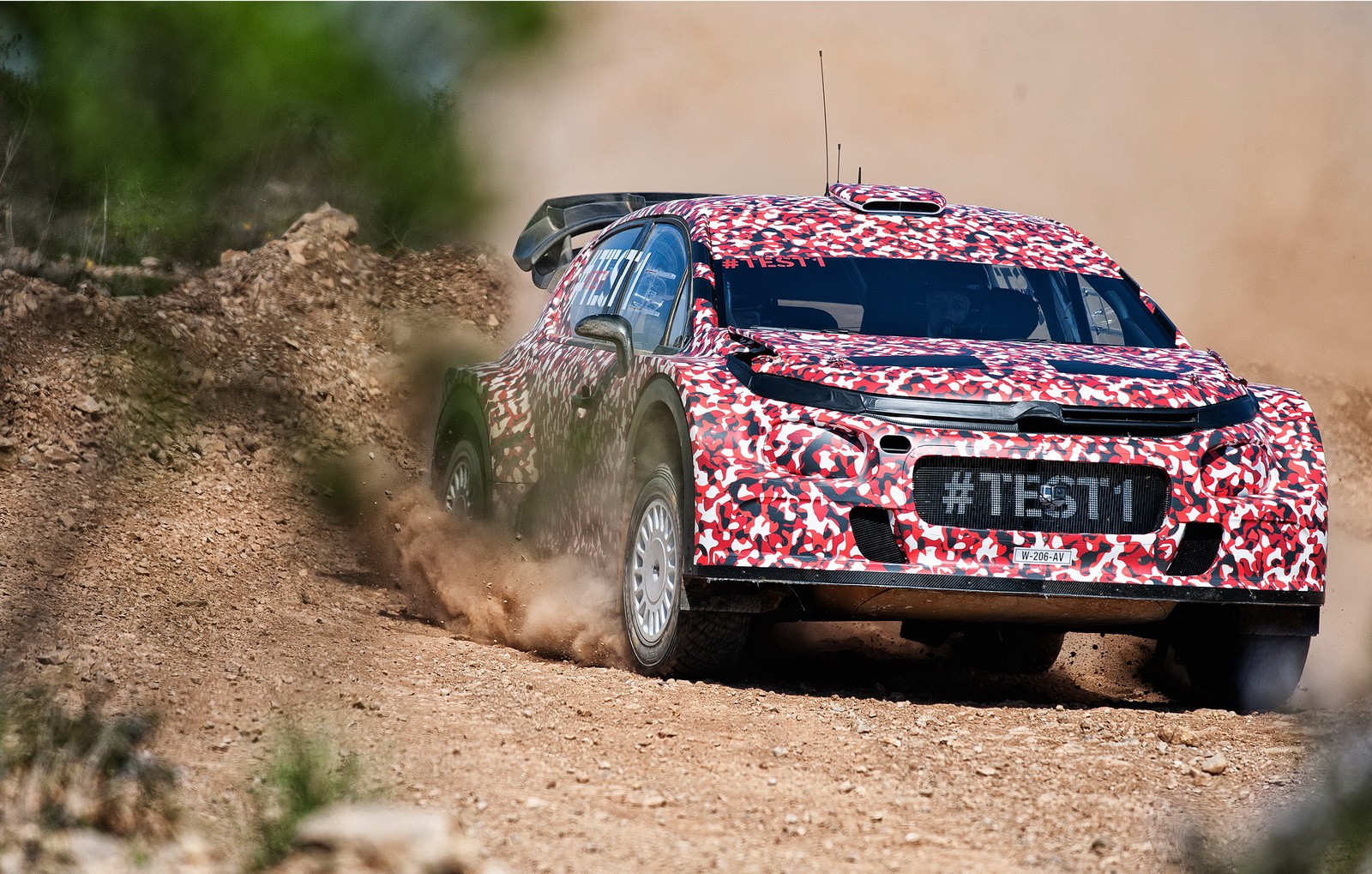
Citroën Racing has completed initial testing of the car that will be entered by the brand in the World Rally Championship for the 2017 season. On the gravel roads around the Château de Lastours and then in Fontjoncouse, Kris Meeke has already tested the reliability and performances of this new generation model.
First and foremost, it is worth remembering what a 2017-spec World Rally Car actually is because compared with the models that first appeared in 2011 the change is set to be dramatic, for eyes and ears alike. 

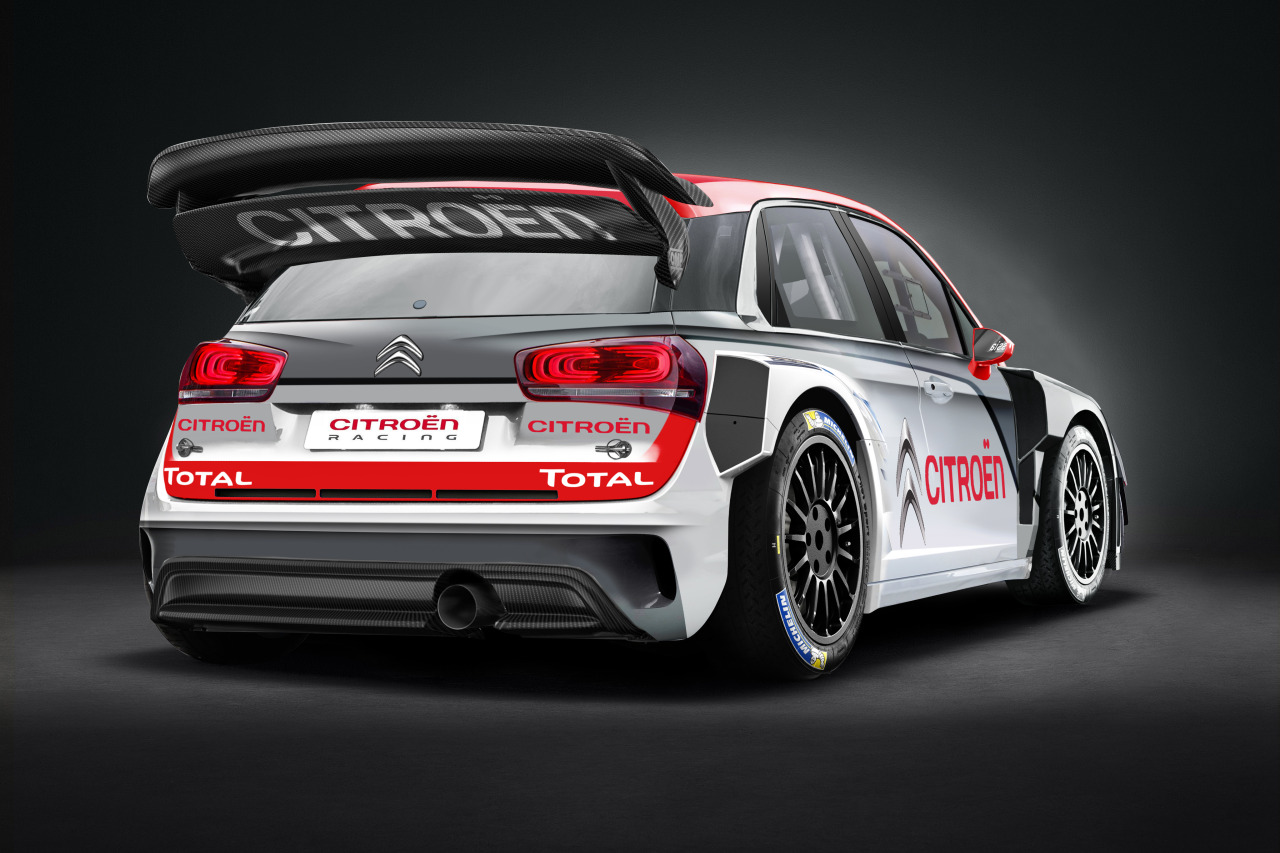
By becoming 55mm wider, the bodywork enjoys great aerodynamic freedom, with a front bumper fitted with a splitter, prominent air inlets and outlets, a rear diffuser, and so on. It is no accident that comparisons have been made with the legendary Group B cars of the 1980s.
Under the bonnet, the 1.6-litre direct injection turbo engine is now fitted with a 36mm booster flange, like the Citroën C-Elysée WTCC. With some 380bhp under the right-hand pedal, the drivers will be able to savour the power on offer, especially as the minimum regulatory weight has been reduced by 25kg and the four-wheel drive now comes with a central differential that improves traction.
This new generation of World Rally Cars has been designed by the FIA and the manufacturers to give the WRC new impetus. After announcing its return to the category in 2017, Citroën is now determined to play a big part in breathing new life into the WRC, with the aim of winning rallies and adding to its collection of world titles.
The very first outing of the brand’s latest model was held on Saturday, 9 April in Versailles on the small track right next to Citroën Racing’s Satory site. Alexandre Bengué, the team’s test driver, was handed the responsibility of completing the first few miles. The following Monday, Kris Meeke got behind the wheel of the prototype for another shakedown session. As he climbed out of the car at the end of his first run, the Northern Irishman’s wide grin spoke volumes about how much he had enjoyed driving the new car.
Overseen by Laurent Fregosi, Citroën Racing’s new Technical Director, the development team then headed for the south of France for the first proper test session. Engineers Alexis Avril (Project Manager) and Didier Clément (Chief Operating Engineer) didn’t go for the easy option in choosing the roads around Château de Lastours and Fontjoncouse as the base for testing. Regularly used by cross-country rally vehicles, the rocky gravel roads provided a demanding environment in which to test the strength of the chassis, the suspension, the gearbox and the bodywork.
To hide the aerodynamic features as much as possible, Citroën Racing’s latest creation was decorated with a special “camouflage” livery, with a red, white and black pattern created by Citroën’s design team. At 9.12am on Thursday, 14 April, Kris Meeke and Paul Nagle began the test programme. Not only did this moment represent an achievement of sorts for the engineers and technicians in charge of designing and building this first version, it also marked the start of a new adventure.
Without ever losing his broad smile, Kris Meeke switched between testing sessions and technical debriefings. Whilst racking up the miles to flush out the inevitable teething problems, he also tried hard to analyse the reactions of the car to changes in the set-up.
On the fourth day, Kris handed over driving responsibilities to Craig Breen. Tasked with analysing the work done using his own experience and feeling, the talented young Abu Dhabi Total WRT driver turned out to be just as enthusiastic about the potential and performances of this new generation World Rally Car.
Back in Versailles, the team now has to go through and analyse the gigabytes of data acquired and prepare the changes that will be made in time for the next test session.
WHAT THEY HAD TO SAY
Yves Matton (Team Principal, Citroën Racing): “It is one of the major stages in a project of this size. The lead-times established for the design phase were very tight. Thanks to its expertise and experience, the team has done a fantastic job to design a car based on the new regulations. Having seen our World Rally Car begin road testing on schedule and complete runs without experiencing any major problems, we can take our time in confirming the upcoming milestones. Once again, what the men and women at Citroën Racing have achieved is quite exceptional.”
“It is very much in line with what we had imagined when we talked about the new regulations, which were devised to make the cars more spectacular. All the factors we had wanted to improve – the noise, impression of speed and aggressive design – are already in evidence, even though this was only the car’s very first test outing. I think rally fans are going to like the new generation of WRCs.”
“The FIA has been working on improving safety for a number of years and we are supportive of this approach. As far as we’re concerned, we have always been something of a pioneer in this field, even if it has meant imposing additional restrictions on ourselves. It will be no different with this car, which will be even safer than its predecessor.”
“We have never strayed far from the WRC and have been constantly updating our knowledge base.
Our WTCC programme will be a bonus, because it will enable us to have a different approach. Before, we had virtually no real experience in aerodynamics. It is now a field in which we have genuine expertise. Similarly, we have an engine that has been running for more than two years with a similar power level and lifespan to those stipulated in the WRC specifications. All of this will be beneficial for the rest of the development phase and when it comes to running the car.”

“We are going to continue testing on gravel and then we’ll begin testing on tarmac. One of the key stages will be the point at which we set the technical definition to start building the cars that will be competing in 2017”
Kris Meeke: “Yes, everyone is absolutely 100% committed and it’s fantastic! When I joined the Citroën Racing fold two years ago, the priority was the WTCC and the development of the WRC was fairly limited. Now, you can feel there’s a real energy, with engineers coming back to rally with experience they have gathered on the track. The Citroën Racing machine is up and running at full power and that motivates me to work even harder. Together, we can all do something really special in the future.”
It’s always exciting to drive a car for the first time. But this is different, this is the start of a major new programme for Citroën Racing and a new era for the WRC. That’s what makes this moment so special.
I know that everyone has put in a lot of work to build this new car. So it’s special for them too. Now, we’re moving into a new stage of the process and it’s up to me to step up to the plate.”
“Obviously, it’s a period of the history of rallying that everyone remembers with affection. The cars were spectacular, with their bold design and big spoilers. We’re returning to that spirit, with more aggressively-designed cars but adding in the technological advances that we now have in 2016. Having driven one or two Group B cars, I can confirm that there really is no comparison. The potential of our new World Rally Car is incredible.”
“With the power and the aerodynamic efficiency, these cars are fascinating. After my first run, one of the mechanics filmed the expression on my face. I didn’t realise it at the time, but the big smile on my face spoke volumes about how much I had enjoyed driving the new car.”
“I’ve always thought that aerodynamics shouldn’t become too important, because rallying shouldn’t become like track racing. I think we have a good balance and these cars will be just as exciting to drive as to watch. But I think the human factor will become more important than it is currently. In my opinion, the 2017 WRCs must remain exclusive to the World Championship, like the F1 cars or the MotoGP bikes.”
“Every year, even if the regulations remain unchanged, we always go a little bit quicker. You can’t stop technology from moving on. This new generation will enable us to make a big step forward in terms of the safety of the cockpit and protection in the event of a side impact. We’re heading in the right direction.”
“As soon as we set off, I felt that I was driving a genuine rallying machine, a well-designed car. I have been involved in the development of several cars in my time; generally speaking, you spend more time waiting around than driving in the first few test sessions. But with this, I was able to rack up the miles and start to explore the set-up options. It was like a dream.”