Purpose

I will try my best to provide detailed info on various cars and what is like to live with them, I have already produced a few for Jaguar-car-forums, I will do my best to be unbiased, but it will be hard for some cars. I will re-produce press releases and copy from other motoring news.

Sunday, 11 January 2015

Biggest Land Rover drawing in the world and three special editions mark the end of an era.

  • World’s most iconic vehicle drawn on huge 1km scale on the same beach used to sketch the original design 68 years ago: http://youtu.be/vjZa9LCIgMo 
  • Heritage, Adventure and Autobiography Limited Edition Defenders announced
  • Solihull production of current Defender due to end in December 2015

Land Rover has gone back to the place where it all began to start a year-long celebration of the iconic Defender. A unique 1km sand drawing at Red Wharf Bay in Anglesey, UK, marks the launch of three exclusive limited edition models and the beginning of an exciting new chapter in the Defender story.

As UK production of the current Defender enters its final phase, Land Rover will use 2015 to celebrate its global automotive icon.


Land Rover Vehicle Line Director Nick Rogers explains the significance of recreating one of the world’s most iconic vehicles: “Passion and enthusiasm surround everything we do with Defender, and that will never change. With a history stretching back 68 years, this is a Land Rover that has thrived for decades on its unquestionable capability and iconic shape. I now have the honour of being one of the many enthusiasts at Land Rover committed to creating a fitting successor to the legendary Defender.”

To mark the announcement Land Rover has created the largest sand drawing ever produced in the UK. A Defender outline measuring a staggering 1km across was drawn on the beach at Red Wharf Bay in Anglesey using a fleet of six Land Rovers. The unique image is a tribute to the moment in 1947 when the engineering director of Rover, Maurice Wilks, first sketched the shape for the original Land Rover in the sand of Red Wharf Bay and proposed the idea to his brother Spencer, Rover’s managing director.

“My father met his brother on the beach at Red Wharf Bay and made a drawing in the sand of how he thought the Land Rover could be made,” said Stephen Wilks, son of Maurice. “That was the start of it all, the conception of Land Rover.”

The Wilks family owned land on the Welsh island and Maurice wanted a versatile vehicle that could double as a light tractor and off-roader. His forward-thinking design was christened the ‘Land Rover’, the outline of which we now recognise as the Defender.

Creating the giant piece of temporary artwork at Red Wharf Bay required a fleet of six Land Rovers, each towing an agricultural 12-foot harrow to draw the unmistakable outline of the Defender in the sand. The vehicles chosen for the race against the Anglesey tides chart the evolution of the Defender from its introduction in 1948 to the present day.

A Land Rover Series I, II and III were joined on the beach by a Ninety from the Eighties, a Defender 90 Hard Top and a Defender 110 Station Wagon. The immaculate Series II once belonged to the Wilks family and in memory of the moment originally enacted by their fathers, cousins Stephen and Nick Wilks, the sons of Maurice and Spencer Wilks respectively, were on hand to take part. They helped to draw the continuous 4.52km line – the length of 1,118 Defender 90 Station Wagons – into the sand with just minutes to spare before it was erased by the incoming tide.

The event witnessed the debut of the Defender Celebration Series; three exciting new limited edition models which each celebrate a different element of Defender’s unique history. The Heritage, Adventure and Autobiography Editions are all powered by Land Rover’s proven 2.2-litre diesel engine and are available to order now.

Land Rover is also investigating the possibility of maintaining production of the current Defender at an overseas production facility, after the close of UK manufacturing. Any continuation would see low volume production maintained for sale outside the EU.

Limited Edition Defenders

The three hotly anticipated limited edition Defender models celebrate a different element of the vehicle’s versatile character.

“We wanted to mark the end of Defender production at Solihull with a special edition but coming up with a single identity was impossible, so we developed three very different interpretations of the Defender to reflect its strength and breadth of character,” said Nick Rogers. “Whether our customers want to celebrate Land Rover’s unrivalled off-road heritage, demand the ultimate in terms of design and performance or have a genuine thirst for adventure, there will be a limited edition Defender that will be fit for purpose.”

The exclusive Autobiography Edition promises more performance, luxury and comfort than ever before thanks to its comprehensive equipment list, unique duo-tone paintwork, full Windsor leather upholstery and a power upgrade from 122PS to 150PS. Exclusivity comes as standard as only 80 Defender Autobiography Editions will be available in the UK. It will be produced exclusively as a 90 Station Wagon and priced from £61,845.

The Heritage Edition is inspired by early Land Rover models and mixes nostalgic design cues with modern creature comforts. It will be identified by distinctive Grasmere Green paintwork and a contrasting white roof. A heritage grille and HUE 166 graphics, recalling the registration plate of the first ever pre-production Land Rover nicknamed ‘Huey’, also identify the Heritage model. It hits showrooms from August with production limited to 400 in the UK. Prices will start from  £27,800.

The exciting new Adventure Edition is aimed at Land Rover customers who relish the great outdoors and embrace the Defender’s ‘go anywhere, do anything’ attitude. It comes fitted with additional underbody protection and Goodyear MT/R tyres to boost the Defender’s already class-leading all-terrain capability. Unique decals and a leather-trimmed cabin ensure the Adventure Edition stands out from the Defender crowd. A total of 600 Adventure Editions are available in the UK priced at £43,495 for all versions.

Click here to see the limited edition models revealed as Land Rover creates the biggest sand drawing ever made in the UK: http://youtu.be/vjZa9LCIgMo 

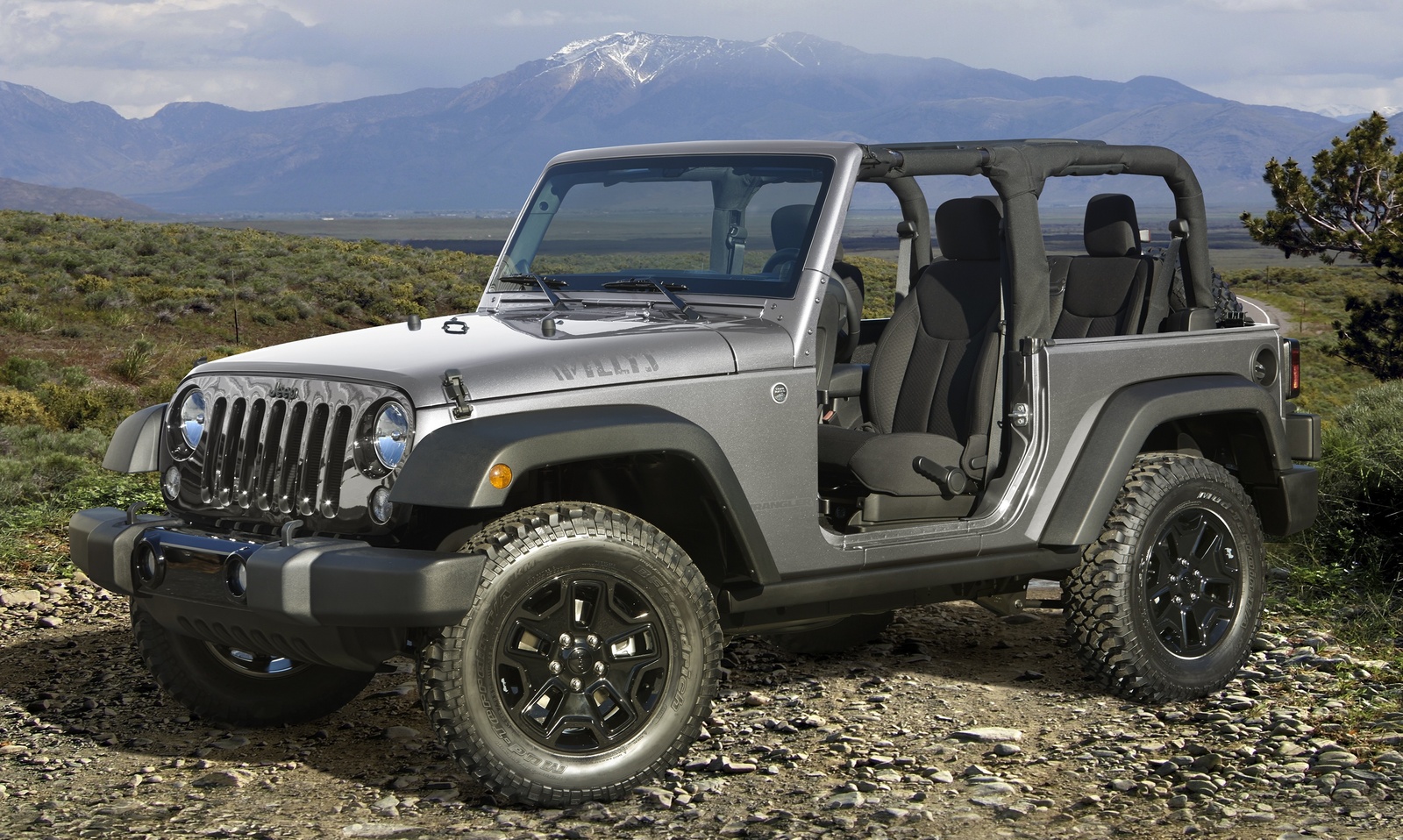
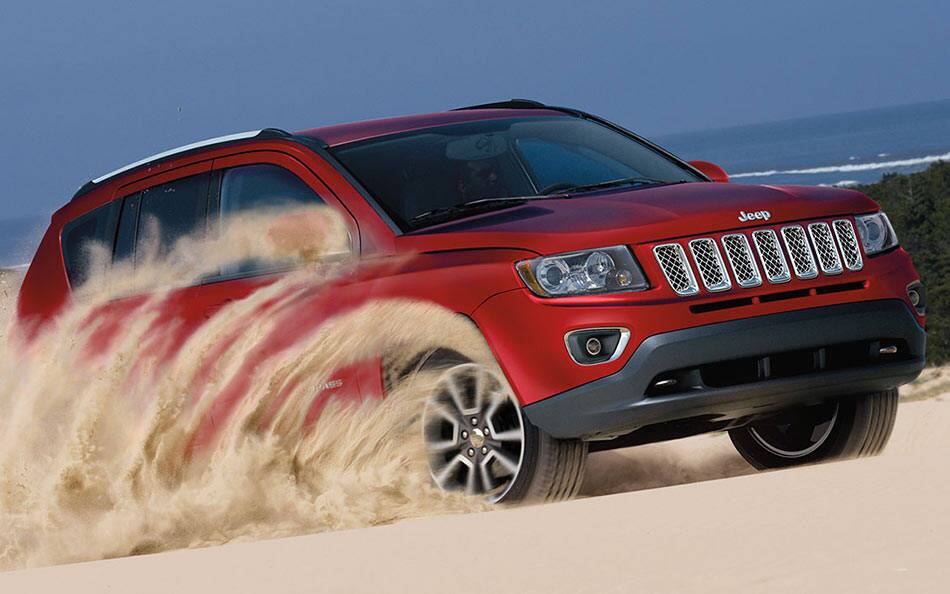
Jeep records in excess of one million sales for the first time ever, and they continue to grow.

  • Jeep global vehicle sales increase 39 per cent in 2014 to all-time annual  record of 1,017,019 units
  • 2014 Jeep sales total surpasses 2013’s previous record of 731,565 units
  • U.S. sales increase 41 per cent to a record 692,348 units
  • Fifth consecutive year of Jeep sales increases globally and in U.S.
  • All Jeep models record increased sales globally and in U.S.
  • Jeep Compass, Patriot and Wrangler record best-ever U.S. sales
  • Jeep sales increase 42 per cent in Asia-Pacific region; up 49 per cent in China
  • Sales of Jeep vehicles up 40 per cent in the Europe Middle East Africa region, while Europe sales rose by 65 per cent
The Jeep® brand recorded sales of more than 1 million units across the globe in 2014, setting a new all-time record for the third consecutive year. Sales of 1,017,019 Jeep vehicles bettered the brand’s 2013 record of 731,565 by 39 per cent.


“2014 marks the fifth consecutive year that Jeep vehicle sales have increased both globally and in the U.S. market,” said Mike Manley, President and CEO – Jeep Brand.  “While we are especially pleased with the way the new Jeep Cherokee is resonating in the marketplace, the fact is that every vehicle in the Jeep line-up recorded significant worldwide sales gains.

“While achieving 1 million vehicle sales in 2014 was certainly a milestone, 2015 will be a transformational year in the globalization of the brand, as we begin local manufacturing in Brazil and return to local manufacturing in China after an absence of nearly a decade,” Manley added.  “We will strive to continue our sales momentum in 2015 with a full line-up of capable and efficient SUVs – including the all-new 2015 Jeep Renegade, as it arrives in showrooms in markets around the world.”

In addition to its 39 per cent global increase, Jeep sales rose 41 per cent in the U.S. in 2014, with a record 692,348 total sales.

Jeep sales rose 40 per cent in the Europe Middle East Africa region, while Europe sales rose by 65 per cent and 42 per cent in the Asia-Pacific region in 2014.  In China – the world’s largest automobile market – sales rose 49 per cent. 

Jeep vehicle sales were led globally and in the U.S. by Grand Cherokee (279,567 global; 183,786 U.S.), Cherokee (236,289 global; 178,508 U.S.), Wrangler (234,579 global; 175,328 U.S.), Compass (134,629 global; 61,264 U.S.), and Patriot (122,387 global; 93,462 U.S.).
2014 marked the fifth consecutive year of increased Jeep sales, both globally and in the U.S.  

In 2013 the brand recorded increases of 4 per cent global and 3 per cent in the U.S.  The previous three years saw increases of 19 per cent global/13 per cent U.S. (2012), 41 per cent global/44 per cent U.S. (2011) and 24 per cent global/26 per cent U.S. (2010).

Lexus expands GS range with new performance saloon, premiering the new GS F.

Lexus is reinforcing its sporting character with the world premiere of a new GS F high-performance saloon at the North American International Auto Show in Detroit on 13 January.
The GS F will be the next addition to Lexus’s ‘F’ line, joining the recently launched RC F coupe. The new model combines a refined, four-door design with the speed and agility of a premium sports car.


The GS F shares the same platform as the Lexus GS, but benefits from extensive enhancements throughout, including the powertrain. This features a naturally aspirated 5.0-litre V8 engine that produces 467bhp (348kW) at 7,100rpm and peak torque of 527Nm between 4,800 and 5,600rpm*. This sophisticated unit can operate in both the Otto and Atkinson combustion cycles to optimise power or efficiency according to driving conditions. It will be matched to an eight-speed automatic gearbox with a manual shift function.

Lexus’s Torque Vectoring Differential, which debuted in the RC F, will be part of the GS F’s standard specification, helping define its handling quality. It will operate in three different modes: -
  • Standard (default), for a balance of agility and firmness
  • Slalom, emphasising nimble steering response and agility
  • Track, delivering stability in high-speed circuit driving
The GS F’s monocoque chassis will feature structural reinforcements and an exclusive suspension package designed to optimise the car’s handling capabilities and ride quality. Drivers can anticipate stable, smooth performance on the open road and rewarding handling when tackling challenging routes or circuit driving.

With a 1,830kg kerb weight*, the GS F is set to be the lightest model in its class.
In sum, the Lexus GS F promises to be a very balanced saloon with a genuine dual personality, equally adept at trimming lap times as it is making the commute back home.

Preliminary specifications (US market)

Overall length (mm)4,915
Overall width (mm)1,845
Overall height (mm)1,440
Wheelbase (mm)2,850
Track – front (mm)1,555
Track – rear (mm)1,560
Kerb weight (kg)1,830
WheelsFront 19in x 9J
Rear 19in x 10J
TyresFront 255/35R19
Rear 275/35R19
* Performance data is preliminary, for US market models.

CHINA - Volvo buys 45% of Dongfeng Commecial Vehicles, on its way to become the biggest truck maker.

AB Volvo has completed the acquisition of 45% of the Chinese automotive manufacturer, Dongfeng Commercial Vehicles Co., Ltd. The purchase consideration amounted to RMB 5.5 billion.

As announced earlier, AB Volvo signed an agreement in January 2013 with the Chinese automotive manufacturer, Dongfeng Motor Group Company Limited (DFG), to acquire 45% of a subsidiary of DFG, Dongfeng Commercial Vehicles Co., Ltd (DFCV). DFCV includes most of Dongfeng’s operations in heavy-duty and medium-duty commercial vehicles.

To implement the transaction, a number of conditions had to be fulfilled, including approval from the Chinese competition authority and other relevant authorities. All approvals have been received.


This transaction will significantly strengthen the Volvo Group’s position in medium-duty trucks while the Group will become one of the world’s largest manufacturers of both medium-duty and heavy-duty trucks.

“This strategic alliance is a real milestone and entails a fundamental change in the Volvo Group’s opportunities in the Chinese truck market, which is the largest in the world,” says Volvo’s President and CEO, Olof Persson. “At the same time, it will provide us with the opportunity to become involved in growing DFCV’s international business in a manner that will benefit us and our Chinese partner.”

In 2013, DFCV’s pro-forma sales amounted to RMB 35 billion (SEK 37 billion) and the pro-forma operating income to RMB 950 million (SEK 1 billion). The total Chinese market for heavy-duty trucks amounted to about 774,000 vehicles in 2013, while the corresponding figure for the medium-duty truck market was 286,000 vehicles. DFCV had a leading position in both the heavy-duty and medium-duty segments, with sales of 120,600 heavy-duty trucks and 51,000 medium-duty trucks, corresponding to market shares of 15.6 and 17.8%, respectively.

During the first three quarters of 2014, DFCV’s sales amounted to RMB 26 billion (SEK 28 billion) and the operating profit to RMB 1.1 billion (SEK 1.2 billion). During the same period, DFCV sold 85,000 heavy-duty and 31,000 medium-duty trucks. On September 30, 2014, DFCV had a net financial asset of RMB 3 billion (SEK 3.6 billion). (2014 un-audited)
AB Volvo’s ownership in DFCV is expected to be recognized as an associated company and will be consolidated as of January 2015 according to the equity method and reported in the trucks segment. 

The payment of the purchase consideration will impact the Group’s cash flow and net financial debt in the first quarter of 2015 by approximately SEK 7 billion. However, as the purchase consideration has been hedged, the nett amount paid for the ownership in DFCV is approximately SEK 5.6 billion.

Volkswagen at the Consumer Electronics Show in las Vegas 2015.

CES 2015 – Car and computer merge
Gesture control and networking for a new age of mobility

Golf R Touch: cockpit concept solves future challenges

Connected Golf: perfect compatibility with MirrorLink, Apple and Google
Intelligent Charge: e-Golf automatically docks above inductive charging plate
Trained Parking: future Park Assist drives into garage semi-automatically


Ten key facts about Volkswagen innovations at CES:
  1. Golf R Touch offers intuitive operation of high-tech infotainment.
  2. Gesture control of Golf R Touch revolutionizes user operation.
  3. Volkswagen will introduce MirrorLink, CarPlay (Apple) and Android Auto (Google) in the vehicle in 2015.
  4. Media Control integrates tablets and smartwatches into the Volkswagen infotainment system.
  5. Regular Routes is ideal for daily drives.
  6. Inductive charging will be an important component of electric mobility.
  7. Charge Check indicates the charge status by vehicle lights.
  8. e-Station Guide shows the way to the perfect charging station.
  9. Digital Key makes the smartphone a car key.
  10. Trained Parking enables semi-automated parking.


  • "The two inventions of the century, the car and the computer, are gradually converging. We need to design future mobility to be even more intelligent and networked." Prof. Dr. Martin Winterkorn, CEO of Volkswagen AG, points out that the automotive industry found itself in the midst of a historical turning point at the beginning of the 21st century. The car and the computer were merging. Volkswagen, Europe's most successful car brand, has been instrumental in driving this development. That is because the car – which operates intuitively, is networked systematically, reacts intelligently and offers significantly greater convenience – gives new innovative impetus to mobile life, making it more communicative, safer and fascinating. This is why Volkswagen is demonstrating – with an entire fleet of vehicles at the 2015 Consumer Electronics Show in Las Vegas (CES; January 6 – 9) – just how much the car and computer are already becoming intertwined today and will continue to grow together in the future. The main focus here is on four aspects. First, computer-driven drive systems. Second, app and smartphone integration. Third, intuitive vehicle operation. Fourth, autonomous and semi-autonomous driving.
  • First – computer-controlled drive systems. Electric mobility is coming into its own. Pure electric cars and plug-in hybrid vehicles are continually increasing their presence. The high production volume models have now arrived, and Volkswagen is setting the pace with best-sellers like the Golf. Driven exclusively by electric motors (as in the e-Golf), or by an alliance of a high-tech gasoline engine and electric motor (as in the Golf GTE plug-in hybrid). The e-Golf and Golf GTE are the protagonists of a new mobility. These cars would be inconceivable without on-board electronics with computers that control such functions as battery charging and, in the case of the hybrid models, switching between the different drive sources. At CES, Volkswagen is showing, among other things, how electric cars will be able to automatically dock to inductive charging stations and output signals that indicate the battery charge state using the vehicle's exterior lights. Everything computer-driven, of course.
  • Second – app and smartphone integration. It has now been eight years, to the month, since Apple introduced its first generation iPhone in San Francisco. Competitors followed, and the rest is history. The fact is that smartphones have irreversibly changed the way we communicate and our everyday lives. It has long been normal practice to have phones automatically connected to a car's hands-free telephone system via Bluetooth and to have the smartphones stream their media libraries into car infotainment and sound systems. But now Volkswagen is taking a significant step forward. Last year, the second generation "modular infotainment platform" (MIB II) was introduced. Along with the new radio and radio-navigation systems, MirrorLink™ was also made available for the first time; it is used to integrate the apps and operating layout of numerous Android smartphones into cars (including Samsung, HTC, LG and Sony). Later this year, the MIB II will be making its debut in the USA. At the same time as MirrorLink™ is introduced, two other interfaces will also be launched under the App Connect label: CarPlay (Apple) and Auto Android (Google). This will result in app integration for the key operating systems. App Connect will significantly expand the range of today's Volkswagen online services. Just as it launches in the USA, CarPlay and Auto Android will also be launched by Volkswagen on the European market.
  • Third – intuitive operation. In the future, the mobile computer, i.e. the car, will not only merge with the mobile world; it will also integrate people into its operating concept more ideally than ever. Here, Volkswagen is following a consistent strategy of implementing user operation by touchscreen. Today, and in the future, the car will be adapted more than ever to people by recognizing their movements – via control based on proximity sensors and gesture recognition. Today, the latest infotainment systems by Volkswagen can already detect the approach of a hand with proximity sensors. Thanks to proximity sensors, the display automatically switches over from a purely informative level to a more varied menu with optimally sized controls. In the next revolutionary step – which Volkswagen is presenting in the Golf R Touch concept vehicle at the 2015 CES – the infotainment unit will precisely detect hand gestures via camera and understand them. Gesture control will make it possible to control, in real space, displays and controls in virtual space without having to touch a touchscreen. This benefits convenience and safety, because it further reduces driver distractions while operating controls. At this point, it is clear that the car and computer can no longer be viewed as separate from one another. The car and computer are one.
  • Fourth – autonomous and semi-autonomous driving. Clearly, cars of the future will need to be able to drive certain route segments autonomously if necessary. Either fully autonomously or semi-autonomously, and this will be introduced step by step. Even today, Park Assist by Volkswagen enables semi-automated parking and exiting from parking spaces. The car executes the entire steering process for the parking maneuver fully independently. At CES, Volkswagen is now presenting another evolutionary stage of Park Assist: Trained Parking. Here, the car scans a frequently driven path to a parking space via camera, and from that point on it executes the path semi-automatically by computer control. In another evolutionary stage, it will be possible to have the car parked without the driver even needing to be present in the vehicle. The driver would maintain control over the car via smartphone.
Volkswagen highlights at the 2015 CES:
Golf R Touch
  • Volkswagen is equipping its show car in Las Vegas with the controls of tomorrow. The high-performance of its computers, the brilliance of today's displays and the recognition of precise human gestures are merging into a new interface generation here. In the Golf R Touch concept vehicle, Volkswagen is presenting, for the first time, an infotainment system that incorporates gesture control as a consistent next development step that is based on current thinking in the area of intuitive control. All it takes is a hand movement in the space in front of the infotainment display of the Golf to make human and machine interact as one. Volkswagen is thereby extending touchscreen operation into a third dimension.
  • The development team for the Golf R Touch pursued the goal of developing an interior and infotainment concept that would fulfill seemingly contradictory requirements. Despite the continually growing complexity and numbers of functions, this concept was intended to reduce driver distractions while attaining a maximum of personalization and intuitive operation in the car. A vehicle was created in which nearly all controls are implemented via touchscreens and sensor switches. Therefore, the Golf R Touch is equipped with three displays: the 12.8-inch high-resolution touchscreen of the infotainment system, a Control Center (8.0-inch with touch feedback) arranged beneath it to control vehicle, climate control and media functions as well as an Active Info Display (digitalized instruments, 12.3-inch). The layouts of the central touch screen and the Active Info Display can be customized rapidly, just as on a smartphone or tablet home screen today. The same is true of the entire color staging in the interior.
Connected Golf
  • At the 2015 CES in Las Vegas, Volkswagen is showing maximum networking of the car of today in the form of the Connected Golf. This e-Golf, which is equipped with the latest generation (MIB II) infotainment system, incorporates an enormous range of apps, smartphones and tablets via its progressive interface management system. The umbrella brand for all online-based functionality is Volkswagen Car-Net; its various features and applications are organized into several clusters. In the USA, for example, they are Travel Link, e-Remote, Safe & Secure and from now on App Connect. All of these clusters are implemented in the Connected Golf. A look at today's App Connect is particularly exciting. As noted above, Volkswagen is one of the first carmakers to integrate the vast majority of smartphone operating systems in models like the Golf based on App Connect. The three underlying software interfaces of App Connect are Mirror Link™, Android Auto (Google) and CarPlay (Apple). Via these interfaces, the driver and passengers in the car are able to use the many different apps of their smartphones over the infotainment system.
  • Beyond the applications of Volkswagen Car-Net, the Connected Golf is equipped with many other innovations. For example, Media Control enables the integration of tablets and smartwatches into the infotainment system. Media Control uses a special app that creates a rear seat entertainment system of a new era. Regular Routes is the name of a function by which the navigation system automatically detects – i.e. without needing to be activated by the driver – traffic disturbances on the daily commute to work, for instance, and it autonomously suggests an available alternative route. Parking Guide is another ingenious navigation feature. It embodies a technology that finds parking sites that have a high probability of available parking spaces.
e-Golf Intelligent Charge
  • This year, Volkswagen launched one of the world's first high production volume electric cars on the American market in the form of the e-Golf – a zero-emission vehicle with a range of up to 83 miles, optimal all-round characteristics and high-tech equipment. In Las Vegas, Volkswagen is now presenting Intelligent Charge in the e-Golf; it illustrates how electric cars will be used even more conveniently in the future. A key theme here: over the mid-term it will be possible to offer inductive charging as an alternative to cable-based charging. In this type of charging, the car is parked over a charging plate. In the future, it will be possible to see in just seconds whether the battery is still being charged, or whether it is already fully charged by looking at the vehicle's exterior lights. The e-Station Guide will not only assist the electric car drivers in finding a desired charging station. They will also be informed about their location and charging equipment as well as payment options. As an additional function, the Digital Key – an electronic vehicle key – is implemented in this Golf. This feature lets third parties use a smartphone or smartwatch to temporarily and safely gain access to the vehicle and to start or stop the engine.
e-Golf Perfect Parking
  • Park Assist from Volkswagen automatically guides the car into parallel and perpendicular parking spaces (in reverse) and can also automatically exit parallel parking spaces. First Volkswagen models will also be able to automatically park into perpendicular parking spaces in a forward direction. When parking or exiting a parking space, the system assists the driver by autonomously making optimal movements of the steering wheel to stay on the ideal line. At CES, Volkswagen is now introducing an advanced evolutionary stage of Park Assist known as Trained Parking. Here the car (an e-Golf) uses a camera – mounted in the base of the rear-view mirror – to scan a frequently used path into a parking space, and from then on the parking process is executed semi-automatically and highly precisely by sensors and computer. In the future, it will of course also be possible to semi-automatically park above a station for inductive charging. In another evolutionary stage, plans call for the driver no longer needing to stay in the car during parking. The driver would just monitor the operation of parking or exiting a parking space with a smartphone as a "remote control" device.