Purpose

I will try my best to provide detailed info on various cars and what is like to live with them, I have already produced a few for Jaguar-car-forums, I will do my best to be unbiased, but it will be hard for some cars. I will re-produce press releases and copy from other motoring news.
Showing posts with label 300kph. Show all posts

Thursday, 17 September 2015

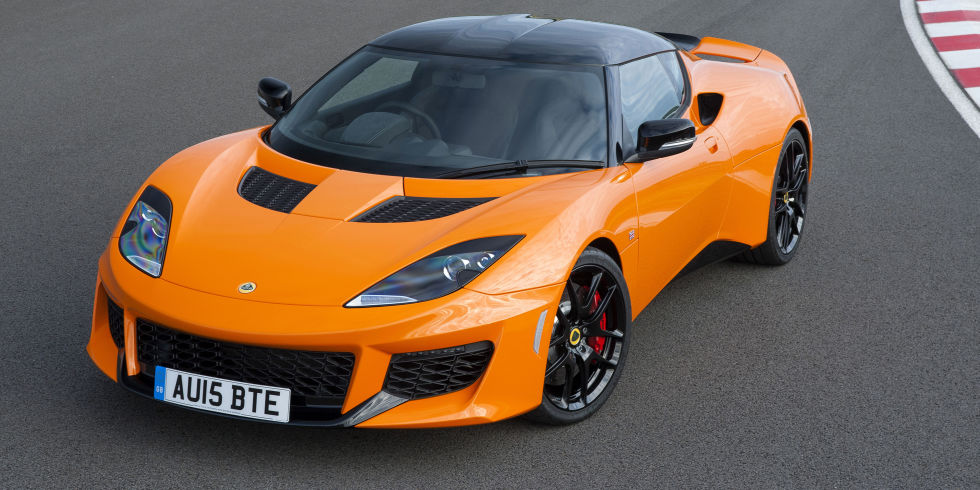
USA - Lotus announces pricing for the ultimate Evora, The 400, which will arrive at dealerships very soon.

  • 0-60 mph in 4.1 seconds; 0-100 km/h in 4.2 seconds
  • Top Speed of 186 mph; 300 km/h
  • Fastest production Lotus sports car ever
The first Evora 400 sports cars destined for customers and dealers have driven off the assembly line and are soon to arrive at dealerships across the UK and mainland Europe. The significant occasion was marked by a small celebration with proud members of the engineering and manufacturing team at Lotus, who are responsible for hand-building Lotus’ fastest production car to date.

Jean-Marc Gales, CEO, Group Lotus plc states, “The Evora 400 has already received admiration and critical acclaim from media around the world, praising its performance, handling and design. 

In September and October, Lotus dealers throughout the UK and mainland Europe will be receiving their demonstrator and customers cars, so now is the opportunity for drivers to get behind the wheel and experience the Evora 400 for themselves.”


Over two thirds of the Lotus Evora 400 is new, including its supercharged and charge-cooled mid-mounted 3.5-litre V6 engine which produces 400 hp and 410 Nm of torque. 

Such revisions result in a faster and dynamically more capable model than the previous Evora and are the reason the new Evora 400 has become the most eagerly anticipated Lotus model for several years.

Weighing just 1395 kg, (42 kg lighter than the previous Lotus Evora S)the new Evora 400 combines high performance with the legendary Lotus benchmark handling.

This performance, and handling, combined with a maximum speed of 186 mph (300 km/h) and acceleration 0-60 mph in just 4.1 seconds (0-100 km/h in 4.2 seconds), enables the new Lotus Evora 400 to lap the Lotus test track at Hethel seven seconds faster than the previous Evora S in a time of 1 minute 31 seconds.

The Lotus Evora 400 benefits from a high level of standard specification including 370 mm composite two piece brake discs from AP Racing, a Limited Slip Differential, automatic air-conditioning and infotainment system including satellite navigation. 

In addition to this, the options list includes automatic transmission, cruise control, Alcantara or Leather trim upgrades and metallic paint.

A “Black Pack” option provides a distinctive look, with selected exterior panels including the roof, sills and centre section of the three-element rear wing in gloss black and a dark headlining in the interior. Lightweight forged alloy wheels can be specified along with optional yellow or black brake callipers.

Over the last 15 months, Lotus has increased its number of dealers worldwide from 138 to 193.

North American markets and China will receive the Evora 400 as a 2017 model year in early 2016.

Drivers who are interested in test driving the new Lotus 400 are encouraged to contact their nearest Lotus dealer or to visit 

Lotus Evora 400 International pricing including local taxes where applicable:
UK(Pound Sterling)    -           £72,000
Germany(Euros)        -           €96,000
Japan(Yen)                 -           ¥13,200,000
USA(Dollars)              -       $89,900 (excluding local sales taxes)
China(RMB)               -           1,318,000

Lotus Evora 400 Fuel Consumption
ManualAutomatic
mpg (l/100 km)mpg (l/100 km)
Urban 20.8 (13.6)20.0 (14.1)
Extra Urban38.7 (7.3)39.8 (7.1)
Combined29.1 (9.7)29.1 (9.7)
CO2 emissions225 g/km225 g/km

Tuesday, 3 June 2014

Canadian Grand Prix review

Grand Prix Preview Canada 2014
This weekend’s Canadian Grand Prix is Formula 1’s first foray of the year to North America. It’s a popular event with fans and drivers alike because the Circuit Gilles Villeneuve usually throws up an exciting and unpredictable race, and the vibrant city of Montreal provides a colourful backdrop to the on-track activity.
Facts & Stats: Circuit de Gilles Villeneuve
The Circuit
The Circuit Gilles Villeneuve is the first high-speed track of the 2014 campaign. The cars exceed 300km/h (186mph) on four occasions around the lap, but the corners are all relatively slow, and that places an emphasis on three key areas of performance: top speed, braking and traction.
From a driving point of view, the 4.361km (2.710-mile) circuit is hard to tame because the walls are close and the apex kerbs high; the smallest error can result in a crash. The final corner in particular has claimed its share of superstars, and is known colloquially as “The Wall of Champions”.
The Canadian Grand Prix’s association with Formula 1 dates back to 1967, the year that Montreal’s Ile Notre Dame was built in the St Lawrence River to host Expo ’67. The early F1 races were staged at Mosport, near Toronto, before the event found its permanent home in Montreal in 1978.
The circuit has been updated several times, the most recent changes taking place in 2002 when the approach to the Hairpin (Turn 10) was shortened and the pitlane exit was lengthened. As a result of those changes, the number of race laps was increased from 69 to 70.
The Race
Harsh winters and hot summers take their toll on the circuit’s asphalt. Despite being re-surfaced only a few years ago, bumps and cracks are already appearing and cars have to be set-up accordingly. However, the track surface remains surprisingly smooth, which is why Pirelli are taking their Soft (Prime) and Supersoft (Option) tyre compounds to the race – the same as at Monaco a fortnight ago.
The Team
McLaren has an impressive record in Canada, having won the race 13 times. Among those victories is Jenson Button’s magnificent victory in 2011, when he drove from last to first and took the lead on the final lap of the race. Kevin Magnussen has never previously raced at the Circuit Gilles Villeneuve.
Vital Statistics
Canadian Grand Prix
6th - 8th MAY

Circuit de Gilles Villeneuve
Race distance 70 laps (305.270km/189.700 miles)
Start time 14:00 (local)/18:00 (GMT)
Circuit length 4.361km/2.710 miles
2013 winner Sebastian Vettel (Red Bull RB9) 70 laps in 1hr32m09.143s (198.759km/h)
2013 pole Sebastian Vettel (Red Bull RB9) 1m25.425s (183.782km/h)
Lap record Rubens Barrichello (Ferrari F2004) 1m13.622s (213.246km/h)
First race 1978
What makes it special: High top speeds, lots of overtaking places and plenty to do in the evenings
Wins from pole 15
Track abrasiveness Low. Pirelli are taking their two softest tyre compounds to the race
Pirelli tyre choice Supersoft (Option)/Soft (Prime)
2013 winning strategy Two stops
Fuel consumption High. Nearly 70 per cent of the lap is spent on full throttle, with lots of hard acceleration from slow-speed corners
Brakewear High. There are seven major braking areas around the lap, with the heaviest deceleration peaking at 5.5g into the final chicane. Brake wear and temperatures have to be carefully monitored
Weather Montreal’s coastal location can throw up all types of weather in June. Last year there was rain in qualifying and sunshine during the race, and the teams should be prepared for anything this weekend
DRS zones Two – along the start-finish straight and on the approach to the final corner
Turbo effect High, due to lots of acceleration from slow speeds
Safety Car likelihood High. Ten of the last 15 Canadian Grands Prix have been interrupted by the Safety Car, with nearly half of the race in 2011 spent behind it
Grid advantage The racing line is on the right-hand-side: if it’s been a rain-free weekend and rubber has built up from practice and qualifying, then it holds a slight advantage at the start
Pitlane time 21s
McLaren at the Canadian Grand Prix

Wins 13 (1968, 1973, 1974, 1976, 1988, 1990, 1992, 1999, 2005, 2007, 2010, 2011, 2012)
Poles 11 (1972, 1974, 1976, 1988, 1989, 1990, 1992, 1998, 2007, 2008, 2010)
Fastest laps 11 (1971, 1981, 1988, 1990, 1992, 1997, 2000, 2005, 2006, 2007, 2011)