3 November 1966 – 3 November 2016: the iconic Fiat convertible turns 50. It crossed decisive decades of the past century with a touch of elegance and sportiness to present day.
It was California Dreamin' back in 1966, and not by chance the model's exciting new evolution was presented in Los Angeles in 2015.
Today, its style embodies the timeless beauty of its predecessor while remaining true to its real self and is setting out to fascinate a new generation of fans.
The background
“The Turin Motor Show under the sign of optimism" was the positive-sounding title of the 48th edition of the event held in halls of Torino Esposizioni in 1966. The Motor Show welcomed visitors with a magnificent display of lights and colours. The glossy paintwork of the cars reflected the bright neon lights multiplying the effect: it was the 1960s and waves of enthusiasm were rolling across Italy.


The monetary crisis of 1964-1965 was coming to an end and automotive production had increased by 8% in 1966. Over 650 billion Lira had been invested from the beginning of the decade to renew and develop the plants in order to face a demand that was on the rise year by year.
In addition to generating employment, cars were the primary indicator of a country's welfare and its degree of civilisation. While the yearning to own one was becoming more and more common, a certain conservative mentality which saw cars as an ephemeral luxury remained strong.
The latter concept was proved wrong: today, we can reasonably declare that cars contributed to establishing true national unity by shortening distances, promoting travels and fostering mutual understanding.
It may have been viewed as an accessory, but as a means of transportation it was nearly always a work tool, a calling card and a springboard for ambitions.
The Fiat stand stood out for its sheer size in the exhibition hall, among those of 515 exhibitors from 13 different countries: the very comprehensive line-up displayed at the Turin Motor Show in 1966 was capable of satisfying the most diverse tastes and needs and was complemented by three brand-new models.
Visitors could admire the Fiat Dino, the production of which was being kicked off at the time, and the models which completed the 124 range.
The 124 was an innovative car with an original style, a new concept of space, sophisticated engineering and state-of-the-art safety. The Fiat 124 was the result of Fiat's commitment to make an affordable, fast car, capable of carrying five people and their luggage in comfortable style.
An estate version – the Fiat 124 Familiare – was introduced at the Motor Show, but that 3rd of November would be remembered above all for the Fiat 124 Sport Spider.
This model was the pinnacle of the evolution in the thrilling yet accessible convertible car segment that Fiat had led since the end of World War II with models such as the 1100 Spider in 1954, the 1200 and the twin-shaft 1500 Bialbero in 1958, the 1500 S and the 1600 S in 1961.
The 124 Sport Spider was designed for motorists seeking brilliant performance at an affordable price: it was a sporty car with a wide circulation. The press dubbed it a "modern event" not just a simple car.
It was modern because the quest for mobility was satisfied by a product that could excite and was reasonably priced, with a convincing and personal style, thrilling performance and innovative technical solutions, particularly mechanical.
The 124 Sport Spider was the evolution of the 124 saloon but was also a genuine sports car with which everyone soon fell in love. To design the car Fiat called Pininfarina, long-time partner of the auto maker and a respected name in automotive car design worldwide.
The 1966 124 Sport Spider: a world automotive legend was born
The model picked up most of the mechanics of the Fiat 124 saloon but was designed from the start with some quintessentially sporty features.
The name of Pininfarina was in itself a guarantee of design and interior elegance and as a whole the 124 Sport Spider stood out for the overall high quality of its finish, its accessories and its colours. The car was 3.97 metres long and its exterior style was modern, restrained and well-proportioned.
Its streamline side was enhanced by the rear wing that dipped slightly in the connection to the front wing. The front end was flat and compact with a light look determined by the recess housing two slightly retracted headlights.
The air intake presented an original hexagonal shape, while the bumpers were stark, wrapping and free from overriders. The tail was characterised by two slightly upward inclined fins forming a concave line connecting to the boot profile.
In short, it expressed the most attractive style and proportions of its time: an enchanter among the enchanter, it stood on that Fiat stand in November 1966 by two beauty pageant winners and actress Marisa Solinas.
The car had a Vinilite rear window and two side windows that retracted when the top was folded down. The large glazed surfaces ensured visibility in all directions. Aerodynamics were suited to motorway speeds and for agile driving in city traffic at the same time.
The design of the windows and the windscreen, as the details of the handles, headlights, seats and colours, were all characterised by research focused on utility and elegance.
The interiors were also carefully crafted with anatomic seats, wood trim and a very complete dashboard: instruments included a speedometer, an electric oil pressure gauge, a coolant thermometer and an electronic tachometer.
With the same rear-wheel drive, the Spider version was strongly connoted by the 124AC.000 engine. It was a straight-4 with bore and stroke of 80 and 71.5 mm, respectively, producing a displacement of 1438 cm3.
It was positively brilliant also as a result of having dual overhead camshaft and valves arranged in a V. It developed a power of 90 HP at 6500 rpm and reached a top speed of 170 km/h. It had a double barrel vertical carburettor, while a double oil filtering system ensured better lubrication and longer life.
Other features placed the model in the premium sports car segment: five-speed gearbox as standard equipment, radial tyres and sporty two-spoke steering wheel. The later was connected to the steering box with a two-part steering column joined by CV joints for excellent handling.
The elegant style, the good engine performance, the stability and the safety of the model – deriving from the four disc brakes with vacuum brake booster and the presence of a Panhard track bar for better load arrangement on bends – secured success in terms of sales and image from the first months.
The 124 Sport Spider was priced at 1,550,000 Lira, approximately half a million more than the saloon. “Cromodora” alloy rims and hard top were available for an extra 65,000 Lire. About 25,000 units of the first series were made until 1969.
A few adjustments to live the American dream and the début of the second series
In 1966 the Italians were singing along to the cover version of The Mamas and Papas' song and dreaming of escaping from grey skies and winter days to the freedom of a new life in California too.
Meanwhile, bolstered by the good market response, Fiat was working on the development of the model that would be launched in the USA in 1968. The Americans loved the proportions and quintessential Italian style of the Spider, as its top that could be quickly and easily folded directly from the driver's seat.
The second version proper was introduced in October 1969, again at the Turin Motor Show, as part of an overall revamp of the range. It maintained the rear-wheel drive arrangement and the typical sporty driving feel despite the number of cars with front-wheel drive that were being presented in that edition of the event.
It could fit either the traditional 1.4-litre or a new 1.6-litre engine. The latter, also with four cylinders and dual overhead camshaft, had two double barrel vertical carburettors: displacement increased to 1608 cm3 and performance was even more brilliant.
It delivered 110 HP and reached a top speed of 180 km/h. The braking system was of the independent circuit type. From the point of view of appearance, it had a new grille with honeycomb radiator.
The most obvious difference were the two significant oval-shaped humps on the bonnet needed to accommodate the larger engine. The rear lights clusters were modified and a reversing light was added. Radial tyres and waterproof top completed the standard equipment. Hard top and light alloy rims were available as optional equipment.
In October 1969 Lucio Battisti released his hit song “Mi ritorni in mente" ("I remember you / as beautiful as you are / maybe more than ever"): it was not dedicated to the Fiat 124 Spider but it could have been.
The roadster evolved while remaining true to itself, with its elegant design by Pinifarina, and was as successful as ever: some 27,000 units were made in the years from 1969 to 1972.
The sparkling seventies welcome the third generation
The 1970s were years of major cultural and social changes. They were years of freedom and transgression, of turmoil and innovation.
New cultural issues that would be current until the present day came into the foreground for the first time, such as the social function of education, the relationship between school and employment and creative communications. Political extremism was another characteristic of those times.
The development of the automotive industry rocked from stagnation caused by the oil crisis and political unrest to maximum production efficiency and economic recovery. The Fiat 124 range was completely renewed and an array of mechanical and style improvements were introduced to enhance performance, comfort and elegance.
Designed in international perspective from the start, the 124 was the turning point in the evolution of the Fiat production in the mid-sized engine sector and the beginning of the 1970s was the pinnacle of its success.
Fiat introduced a new generation of the Spider in 1972: the style was basically unchanged but minor tweaks had been made to the dashboard, like replacing the chrome-plated instrument panel with a black one and the addition of a clock.
The most substantial news concerned the engine because both the “1600” and the new “1800” engines of the Fiat 132 were fitted on the Fiat 124 Sport Spider. More in detail, they were both straight-4 with dual overhead camshaft, overhead valves and a double barrel Weber 34 DMS or Solex C34 EIES 5 carburettor.
Displacement was 1592 cm3 for the “1600” and 1756 cm3 for the “1800”. Power was 108 and 118 HP with top speeds of 180 and 185 km/h, respectively.
The 124 Sport Spider was successful as a result of its timeless appeal and unchanged driving pleasure despite the social unrest of those years which tended to penalise the showiest models.
After 1972 the model would also be remembered for its memorable racing triumphs. Eddy Merckx deserved his nickname of “The Cannibal”, winning the Tour de France and the Giro d’Italia, in addition to the Milano-Sanremo and the speed record.
Mark Spitz set new world records in all seven competitions he competed in during the Munich Olympics, while Italians Mennea and Thoeni made a name for themselves in track and field and in skiing with the European 100 metres record and the Alpine Skiing World Cup. The Fiat 124 Abarth Rally for racing in Group 4 was launched the same year as the street-legal version.
Compared to the standard production model, the Fiat 124 Abarth Rally Gr.4 benefited from a more powerful engine, fibreglass roof and bonnet, aluminium doors and considerable weight reduction. Tuned by the Abarth Racing Team, the car made its début in the 1972 season and continued racing until 1975.
Production of the 124 Sport Spider continued from June 1974 until 1982 for exports to the United States where the model was still very successful. The style remained the same.
The only change concerned the adoption of energy-absorbing bumpers, as required by US safety standards, and the introduction of a 2-litre 87 HP engine starting from 1978. In 1981, Pininfarina displayed a new model called “Spider Europa” at the Geneva Motor Show.
The appearance was essentially the same with upgrades focusing mainly on safety and comfort. Under the bonnet was a 1995 cm3 twin-shaft four-cylinder engine that delivered 105 HP. Handling was as excellent as ever and fuel efficiency was improved.
The last development came in 1983 with the 136 HP “Volumex” with volumetric turbocharger. It was designed mainly for the US market and continued the success of the model with over 200,000 units sold worldwide, 75% of which in the USA.
The new 124 Spider returns to the world roads
The United States had always been the target market of the Fiat 124 Sport Spider: not by chance the new Fiat 124 Spider was presented at the Los Angeles Motor Show last year.
Following in the wake of tradition of its legendary namesake, it has set out to fascinate a new generation with its typically Italian style and performance. The 124 Spider is the authentic roadster experience. Packed with thrills, technology and safety, rolled up with all-Italian flair, it turns 50 today.
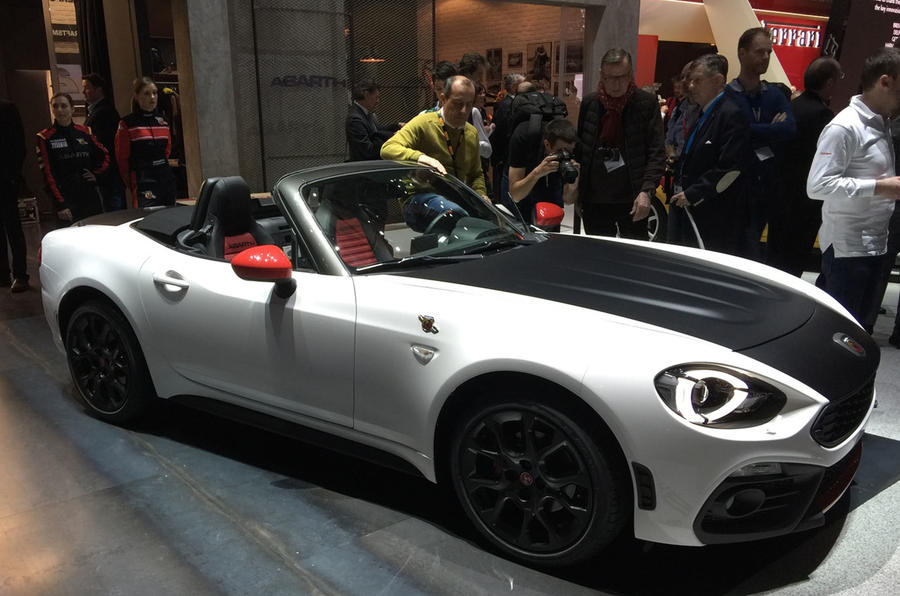
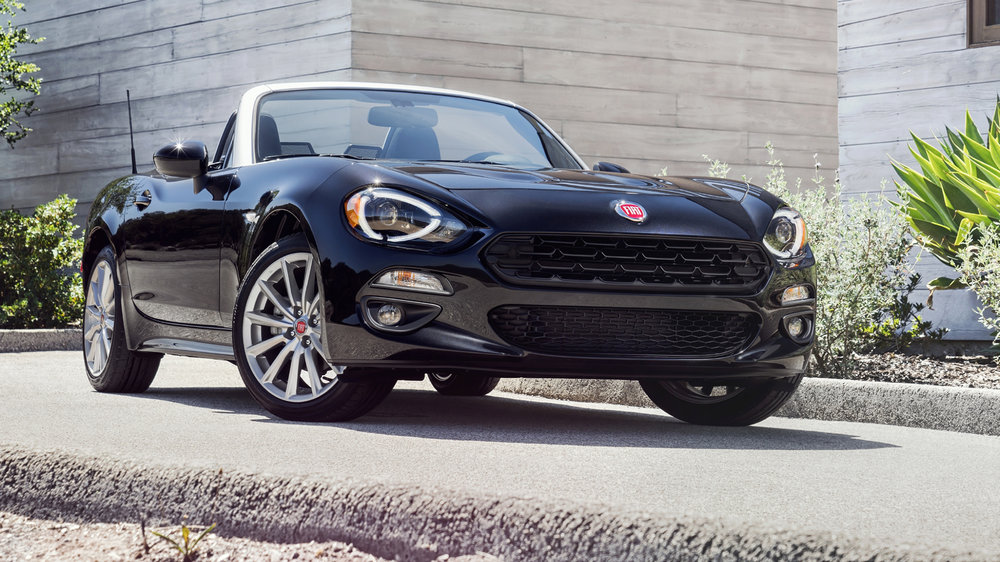
The Fiat Style Centre designers created a car that encompasses the classic beauty of its predecessor without betraying its very essence in a new perspective. The front-end is bold without being aggressive and the two small humps on the bonnet suggest the engine power.
The side proportions are those of a true sports car with longitudinal engine, rear-wheel drive mechanical architecture and retracted cockpit: design pays homage to the past projecting it into the future.
The new Fiat 124 Spider is inspired by some details of its 1966 predecessor and reinterprets them in a modern key. It has a streamline, timeless silhouette as well as the classic, perfectly proportioned side, the low centre of gravity, the retracted cockpit and the stretched bonnet of a real sports car.
References to the vintage model are also found in the upper grille, in the hexagonal front grille pattern, in the classic "humps" along the front bonnet and in the bold horizontal rear lights.
Similarly, the upper hexagonal grille was inspired by the exclusive form of the front air intakes on the vintage model and recalls the honeycomb structure of the sporty grille on the legendary 124 Spider.
The rear end is characterised by two elements: the swallow-tail section rear wings and the horizontally developed rear lights which wink to the features of its predecessor.
The shape of the rear bumpers with the upper surface jutting into the boot lid conveys a characteristic V-shape to the rear end of the car.
Interiors are designed and built to guarantee maximum occupant comfort using high-quality, soft materials. The ergonomics of the car were painstakingly designed to enhance the driving experience, also through the perfect layout of pedals, steering wheel and transmission.
Fiat 124 Spider fits the reliable four-cylinder 1.4-litre MultiAir turbo engine that delivers 140 HP of power (103 kW) and 240 Nm of peak torque available right away at 2250 rpm. The engine has retained its distinguishing features: four cylinders in-line with an aluminium head, a 72 mm bore and an 84 mm stroke, developing a total displacement of 1368 cm3.
Fiat 124 Spider clocks a top speed of 215 km/h and accelerates from 0 to 100 km/h in 7.5 seconds. The outstanding dynamism of the car is also achieved thanks to the rear-wheel drive, an extremely well-balanced weight distribution and a low centre of gravity.
Fiat 124 Spider is available with six-speed manual gearbox for smooth, direct shifting, or with automatic transmission. Suspension and steering are designed for excellent driving dynamics.
In the front, the new 124 Spider uses an elegant double wishbone suspension arrangement and a multilink architecture for total vehicle control in a curve on the rear. With dual pinion electric power assistance, the steering is light and reactive.
As a tribute in the tribute, an example of the new 124 Spider America limited number special series, of which only 124 numbered units will be made, was displayed at the Paris Motor Show.
The model is specially equipped to celebrate its namesake that in the 1980s was launched to celebrate the 50th anniversary of Pininfarina. Not by chance, the special series reproduces the magnetic bronze livery of that famous model.
The wing mirror caps are silver colour and the leather interiors are tobacco. On demand, the new 124 Spider America can be fitted with 17” light alloy rims with a classic design and rear parcel rack.
These two accessories were developed by Mopar to enhance the vintage personality of the car. Finally, 124 Spider America sports a celebratory numbered badge (124 for the Italian market, available from the end of the year) and a special badge on the front grille.
The six-speed sequential automatic transmission was first introduced on this version. Orders will open in Italy during the first quarter of 2017.
From 1966 to 2016: the fifty years of a legendary model which continues to fascinate with its stylistic developments and constant engineering quality with an eye to its successful past. Growing to improve and reach new goals: happy birthday, 124 Spider.