Purpose

I will try my best to provide detailed info on various cars and what is like to live with them, I have already produced a few for Jaguar-car-forums, I will do my best to be unbiased, but it will be hard for some cars. I will re-produce press releases and copy from other motoring news.
Showing posts with label pininfarina. Show all posts

Monday, 7 November 2016

3 November 1966 – 3 November 2016: the iconic Fiat convertible turns 50. Happy Birthday to the FIAT 124 Spider.

3 November 1966 – 3 November 2016: the iconic Fiat convertible turns 50. It crossed decisive decades of the past century with a touch of elegance and sportiness to present day. 
It was California Dreamin' back in 1966, and not by chance the model's exciting new evolution was presented in Los Angeles in 2015. 
Today, its style embodies the timeless beauty of its predecessor while remaining true to its real self and is setting out to fascinate a new generation of fans.
The background
“The Turin Motor Show under the sign of optimism" was the positive-sounding title of the 48th edition of the event held in halls of Torino Esposizioni in 1966. The Motor Show welcomed visitors with a magnificent display of lights and colours. The glossy paintwork of the cars reflected the bright neon lights multiplying the effect: it was the 1960s and waves of enthusiasm were rolling across Italy. 

The monetary crisis of 1964-1965 was coming to an end and automotive production had increased by 8% in 1966. Over 650 billion Lira had been invested from the beginning of the decade to renew and develop the plants in order to face a demand that was on the rise year by year. 
In addition to generating employment, cars were the primary indicator of a country's welfare and its degree of civilisation. While the yearning to own one was becoming more and more common, a certain conservative mentality which saw cars as an ephemeral luxury remained strong. 
The latter concept was proved wrong: today, we can reasonably declare that cars contributed to establishing true national unity by shortening distances, promoting travels and fostering mutual understanding. 
It may have been viewed as an accessory, but as a means of transportation it was nearly always a work tool, a calling card and a springboard for ambitions.
The Fiat stand stood out for its sheer size in the exhibition hall, among those of 515 exhibitors from 13 different countries: the very comprehensive line-up displayed at the Turin Motor Show in 1966 was capable of satisfying the most diverse tastes and needs and was complemented by three brand-new models. 
Visitors could admire the Fiat Dino, the production of which was being kicked off at the time, and the models which completed the 124 range. 
The 124 was an innovative car with an original style, a new concept of space, sophisticated engineering and state-of-the-art safety. The Fiat 124 was the result of Fiat's commitment to make an affordable, fast car, capable of carrying five people and their luggage in comfortable style.
An estate version – the Fiat 124 Familiare – was introduced at the Motor Show, but that 3rd of November would be remembered above all for the Fiat 124 Sport Spider. 
This model was the pinnacle of the evolution in the thrilling yet accessible convertible car segment that Fiat had led since the end of World War II with models such as the 1100 Spider in 1954, the 1200 and the twin-shaft 1500 Bialbero in 1958, the 1500 S and the 1600 S in 1961. 
The 124 Sport Spider was designed for motorists seeking brilliant performance at an affordable price: it was a sporty car with a wide circulation. The press dubbed it a "modern event" not just a simple car. 
It was modern because the quest for mobility was satisfied by a product that could excite and was reasonably priced, with a convincing and personal style, thrilling performance and innovative technical solutions, particularly mechanical. 
The 124 Sport Spider was the evolution of the 124 saloon but was also a genuine sports car with which everyone soon fell in love. To design the car Fiat called Pininfarina, long-time partner of the auto maker and a respected name in automotive car design worldwide.
The 1966 124 Sport Spider: a world automotive legend was born
The model picked up most of the mechanics of the Fiat 124 saloon but was designed from the start with some quintessentially sporty features. 
The name of Pininfarina was in itself a guarantee of design and interior elegance and as a whole the 124 Sport Spider stood out for the overall high quality of its finish, its accessories and its colours. The car was 3.97 metres long and its exterior style was modern, restrained and well-proportioned. 
Its streamline side was enhanced by the rear wing that dipped slightly in the connection to the front wing. The front end was flat and compact with a light look determined by the recess housing two slightly retracted headlights. 
The air intake presented an original hexagonal shape, while the bumpers were stark, wrapping and free from overriders. The tail was characterised by two slightly upward inclined fins forming a concave line connecting to the boot profile. 
In short, it expressed the most attractive style and proportions of its time: an enchanter among the enchanter, it stood on that Fiat stand in November 1966 by two beauty pageant winners and actress Marisa Solinas. 
The car had a Vinilite rear window and two side windows that retracted when the top was folded down. The large glazed surfaces ensured visibility in all directions. Aerodynamics were suited to motorway speeds and for agile driving in city traffic at the same time. 
The design of the windows and the windscreen, as the details of the handles, headlights, seats and colours, were all characterised by research focused on utility and elegance. 
The interiors were also carefully crafted with anatomic seats, wood trim and a very complete dashboard: instruments included a speedometer, an electric oil pressure gauge, a coolant thermometer and an electronic tachometer.
With the same rear-wheel drive, the Spider version was strongly connoted by the 124AC.000 engine. It was a straight-4 with bore and stroke of 80 and 71.5 mm, respectively, producing a displacement of 1438 cm3
It was positively brilliant also as a result of having dual overhead camshaft and valves arranged in a V. It developed a power of 90 HP at 6500 rpm and reached a top speed of 170 km/h. It had a double barrel vertical carburettor, while a double oil filtering system ensured better lubrication and longer life. 
Other features placed the model in the premium sports car segment: five-speed gearbox as standard equipment, radial tyres and sporty two-spoke steering wheel. The later was connected to the steering box with a two-part steering column joined by CV joints for excellent handling. 
The elegant style, the good engine performance, the stability and the safety of the model – deriving from the four disc brakes with vacuum brake booster and the presence of a Panhard track bar for better load arrangement on bends – secured success in terms of sales and image from the first months. 
The 124 Sport Spider was priced at 1,550,000 Lira, approximately half a million more than the saloon. “Cromodora” alloy rims and hard top were available for an extra 65,000 Lire. About 25,000 units of the first series were made until 1969.
A few adjustments to live the American dream and the début of the second series
In 1966 the Italians were singing along to the cover version of The Mamas and Papas' song and dreaming of escaping from grey skies and winter days to the freedom of a new life in California too.
Meanwhile, bolstered by the good market response, Fiat was working on the development of the model that would be launched in the USA in 1968. The Americans loved the proportions and quintessential Italian style of the Spider, as its top that could be quickly and easily folded directly from the driver's seat. 
The second version proper was introduced in October 1969, again at the Turin Motor Show, as part of an overall revamp of the range. It maintained the rear-wheel drive arrangement and the typical sporty driving feel despite the number of cars with front-wheel drive that were being presented in that edition of the event.
It could fit either the traditional 1.4-litre or a new 1.6-litre engine. The latter, also with four cylinders and dual overhead camshaft, had two double barrel vertical carburettors: displacement increased to 1608 cm3 and performance was even more brilliant. 
It delivered 110 HP and reached a top speed of 180 km/h. The braking system was of the independent circuit type. From the point of view of appearance, it had a new grille with honeycomb radiator. 
The most obvious difference were the two significant oval-shaped humps on the bonnet needed to accommodate the larger engine. The rear lights clusters were modified and a reversing light was added. Radial tyres and waterproof top completed the standard equipment. Hard top and light alloy rims were available as optional equipment. 
In October 1969 Lucio Battisti released his hit song “Mi ritorni in mente" ("I remember you / as beautiful as you are / maybe more than ever"): it was not dedicated to the Fiat 124 Spider but it could have been. 
The roadster evolved while remaining true to itself, with its elegant design by Pinifarina, and was as successful as ever: some 27,000 units were made in the years from 1969 to 1972.
The sparkling seventies welcome the third generation
The 1970s were years of major cultural and social changes. They were years of freedom and transgression, of turmoil and innovation. 
New cultural issues that would be current until the present day came into the foreground for the first time, such as the social function of education, the relationship between school and employment and creative communications. Political extremism was another characteristic of those times. 
The development of the automotive industry rocked from stagnation caused by the oil crisis and political unrest to maximum production efficiency and economic recovery. The Fiat 124 range was completely renewed and an array of mechanical and style improvements were introduced to enhance performance, comfort and elegance. 
Designed in international perspective from the start, the 124 was the turning point in the evolution of the Fiat production in the mid-sized engine sector and the beginning of the 1970s was the pinnacle of its success. 
Fiat introduced a new generation of the Spider in 1972: the style was basically unchanged but minor tweaks had been made to the dashboard, like replacing the chrome-plated instrument panel with a black one and the addition of a clock. 
The most substantial news concerned the engine because both the “1600” and the new “1800” engines of the Fiat 132 were fitted on the Fiat 124 Sport Spider. More in detail, they were both straight-4 with dual overhead camshaft, overhead valves and a double barrel Weber 34 DMS or Solex C34 EIES 5 carburettor. 
Displacement was 1592 cm3 for the “1600” and 1756 cm3 for the “1800”. Power was 108 and 118 HP with top speeds of 180 and 185 km/h, respectively.
The 124 Sport Spider was successful as a result of its timeless appeal and unchanged driving pleasure despite the social unrest of those years which tended to penalise the showiest models.
After 1972 the model would also be remembered for its memorable racing triumphs. Eddy Merckx deserved his nickname of “The Cannibal”, winning the Tour de France and the Giro d’Italia, in addition to the Milano-Sanremo and the speed record. 
Mark Spitz set new world records in all seven competitions he competed in during the Munich Olympics, while Italians Mennea and Thoeni made a name for themselves in track and field and in skiing with the European 100 metres record and the Alpine Skiing World Cup. The Fiat 124 Abarth Rally for racing in Group 4 was launched the same year as the street-legal version. 
Compared to the standard production model, the Fiat 124 Abarth Rally Gr.4 benefited from a more powerful engine, fibreglass roof and bonnet, aluminium doors and considerable weight reduction. Tuned by the Abarth Racing Team, the car made its début in the 1972 season and continued racing until 1975.
Production of the 124 Sport Spider continued from June 1974 until 1982 for exports to the United States where the model was still very successful. The style remained the same. 
The only change concerned the adoption of energy-absorbing bumpers, as required by US safety standards, and the introduction of a 2-litre 87 HP engine starting from 1978. In 1981, Pininfarina displayed a new model called “Spider Europa” at the Geneva Motor Show. 
The appearance was essentially the same with upgrades focusing mainly on safety and comfort. Under the bonnet was a 1995 cm3 twin-shaft four-cylinder engine that delivered 105 HP. Handling was as excellent as ever and fuel efficiency was improved. 
The last development came in 1983 with the 136 HP “Volumex” with volumetric turbocharger. It was designed mainly for the US market and continued the success of the model with over 200,000 units sold worldwide, 75% of which in the USA.
The new 124 Spider returns to the world roads
The United States had always been the target market of the Fiat 124 Sport Spider: not by chance the new Fiat 124 Spider was presented at the Los Angeles Motor Show last year. 
Following in the wake of tradition of its legendary namesake, it has set out to fascinate a new generation with its typically Italian style and performance. The 124 Spider is the authentic roadster experience. Packed with thrills, technology and safety, rolled up with all-Italian flair, it turns 50 today.
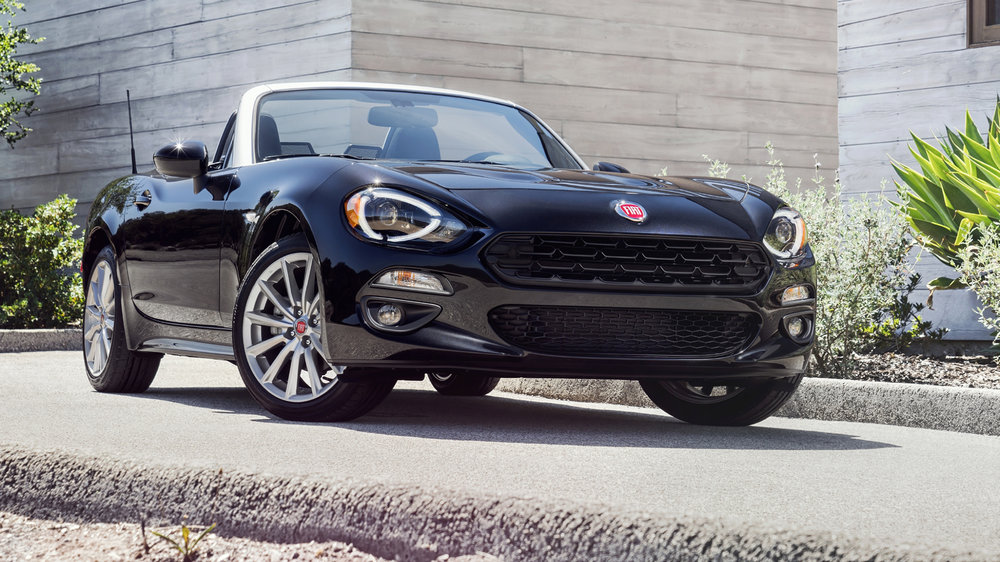
The Fiat Style Centre designers created a car that encompasses the classic beauty of its predecessor without betraying its very essence in a new perspective. The front-end is bold without being aggressive and the two small humps on the bonnet suggest the engine power. 
The side proportions are those of a true sports car with longitudinal engine, rear-wheel drive mechanical architecture and retracted cockpit: design pays homage to the past projecting it into the future.
The new Fiat 124 Spider is inspired by some details of its 1966 predecessor and reinterprets them in a modern key. It has a streamline, timeless silhouette as well as the classic, perfectly proportioned side, the low centre of gravity, the retracted cockpit and the stretched bonnet of a real sports car. 
References to the vintage model are also found in the upper grille, in the hexagonal front grille pattern, in the classic "humps" along the front bonnet and in the bold horizontal rear lights. 
Similarly, the upper hexagonal grille was inspired by the exclusive form of the front air intakes on the vintage model and recalls the honeycomb structure of the sporty grille on the legendary 124 Spider.
The rear end is characterised by two elements: the swallow-tail section rear wings and the horizontally developed rear lights which wink to the features of its predecessor. 
The shape of the rear bumpers with the upper surface jutting into the boot lid conveys a characteristic V-shape to the rear end of the car. 
Interiors are designed and built to guarantee maximum occupant comfort using high-quality, soft materials. The ergonomics of the car were painstakingly designed to enhance the driving experience, also through the perfect layout of pedals, steering wheel and transmission.
Fiat 124 Spider fits the reliable four-cylinder 1.4-litre MultiAir turbo engine that delivers 140 HP of power (103 kW) and 240 Nm of peak torque available right away at 2250 rpm. The engine has retained its distinguishing features: four cylinders in-line with an aluminium head, a 72 mm bore and an 84 mm stroke, developing a total displacement of 1368 cm3
Fiat 124 Spider clocks a top speed of 215 km/h and accelerates from 0 to 100 km/h in 7.5 seconds. The outstanding dynamism of the car is also achieved thanks to the rear-wheel drive, an extremely well-balanced weight distribution and a low centre of gravity. 
Fiat 124 Spider is available with six-speed manual gearbox for smooth, direct shifting, or with automatic transmission. Suspension and steering are designed for excellent driving dynamics. 
In the front, the new 124 Spider uses an elegant double wishbone suspension arrangement and a multilink architecture for total vehicle control in a curve on the rear. With dual pinion electric power assistance, the steering is light and reactive.
As a tribute in the tribute, an example of the new 124 Spider America limited number special series, of which only 124 numbered units will be made, was displayed at the Paris Motor Show. 
The model is specially equipped to celebrate its namesake that in the 1980s was launched to celebrate the 50th anniversary of Pininfarina. Not by chance, the special series reproduces the magnetic bronze livery of that famous model. 
The wing mirror caps are silver colour and the leather interiors are tobacco. On demand, the new 124 Spider America can be fitted with 17” light alloy rims with a classic design and rear parcel rack. 
These two accessories were developed by Mopar to enhance the vintage personality of the car. Finally, 124 Spider America sports a celebratory numbered badge (124 for the Italian market, available from the end of the year) and a special badge on the front grille. 
The six-speed sequential automatic transmission was first introduced on this version. Orders will open in Italy during the first quarter of 2017.
From 1966 to 2016: the fifty years of a legendary model which continues to fascinate with its stylistic developments and constant engineering quality with an eye to its successful past. Growing to improve and reach new goals: happy birthday, 124 Spider.

Friday, 17 April 2015

Mahindra & Mahindra, India's largest SUV maker, is in the final stages to buy Pininfarina.

Mahindra & Mahindra, India's largest maker of SUVs, is in the final stages of negotiations to buy Italian design and engineering firm Pininfarina, according to people familiar with the matter.
Mahindra may reach an agreement to purchase the company that has designed some of the most iconic Ferrari sports cars as early as next week, said the people, who asked not to be identified because the discussions are private.
Representatives for Mahindra and Pininfarina declined to comment.

While other potential bidders have expressed interest in buying the Turin-based creator of the Ferrari California T roadster, Mahindra is favored by the Pininfarina family and its creditor banks because the Indian company is seen as providing stability through its position in the auto industry, the people said.
Negotiations are continuing and could still fall apart, the people said.
Pininfarina was founded in 1930 and has designed automotive classics such as the Ferrari 250 GT and Alfa Romeo Giulietta Spider from the 1950s.
The company has been unprofitable for 10 of the past 11 years while struggling with debt and a floundering division that built cars for other manufacturers, a business it shut three years ago.
Pininfarina would be the latest Italian company to be purchased by a foreign buyer as the country struggles to emerge from a cycle of recessions.
Owner's review
Pininfarina's controlling shareholder, Pincar Srl, confirmed Mumbai-based Mahindra's interest on March 26. The Pininfarina family's investment vehicle said it has been reviewing several options for the design firm jointly with its financial institutions.
Pincar, which owns about 76 percent of Pininfarina's stock, ceded control of the stake to banks as a guarantee for debt restructuring in 2012. Those creditors also need to approve any sale.
Pininfarina shares have gained about 35 percent since Bloomberg reported on March 25 the talks with Mahindra. The stock was trading Wednesday at 5.73 euros, valuing the company at 168 million euros ($179 million).
The designer already cooperates with Mahindra on SUV development and worked with it on the Halo electric sports car concept presented at the Delhi auto show last year.
Pininfarina could help Mahindra add flair to the Indian manufacturer's namesake brand and its South Korean car making unit SsangYong, which also specializes in SUVs.
Other models that Pininfarina has designed include the Rolls-Royce Camargue, Cadillac Allante and Maserati Quattroporte.
The company has branched out to non-automotive design projects, including residential apartment towers, vending machines and toothbrushes.
Mahindra, which bought controlling stakes in SsangYong in 2011 and PSA/Peugeot-Citroen's scooter unit earlier this year, had 82.6 billion rupees ($1.3 billion) in cash and short-term investments at the end of its fiscal year on March 31, 2014, according to data compiled by Bloomberg. The manufacturer is scheduled to release fiscal 2015 earnings figures in May.

Monday, 8 December 2014

The first Ferrari Sergio has arrived in the United Arab Emirates.

The first Ferrari Sergio has arrived in the United Arab Emirates. It has been delivered today to its new owner, the SBH Royal Auto Gallery in the UAE, at Abu Dhabi’s Yas Marina Circuit, where the Finali Mondiali Ferrari are being staged and which is home to the Ferrari World theme park.  
Designed by Pininfarina, just six of this incredibly limited edition roadster are being built. The car was created to celebrate the spirit and core values of the historic Cambiano company in the 60th anniversary year of its collaboration with the Prancing Horse. Needless to say, Sergio was the only possible choice of name for the model, in homage to great Sergio Pininfarina, who sealed the unique, longstanding partnership with Ferrari. 

The Ferrari Sergio is a genuinely radical car. It is both exclusive and spare in the sense that every single element aboard is focused entirely on performance. An authentic open-top, it explicitly references the track, underscoring and intensifying its sense of sportiness, fun behind the wheel and the pleasure of design at its purest.  
The Ferrari Sergio’s performance and dynamics are excellent in the extreme too. It is based on the 458 Spider and retains the latter’s technological content as well as all of the functional aspects of its cockpit. It is powered by the latest 605 hp version of Ferrari’s naturally aspirated 4497 cc V8 which has won the International Engine of the Year award on three consecutive occasions. This power unit also guarantees the car sprints from 0 to 100 km/h in just 3 seconds. 
The Ferrari Sergio has an extremely simple, clear style. Both its volumes and treatments of its surfaces reflect the spirt of Pininfarina’s 1960s and 70s creations for Ferrari. Its proportions have been pushed to the extreme with the front of the car seeming to penetrate the rear which itself projects forward. 
The result is an exceptionally sculptural, three-dimensional take on the classic roadster. The two bodyshell masses are melded together via a longitudinal black insert, the main styling cue of the design.  The flank is also characterised by the same black longitudinal element which acts as both a dividing and unifying element between front and rear. The two sections of the car flow effortlessly into one another resulting in sublimely harmonious yet extremely muscular forms.
As with all Ferraris, the Sergio’s design was never an end in itself but is a marriage of function and aesthetics. The semi-floating development of the front spoiler beneath the bonnet balances downforce and optimises heat exchange. The roll-bar is a modern take on the classic Ferrari flying buttress and negative rear window.  Integrated into the roll-bars are the air intakes for clutch and gearbox oil cooling.  Lastly, the rear nolder and rear extractor generate downforce, adding an efficient finishing flourish to the car’s design.  
At the front of the car, Pininfarina has integrated the headlights in a classic move, turning them into a single transparent transverse element, a signature of the car’s extreme formal purity. At the rear, the circular tail lights are another modern nod to Ferrari history.  The two-tone theme continues on both the front bonnet and rear deck with the latter featuring the iconic circular air vents seen on other iconic Pininfarina creations from the past.
The cockpit is pared-back and functional in the extreme with the engine compartment actually hugging the backs of the seats. The example delivered to Abu Dhabi has three-layer red exterior paintwork and an extremely sporty cockpit with black leather upholstery with contrasting red stitching, Alcantara seat inserts, and extensive carbon dash and door well trim. It also features Sergio-specific forged wheels, in this instance gold in colour with a diamond finish.
Each one of the six Ferrari Sergios was configured by its owner in dedicated sessions at the Tailor Made atelier in Maranello where clients are invited to personalise their cars to their own individual tastes. The atelier offers enormous freedom of choice in terms of colours, materials and finishes. As a result, every detail is extremely exclusive, thereby continuing the Prancing Horse tradition begun in the 1950s and 60s of creating bespoke cars minutely tailored to each client’s wishes. 

Wednesday, 11 September 2013

Ferrari 458 Speciale joins 458 range of stunning cars.

The 458 Speciale joins the Ferrari range alongside the 458 Italia and 458 Spider and, like all special-series Ferraris, is aimed at a specific kind of owner, in this case those looking for an even more focused sports car that offers extreme driving emotions.

Whether on the road or on the track, drivers will feel immediately at one with the 458 Speciale thanks to the speed with which it responds to every input and the consequently natural control that it offers, even in extreme manoeuvres. This finely-tuned handling balance enables the car to reach the highest performance levels of any Ferrari V8.

Ferrari’s core engineering philosophy centres around pushing the envelope with each new model whilst maintaining the innate chassis balance and handling that ensures that even non-professional drivers can extract maximum performance and driving pleasure.  With the new 458 Speciale all clients will be able to drive on the limit on the track as well as experience the exhilaration of genuinely sporty driving even at lower speeds on demanding roads.


The new berlinetta is, in fact, the result of the search for extreme technology, driving thrills and performance, with the application of advanced technical solutions for the powertrain, aerodynamics and vehicle dynamics. Those achievements set it apart from the 458 Italia from which it is derived, to an extent unprecedented in the previous Challenge Stradale and 430 Scuderia special series.

The 458 Speciale’s performance is exceptional across the board, thanks to factors such as an extraordinary weight-power ratio of 2.13 kg/cv, 0-100 km/h longitudinal acceleration in 3 seconds, lateral acceleration of 1.33 g and a Fiorano lap time of 1’23”5. The 458 Speciale is an extremely entertaining car to drive even in less extreme situations, too: its unparalleled agility, in fact, is reflected in a response time to commands of just 0.060 seconds.

POWERTRAIN

The 458 Speciale’s mid-rear-mounted 4497 cc GDI engine is the most powerful naturally aspirated Ferrari 8-cylinder ever developed, punching out 605 cv at 9000 rpm and maximum torque of 540 Nm at 6000 rpm, while its record 135 cv/l specific power output is also the highest ever achieved by a naturally-aspirated road-going engine.

F1 technology transfer to the 458 Speciale was of fundamental importance to its development, including the production processes. The engine is produced in the factory’s in-house foundry using the same machinery and processes as employed by the F1 team for complex components with the extreme structural and dimensional characteristics needed for a naturally-aspirated engine capable of hitting 9000 rpm.

To achieve these results, Maranello’s engineers have maximised the 458’s V8 potential, carrying out detailed refinements to all the components to optimise combustion, volumetric and mechanical efficiency.

Maximum combustion efficiency is guaranteed by a highly evolved knock control system which senses the ionisation across the spark plug gap thereby optimising combustion across the entire rev range.


The other main challenge aside from boosting power was to improve torque across the entire power curve. This involved increasing the compression ratio to an exceptional 14:1, the highest value ever achieved by a naturally-aspirated V8, which was achieved by modifying piston geometries.

The fluid-dynamics of the combustion chamber were revised to optimise both the intake and exhaust phases. The intakes feature new geometry, both with regard to the manifolds and the cylinder heads, with shorter inlet ducts (-10 mm) in the former instance, and in the latter a higher valve lift (+5%).  A new cam profile not only increases valve lift but also helps reduce average pressure during the pumping cycle.

The 458 Speciale’s increased power and torque are also the result of redesigning various engine components and reducing internal friction. The pistons are made from a new material that reduces overall mass.New materials were also used for the con-rod bushings while specific heat treatment (DLC: Diamond-Like Carbon) on the piston pins makes for greater fatigue and wear resistance.  The crankshaft was also redesigned to optimise and improve lubrication of the main bearings in all conditions of use.

Around 8 kg was also slashed off the engine’s overall weight by the redesign of the intake (carbon-fibre plenums and air filter box as well as shortened inlet ducts) and exhaust (in aluminium) systems. Once again Ferrari drew heavily on its extensive F1 experience, particularly with regard to the intake system, which now has a new carbon-fibre plenum and filter box, new materials for the pistons and con-rod bearings.

AERODYNAMICS

One of the car’s main characteristics is new Ferrari-patented mobile aerodynamic solutions at the front and the rear of the car which ensure that different aerodynamic configurations can be adopted in cornering, where maximum downforce is essential, and on straights where, instead, drag must be reduced to a minimum.

The 458 Speciale has an excellent downforce (Cl) value of 0.53. Thanks to the aforementioned active aerodynamics, the latter does not penalise the Cd which is just 0.35.

Of particular note are the innovative solutions adopted at the front of the car, with two vertical flaps in the centre and the horizontal flap below them. At relatively low speeds, the vertical flaps are closed, channelling air into the radiators to guarantee the necessary cooling for the engine. However, at speeds in excess of 170 km/h, the flaps open, reducing the volume of air flowing into the radiators, thereby cutting drag. At speeds of over 220km/h the horizontal flap lowers to balance downforce between the front and rear axles, leading to a 20 per cent shift in overall downforce towards the rear.

The turning vanes at either side of the front bumper slow the air flow which increases downforce, thereby shifting the aerodynamic balance 4 per cent over the front. Thanks to their shape, the aerodynamic fins ahead of the rear wheels increase downforce very much in the same way as the front turning vanes.

The rear spoiler has a larger surface area and more pronounced shape which has improved the efficiency of the underbody, increasing downforce. Moving the position of the tailpipes also allowed a new diffuser to be designed which optimises the extraction capacity of the underbody.  The rear flaps have two different configurations: raised for high downforce and lowered to minimise drag. Sophisticated sensors and a specific algorithm allow the flaps to be lowered by as much as a 17° angle, thereby stalling the diffuser and reducing Cd by 3 points.

DYNAMICS

The 458 Speciale’s dynamic behaviour guarantees maximum driving emotions in all situations, allowing drivers to match and improve their own limits with ease and delivering an intense driving experience even at lower speeds.

Nimble and responsive, the car is at its best over really twisty routes with demanding switchbacks and camber changes. New technical features have not only improved the 458 Speciale’s lap time over single laps, but also the repeatability of that performance on subsequent laps without needing to be a professional driver, offering unprecedented levels of driving pleasure.

Side Slip Angle Control (SSC)

The 458 Speciale sees the introduction of Side Slip Angle Control (SSC) for more effortless car control on the limit, thereby greatly enhancing driver enjoyment.

Thanks to sophisticated new software, which computes lateral acceleration, yaw angle, steering wheel angle and speed,  SSC carries out instantaneous analysis of the car’s side slip angle, comparing it with reference data, thereby allowing smooth, controllable oversteer, and optimising both torque management (via F1-Trac traction control) and differential torque distribution between the two driven wheels (via the E-Diff electronic differential) for maximum vehicle response times.


With the Manettino set at RACE or CT OFF, the 458 Speciale will then make the most of available grip for improved acceleration out of corners, greater ease and control on the limit, and more consistent performance.

Also available on request is an advanced telemetry system which records data from track sessions which can then be accessed directly through the multimedia menu or via an external device such as an iPad or laptop. The system uses a series of high-precision GPS antennae installed in the car to pinpoint its position on a pre-loaded circuit or a recordable route. At the end of the session, the Virtual Track Engineer helps drivers analyse their performance, highlighting the main critical errors (e.g. braking too early or too late).

Braking system

To cope with the demands of the car’s increased performance, all of the components in the Brembo braking system have been evolved from the solutions introduced on the LaFerrari. The 458 Speciale sports Extreme Design calipers, new generation HT2 discs with a higher percentage of silicon, and smaller front pads made from HY hybrid material for improved heat dissipation which is also boosted by special channels in the bodywork and is crucial in extreme driving situations.  The result is shorter stopping distances (100 – 0 km/h in 31 m) without any compromises in weight, and more consistent performance under severe use.

Tyres and wheels

Part and parcel of the Speciale’s development included Michelin Pilot Sport Cup2 tyres which were specifically honed for it in an intensive collaboration programme involving lengthy track tests and simulator sessions.

Specially made for the 458 Speciale, they feature a compound obtained using specific additives to boost performance over a single lap in the dry as well as improving performance consistency over multiple laps. They also deliver 6 per cent more grip, which also translates into better grip even in the wet.

The forged 20” wheels feature a new design, resulting in a weight reduction of over 12 kg.

Suspension

Thanks to being very flat through corners, the 458 Speciale is extremely efficient and satisfying in faster, sharper, more challenging changes of direction. This is due partly to its Frequency-Shaped SCM-E (Frs SCM-E) dampers which have twin solenoids, new CPU and new software that modifies the magnetic field every millisecond. The result is a much faster response and more precise body control.

These technical features guarantee exceptionally fast response to inputs from the road or the steering (0.060 s) and mean the car can deliver 1.33 g of lateral acceleration, a combination that ensures a genuinely extraordinary experience behind the wheel. The car, in fact, responds instantaneously and is easy to drive on the limit in all types of situations.

Soundtrack

Like the rest of the car, the 458 Speciale’s soundtrack is both seductive and uncompromising, thanks to unprecedented intensity inside the cabin as well as outside. The position of the tailpipes lends the V8 the full-bodied low frequency soundtrack typical of Ferrari’s sportiest engines while the configuration of the silencers is designed to guarantee maximum intensity and exceptional clarity. The immense power and full-bodied nature of the sound inside the cabin were achieved by redesigning the inlet tract.

Gear-shift strategy

The F1 dual-clutch transmission now features a new control logic that delivers an even keener sense of urgency during gear shifts.  The car feels much sportier as it shifts up through the gears, with response time to commands more prompt than ever, thereby guaranteeing 40 per cent faster longitudinal acceleration with engine revs adapting 20 per cent more rapidly. Conversely with the Fast-Down Shift strategy, when down-shifting, the transient time required for engine revs to match the gear ratio is 44 per cent faster.


DESIGN

Exterior

Aerodynamic requirements guided the work of the Ferrari Styling Centre which collaborated on the project with Pininfarina to sculpt forms that are more performance-oriented than ever, balancing aerodynamic requirements while staying true to Ferrari’s aesthetic philosophy.

Most of the bodywork panels have been redesigned without modifying either the passenger cell or the signature design features of the 458 Italia. The thickness of the glass used has been reduced to cut weight, while the rear windscreen is now a Lexan© panel.

The composite bumpers have been redesigned and the front bonnet now features two deep air outlets to channel away the air exiting the radiator.

The air outlets to the side of the headlight assemblies now also include three louvers reminiscent of Ferraris of the past, from the 250 GTO to the F40. The rear features a Kamm tail with a full-width grille and twin exhausts.

Interior

The cockpit features a distinctly racing-inspired atmosphere, with simplicity the order of the day. Lightweight exclusive technical materials, such as Alcantara and carbon-fibre, are used extensively but meld seamlessly with the superb craftsmanship and sophistication typical of all Ferrari interiors, courtesy of exclusive details, contrasting hand-stitching, aluminium triangular-pattern tread plates and sills with a pewter grey finish, and particularly fluidly sculpted door panels.

The glove compartment on the dash has been replaced with convenient odds and ends pockets on the tunnel and doors. This has significantly streamlined the volumes under the dash adding practical padding at knee level.

Onboard ergonomics are absolutely functional with all controls clustered around the driver and on the steering wheel. This concept has been further enhanced by the use of the iconic bridge, a carbon-fibre wing that extends over the central tunnel section, putting the F1 gearbox controls at an ideal angle to the driver. There is also a comfortable leg rest cushion on the driver’s side of the tunnel.

The Sabelt seats have carbon-fibre shells and boast excellent side bolstering thanks to an ergonomic design which also helps contain weight.   The shoulder-rests are trimmed in Alcantara for improved grip while seated and the backrests are padded with a breathable 3D fabric to guarantee excellent air circulation and comfort.  

The 458 Speciale is being unveiled in an unusual red livery featuring a blue and white central stripe inspired by the historic NART (North America Racing Team) livery which is available on request. Characterised by five exceptionally slender spokes, its newly designed forged wheels are available in gold, dark grey and black.

458 Speciale Technical Specifications

Engine

Type V8, 90° - Direct Injection - Dry Sump
Bore and stroke 94 x 81 mm (3.7 x 3.2 in)
Overall displacement 4497 cm3 (274.4 cu in)
Compression ratio 14.0:1
Maximum power** 445 kW (605 cv) at 9000 rpm
Specific power output 135 CV/l (1.62 kW/cu in)
Maximum torque 540 Nm (398 lb ft) at 6000 rpm
Maximum revs (limiter) 9000 rpm
Dimensions and weight

Length 4571 mm (180.0 in)
Width 1951 mm (76.8 in)
Height 1203 mm (47.4 in)
Wheelbase 2650 mm (104.3 in)
Front track 1679 mm (66.1 in)
Rear track 1632 mm (64.3 in)
Dry weight*   1290 kgf  (2844 lb)
Kerb weight* 1395 kgf (3075 lb)
Weight distribution 42% front, 58% rear
Weight/power ratio 2.13 kg/cv
Fuel tank capacity 86 l (22.7 US gallon)