Purpose

I will try my best to provide detailed info on various cars and what is like to live with them, I have already produced a few for Jaguar-car-forums, I will do my best to be unbiased, but it will be hard for some cars. I will re-produce press releases and copy from other motoring news.
Showing posts with label Bradford. Show all posts

Monday, 25 July 2016

The continued expansion of MG is built upon again with another new dealership in Bradford, West Yorkshire.

MG Motor UK’s first representation in West Yorkshire has come in the form of family-owned dealership, Stanley Cars.
Stanley Cars, a well respected and established dealership, is situated in one of the main areas for car dealerships in Bradford. The company was started by Managing Director Tony Stanley in 1980 and, since then, it has mainly operated as a one-manufacturer dealership.

Realising that they were losing touch of the ethos they built themselves on, Tony and his team decided to take on two smaller manufacturers to allow them to return to focusing more on their customers and what they want.
Sales Manager, John Heptinstall, wanted a franchise that they could also grow with. He said: “MG is great for us as we wanted to bring in a manufacturer that suited us and our philosophy. Whilst the brand is relatively small now, it’s growing and we’re very excited and positive about that, we’re really looking forward to getting started and seeing what the future holds.”
The dealership has already got product placements, events and sponsorships lined up. John will be looking to take the MG range to the Emley Show, a well-known agricultural event in Yorkshire.
Stanley Cars was previously selling second-hand MGs and now they are very excited to have brand new models in the showroom.
John added: “Despite not having the branding up yet, we’ve already had a fair bit of interest with people popping their head in to have a look around. We can’t wait to get the cars in now. The MG3 has already done really well for us and the MG GS is set to be no exception. It’s a fantastic car and I really hope that it won’t be a hidden gem, as it deserves to be seen and for people to know about it.”
Matthew Cheyne, Head of Sales and Marketing for MG, said: “Tony runs a fantastically professional dealership dedicated to great customer service, I was very impressed when I went to visit them and they are an excellent addition to the network. We want to attract more top-quality dealers like Tony, John and their team.”

Wednesday, 23 March 2016

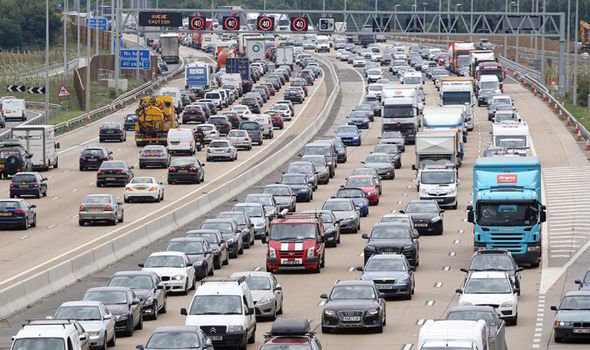
Not that we need telling, but the UK is more congested on the roads today than five years ago.

Traffic congestion in the UK’s biggest cities is 14% worse than it was just five years ago, according to a major new report just released. Across the rest of Europe, average congestion is actually 3% down over the same period.
The annual Traffic Index from TomTom shows average UK journeys in 2015 took 29%* longer than they would in free-flowing conditions – up from a 25% delay in 2010.  
The analysis of 14 trillion pieces of traffic data worldwide showed that the morning rush hour is almost 10% more congested than in 2010, with the evening peak nearly a fifth (19%) worse – suggesting that people return home in a narrower time period in the evenings.

The average commuter driving to and from work in the UK’s top 25 cities wasted 127 hours (more than 5 whole days) stuck in traffic during 2015.  
Congestion has got 4% worse in the past year alone. It’s risen in 17 of the 25 UK cities in the report, with a further 4 remaining about the same.  Only Nottingham, Portsmouth, Middlesbrough and Preston have shown slight decreases.  
The TomTom Traffic Index analysed traffic patterns in 295 cities globally and found that Belfast was once again the most congested city in the UK – and 14th worst in the world.  Journey times in 2015 were 40% slower than free-flow traffic throughout the day – peaking at 86% longer in the evening rush hour.
London is the 20th most congested city worldwide – and second worst in the UK - with journey times 38% slower, rising to 66% in the evening peak.  The Northern Powerhouse of Manchester (37% slower) moves up into third place, overtaking Edinburgh (37%) and Brighton (34%).  
The next five worst cities for congestion are Hull, Bournemouth, Newcastle, Bristol and Sheffield.
“Transport authorities are managing congestion with well-engineered policies, but you can’t just build your way out of traffic jams”, comments Ralf-Peter Schaefer, Vice-President of TomTom Traffic.  "Studies have shown that policies of ‘predict and provide’ are unsustainable.  Building new motorways and ring roads doesn’t eliminate congestion.  More must be done to better manage existing road space and to spread demand.  
“People simply aren’t doing enough to change their travel habits - such as working flexible hours, avoiding peak commuting times, making use of real–time traffic information and trying alternative travel modes.
“If only five per cent of us changed our travel plans, we could improve traffic congestion on our main roads by up to thirty per cent.”
Globally, Istanbul has been knocked off the top spot by Mexico City.  Commuters in the Mexican capital can expect to spend 59% extra travel time stuck in traffic during the day, rising to 94% in the evening peak period – a total of 219 wasted hours a year.   
The next most congested big cities worldwide are Bangkok (57%), Istanbul (50%), Rio de Janeiro (47%) and Moscow (44%).
TomTom has been collecting traffic data since 2008 and over that period, the UK city that has recorded the largest overall growth in congestion is Coventry - up a staggering 67%.  Stoke-on-Trent has seen the biggest increase in rush hour congestion, at 44%.
But Cardiff can give itself a pat on the back, with overall congestion down 19% since 2008.  
The TomTom Traffic Index is the only global measurement of congestion comparing travel times between non-congested hours and rush hour periods, for passenger vehicles.  It takes into account local roads, main roads and motorways across 295 cities in 38 countries on six continents.  
The latest report is based on data for January – December 2015 and can be found here: