Purpose

I will try my best to provide detailed info on various cars and what is like to live with them, I have already produced a few for Jaguar-car-forums, I will do my best to be unbiased, but it will be hard for some cars. I will re-produce press releases and copy from other motoring news.
Showing posts with label Car-to-X communication. Show all posts

Sunday, 9 April 2017

The S-Class from Mercedes takes a leap forward in technology and automation.

  • Driving assistance systems: the next step

With new and considerably extended driving assistance functions, the new S‑Class will this autumn be taking a further, major step towards autonomous driving. Active Distance Assist DISTRONIC and Active Steering Assist now support the driver even more conveniently in keeping a safe distance and steering, and the vehicle speed is now also automatically adjusted in bends and at road junctions. Also on board are Active Emergency Stop Assist and a considerably improved Active Lane Change Assist.

"The new S-Class raises Mercedes-Benz Intelligent Drive to the next level," says Dr Michael Hafner, Head of Automated Driving and Active Safety at Mercedes‑Benz. "We are approaching the goal of automated driving more purposefully and faster than many people suspect. From the autumn, the new S‑Class will be able to support its driver considerably better than all systems which have been available to date."
With the new driving assistance generation autonomous driving is becoming yet more tangible. The scope of automated driving functions has been expanded in line with practical needs and now provides further enhanced, tangible customer benefits on virtually all types of road.
Thanks to enhanced camera and radar systems, the new S‑Class has an even better view of the traffic situation: in addition, for the first time it makes use of map and navigation data to calculate driving behaviour.
The driver is also able to see at a glance which assistance functions have been selected, and to which situations the systems are reacting at present. Clearly understood icons – e.g. a steering wheel with hands on both sides – give information both on the screen and in the head-up display. All functions are now controlled from the steering wheel.
As a pioneer of automotive safety, Mercedes-Benz pursues research in this field with a rigour unmatched by any other car brand. Dr Michael Hafner: "We have always programmed the software for the assistance functions in-house. This means that we are able to implement new ideas very quickly."
The individual functions in detail:
Active Distance Assist DISTRONIC: The speed preset in DISTRONIC is predictively reduced according to the route ahead of bends, junctions, roundabouts or toll booths, then increased back up. If the route has been selected using the navigation system, the S‑Class also responds accordingly: if the car is in the slow lane, it is decelerated when approaching the desired motorway exit. The same applies to junctions where the navigation route prescribes a turn-off or ahead of which the driver activates the turn indicator.
The reduction in speed is in varying degrees, depending on the selected transmission mode (ECO, COMFORT or SPORT). In ECO mode, the cornering speed is configured to harmonise with Steering Assist. This means that automated driving for longer periods is also a reality on country roads. On highways and motorways, Active Distance Assist DISTRONIC controls the distance from the vehicle ahead within a speed range from 0 to 210 km/h, and keeps the car on track.
Coasting characteristics, e.g. on downhill slopes, can now also be taken into account. In the interests of smooth and efficient driving, the speed is reduced in good time. If the vehicle is equipped with a drive system suitable for "gliding" (coasting with the engine off), this mode is automatically activated when the ECO transmission mode is active.
Active Lane Change Assist: When the driver wishes to change lanes on multi-lane roads (recognised by the navigation system) at speeds from 80 to 180 km/h, it is now sufficient to nudge the indicator stalk. Within the next ten seconds, the sensor system checks, together with the driver, whether the next lane is clear in front of, alongside and behind the vehicle, also taking into account the speed of any other vehicles. When there is no other vehicle within the relevant safety zone, the driver is supported in changing lane. The initiated lane change is indicated in the instrument cluster and on the head-up display.
Active Speed Limit Assist: In conjunction with COMAND Online, Active Speed Limit Assist – an engageable subfunction of Traffic Sign Assist – is also able to recognise sign gantries and road works signs. Known limits, such as 50 km/h in built-up areas or 100 km/h on country roads, are also adopted from the navigation system. Active Distance Assist DISTRONIC adapts the vehicle's speed to the recognised speed limits automatically. In certain cases, the speed can be adapted in anticipatory mode on the basis of map data. On roads without speed limits, such as stretches on German motorways, the recommended speed – in this case 130 km/h – is adopted as the set speed. This speed can be adjusted by the driver. The desired maximum speed is always adopted in the course of the journey when the speed limit is lifted. It remains preset until the vehicle leaves the motorway or until the engine is switched off.
Following vehicles in a tailback: In stop-and-go traffic on motorways and similar roads, stops of up to 30 seconds are now possible, within which the S‑Class automatically moves off and follows the traffic ahead.
Active Emergency Stop Assist: Active Emergency Stop Assist brakes the vehicle to a standstill in its lane if it detects that the driver is no longer actively driving the vehicle while it is on the move with Active Steering Assist switched on. If there is no steering wheel movement over a predefined period, the system gives the driver a visual and audible prompt to place his/her hands on the wheel. If the driver fails to respond after repeated visual and audible prompts by moving the steering wheel, accelerating, braking or pressing the Touch Control Button on the steering wheel, the car will be slowed down in the identified lane until it comes to a standstill. At speeds below approx. 60 km/h the following traffic is warned by means of hazard warning lamps. When the vehicle comes to a standstill, the parking brake is engaged automatically and the Mercedes-Benz emergency call system is activated. The vehicle is also unlocked, to allow first aiders access to the interior. The functions are aborted as soon as the driver takes control of the vehicle again.
Active Brake Assist: Active Brake Assist with cross-traffic function is able to help the driver avoid impending collisions with vehicles ahead, stationary or crossing vehicles and with people if the driver fails to take any action to defuse the dangerous situation. This assistance takes the form of:
  • a distance warning from a warning lamp in the instrument cluster, if the distance from a vehicle in front is inadequate
  • an additional audible warning when a danger of collision is identified
  • autonomous emergency braking to avoid a collision with moving stationary or crossing vehicles ahead
  • autonomous emergency braking for pedestrians
  • situation-related braking assistance as soon as the driver applies the brakes.
Evasive Steering Assist: Evasive Steering Assist can support the driver in taking evasive action when pedestrians are detected in the danger zone in front of the vehicle and the driver initiates such action. The system then applies additional steering torque in the direction in which the driver is performing an evasive manoeuvre. This helps the driver to evade the pedestrian in a controlled manner and to stabilise the vehicle on its evasive course.
Active Lane Keeping Assist: This system is able to warn the driver by means of pulsed vibrations on the steering wheel when the vehicle is unintentionally drifting out of its lane at speeds between 60 and 200 km/h. If the vehicle passes over a continuous line, it can pull the vehicle back into lane by applying the brakes on one side. In the case of a broken line, such intervention takes place only when there is a danger of collision with a vehicle in the next lane (including danger from oncoming traffic).
Active Blind Spot Assist: In the speed range from approx. 10 to 200 km/h, this system is able to provide the driver with a visual alert, plus an audible alarm when a turn indicator is actuated, to warn of a danger of side collisions with other vehicles, including bicycles, for example. At speeds above 30 km/h, automatic braking on one side of the vehicle can additionally be applied to help avoid a side collision at the last moment.
Traffic Sign Assist: Image recognition and information from the digital road map in the navigation system allow the permitted maximum speed and any restrictions on overtaking for the current route section and zebra crossings to be computed and shown in the instrument cluster. Additional restrictions such as speed limits in wet conditions (warning when the windscreen wipers are switched on) or speed limits for trucks only are also taken into account or ignored as appropriate in the individual case concerned. The road speed is compared with the maximum permissible speed. If set to do so by the driver, a visual/visual-acoustic warning is given if the speed limit is exceeded. No-entry signs are also recognised and the driver is prompted to check the vehicle's direction of travel. A warning additionally appears in the instrument cluster and on the head-up display when persons are detected in the area of zebra crossings.
Car-to-X Communication: Information concerning hazardous situations which a vehicle on the road has detected is made available to all other Car-to‑X users to give drivers an early warning. As with Live Traffic Information, reports transmitted by Car-to‑X are shown on the COMAND Online map display. Depending on the situation, a warning by voice output can be given when approaching a hazard.
Active Parking Assist: Active Parking Assist with Parking Assist PARKTRONIC supports the driver in searching for a parking space and when entering or leaving parallel or end-on parking spaces. In the case of end-on parking spaces it is active in both forward and reverse direction. It manoeuvres the vehicle automatically into the selected parking space. In conjunction with Blind Spot Assist, Rear Cross Traffic Alert can warn the driver of cross traffic when reversing out of end-on parking spaces and can also initiate automatic braking if necessary. In the case of Active Parking Assist with 360° camera, all-round vision is made possible by the reversing camera and three additional cameras. The information is presented clearly in full HD in a choice of different views on the central display.
Remote Parking Assist: Remote Parking Assist enables the driver to manoeuvre the vehicle into tight parking spaces or garages by smartphone, so as to facilitate entering and alighting from the vehicle. The vehicle can be manoeuvred into parallel and end-on parking spaces in both forward and reverse direction. Manoeuvring out of end-on parking spaces is also possible, e.g. if the driver returns to their vehicle to find that it has been blocked in. In Explore mode the vehicle can be manoeuvred straight forward or in reverse by up to fifteen metres, avoiding detected obstacles. In narrow passageways, following confirmation by the driver the vehicle is able to fold in the exterior mirrors so that it can approach the detected obstacle more closely (e.g. narrow garage entrance).

Friday, 20 May 2016

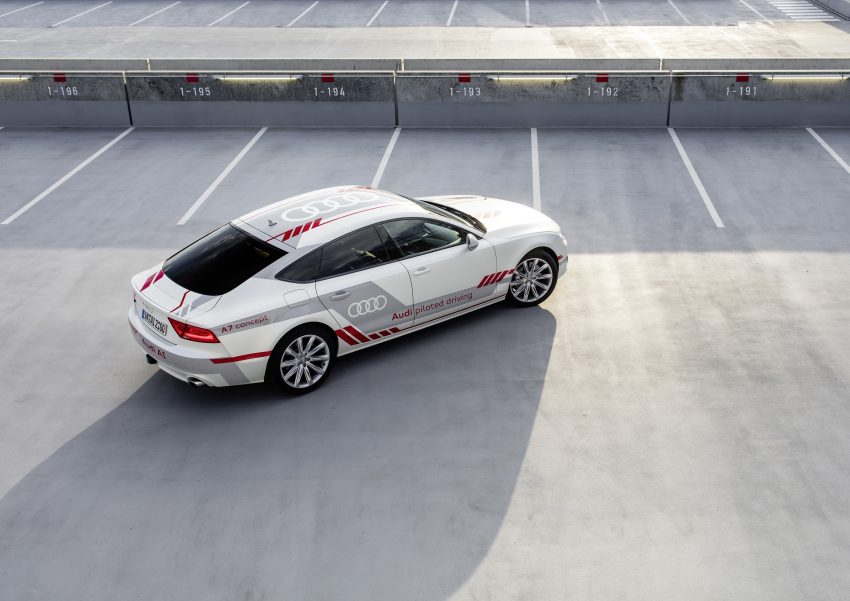
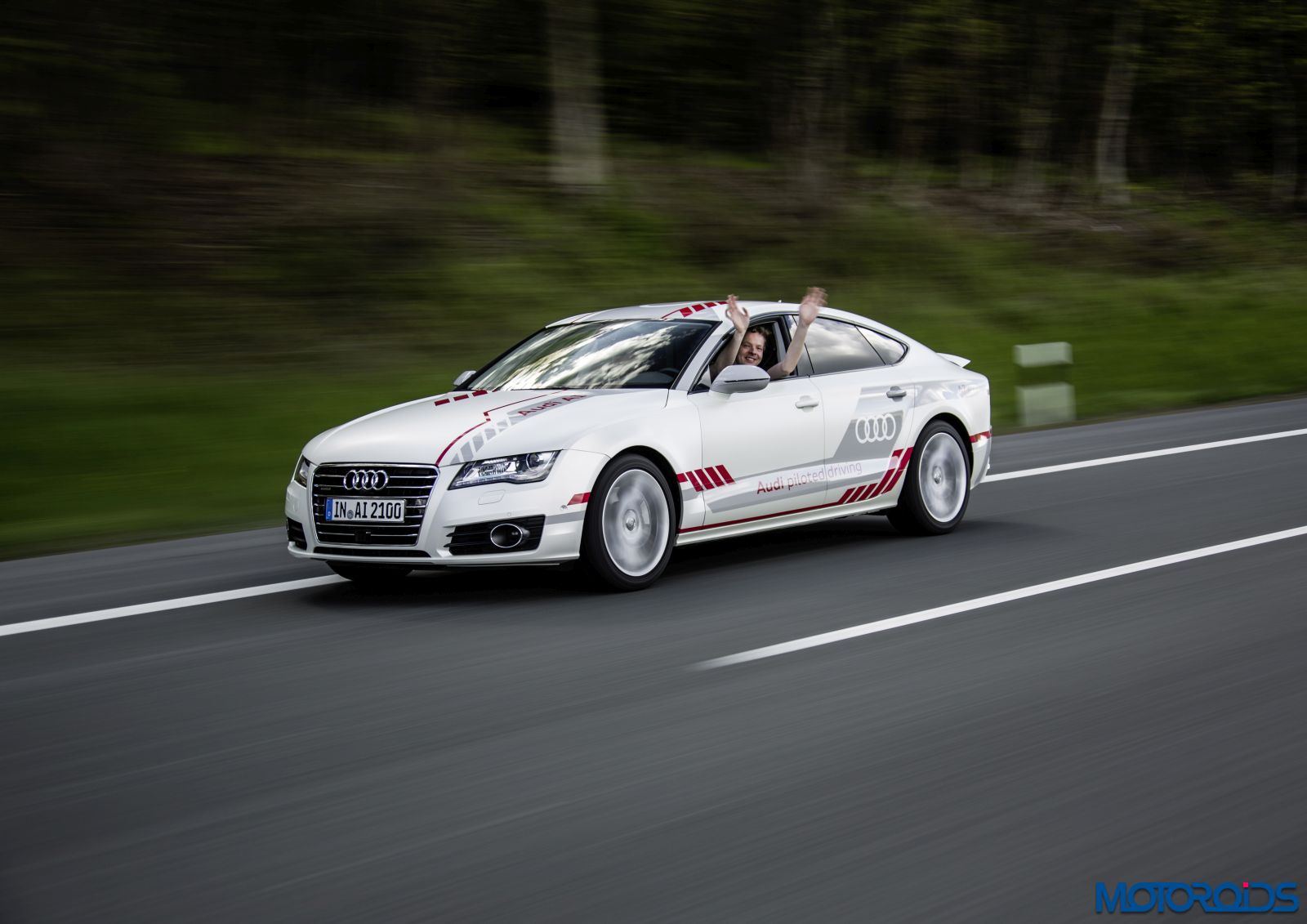
Audi A7 drives it's self wherever you want to go, the technology is getting better and more realistic day by day.

  • Piloted A7 displays the results of further character-building development work to foster ‘social competence’ 
  • Audi A7 piloted driving concept: concept car impresses with its natural interaction with other road users during autobahn testing
  • Navigation system can now devise routes containing maximum piloted driving opportunities
  • Car-to-X communication: digital test site on the A9
  • “First mile”: piloted driving in the urban environment
The evolution of the piloted Audi is continuing apace – the Vorsprung durch Technik brand’s latest research car, the Audi A7 piloted driving concept “Jack”, is now even more adept at operating just like a human driver – its autonomously performed motorway driving manoeuvres have been further refined, and it is now even more proficient at showing consideration for other road users. 
“Jack” exhibits a driving style that is adaptive to the given situation, safe and especially interactive – it is a research car with social competence.
Audi is continually advancing the development of its piloted driving test car. “Jack” – the internal nickname for the A7 Sportback-based technology platform – is now driving more naturally. 

This is illustrated by the way it confidently deals with hazardous points on the road, passes trucks with a slightly wider lateral gap and signals upcoming lane changes by activating the indicator and moving closer to the lane marking first – just like human drivers would do to indicate their intentions. The opportunities for taking full advantage of “Jack’s” piloted features are also now made more apparent to its driver – its sophisticated navigation system is now capable of computing a route containing the largest possible proportion of piloted driving sections.
The cooperative attitude of “Jack” is especially apparent when other vehicles want to merge into its lane on the motorway. Here the test car decides – based on the selected driving profile – whether to accelerate or brake, depending on which is best suited to handling the traffic situation harmoniously for all road users.
State-of-the-art zFAS controller
The super brain of piloted driving is the central driver assistance controller, or zFAS. It uses state-of-the-art, high-performance processors to evaluate the signals from all sensors in real-time and create a model of the car’s surroundings. This model represents the prevailing traffic situation as accurately as possible. It lets the zFAS calculate upcoming manoeuvres in advance, taking a look into the future, so to speak.
Piloted driving offers greater safety, more efficient utilisation of the transportation infrastructure and more relaxation time for the driver. Audi has already derived systems for assisted driving from the tested technologies, including the traffic jam assist function now available in the Audi A4 and Audi Q7.
Audi continues to document its progress in piloted driving with spectacular events. In the United States, for instance, a driverless Audi TTS etched the brand’s four rings trademark into the surface of a salt flat and also conquered the legendary hill climb up Pikes Peak in the Rocky Mountains without a driver. At the Hockenheim Motodrome, a driverless Audi RS 7 Sportback chased down the limits of driving physics in fall 2014. Since then, Audi has been demonstrating the next steps in piloted driving on public roads too, for example under real traffic conditions on American highways from the west coast to Las Vegas.
Digital test site on the A9 autobahn
The future is networked – this is especially applicable to piloted driving. In the future, cars and the infrastructure will communicate with one another more intensively. Common information interfaces are an important condition for this, so that the benefits of piloted driving can be better utilised on motorways. The digital test site on the A9 autobahn – announced by the German Federal Ministry of Transport and Digital Infrastructure – offers ideal conditions for evaluating and further developing future functions and concepts together with representatives of the Free State of Bavaria, the automotive industry and the IT industry. The brand with the four rings can once again probe the technical possibilities of Car-to-X communication here – under real road conditions and in real time.
In the future, information on variable-message traffic signs, for example, will be digitally transmitted into the car in order to assist the traffic flow. In addition, Audi is defining and testing elements of the future communications standard 5G together with IT partners. Car-to-X communication immediately enables piloted driving cars to use paved road shoulders when these are temporarily opened.
Another step forward is Car-to-Car communication between automobiles that are travelling on the same routes. They can report on hazardous points and accidents in real time. The driving speeds of other road users operating with piloted driving are then automatically adjusted to the potential hazard.
The local infrastructure plays a special role for piloted driving on the motorway. In addition to sensors in the car, signals from the environment give the driver a precise preview of the road ahead. Audi’s partners for the digital test site on the A9 autobahn, for example, are testing the internal composition and modified material structure of roadside posts. These are to be designed to reflect the radar sensors of cars even from greater distances. In addition, project participants within the scope of the test parameters are studying special traffic signs that allow the test vehicles to localize their positions with high precision within the various driving lane markings.
For most customers, the complexity of traffic situations significantly intensifies again along the route segment from the motorway exit to city zones. Audi is researching and developing another test site for this so-called “first mile” in Bavaria, near the redesigned autobahn exit “Ingolstadt-Süd.” From 2017, Audi – together with the city of Ingolstadt – will be testing construction methods such as the use of different types of pavement as well as technical solutions such as the use of sensors in junction zones. Piloted driving research cars from Audi are already being incorporated into the design of the new infrastructure. Test operation should begin in 2018.

Monday, 11 January 2016

CES 2016 - Audi to première a special e-tron quattro concept study At Las Vegas this year.

  • Interior model with new operating and display concept
  • Audi e-tron quattro concept study with full-electric drive
  • Evolution of the Audi connect portfolio to include Car-to-X communication and remote vehicle services
  • Livestream and subsequent download of the Audi Press Conference at CES on Wednesday, January 6 at 7pm GMT available on www.audimedia.tv and Audi Media Center
At the 2016 Consumer Electronics Show (CES), Audi is presenting its latest technologies in the form of attractive solutions for today and visionary ideas for tomorrow. 

The world’s most important electronics show took place January 6–9, 2016, in Las Vegas, Nevada (USA) and the focus for the brand with the four rings is on the three future automotive trends of electrification, digitalisation and piloted driving.


The Audi e-tron quattro concept combines all of these innovations which build upon technologies that are used in its production cars today. Visitors will be able to experience the new control and display concept that has been implemented in an interior mock-up of the Audi e-tron quattro concept. Advanced development of Audi connect as well as new developments in lighting technology will be also be showcased.

New approaches: controls and displays

User-friendly operation is an Audi strength, and now the brand with the four rings is expanding its operating and display concept (HMI, human-machine interface) with new solutions. 

The concept is being presented in an interior mock-up of the Audi e-tron quattro concept car. The curved OLED (OLED: Organic Light Emitting Diodes) of the new Audi virtual cockpit lies in the driver’s immediate visual field.

The AMOLED (AMOLED: Active Matrix Organic Light Emitting Diodes) technology that is used offers new creative freedoms in designing display shapes. The two displays of the Audi MMI on the centre console offer an outlook on the digital future. Key functions can also be controlled conveniently by voice. 

Both displays exploit the advantages of a new type of touch recognition – what is known as Audi MMI touch response. Here, the selected functions are activated by gentle yet defined pressure on the display. This makes it possible to operate the system safely and with few distractions while driving.

Behind the new operating and display concept is the latest extension stage of the Audi Modular Infotainment Platform, MIB2+. Its further boosted computing power makes it possible to drive several high-resolution displays.

MIB2+ has been prepared for the latest mobile communications standard: LTE Advanced. It can download data into the car at a maximum speed of 300 Mbit/s. LTE Advanced also enables mobile telephony using the VoLTE (VoLTE = Voice over LTE) method, which shortens the time needed to make a phone connection and increases voice quality. Voice control has also become more powerful – it utilises both the on-board address book and a server in the cloud.

The control and display concepts from Audi are already visionary today. The Audi virtual cockpit – a fully digital instrument cluster with a 12.3-inch TFT display – provides all information in intricately calculated and brilliant 3D graphics, in which drivers can choose between different views. 

The latest Audi models have MMI terminals on board that follow a new operating logic. This resembles the concept that is familiar from modern smartphones – flat hierarchies instead of complex menu trees. Voice control is available as an alternative.

Audi connect

The term Audi connect covers all applications and developments that network an Audi with its owner, the Internet, infrastructure and other vehicles. Audi continues to extend its lead in this technology field. An LTE/UMTS module of Audi connect connects to the Internet with download speeds of up to 100 MBit/s.

The integrated Wi-Fi hotspot lets passengers freely surf the web, stream and text/e-mail with up to eight mobile devices. Customised services from the Audi connect portfolio are delivered to the car for the driver. 

They include traffic information online, Google Earth and Google Street View, parking information, fuel prices and flight, train and gate information. The Audi connect lineup is rounded out by City Events, individually configurable news, travel and weather information and other services.

Audi will also be offering additional new services in Europe, and soon in the USA.

They include emergency call that alerts the Audi Emergency Call Centre after an accident, online roadside assistance that calls the Audi Service Centre and Audi service request with which customers can schedule a service appointment.

The free Audi MMI connect app brings more services into the car such as Online Media Streaming, which offers access to the services of the subscription music portals Napster and Rhapsody and the Aupeo! radio service. 

For owners of the new A4 and Q7 models, the Audi MMI connect app also offers remote vehicle services. From a smartphone, they can lock or unlock the doors or view the latest car status report. They can also have the parking location and parking time displayed. 

Other functions have been added for the Audi e‑tron models – remote control of battery charging and climate control and access to driving data. The app’s remote functions can also be activated by a smartwatch, and effective at the beginning of 2016 by a fourth-generation Apple TV.

In just a few months, the Audi connect SIM will be available for the new A4 and Q7 models in European markets. It is a permanently installed embedded SIM (e-SIM) that automatically brings Audi connect services into the car across Europe and does not require that the driver perform an activation procedure.

It permits EU-wide roaming, because the SIM card can be automatically set to specific country providers as necessary. This eliminates country-specific roaming fees and annoying roaming confirmations.

Regardless of which connect services are integrated, Audi owners can choose additional data packages for the Audi connect SIM at economical rates to operate the Wi-Fi hotspot. Here too, the data transfer automatically continues at the fixed price when crossing a border, i.e. when switching providers.

In 2016, Audi is expanding its connect lineup to include the first Car-to-X technologies. The services traffic sign information and hazard information make the new Audi models part of a swarm. 

They report detected speed limits and hazardous locations, e.g. at points where a vehicle has broken down or the road service is slippery, to a server in the cloud via the mobile phone network. 

The server collects the data, processes it, and provides it to other Audi drivers who have suitable equipment. The updated information also flows into regular map updates for the MMI navigation plus system, making it available to the entire Audi fleet.

The traffic light information service connects the new models in the USA via the mobile phone network to the central traffic computer that controls traffic lights in the city. Based on the information from this system, the Audi virtual cockpit recommends a speed to the driver for reaching the next traffic light while it is green.

Audi electrification strategy

The Audi e-tron quattro concept, the brand’s conceptual study at CES, is an all electrically powered sport SUV. Three electric motors with a total output of up to 370 kW enable a quattro drive system and electric torque vectoring for maximum dynamic performance and stability. 

The 95 kWh battery, located between the axles and therefore in an ideal position in terms of the centre of gravity, enables a range of over 310 miles. The Audi e-tron quattro concept car is a preview of a future production model that will arrive on the market in 2018.

Piloted driving

The Audi e-tron quattro concept has piloted driving technologies on board, which Audi will be launching into production in the near future. They include piloted driving in traffic jams and piloted parking. 

These services  represent greater safety, time savings, efficiency, comfort and convenience. The systems can make a valuable contribution toward safety, especially in situations in which the driver is either overwhelmed or underwhelmed by driving tasks. 

The core component of future systems will be the central driver assistance controller, known as the zFAS. Information is continually acquired from all of the car’s sensors and processed in this compact module. 

They include signals from the 3D cameras, the laser scanner and radar and ultrasonic sensors. The high computing power of the zFAS gives it the ability to continually compare the data of vehicle sensors to the environmental model of the road.

Especially in this area, Audi will benefit from the highly up-to-date HERE maps database, which AUDI AG acquired together with the BMW Group and Daimler AG in December 2015. In the future, self-driving vehicles will need to be based on a new data source with centimetre accuracy. 

The live data approach of HERE makes it possible to evaluate all sorts of changes and movements and recognise potential hazards in an extremely short time. In addition, vehicle sensors will send anonymised feedback to the cloud in real time – not only about the current traffic situation, but also about changes, e.g. related to the road condition, detours or other disturbances. 

In addition, HERE serves as a database with information on hotels and businesses, parking places and events. This is an example of how Audi is generating swarm intelligence with a high level of relevance.

Lighting innovations at Audi

The company is driving progress in automotive lighting technology. The latest highlights are matrix OLED technology and matrix laser technology which will soon be introduced to production.

OLED lighting units are moving into a new dimension with their precision and homogeneity. As a flat light source, they are excellently suited for use in tail lights. 

Subdivided into small segments that can be driven with high variability, they enable new, dynamic lighting scenarios – OLED technology will become matrix OLED technology at Audi.
Matrix laser headlights illuminate the road with a new standard of precision. 

Distributed into many tiny pixels, its light beam can be dispersed with extremely fine control. The new technology lets the car generate the ideal light for each driving situation. Matrix laser headlights offer tremendous gains in safety for the driver and all other road users.

The Audi VR experience

Audi is the world’s first carmaker to develop its own software and hardware solution for virtual reality applications by introducing the Audi VR experience in 2016. Customers can use virtual reality glasses to experience the car of their choice at a dealership with unprecedented realism – in 3D, with a 360-degree panoramic view, sound effects and all available features.

Audi Fit Driver

The Audi Fit Driver project is focusing on the well-being of the driver. Audi has a vision of drivers who step out of their cars at their destinations feeling more relaxed than when they stepped into them. 

A wearable – a fitness wristband or watch – monitors important vital parameters such as heart rate and skin temperature. The car’s sensors supplement them with information on driving style, breathing rate and relevant environmental data such as the weather or traffic situation. 

By analysing the combination of this data, the car can deduce the current state of the driver, e.g. whether the driver is stressed or overly tired. The vehicle systems then adjust their modes of operation to relax, vitalise, or even protect the driver.

In a later extension phase, Audi Fit Driver will also incorporate driver assistance and safety systems as well as systems for piloted driving – with functions that extend all the way to piloted emergency stops with emergency calling. When it comes to data protection, the usual strict regulations by Audi apply.

Infotainment

The scalable electronic architecture strategy that the modular infotainment platform follows is letting Audi approach the short product cycles of the consumer electronics industry. 

The Progressive Semiconductor Program (PSCP), established in 2010, is the key for future innovations. System component suppliers are key partners here. Audi engineers also engage in direct dialogue with semiconductor manufacturers. This principle leads to high efficiency and effectiveness.

One of the infotainment components in production today is the Audi phone box. It lets users charge their mobile phones inductively based on the Qi standard, and it improves mobile phone reception.

The component lineup is rounded out by 3D sound systems from Bose and Bang & Olufsen as well as the Audi smartphone interface and the Audi tablet.

Three production models will also be on display at the CES: the Audi Q7 SUV, the all-new Audi A4 and the 610 PS Audi R8 V10 plus.