Purpose

I will try my best to provide detailed info on various cars and what is like to live with them, I have already produced a few for Jaguar-car-forums, I will do my best to be unbiased, but it will be hard for some cars. I will re-produce press releases and copy from other motoring news.
Showing posts with label Intelligent Drive. Show all posts

Sunday, 9 April 2017

The S-Class from Mercedes takes a leap forward in technology and automation.

  • Driving assistance systems: the next step

With new and considerably extended driving assistance functions, the new S‑Class will this autumn be taking a further, major step towards autonomous driving. Active Distance Assist DISTRONIC and Active Steering Assist now support the driver even more conveniently in keeping a safe distance and steering, and the vehicle speed is now also automatically adjusted in bends and at road junctions. Also on board are Active Emergency Stop Assist and a considerably improved Active Lane Change Assist.

"The new S-Class raises Mercedes-Benz Intelligent Drive to the next level," says Dr Michael Hafner, Head of Automated Driving and Active Safety at Mercedes‑Benz. "We are approaching the goal of automated driving more purposefully and faster than many people suspect. From the autumn, the new S‑Class will be able to support its driver considerably better than all systems which have been available to date."
With the new driving assistance generation autonomous driving is becoming yet more tangible. The scope of automated driving functions has been expanded in line with practical needs and now provides further enhanced, tangible customer benefits on virtually all types of road.
Thanks to enhanced camera and radar systems, the new S‑Class has an even better view of the traffic situation: in addition, for the first time it makes use of map and navigation data to calculate driving behaviour.
The driver is also able to see at a glance which assistance functions have been selected, and to which situations the systems are reacting at present. Clearly understood icons – e.g. a steering wheel with hands on both sides – give information both on the screen and in the head-up display. All functions are now controlled from the steering wheel.
As a pioneer of automotive safety, Mercedes-Benz pursues research in this field with a rigour unmatched by any other car brand. Dr Michael Hafner: "We have always programmed the software for the assistance functions in-house. This means that we are able to implement new ideas very quickly."
The individual functions in detail:
Active Distance Assist DISTRONIC: The speed preset in DISTRONIC is predictively reduced according to the route ahead of bends, junctions, roundabouts or toll booths, then increased back up. If the route has been selected using the navigation system, the S‑Class also responds accordingly: if the car is in the slow lane, it is decelerated when approaching the desired motorway exit. The same applies to junctions where the navigation route prescribes a turn-off or ahead of which the driver activates the turn indicator.
The reduction in speed is in varying degrees, depending on the selected transmission mode (ECO, COMFORT or SPORT). In ECO mode, the cornering speed is configured to harmonise with Steering Assist. This means that automated driving for longer periods is also a reality on country roads. On highways and motorways, Active Distance Assist DISTRONIC controls the distance from the vehicle ahead within a speed range from 0 to 210 km/h, and keeps the car on track.
Coasting characteristics, e.g. on downhill slopes, can now also be taken into account. In the interests of smooth and efficient driving, the speed is reduced in good time. If the vehicle is equipped with a drive system suitable for "gliding" (coasting with the engine off), this mode is automatically activated when the ECO transmission mode is active.
Active Lane Change Assist: When the driver wishes to change lanes on multi-lane roads (recognised by the navigation system) at speeds from 80 to 180 km/h, it is now sufficient to nudge the indicator stalk. Within the next ten seconds, the sensor system checks, together with the driver, whether the next lane is clear in front of, alongside and behind the vehicle, also taking into account the speed of any other vehicles. When there is no other vehicle within the relevant safety zone, the driver is supported in changing lane. The initiated lane change is indicated in the instrument cluster and on the head-up display.
Active Speed Limit Assist: In conjunction with COMAND Online, Active Speed Limit Assist – an engageable subfunction of Traffic Sign Assist – is also able to recognise sign gantries and road works signs. Known limits, such as 50 km/h in built-up areas or 100 km/h on country roads, are also adopted from the navigation system. Active Distance Assist DISTRONIC adapts the vehicle's speed to the recognised speed limits automatically. In certain cases, the speed can be adapted in anticipatory mode on the basis of map data. On roads without speed limits, such as stretches on German motorways, the recommended speed – in this case 130 km/h – is adopted as the set speed. This speed can be adjusted by the driver. The desired maximum speed is always adopted in the course of the journey when the speed limit is lifted. It remains preset until the vehicle leaves the motorway or until the engine is switched off.
Following vehicles in a tailback: In stop-and-go traffic on motorways and similar roads, stops of up to 30 seconds are now possible, within which the S‑Class automatically moves off and follows the traffic ahead.
Active Emergency Stop Assist: Active Emergency Stop Assist brakes the vehicle to a standstill in its lane if it detects that the driver is no longer actively driving the vehicle while it is on the move with Active Steering Assist switched on. If there is no steering wheel movement over a predefined period, the system gives the driver a visual and audible prompt to place his/her hands on the wheel. If the driver fails to respond after repeated visual and audible prompts by moving the steering wheel, accelerating, braking or pressing the Touch Control Button on the steering wheel, the car will be slowed down in the identified lane until it comes to a standstill. At speeds below approx. 60 km/h the following traffic is warned by means of hazard warning lamps. When the vehicle comes to a standstill, the parking brake is engaged automatically and the Mercedes-Benz emergency call system is activated. The vehicle is also unlocked, to allow first aiders access to the interior. The functions are aborted as soon as the driver takes control of the vehicle again.
Active Brake Assist: Active Brake Assist with cross-traffic function is able to help the driver avoid impending collisions with vehicles ahead, stationary or crossing vehicles and with people if the driver fails to take any action to defuse the dangerous situation. This assistance takes the form of:
  • a distance warning from a warning lamp in the instrument cluster, if the distance from a vehicle in front is inadequate
  • an additional audible warning when a danger of collision is identified
  • autonomous emergency braking to avoid a collision with moving stationary or crossing vehicles ahead
  • autonomous emergency braking for pedestrians
  • situation-related braking assistance as soon as the driver applies the brakes.
Evasive Steering Assist: Evasive Steering Assist can support the driver in taking evasive action when pedestrians are detected in the danger zone in front of the vehicle and the driver initiates such action. The system then applies additional steering torque in the direction in which the driver is performing an evasive manoeuvre. This helps the driver to evade the pedestrian in a controlled manner and to stabilise the vehicle on its evasive course.
Active Lane Keeping Assist: This system is able to warn the driver by means of pulsed vibrations on the steering wheel when the vehicle is unintentionally drifting out of its lane at speeds between 60 and 200 km/h. If the vehicle passes over a continuous line, it can pull the vehicle back into lane by applying the brakes on one side. In the case of a broken line, such intervention takes place only when there is a danger of collision with a vehicle in the next lane (including danger from oncoming traffic).
Active Blind Spot Assist: In the speed range from approx. 10 to 200 km/h, this system is able to provide the driver with a visual alert, plus an audible alarm when a turn indicator is actuated, to warn of a danger of side collisions with other vehicles, including bicycles, for example. At speeds above 30 km/h, automatic braking on one side of the vehicle can additionally be applied to help avoid a side collision at the last moment.
Traffic Sign Assist: Image recognition and information from the digital road map in the navigation system allow the permitted maximum speed and any restrictions on overtaking for the current route section and zebra crossings to be computed and shown in the instrument cluster. Additional restrictions such as speed limits in wet conditions (warning when the windscreen wipers are switched on) or speed limits for trucks only are also taken into account or ignored as appropriate in the individual case concerned. The road speed is compared with the maximum permissible speed. If set to do so by the driver, a visual/visual-acoustic warning is given if the speed limit is exceeded. No-entry signs are also recognised and the driver is prompted to check the vehicle's direction of travel. A warning additionally appears in the instrument cluster and on the head-up display when persons are detected in the area of zebra crossings.
Car-to-X Communication: Information concerning hazardous situations which a vehicle on the road has detected is made available to all other Car-to‑X users to give drivers an early warning. As with Live Traffic Information, reports transmitted by Car-to‑X are shown on the COMAND Online map display. Depending on the situation, a warning by voice output can be given when approaching a hazard.
Active Parking Assist: Active Parking Assist with Parking Assist PARKTRONIC supports the driver in searching for a parking space and when entering or leaving parallel or end-on parking spaces. In the case of end-on parking spaces it is active in both forward and reverse direction. It manoeuvres the vehicle automatically into the selected parking space. In conjunction with Blind Spot Assist, Rear Cross Traffic Alert can warn the driver of cross traffic when reversing out of end-on parking spaces and can also initiate automatic braking if necessary. In the case of Active Parking Assist with 360° camera, all-round vision is made possible by the reversing camera and three additional cameras. The information is presented clearly in full HD in a choice of different views on the central display.
Remote Parking Assist: Remote Parking Assist enables the driver to manoeuvre the vehicle into tight parking spaces or garages by smartphone, so as to facilitate entering and alighting from the vehicle. The vehicle can be manoeuvred into parallel and end-on parking spaces in both forward and reverse direction. Manoeuvring out of end-on parking spaces is also possible, e.g. if the driver returns to their vehicle to find that it has been blocked in. In Explore mode the vehicle can be manoeuvred straight forward or in reverse by up to fifteen metres, avoiding detected obstacles. In narrow passageways, following confirmation by the driver the vehicle is able to fold in the exterior mirrors so that it can approach the detected obstacle more closely (e.g. narrow garage entrance).

Friday, 11 December 2015

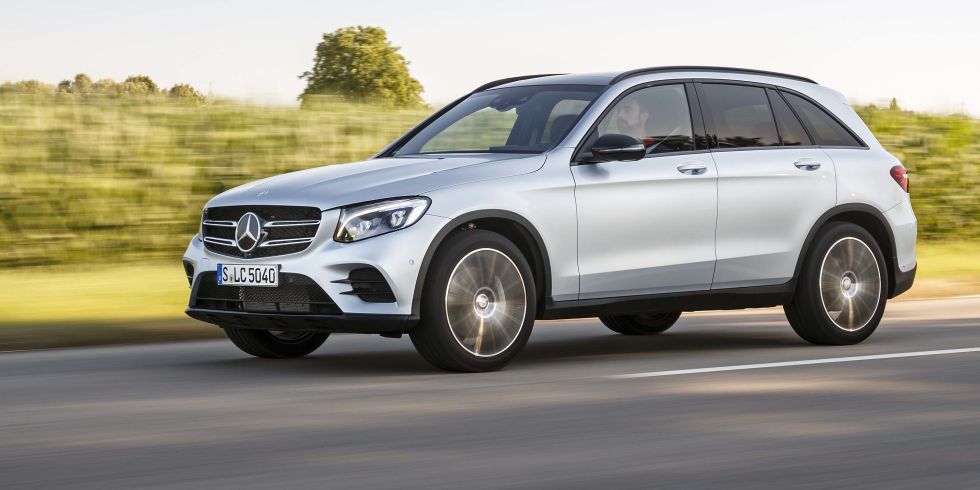
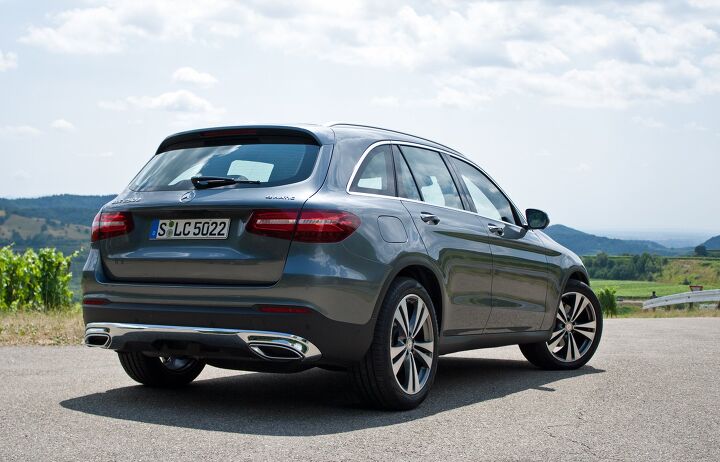
Now it is the turn of the Mercedes-Benz GLC to be awarded the full five star Euro NCAP Award.

Top score in the Euro NCAP rating
The Mercedes-Benz GLC has achieved the top score in the Euro NCAP rating. The new mid-size SUV has received five stars, continuing the Mercedes-Benz success story in impressive style. In 2014 the GLA, C-Class and V-Class were likewise awarded five stars by Euro NCAP.

The GLC has achieved five stars for occupant safety, child safety, pedestrian protection and its assistance systems – giving it the maximum score in the Euro NCAP rating. The basis for this outstanding result is the perfect interaction between active and passive safety: the combination of a highly rigid safety passenger cell, highly effective restraint systems, the latest driver assistance systems and other measures leads to first-class test results.
“The new GLC’s gratifying result in the Euro NCAP rating confirms the success of our efforts in the areas of active and passive safety,” said Prof. Dr.-Ing. Rodolfo Schöneburg, Head of Vehicle Safety, Durability and Corrosion Protection at Mercedes-Benz Cars. “We will continue to intensify our efforts in the future, so as to provide the best possible safety not only for drivers and passengers in a Mercedes-Benz, but also for more vulnerable road users such as pedestrians and cyclists.”
Real Life Safety plus Intelligent Drive
Assessment by means of crash ratings is only one aspect of the comprehensive safety philosophy followed by Mercedes-Benz. Thanks to the knowledge acquired as a result of accident research conducted in-house, the GLC has also been systematically designed with real-world accidents in mind. 
In this way, Mercedes‑Benz is once again highlighting the leading role it plays as a safety pioneer in the field of automotive safety. The comprehensive approach taken by Mercedes-Benz accident research centres focuses on avoiding accidents completely or mitigating their consequences. The company uses the term “Real Life Safety” to describe this approach.
Almost all of the driver assistance systems which are familiar from the C-, E- and S‑Class are available for the new GLC. 
As part of the Intelligent Drive concept, these systems combine data from various sensor technologies to substantially enhance comfort and safety. COLLISION PREVENTION ASSIST PLUS, Crosswind Assist, Headlamp Assist and ATTENTION ASSIST are on board as standard. 
The Driving Assistance package Plus provides an even more comprehensive range of active safety features, comprising DISTRONIC PLUS with Steering Assist and Stop&Go Pilot, PRE-SAFE® Brake with pedestrian detection, BAS PLUS with Cross-Traffic Assist, Active Blind Spot Assist, Active Lane Keeping Assist and PRE-SAFE® PLUS.
These measures exceeding the bounds of the actual Euro NCAP rating have been acknowledged by Euro NCAP with two so-called “Advanced Rewards” for PRE‑SAFE® and ATTENTION ASSIST.
Best possible protection for more vulnerable road users
The protection of more vulnerable road users such as pedestrians and cyclists is also taken very seriously by Mercedes-Benz. 
The GLC is equipped with an active bonnet which is raised by 80 millimetres during an impact to provide additional deformation space. Under the bonnet, the package has been further optimised with a new engine cover and deformable air intake,creating yet more deformation space. 
In this way the GLC meets the stringent pedestrian protection requirements of Euro-NCAP, which go well beyond the legal requirements.
BAS PLUS warns the driver when pedestrians are detected in the danger zone by the stereo camera. 
The PRE-SAFE® Brake with pedestrian recognition triggers autonomous braking when the system detects a pedestrian in the danger zone and the driver does not react to the system’s warnings. 
This pedestrian detection forming part of the optionally available Driving Assistance package Plus represents a milestone in preventing accidents with pedestrians or mitigating their consequences.
The GLC’s standard safety systems, which in the UK include the autonomous emergency braking system Collision Prevention Assist Plus, also help it to achieve a reduction of up to six insurance groups in Thatcham ratings, when compared with an equivalent model without such systems.
A tradition of top results for Mercedes-Benz
The most recent top result for the GLC is a continuation of last year's successes: in last year’s Euro NCAP ratings the GLA, the C-Class and the V-Class all achieved five stars, occupying the top positions amongst all vehicles tested in 2014. The C-Class was specially praised by Euro NCAP as the best in class among medium-class passenger cars.
From 2015 onwards, the test requirements have been extended to include a further frontal impact against a rigid barrier. 
The full points score for frontal impact protection is therefore divided between this new test and the offset frontal impact test against a deformable obstacle. The side impact test now uses a larger, heavier impact sledge, and the lateral post impact test is conducted with a stronger impact offset at an angle. 
A new, more realistic crash-test dummy – WordSID – is now used for the side impact tests for a better assessment of occupant protection.

Sunday, 11 January 2015

Mercedes launches future F 015 concept at CES in Las Vegas.

  • The F 015 Luxury in Motion is a research vehicle and vision of the future of autonomous driving – unveiled today at the Consumer Electronics Show (CES) in Las Vegas
  • Designed from the outset as an autonomous car, creating new possibilities in vehicle design, packaging and connectivity – a mobile living space
  • Body structure is extremely rigid yet lightweight,  weighs 40 per cent less than current cars of a similar size due to the use of carbon fibre reinforced plastic, aluminium and steel
  • Interior space unlike any other – capable of seating four adults either facing each other or in tandem – is finished in natural open grain wood, aluminium, glass and leather
  • Measures 5,220 mm in length, is 2,018 mm wide and 1,524 mm tall – making it similar in length to an S-Class long wheelbase, albeit both wider and taller
  • Maximum interior space made possible by a wheelbase measuring 3,610 mm – 445 mm more than the current S-Class long wheelbase
  • Dr Dieter Zetsche, Chairman of the Board of Management of Daimler AG and Head of Mercedes-Benz Cars: "Anyone who focuses solely on the technology has not yet grasped how autonomous driving will change our society. The car is growing beyond its role as a mere means of transport and will ultimately become a mobile living space."
  • The F 015 made its debut at the Consumer Electronics Show in Las Vegas, California – starting the New Year with a bold look into the future of transport, of autonomous driving and the possibilities it opens up in packaging, in design, in integration and in how we use cars in our lives
  • Four individual lounge chairs are accessed via twin, rear-hinged doors that open to 90 degrees – the seats swivelling by 30 degrees to allow easy ingress and egress
  • Interior is like no other – a mobile living space crafted out of open grain walnut, glass, ice white nappa leather and aluminium. Connectivity is through a choice of six screens seamlessly integrated throughout the interior, controlled via eye-tracking, gesture recognition or touch
  • The F 015 Luxury in Motion can operate in manual or autonomous modes. Large LED light modules on the front and back of the car denote which mode it’s operating in, with white indicating it’s being driven manually and a cool blue hue for when it’s in autonomous mode.  With manual mode engaged, the front seat driver and passenger seats swivel automatically to face the direction of travel and the steering wheel emerges seamlessly from the dashboard   
  • Capable of being powered by hydrogen fuel cells, the powertrain in the F 015 Luxury in Motion draws inspiration from the pioneering F-CELL PLUG-IN HYBRID system first seen in the F 125! research vehicle from 2011 – allowing for the on-board generation of electricity and storage via a series of high-voltage batteries
  • The all-new body structure is made up of carbon fibre reinforced plastic, aluminium and high strength steel. Resulting structure is around 40 per cent lighter than today’s production cars of a similar size and is extremely strong – enhanced by the external beltlines below the windows which inflate in the case of a side-on collision to protect the occupants of the car
  • Length/width/height (mm): 5,220/2,018/1,524 (S-Class long wheelbase L/W/H: 5,246/ 1,899/1,496)
  • The first steps towards an autonomous future were taken in August 2013 when an S 500 INTELLIGENT DRIVE completed the 62-mile drive from Mannheim to Pforzheim without any driver input – retracing the route taken by Bertha Benz in 1888 on the first recorded journey by a car
  • The research vehicle marks the start of an exciting year and a busy January – with the new  C 350 Plug-in Hybrid and the GLE Coupé both being unveiled at the Detroit Motor Show next week
The Mercedes-Benz F 015 Luxury in Motion

Forerunner of a mobility revolution

With the S 500 INTELLIGENT DRIVE and the Future Truck 2025, Mercedes-Benz has already made the vision of autonomous driving become reality. The new research vehicle F 015 Luxury in Motion had its world premiere at the Consumer Electronics Show, and provides a concrete example of the visionary ideas the company is developing with regard to autonomous driving of the future. 

With this self-driving luxury saloon Mercedes-Benz illustrates how the car is growing beyond its role as a mere means of transport and will ultimately become a private retreating space. This new way of travelling gives passengers the freedom to use their valuable time on the road in manifold ways.


Progressing from the self-propelled ("automotive") to the self-reliant ("autonomous") vehicle, Mercedes-Benz as a pioneer goes far beyond the purely technical realisation of automated driving. The company's experts also have to anticipate different outlooks and social trends. People are always at the centre of such considerations. Just as the 1886 Benz Patent Motor Car and its successors revolutionised personal mobility and, as a consequence, society as a whole, the first self-driving cars will also bring about major changes.

"Anyone who focuses solely on the technology has not yet grasped how autonomous driving will change our society. The car is growing beyond its role as a mere means of transport and will ultimately become a mobile living space," explains Dr Dieter Zetsche, Chairman of the Board of Management of Daimler AG and Head of Mercedes-Benz Cars.

Expressive forerunner of a mobility revolution

With the huge amount of space in its lounge-like interior, the Mercedes-Benz F 015 Luxury in Motion takes the concepts of comfort and luxury to a new level. Every facet of the vehicle reflects perfectly the Mercedes way of interpreting the terms "modern luxury", emotion and intelligence. This innovative four-seater is a forerunner of a mobility revolution, and this is immediately apparent from its futuristic appearance.

It is obvious that the F 015 represents the vision of a brand new vehicle concept just from its unusual proportions (length/width/height: 5220/2018/1524 millimetres), its seamless, monolithic exterior and its large LED light modules at the front and rear. A range of different lighting functions can be provided through these LED fields. At the same time, the vehicle communicates and interacts with the outside world by means of the LED fields. These LED fields show for example, if the F 015 is driving autonomously (blue) or is controlled manually (white).

The low-slung front end, smooth and streamlined roof line, flat front windscreen and road-hugging rear end give the F 015 Luxury in Motion an extended and decidedly dynamic silhouette. The F 015 Luxury in Motion's unusually large wheelbase of 3610 millimetres in combination with its short overhangs clearly show that the design focus was on providing the maximum possible space for the passengers.

A lounge-like interior with an atmosphere of well-being

In the interior of the F 015 Luxury in Motion the designers have created a lounge-like space with a feel-good ambience characterised by elegance, quality and lightness. Sensual, flowing transitions and warm, organic materials such as open-pore walnut wood shaped into a three-dimensional veneer, and extremely soft ice white nappa leather contrast with clearly-defined metal and glass surfaces with a cool and technical feel.

The pivotal feature of the innovative interior concept is the variable seating system, with four rotating lounge chairs that allow a face-to-face seat configuration. In order to make getting in and out of the car easier, the electrically powered seats also swing outwards by 30 degrees as soon as the doors are opened. If necessary, the driver and front-seat passenger can also turn their eyes and attention towards the front – a prerequisite for manual driving. To this end the steering wheel extends automatically from the dashboard.

The leather-covered cushions of the lounge chairs are set in curved mounts of highly-polished aluminium. Each seating mount has a contrasting light band of blue LED lights and can also be manually swivelled.

One key aspect of the research vehicle is the continuous exchange of information between vehicle, passengers and the outside world. This is facilitated by six display screens harmoniously integrated into the instrument panel and the rear and side panels, which turn the interior of the F 015 Luxury in Motion into a digital arena. Passengers can interact intuitively with the connected vehicle through gestures, eye-tracking or by touching the high-resolution screens. Sensors recognise the passengers' hands and offer them user interfaces within convenient reach that present appropriate operating options for each particular situation. Particle streams on the displays visualise the vehicle's movement.

Revolutionary vehicle structure

The high-strength body of the F 015 Luxury in Motion ensures optimum safety and supreme comfort for its passengers. At the same time, the bodyshell's structure provides the ideal basis for the door concept that makes getting in and out especially easy, and for the communication-oriented seating featuring four lounge chairs in a face-to-face arrangement.

New materials and structures were used to develop the highly efficient "Smart Body Structure (SBS)" of the F 015. By cleverly combining carbon-fiber-reinforced plastic (CFRP), aluminium and high-strength steels in a way that matches the varying requirements exactly, the lightweight engineering experts were able to make the bodyshell 40 percent lighter compared with today's production vehicles.

Another key element of the body design concept is the innovative saloon-door-style door system featuring rear-hinged rear doors. The front and rear doors can be opened and closed independently of one another. With an opening angle of 90 degrees for all doors, the spacious interior can be easily and comfortably accessed on both sides. B-pillars were not needed. 

A very sturdy interconnected system with mechanical locking elements ensures exemplary safety standards. These elements securely interlock the front and rear doors when they are closed at the same time as fixing them firmly to the roof frame and side skirts. The resulting composite load path allows an extremely high amount of energy to be absorbed in the event of frontal or side impact, with minimal intrusion into the passenger compartment.

The doors themselves have a crucial role to play in the vehicle's passive safety concept. The crash-responsive beltlines underneath the side windows are vital here. The PRE-SAFE® Structure, previously unveiled on the ESF 2009 Experimental Safety Vehicle and now further enhanced, offers maximum safety while taking up minimum space: in a side-on collision, these bodywork elements "inflate" in an instant, just like an airbag, allowing them to absorb as much impact energy as possible.

In addition, the bodyshell of the F 015 Luxury in Motion was designed to allow the impact-protected integration of an electric drive system with fuel cell. This is based on the pioneering F-CELL PLUG-IN HYBRID system seen in the F 125! research vehicle from 2011, and combines on-board generation of electricity with an exceptionally powerful and compact high-voltage battery. The pressure tank made from CFRP is designed to store the hydrogen.

The vision: greater quality of life for all city dwellers

As a foundation for creating the F 015 Luxury in Motion, experts from all areas of Mercedes-Benz developed a future scenario entitled "City of the Future 2030+", which considered many aspects of mobile living.

The greater the advance of urbanisation, the greater is the desire of the individual to be able to retreat to a private sphere. Autonomous driving will become a given. As drivers are relieved of work and stress in situations in which driving is not enjoyable, the time gained while in their car takes on a whole new quality. Time and space will become the luxury of the future.
New technologies and forms of communication open up numerous new possibilities for interaction, both between the vehicle and its passengers and between the vehicle and other road users.

Autonomous cars also open up new possibilities for urban infrastructure design. Following the example of today's low-emission zones in city centres, special "safety zones" that are only accessible to autonomous vehicles could be created. Urban space would be regained by autonomous vehicles parking themselves on the periphery.

In the shared space of the future, humans and machines share the roads. The "car-friendly city" is transformed increasingly into the "people-friendly city" without any loss of individual freedom. The divide between residential, recreational and traffic areas therefore melts away. The result is superior quality of life for all urban dwellers.

The road to autonomous driving

Even now, vehicles from Mercedes-Benz are capable of detecting many different hazardous situations out on the road and reacting as the situation demands – by means of autonomous braking, for instance. And from the C-Class through to the S-Class, there are already Mercedes-Benz models driving semi-autonomously on public roads today, equipped with features such as DISTRONIC PLUS with Steering Assist and the Stop&Go Pilot semi-autonomous traffic jam vehicle following function. Active Parking Assist with PARKTRONIC allows automated parking with active steering and brake control in both parallel and end-on spaces.

In August 2013, Mercedes-Benz demonstrated to great effect that autonomous driving is possible now. The close-to-production Mercedes-Benz S 500 INTELLIGENT DRIVE completed the approximately 100-kilometre journey from Mannheim to Pforzheim fully autonomously, following the route Bertha Benz took in 1888 on the first ever long-distance drive by car.

Mercedes-Benz is setting the pace of development in the area of trucks, too – as the innovator and launcher of intelligent assistance systems. With its Future Truck 2025, the brand presented the world's first truck to feature autonomous driving at the IAA Commercial Vehicles in September 2014. In July 2014, this one-off vehicle, based on the Mercedes-Benz Actros 1845, drove at speeds of up to 80 km/h in realistic traffic situations on a section of the A14 autobahn near Magdeburg.

As a global company, Mercedes-Benz has its sights set on autonomous driving worldwide. In order to factor in the differences in traffic and infrastructure in other markets, the experts also carry out testing in the USA, for example. In mid-September 2014, Mercedes-Benz became one of the first automotive manufacturers to be issued with an official licence by the US state of California for testing self-driving vehicles on public roads there. In addition the company makes use of the USA's largest test facility, the Concord Naval Weapons Station (CNWS).

The Mercedes-Benz management team on the F 015 Luxury in Motion
"The car is becoming a mobile living space"

"Anyone who focuses solely on the technology has not yet grasped how autonomous driving will change our society. The car is growing beyond its role as a mere means of transport and will ultimately become a mobile living space." 

Dr Dieter Zetsche, Chairman of the Board of Management of Daimler AG and Head of Mercedes-Benz Cars

"Autonomous driving is one of the greatest innovations since the invention of the motor car. Drivers are relieved of work and stress in situations in which driving is not enjoyable, and the time gained while in their car takes on a whole new quality." 

Prof Dr Thomas Weber, Member of the Board of Management of Daimler AG, responsible for Group Research and Head of Mercedes-Benz Cars Development

"Visionary concepts as the F 015 are vital for fueling the social discourse on mobility and the design of urban habitats. An essential part of our culture of innovation is to make humans, with their needs and desires, the central focus of our considerations and developments." 

Prof Dr Herbert Kohler, Head of Corporate Research & Sustainability and Chief Environmental Officer for Daimler AG

"With the F 015 Luxury in Motion we wanted to design a luxurious vehicle with a lounge-like ambience in the interior, which combines sensuality with purity in a very special way and appeals equally to the intellect and to the emotions, thereby exerting a natural appeal. In addition, its exterior had to signal its visionary and pioneering character at first glance." Gorden Wagener, Vice President Design Daimler AG