Purpose

I will try my best to provide detailed info on various cars and what is like to live with them, I have already produced a few for Jaguar-car-forums, I will do my best to be unbiased, but it will be hard for some cars. I will re-produce press releases and copy from other motoring news.
Showing posts with label EU6 compliant. Show all posts

Wednesday, 30 November 2016

The New Amarok from Volkswagen comes with a refreshed interior and better tech.

  • New Amarok available to order now; first UK customer deliveries due January
  • Prices at launch start from £32,493 (RRP OTR) for Trendline with 204 PS
  • New 3.0-litre V6 TDI replaces 2.0-litre engine, with up to 224 PS and 550 Nm
  • Refreshed exterior and all-new touchscreen infotainment system
Volkswagen Van Centres across the UK have started taking orders for the new Amarok model, with first customer deliveries expected in January 2017.
Replacing the previous model’s 2.0-litre TDI engine, the new Amarok has at its heart a 3.0-litre V6 TDI engine, making it the only six-cylinder model in the segment. 
The top-of-the-range version of this 3.0-litre V6 delivers 224 PS and 550 Nm of torque channelled through its standard eight-speed automatic gearbox, giving a top speed of 119 mph and a 0 to 62 mph time of 8.0 seconds. 

An overboost function on the 224 PS takes the power up to 240 PS. Further iterations of this V6 TDI engine include a 204 PS version which is available to order at launch with an automatic gearbox, plus a manual 204 PS and a 163 PS manual to follow later in 2017.
Combining car-like comfort and technology with full off-road capability, UK customers can choose from selectable (with manual gearbox) and permanent (with auto) 4MOTION four-wheel drive. 
An optional mechanical rear-axle differential lock is also available for demanding off-road use.
From the outside the new Amarok distinguishes itself from the previous model through new front bumper and radiator grille design including front fog lights, new alloy wheels and a third brake light with LED technology.
Inside the cab the changes are more prominent with an all-new dash panel design which incorporates Volkswagen’s MIB infotainment system with touchscreen, radio and new technology including the option of navigation, Guide & Inform, Car-Net and App-Connect systems. Bluetooth and DAB digital radio are also now standard features.
A comprehensive list of safety equipment comes as standard on every new Amarok, including four airbags, Electronic Stabilisation Programme and Volkswagen’s award-winning Automatic Post-Collision Braking System. 
Additional highlights including Park Pilot and a rear-view camera also enhance comfort, convenience and safety.
UK specifications follow the previous model’s pattern and are familiar to buyers of Volkswagen’s other commercial vehicles. As such they range from Startline (later in 2017), through Trendline to Highline. 
Special editions will also be offered during the model’s life, for example the range-topping Aventura, 240 examples of which are available from launch.
The Aventura adds, on top of the Highline’s already generous equipment list which includes items such as bi-xenon headlights with integrated LED daytime running lights, a host of special features including 19-inch alloy wheels with 255/55 wide tyres and arch extensions. 
The bed of the Aventura’s cargo box also has a matt black Durabed coating. The interior is no less exclusive with ‘Discover Media’ navigation system and mobile online services. 
The Aventura also comes with ParkPilot automatic parking system, featuring front and rear parking sensors and a reversing camera. This model is available in exclusive Ravenna Blue metallic paint finish.

At launch, prices for the new model start at £32,493 (RRP OTR) for the Trendline with 204 PS. The limited edition Aventura launch model costs £39,381 (RRP OTR).
New Amarok (prices and specification shown for models available at launch)
ModelEngine Basic RRP exc. VAT Total RRP inc. VAT Total RRP inc. OTR exc. VAT Total RRP inc. OTR inc. VAT
Trendline3.0 V6 TDI 204 PS 8spd auto 4MOTION £26,255.00 £31,506.00 £27,125.00 £32,493.00
Highline3.0 V6 TDI 204 PS 8spd auto 4MOTION £29,995.00 £35,994.00 £30,865.00 £36,981.00
Highline3.0 V6 TDI 224 PS 8spd auto 4MOTION £30,495.00 £36,594.00 £31,365.00 £37,581.00
Aventura3.0 V6 TDI 224 PS 8spd auto 4MOTION £31,995.00 £38,394.00 £32,865.00 £39,381.00

Friday, 30 September 2016

PARIS - Dacia moves its core models, Sandero, Stepway and Logan more upmarket with better interiors and exterior tweaks.

  • Refreshed styling for Dacia’s core models – the Sandero, Sandero Stepway, Logan MCV and, in certain European markets, Logan. These models are now more modern and more attractive than ever
  • The new entry-level three-cylinder petrol engine – the 1.0-litre SCe 75 – is modern, more economical and Euro6 compliant
  • Dacia sales have continued to climb ever since the brand’s relaunch in 2004
  • At the end of August 2016 Dacia set a new sales record with more than 391,000 units sold worldwide YTD – an increase of 7.3 per cent compared to 2015
  • New Dacia models to go on sale in the UK at the start of 2017
WHAT’S NEW AT THE 2016 PARIS MOTOR SHOW
Dacia has refreshed the design of its three signature models: the Sandero, Sandero Stepway, Logan MCV and, in certain European markets, Logan. A wide range of engine options (including the new SCe 75) is also available, along with a choice of transmissions and new affordable equipment options. Meanwhile, the Duster can be equipped for the first time with EDC (Efficient Dual Clutch) automatic transmission for an even more enjoyable drive. 
New Sandero, Sandero Stepway and Logan MCV… always more
Dacia has refreshed the exterior and interior design of its three signature models, namely the Logan MCV, the Sandero and the Sandero Stepway. These enhancements embody Dacia‘s new, more assertive and even more modern lighting signature.

Exterior styling: even more modern and attractive
Dacia design is on the move. The models display a new lighting signature front and rear[1] for an even more dynamic, contemporary look. The design of the front and rear lights has been revised. The front LED daytime running lights feature a pattern of three stacked rectangles. The rear lighting signature is based on three illuminated squares.
The new Logan MCV and the new Sandero all share a more modern front bumper design, along with chrome detailing for the air intake grille. Meanwhile, the design of the front and rear bumpers[2] has been reworked to emphasise the models’ muscular stance.
These design enhancements are shown to particularly powerful effect on the new Sandero Stepway. This model has a new frontal identity which picks up on the design cues of the Duster. The grille elegantly combines the black tones of the bumper with chrome detailing which brings an even more dynamic touch to the vehicle’s nose. At the rear, a chromed exhaust tailpipe highlights the car’s tough, ready-for-action character.
Last but not least, the brand’s range of wheel trims and alloy wheels has been updated (depending on individual markets and models).
Status-enhancing interior
The cabins of the new models have been upgraded, too, including a more elegant and more contemporary satin-effect chrome finish for the air vent surrounds, trim strip and centre console fascia. The new four-spoke steering wheel has the horn push in the centre and proudly displays the Dacia logo. The steering wheel on high-end versions stands out through its exclusive Soft Feel finish that is both durable and pleasant to the touch.
On the new Sandero Stepway, the interior door releases are now chrome plated. Models across the range come with new upholstery fabrics with textures and patterns that convey both a fresher feel and an impression of comfort. The upholstery of new Sandero Stepway features a 3D weave for a greater sensation of depth, enhanced by top-stitching.
Even more extensively equipped but still at an affordable price
The new Logan MCV, new Sandero and new Sandero Stepway feature new driver aids designed to make driving even easier and more practical. A reversing camera (depending on version) and Hill Start Assist simplify manoeuvring and, in response to customer feedback, Dacia has relocated the front and rear electric window switches to the door panels. For the driver, the window switch has a handy one-touch function, while comfort is further enhanced by a retractable armrest incorporated into the driver’s seat (depending on version).
The cabin is as spacious as ever and even more practical thanks numerous stowage spaces, including a front mobile phone cubby hole and a tray on the side of the console to accommodate small items. The new centre console design incorporates a bottle holder at the rear. Also new is a 12-volt power socket which allows rear passengers to charge mobile devices.
A new engine, the SCe 75
Seven different powertrains are available from launch, including the new, Euro 6-compliant SCe 75. This 75-horsepower, three-cylinder, 1.0-litre unit has benefited from Renault’s expertise. The result is a CO2 emissions and fuel consumption saving of almost 10 per cent[3] .
Dacia offers a broad range of engine-transmission combinations:
  • Petrol: SCe 75 / TCe 90 with Stop&Start (S&S) / TCe 90 S&S LPG / TCe 90 S&S mated to Easy-R automated manual transmission.
  • Diesel: dCi 75 S&S / dCi 90 S&S with either a manual gearbox or Easy-R automated manual transmission.
DACIA SALES CONTINUE TO CLIMB
Since its revival in 2004, Dacia has soldmore than four million vehicles, mainly in Europe and the Mediterranean region. Dacia set a new sales record at the end of August 2016, selling more than 391,000 units and reporting a 7.3 per cent increase in sales. Its market share increases in Europe +0.1 point (2.5%), in Eurasia + 0.1 point (7.9%) and + 1.7 point in Maghreb (17.8%). Dacia remains a hugely popular brand among its customers.
Record sales
At end-August 2016, Dacia had sold 391,098 units globally, a gain of 7.3 per cent. No fewer than 27 of the 44 markets where the Dacia brand is sold set markets share or sales records as of end-August 2016.
  • In Europe, Dacia’s sales totalled 288,477 units – a new record and an increase of 12.5 per cent. The Sandero is Europe’s third best-B-segment selling vehicle to retail customers[4]. The Dacia Duster is the second best-selling C-segment vehicle to retail customers in Europe.
  • In France, Dacia reported a 12.3 per cent rise in sales to 77,671 vehicles and set a new record for passenger car sales. The brand beat its existing record for passenger car sales, with more than 76,000 registrations. Sales of the Sandero climbed by 26.7 per cent and the model moved up three spots in the French rankings. The Sandero was the second top-selling car to retail customers.
  • In other European countries, Dacia saw its sales increase by 12.6 per cent to 210,806 units. In Italy, the brand posted record sales of 38,316 units, up 18.2 per cent. New records were also set in Spain (39,192 units) and Poland (13,381 units), where Dacia reported its highest-ever market share at 4.3 per cent. Dacia also posted record market share in the Czech Republic at 4.8 per cent.
  • In Morocco, Dacia’s sales grew by 21.9 per cent to 28,327 units. The brand was still in the lead in the passenger car and LCV market combined, scoring a 26.4 per cent market share.
  • In Turkey, with 26,984 sales, Dacia still beat its previous records for market share (up 4.7 per cent).
Active in 44 countries, Dacia aims to build on recent new model releases in its mainstream range to boost its popularity.
For more than 10 years, the Dacia brand has stood out as a major player in the car market thanks to its straightforward policy of manufacturing attractive models that provide real value for money for the equipment they feature.
Dacia customers keep close contact with the brand
Dacia customers show their commitment to the brand on Facebook, which has a community of more than three million Dacia fans. Dacia Picnics are now a tradition and each year attract several thousand people in a number of different countries.
Customer loyalty has driven the brand’s commercial success. On June 26, more than 11,000 customers attended Dacia’s eighth annual picnic in France. Similar events held in Denmark and Germany attracted 3,000 people and 5,500 people, respectively. In the UK, the Dacia Day is into its fourth year where everyone enjoys a friendly atmosphere and a fun-packed day.

Sunday, 17 July 2016

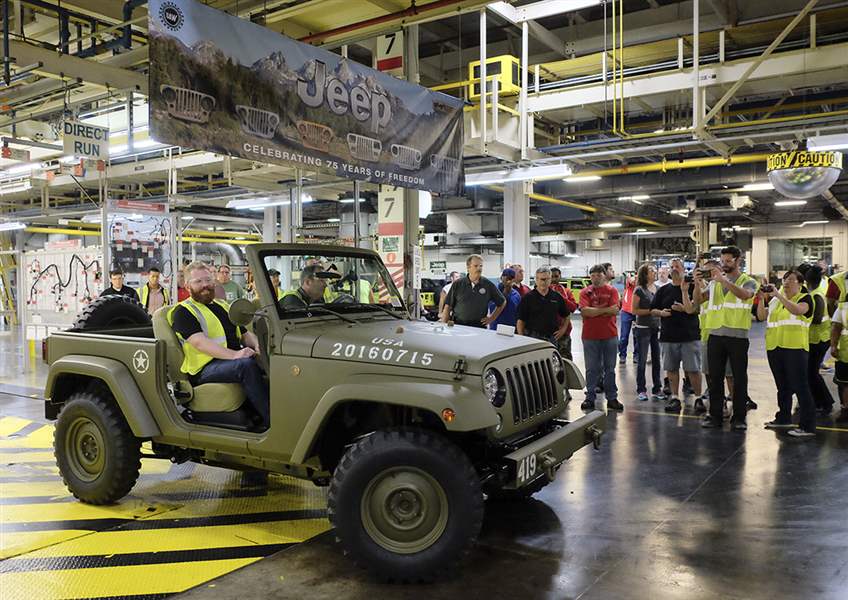
USA - Unique commemorative Wrangler 75th Salute concept celebrates the Jeep® brand’s history and legendary military heritage.

  • Unique commemorative Wrangler 75th Salute concept celebrates the Jeep® brand’s history and legendary military heritage  
  • Wrangler 75th Salute concept showcases rugged functionality highlighted with heritage design cues first seen on original Jeep military vehicles
  • Built on the 75th Anniversary of July 15, 1941: the date Willys-Overland Motor Co. was awarded the U.S. government contract to build the first Willys MB
  • New Jeep Wrangler 75th Salute concept built on the same assembly line in Toledo, Ohio, that has produced Wrangler for decades  
  • Based on a Wrangler Sport model, powered by a 3.6-liter Pentastar V-6 engine and mated to a six-speed manual transmission
Since 1941, the Jeep® name has symbolized a unique family of go-anywhere, do-anything vehicles – first developed for military use, and after 1945, continually adapted for a wide variety of civilian applications. The Jeep brand is celebrating its 75th anniversary in 2016, and to mark the occasion, a commemorative one-of-a-kind Wrangler 75th Salute concept vehicle is being created today as a tribute to the brand’s legendary history and military heritage.


“We are creating this unique Jeep Wrangler 75th Salute concept vehicle in celebration of the brand’s legendary history, and to demonstrate that 75 years later, today’s iconic Jeep Wrangler is instantly recognizable and clearly connected to the original Willys MB,” said Mike Manley, Head of Jeep Brand – FCA Global. “Since they were first produced in 1941, Jeep vehicles have been the authentic benchmark for off-road capability, having mastered more terrain, led more adventures and provided drivers more freedom than any other vehicle before or since.”
 
The “function over form” of the original Jeep military service vehicles is evident in this unique concept vehicle. The Wrangler 75th Salute concept – a modern interpretation of the Willys MB – is based on a two-door Wrangler Sport and highlights rugged functionality with heritage design cues, including the absence of B-pillars and doors. The exterior features an olive-drab color scheme that was first seen on military vehicles 75 years ago and is present throughout the Wrangler 75th Salute concept.
 
Features, including 16-inch steel wheels wrapped in 32-inch military non-directional tires, hood latches, a rear-mounted spare tire, steel front and rear bumpers with tow hooks and low back canvas seats, echo the original military Jeep vehicles. Other features include custom wood hood blocks and side mirrors, as well as bronze commemorative fender badges.
 
The Jeep Wrangler 75th Salute concept vehicle is built on the same assembly line that has produced the Wrangler in Toledo, Ohio, for decades, and is powered by a 3.6-liter Pentastar V-6 engine and mated to a six-speed manual transmission.
 
About Jeep’s Military History
In July 1940, the U.S. military informed automakers that it was looking for a “light reconnaissance vehicle” to replace the Army's motorcycle and modified Ford Model-T vehicles. The Army invited 135 manufacturers to bid on production and developed a lengthy specification list for the vehicle, including a 600-lb. load capacity, wheelbase less than 75 inches, height less than 36 inches, smooth-running engine from 3 to 50 miles per hour, rectangular-shaped body, four-wheel drive with a two-speed transfer case, fold-down windshield, three bucket seats, blackout and driving lights and a gross vehicle weight below 1,300 lbs.
 
At first, Willys-Overland and American Bantam Car Manufacturing Company were the only two companies answering the call. Soon, however, Ford Motor Company entered the picture, and competition began among the three over which company would receive the lucrative government contract.
 
Each company produced prototypes for testing in record time. The Army took possession of these vehicles in November 1940 at Camp Holabird, Maryland. Each of the three designs exceeded the Army's specification of 1,300 lbs., but the Army soon realized that limit was far too low and raised it for the next round of vehicles.
 
The Army issued the next round of contracts in March 1941. Bantam was to produce 1,500 Model 40 BRC vehicles, Ford would build 1,500 modified and improved GP Pygmies and Willys would build 1,500 Quads. Further testing and evaluation led to the Army's selection of the Willys vehicle as the standard.

With modifications and improvements, the Willys Quad became the MA, and later the MB. But the Army, and the world, came to know it as the Jeep. In 1941, the Willys MB began rolling off the assembly line straight into the heat of battle and the rest is history.