Purpose

I will try my best to provide detailed info on various cars and what is like to live with them, I have already produced a few for Jaguar-car-forums, I will do my best to be unbiased, but it will be hard for some cars. I will re-produce press releases and copy from other motoring news.
Showing posts with label Jan Lammers. Show all posts

Tuesday, 7 June 2016

25 years ago this week, Volvo launched a new car, a car that was to define it's future, and one that no one will forget.

The Volvo 850 was the car that changed everything – a front-wheel-drive Volvo with a five-cylinder transverse engine. It was the result of the Galaxy project, which got its name because it was aiming for the stars. The 850 series achieved great success in the field of motorsport, and was the first car from Volvo available with AWD.

The brand-new Volvo 850 GLT had its world premiere in the Stockholm Globe Arena on June 11 in 1991. The model was the result of one of Sweden's largest industrial investments and differed fundamentally from previous Volvo designs. It had front-wheel drive, a five-cylinder transverse engine and offered a whole new level of driving pleasure.
The new car was launched under the banner "A dynamic car with four world firsts". These new features were the transverse five-cylinder engine, the Delta-link rear axle designed in-house, the integrated side-impact protection system, SIPS, and the self-adjusting front seat belt.
Even though the design was reminiscent of the 700 series, the 850 was a completely new car. The work on developing the model began back in 1978. At a meeting held that year, it was decided that it was now time to think freely and aim for the stars. That's why the project was christened Galaxy.
Project Galaxy resulted in two model series – one Swedish and one Dutch. The underlying technology was developed jointly; after this the teams split up. The Dutch company Volvo Car B.V went on to develop what would become the 400 series, while Volvo Cars in Sweden developed the 850 series.
The first model to be presented was the 850 GLT, with its 20-valve naturally aspirated engine producing 170 hp. During the development phase, Volvo worked actively to make the 850 GLT a lively car that delivered great driving pleasure while achieving the correct intake and exhaust noise.
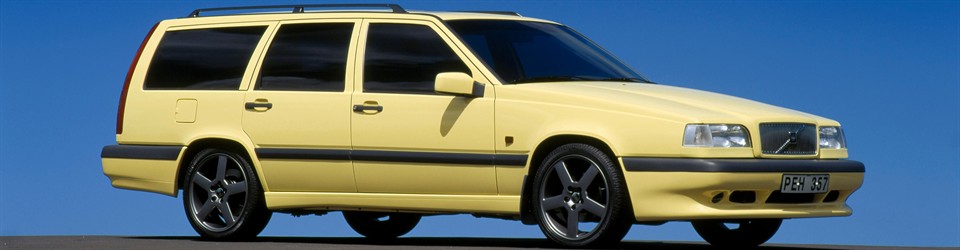
The next important 850 version was presented in February 1993 – the estate car. It boasted typical Volvo features such as the abruptly ending rear section for maximum load capacity. One new design feature, however, was the extended vertical tail lights that covered the entire D-post. During the development work, Chief Designer Jan Wilsgaard had a model on which the large tail lights could be removed and replaced for comparison. The estate version was subsequently awarded the prestigious Japanese distinction “1994 Good Design Grand Prize” as well as the Italian “Most beautiful estate”.
The 850 series was soon expanded with various engine options. The model that would achieve most attention was presented at the Geneva Motor Show in 1994. With its distinctive yellow colour, the T-5R really stood out like an exclamation mark on wheels. This special model was intended to be manufactured in a run of 2,500 cars. The turbocharged engine with intercooler produced 240 hp and 330 Nm of torque. The equipment on the car included special spoilers, a square exhaust pipe and 17” Titan alloy wheels. The yellow cars sold out in a couple of weeks, and so the same number of black cars were produced, finally followed by a run of 2,500 dark green T-5Rs.
1994 was also the year when Volvo returned to the racetrack – and did so in an extremely eye-catching way. When two 850s drove up to the starting line for the season premiere at the Thruxton track in southern England, they were the estate version! 
Competing with a “van” in Europe’s most prestigious standard car series, the British Touring Car Championship (BTCC) attracted an enormous amount of attention. 
Volvo invested heavily alongside Tom Walkinshaw Racing, with the two cars being driven by the Swede Rickard Rydell and the Dutch driver Jan Lammers. In 1995, estate cars were practically made illegal by rule changes and Volvo switched to the saloon model. That season Rickard Rydell came in third place overall in the championship.
Right from the outset, the press called the Volvo 850 “the world’s safest car”, and in 1995 it introduced another world first in terms of safety. At this point, the Volvo 850 became the first mass-produced car to come with side-impact airbags.
The 850 AWD – the company's first four-wheel-drive car – was a pioneer for Volvo when it was launched in 1996. 
The 850 All Wheel Drive had four-wheel drive engaged at all times – a viscous coupling automatically distributed the power between the front and rear wheels. If one of the rear wheels started to spin, the electronic TRACS anti-spin system automatically distributed the power between the front wheels to the one with the best grip. 
The 850 AWD was powered by a newly developed engine with light pressure turbo boost producing 193 hp, and was a predecessor to Volvo's four-wheel-drive XC models.
1996 was the final year the 850 was in production. When the models underwent a major upgrade in 1997, the designations were changed to S70 for the saloon models and V70 for the estate version. A total of 1,360,522 cars were built in model versions originating from the 850 series.

Friday, 25 April 2014

Volvo 850 Estate in the 1994 BTCC - Oh such great memories.


It is now 20 years since Volvo marked its return to the racetrack – with an estate! The venture would lead to many successful years in the BTCC – including an overall victory in 1998. "When I signed up for Volvo and TWR around Christmas 1993, I didn't know about the estate plans," says Rickard Rydell. "If I'd known, I would probably have hesitated. It was lucky I didn't know!"
Volvo's Back on Track project was tangibly launched in April 1994, when two liveried Volvo 850 estate cars rolled up to the start line on the Thruxton track in southern England. It was the start of the season of the most prestigious standard car series, the British Touring Car Championship (BTCC).
Alongside Tom Walkinshaw Racing – TWR – Volvo had initiated a major investment in the class, and the idea of using estate cars was a great success right from the outset. They attracted a great deal of attention and challenged Volvo's image in a positive way, particularly in the UK. Volvo wanted to demonstrate that it was possible to combine practicality with pleasure!
Behind the wheel of one of the cars was 26-year-old Rickard Rydell who, despite his tender age, had a great deal of experience from karting, Formula 3000 and Formula 3. In the other car was his team-mate Jan Lammers, a 37-year-old Dutchman who had competed in various classes including Formula 1.
The Volvo 850 Estate in the 1994 BTCC

"It's hard to believe that 20 years have passed," says Rickard Rydell today. "It doesn't feel like it. But now looking back it is clear that we were focusing on the right class at the right time."
TWR, which had been Volvo's main competitor in the European Championship series during the 1980s when the 240 Turbo was competing against the Rover SD1, had now been contracted for three years and was responsible for the technical development of the racing car. Volvo would be responsible for technical support, marketing and PR.
The decision to compete with two estate cars was taken several months before the start, but was kept secret until the last moment. When the news was released, many thought it was a joke. A large estate is not an ideal track car – with a lot of weight behind the rear axle and a higher centre of gravity, it is harder to get around the corners than a saloon.
"But the aerodynamics of the estate were slightly better than the saloon," says Rickard Rydell. The deciding factor, however, was that the estate would attract more attention. 
According to the FIA class 2 regulations, the competition cars had to be based on a production model. The appearance of the body could not be changed, although to make the races close and exciting, the engine cylinder volume was restricted to two litres, the maximum engine speed to 8,500 rpm and the minimum weight to 950 kg for front-wheel drive cars. Supercharging was not permitted in any form.
Volvo and TWR used their five-cylinder engine as a basis, which in the 850 Turbo had a 2.3 litre volume and produced 225 hp. In the racing version – with no turbo and with a 2 litre volume – it produced around 290 hp. The five speed manual transmission in the standard car was replaced with a six speed sequential transmission. Volvo was the first team to incorporate a catalytic converter in its cars – a feature that was soon to become mandatory according to regulations for the class.
"We hadn't had time to test the car on the track before its launch at Thruxton on 4 April," says Rickard Rydell. "Jan Lammers and I had been able to drive a few hundred metres at the entrance to TWR's development workshop, but that was all!"
The Volvo 850 Estate in the 1994 BTCC

From the outset, the first season was designated a trial year for the drivers, team and cars, and they didn't expect to be near the front of the standings. As a result, they could also treat themselves to the PR stunt of driving an estate.
"The Volvo 850 estate was by far the largest car in the series," explains Rickard Rydell. "Our competitors, who were taking part largely to strengthen their sporting image, were not pleased about having to compete with an estate. There were a few taunts from other drivers – but that was no problem. To wind them up, in one heat we drove with a large stuffed collie in the boot during the parade lap!"
When the series drew to a close after 21 heats, at Donington Park on 21 September 1994, they could look back over a very successful season from a public perspective – even though Volvo only finished in 14th place overall.
"We had learnt an enormous amount during the season, and developed the car continually," says Rickard Rydell. "Our best finish was fifth place at Oulton Park, although there were more column inches written about us than about any other team!"
As early as the following year, the results improved significantly, and Rickard Rydell came in third place overall in the championship, and repeated that success in 1996. However, they only drove the 850 estate during the first season, switching to the saloon model in subsequent years. Even though an estate body enjoys better natural downforce at the back than a saloon, the option of an additional spoiler at the rear was introduced in 1995. This was of no benefit on an estate, although on a saloon body it could make a significant difference. Volvo changed to the S40 in 1997, and Rickard pinched fourth place, before going on to win the entire series in 1998.
Volvo was definitely back on track!