Purpose

I will try my best to provide detailed info on various cars and what is like to live with them, I have already produced a few for Jaguar-car-forums, I will do my best to be unbiased, but it will be hard for some cars. I will re-produce press releases and copy from other motoring news.
Showing posts with label Kia Motors. Show all posts

Tuesday, 25 July 2017

Kia Motors has recorded its best-ever European* half-year sales surpassing 250,000 Units.

  • Six – month sales record – 251,472 units sold; a 9.5 per cent year – on – year rise
  • Market share increase to 3.0 per cent
  • The UK representing 20 per cent of sales
  • Hybrid and electric cars account for 7.5 per cent of 2017 sales, up from one percent in 2016
  • New models and electrified powertrains drive growth
Kia Motors has recorded its best-ever six-month sales period, with European* half-year sales surpassing 250,000 for the first time in the company’s history, with UK sales representing 20 per cent of sales at 50,000 units.
The latest data released today by ACEA (European Automobile Manufacturers’ Association) shows that Kia sold 251,472 units across Europe during the first six months of the year, a 9.5 per cent rise, year-on-year. In addition, Kia’s cumulative market share climbed to 3.0 per cent, up from 2.8 per cent (229,585 units) during the first half of 2016.
The second quarter of 2017 also represents Kia’s best-ever quarterly sales, with 126,485 units sold (+6.3 per cent compared to Q2 2016, with 118,985 units sold). This is the second time Kia has broken its quarterly sales record this year – between January and March 2017, Kia sold 124,987 units across Europe.
Michael Cole, Chief Operating Officer of Kia Motors Europe, commented: “Our growth has been boosted by new models launched in the last few months, and our growing range of vehicles with electrified powertrains. Alternatively-fuelled vehicles have accounted for 7.5 of our European sales so far this year, up from just one per cent in the first six months of 2016. This trend will continue as we expand our electric and hybrid model line-up, and as consumer demand continues to shift towards advanced powertrains."
Cole added: “Four Kia models in particular stand out with high sales growth so far this year. The new Rio and Picanto were introduced earlier in 2017, and are both outselling their predecessors. The Niro hybrid crossover proves appeal of a car that uniquely combines an advanced hybrid powertrain with a smart compact crossover design. Sales of the renewed Optima range, with new GT, Sportswagon and Plug-in Hybrid variants, have also been positive, more than doubling sales of the previous model.”
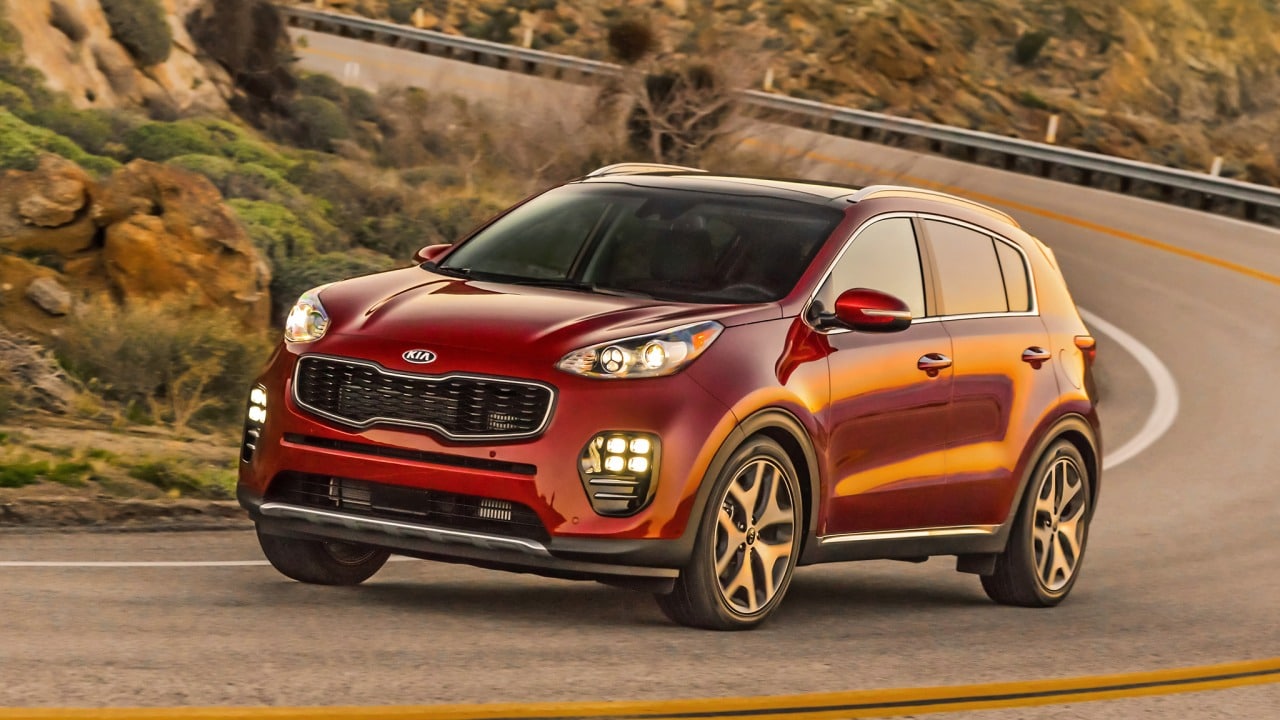
In the UK Sportage continues to dominate sales with 21,573 units sold. The all-new Picanto comes in second with 7,292 units sold, followed by the Rio and Cee’d in third and fourth place.
Seven-fold increase in sales of electrified Kia models
Vehicles with all-electric or electrified powertrains represent the greatest area of growth for Kia sales in Europe. Since the start of 2017, the new Kia Niro hybrid crossover has accounted for 16,002 unit sales, making it Kia’s fifth best-selling European vehicle (after the Picanto, Rio, Sportage and cee’d model family).
In total, electrified and all-electric Kia vehicles accounted for 18,804 unit sales in the first half of 2017, up from 2,398 units from January-to-June in 2016 (more than a seven-fold increase in sales). The Niro was joined by the new Optima Plug-in Hybrid sedan (428 units) and Soul EV (2,272 units).
Hybrid and electric sales are due to grow further throughout the year, as the new Niro Plug-in Hybrid and Optima Sportswagon Plug-in Hybrid – with greater all-electric, zero-emissions range from their larger batteries – are due on sale over the summer. These latest models ensure Kia remains on target to achieve its global aim for 2020 – to improve fuel efficiency by 25 per cent compared with 2014 levels.
Two new compact models – the all-new Rio and Picanto – were also launched at the start of the year, with each resulting in greater sales than their predecessors. Combining run-out sales of the old models and those of the new model, Rio sales have grown 15.1 per cent year-on-year (41,139 units), while sales of the A-segment Picanto grew 23.2 per cent year-on-year (to 34,880 units).
Optima sales have also seen an increase, with the creation of the new Sportswagon body style and new powertrain options, including a high-powered GT model, and Plug-in Hybrid variants. Optima sales so far this year stand at 8,371 units, a rise of 153.8 per cent compared to the same period in 2016 when the previous generation was on sale.

Wednesday, 21 June 2017

The All-New Kia Stonic, a B-Segment SUV to compete against the market leaders.

  • An important all-new model for Kia in a fast-growing segment
  • Eye-catching, confident, SUV inspired design
  • Combines agile handling and a sporty ride for an exciting drive
  • Powered by a range of lightweight, downsized engines
  • Cabin combines style and technology options
  • Smart packaging for a spacious and versatile cabin
  • Strong, lightweight body with new driver-assist technologies
  • On sale in Europe during Q3 2017
The all-new Kia Stonic is an eye-catching and confident compact crossover, and is set to become an important conquest model for Kia in one of Europe’s newest and fastest-growing vehicle segments.
The B-SUV segment currently accounts for 1.1 million new car sales in Europe each year – around seven per cent of the market – and is forecast to expand to more than two million annual sales by 2020.
Michael Cole, Chief Operating Officer of Kia Motors Europe, comments: “The Kia Stonic will be one of the most compelling new cars in this rapidly-expanding class, backed by Kia’s unique warranty, and the brand’s reputation for reliability, quality and contemporary design. As the segment expands, the Stonic looks set to become one of our best-selling cars.”
“By volume, the B-SUV market is expected to overtake the C-SUV segment by 2020, when more than one in ten new cars sold in Europe will be from the Stonic’s segment. 
The B-SUV segment attracts buyers from across the spectrum, with 21 per cent of all customers upsizing from a supermini, and another 15 per cent downsizing from their family hatchbacks. Cars like the Stonic also appeal to those looking to replace their compact MPVs.”
The design of the car is one of the brand’s most striking to date, yet it is immediately recognisable as a Kia thanks to key signature design elements, such as the ‘tiger-nose’ grille. Designed in Europe, in collaboration with Kia’s Korean design studio, the body blends sharp horizontal feature lines with softer sculpted surfaces. 
Individuality is important to many customers in the B-SUV segment, and the Stonic’s ‘Targa’-style roof enables buyers to choose a two-tone paint finish, inspired by the design of the 2013 Kia Provo concept. It will be available in Europe with up to 20 two-tone colour combinations, with a choice of up to five distinctive colours for the roof.
A range of lightweight, downsized, turbocharged petrol and diesel engines are available, each paired with a manual transmission, maximising driver engagement and efficiency. Buyers have the choice of Kia’s lightweight 1.0-litre T-GDI (turbocharged gasoline direct injection) engine, producing 120 ps, as well as 1.25- or 1.4-litre naturally-aspirated MPI (multi-point injection) petrol engines. 
An efficient 1.6-litre diesel engine completes the range, offering the lowest emissions in the line-up.
The car’s European-tuned steering and suspension are designed to offer an exciting drive, with immediate handling responses and a stable ride. 
The car is fitted as standard with Electronic Stability Control (ESC) and Vehicle Stability Management (VSM), ensuring the front-wheel drive Stonic remains enjoyable and confidence-inspiring to drive in all conditions. Specific functions of VSM include Torque Vectoring by Braking, Straight Line Stability, and Cornering Brake Control.
The Stonic’s European-designed cabin places technology and ergonomics at its heart, offering buyers as much potential for individuality as the exterior with a range of vivid colour packs for buyers to choose from. One of the smartest cars in its class, it provides owners infotainment technologies designed to enhance safety, comfort and convenience. 
The car gets Apple CarPlay™ and Android Auto™ as standard, bringing seamless smartphone functionality to the touchscreen infotainment system. Like other Kia models, it is available with a broad range of technologies to enhance comfort and convenience, including heated front seats, cruise control and keyless entry.
Within its compact exterior dimensions, the Stonic’s smart packaging maximises interior space for all occupants. The car offers class-leading shoulder room and generous leg- and head-room, while the versatile 352-litre (VDA) boot has a two-step boot floor.
The car is built on a strong, safe and lightweight platform and bodyshell, with Advanced High Strength Steel accounting for 51 per cent of materials used. The body ensures driving confidence, passenger comfort and refinement in all conditions. 
Buyers can choose from a selection of Kia’s DRiVE WISE Advanced Driver Assistance Systems (ADAS) to further enhance active safety. These technologies include Autonomous Emergency Braking with pedestrian recognition and Forward Collision Alert; Blind Spot Detection with Rear Cross Traffic Alert; and Lane Departure Warning System. Backed by a new fusion camera system, Stonic offers High Beam Assist and Driver Attention Warning to further satisfy the safety needs of customers.
Backed by Kia’s quality promise, the car will be sold as standard with the company’s unique seven-year, 100,000 mile warranty. It goes on sale across Europe during the third quarter of 2017.

Wednesday, 3 May 2017

The new Third Generation Picanto moves the goalposts again with a bigger car to impress.

  • Third generation of Kia’s stylish city car
  • Five doors and five seats as standard
  • Up to 64.2mpg, with emissions as low as 101g/km
  • Available with advanced driver aids and connectivity features
  • All-new platform makes extensive use of high-strength steel
  • 1.0-litre T-GDi turbo engine to be added later in 2017
  • Priced from £9,450 on the road
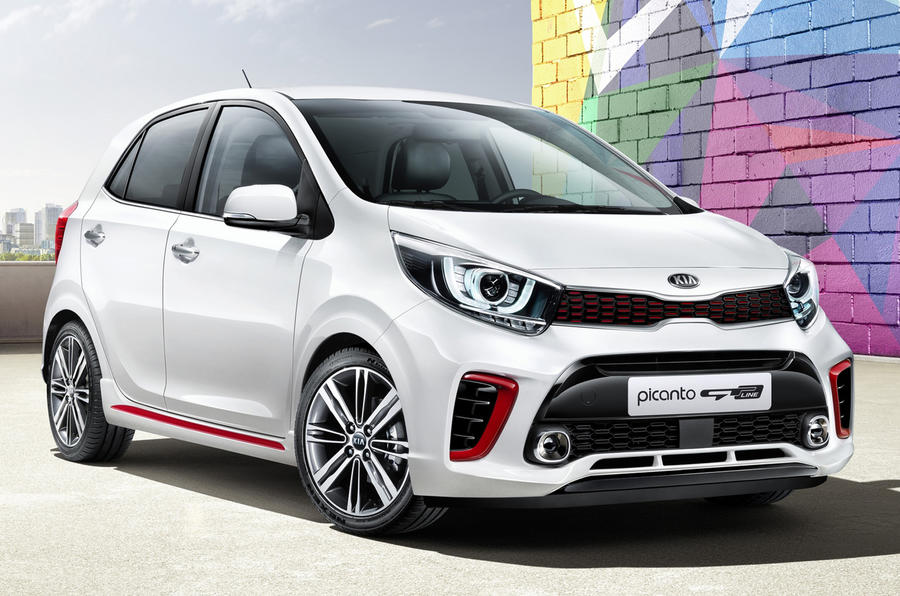
The most technologically advanced, most stylish, most refined and sportiest small car that Kia has ever produced – the all-new third-generation Picanto – goes on sale in the UK priced from £9,450. 
At launch there are nine versions on offer, based on two engines, two transmissions and five trim lines – badged ‘1’, ‘2’, ‘3’, ‘GT-Line’ and ‘GT-Line S’. ‘GT-Line’ and ‘GT-Line S’ bring an unprecedented level of sportiness to the Picanto range, with bespoke exterior and interior styling and exclusive trim features. Later this year the most powerful engine ever offered in a Picanto – a 99bhp 1.0-litre T-GDi turbocharged unit – will become available. 
The third-generation Picanto will be available only as a five-door car, since three-door models account for only 10 per cent of sales in the city-car sector – a share which is diminishing. 

In this corner of the market, size matters. Customer research shows that city-car buyers do not want big cars, so the all-new Picanto occupies exactly the same amount of road space as the previous model, with an overall length of 3,595mm and a width of 1,595mm. However, those figures do not reveal the ingenuity that has gone into the new car's packaging to improve passenger and luggage space. 
Advanced connectivity and driver assistance features are now available to keep occupants fully in touch with the outside world while minimising the risk of accidents, the car is based on an all-new platform featuring twice as much high-strength steel as the previous Picanto for strength and safety. 
Extensively modified versions of the 1.0-litre and 1.25-litre normally aspirated petrol engines from the previous Picanto reduce fuel consumption and emissions. The all-new Picanto is capable of up to 64.2mpg, with CO2 as low as 101g/km.
The all-new Picanto in the UK
Small cars do not have to be spartan. In fact, customers cite equipment levels among their chief considerations in deciding what to buy. The all-new Picanto will not disappoint. 
Even the entry-level grade ‘1’ model features electric front windows, remote locking with a folding key, tinted windows, a radio with AUX and USB ports, a tilt-adjustable steering column, automatic headlight control, Electronic Stability Control (ESC), Vehicle Stability Management (VSM), Hill-start Assist Control (HAC), 60:40 split folding rear seats and six airbags. 
From grade ‘2’, air conditioning, electric rear windows, electric heated door mirrors, Bluetooth with music streaming, a leather-trimmed steering wheel and gear-lever become standard. There is a four-speaker rather than a two-speaker audio system, body-coloured door handles and side mirror housings, high-gloss black centre fascia trim, a chromed grille surround and 14-inch alloy wheels in place of steel rims. 
Grade ‘3’ adds 15-inch alloy wheels, a supervision instrument cluster, Autonomous Emergency Braking, front foglights, electric folding mirrors with LED indicators, a floor-mounted sliding centre armrest, automatic air conditioning, cruise control with a speed limiter, a 7-inch 'floating' central display unit with satellite navigation and full connectivity, Bluetooth with voice recognition, DAB radio as part of a six-speaker audio system, a rear parking camera and sensors and chromed exterior door handles. 
Distinguishing features on the ‘GT-Line’ model are 16-inch alloy wheels, sports front and rear bumpers and side sills, a dual exhaust, black and red faux leather seats, a supervision instrument cluster, electric folding mirrors with LED indicators, satin chrome interior door handles, privacy glass on the rear windows and tailgate, bi-function projection headlamp units, LED daytime running lamps and rear lights, a chrome beltline strip and stainless steel pedals with non-slip rubber inserts. 
To this, ‘GT-Line S’ adds a wireless phone charger, an electric sunroof, heated front seats and steering wheel, a smart key and push-button engine start/stop, a 7-inch central display unit with satellite navigation and connected services, DAB radio, rear parking camera and sensors, a dual-height boot floor, luggage net and hooks and a driver's-side illuminated vanity mirror. 
The ‘GT-Line S’ and grade ‘3’ versions are distinguished by the 7-inch centre-mounted 'floating' touchscreen, giving access to the navigation, infotainment and connectivity systems, which include integration with Kia Connected Services powered by TomTom and Android Auto and Apple CarPlay via apps pre-loaded onto a smartphone. 
All models from grade ‘3’ have Autonomous Emergency Braking which can bring the car to a complete stop at certain speeds and to a partial stop at up to 107mph. This means that many accidents can be avoided, while the severity of others is considerably reduced. This feature is a £350 option on grades ‘1’ and ‘2’. 
Torque Vectoring, a first for Kia in the city-car class, is a further aid to handling stability. Using the anti-lock brake and stability control sensors, it detects when the car is drifting off its intended course in corners and gently brakes the inside rear wheel if the front of the car is running wide, or the outer rear wheel if the rear tyres are starting to slide outwards. It is standard on all models.
More space and more style within the same compact footprint
While the all-new Picanto is no longer or wider than the previous model, it provides significantly more passenger and luggage space. It is 5mm taller at 1,485mm, and has a 15mm longer wheelbase – now 2,400mm. The front overhang is shorter to give the car a squatter, sportier stance, while the rear overhang is longer to enhance the profile and create more luggage space, which goes up from 200 litres to a class-best 255 litres. This increases to 1,010 litres with the rear seats folded. 
There is a lower waistline to make the cabin lighter and more airy, a slimmer dashboard to enhance space for the driver and front passenger, and lower seats placed further backwards in the cabin. There is more front head, leg and shoulder room than in the previous model, with largely unchanged space in the rear. 
The changes in wheelbase and overhang dimensions have given the all-new Picanto a different character to its predecessor. Whereas the previous model was regarded by buyers as 'cute' and 'cheeky', the newcomer is sportier and more sophisticated. It has a more voluminous body which is simpler and more modern. The design was a joint effort by Kia's studios in Germany and at Namyang in South Korea. 
At the front there are wider grilles and air intakes flanked by multi-focus reflector or bi-function projection headlamp units, depending on model. The front foglamps, where fitted, are housed in separate side grilles or, on GT-Line and GT-Line S models, within the main lower grille. Air curtains in the side grilles channel air away from the wheel arches and wheels to reduce turbulence and improve aerodynamics while adding a more dynamic appearance. There is a bolder, more assertive bumper, which is echoed at the rear. The top of the windscreen is castellated, as on the Sportage. 
The black upper radiator grille with a silver paint or chrome surround is wider and slimmer than before, emphasising the Picanto's sportier appearance. At the sides, the waistline is lower and flatter, the window area has consequently been enlarged and the wheel arches are more emphatic. Wheels of between 14 and 16 inches in diameter fit snugly in their housings, there are body-colour or chromed door handles, black or chrome belt-line strips and black or body-coloured door mirrors, with integrated indicators on upper models. The wide rear roof pillar – a familiar Kia styling feature – is now more upright to accentuate the greater cabin space. 
At the rear, C-shaped rear light clusters are retained, but these are now larger and feature added detail. 
Inside, the all-new Picanto follows other recent Kias with a horizontally structured dashboard split into display and control areas, separated by a satin chrome trim strip which emphasises the cabin's width and the car's strong, stable stance. Vertical ventilation outlets at the outer edges of the dashboard act as bookends for the instruments and display areas. 
New materials and trim enhancements emphasise the significantly improved quality of the all-new Picanto. The seats are in smart black cloth, premium black cloth or black and red faux leather, depending on model; there are black, silver paint or satin chrome door handles; and leather trim adorns the steering wheel and gear-lever from grade ‘2’.
The new range of paint choices has Blue Breeze as the standard colour with Clear White as a £250 option and Silver Frost, Titanium Silver, Midnight Black, Chilli Red and Pop Orange as the premium alternatives, all priced at £495. 
Three powerful petrol engines including new T-GDi turbo
In line with the majority of city cars, the all-new Picanto is available only with petrol engines because diesel engines add to the purchase price while offering few advantages in overall running costs. 
The all-new Picanto's three powerful and refined engines will include – for the first time – a 99bhp three-cylinder 1.0-litre T-GDi unit, which becomes available later in the year. All three engines are from the Kappa family. The T-GDi unit is supported by a three-cylinder 66bhp 1.0-litre engine and a four-cylinder 83bhp 1.25. Both of these are multi-point injection (MPi) engines, now with reduced fuel consumption and emissions thanks to extensive re-engineering. 
The entry-level 1.0-litre engine, for example, is capable of 64.2mpg, with CO2 emissions of only 101g/km. Yet they provide lively performance for zipping around in urban traffic, with plenty in reserve for motorway driving. A five-speed manual gearbox is standard, but a four-speed automatic is optional with the 1.25 MPi engine. 
All-new platform boosts driving dynamics and safety
The third-generation Picanto is built on Kia's all-new and immensely strong H platform, which boosts both driving dynamics and safety. 
The amount of advanced high-strength steel in the body construction has doubled compared with the outgoing Picanto, from 22 per cent to 44 percent, making the all-new car's shell not only more robust but also 23 kilogrammes lighter. At the same time, the amount of structural adhesives bonding the body sections together has increased almost nine-fold, from 7.8 to 67 metres, to add further stiffness. 
As a result, the all-new Picanto is 32 per cent better than its predecessor in torsional stiffness and 12 per cent better for tensile strength. A stiffer body benefits ride comfort and handling by allowing the suspension to do its work without having to compensate for flexing; helps to reduce noise, vibration and harshness; and provides a stronger, safer barrier in the event of impact. 
The all-new Picanto, like its predecessor, has MacPherson strut front suspension, but now features a U-shaped torsion beam at the rear and revised trailing arms for improved handling with reduced weight. Steering column-mounted Motor-Driven Power Steering (MDPS) with quickened responses reduces turning effort for parking and manoeuvring while providing a firm feel and good feedback at higher speeds. The ride and handling also benefit from measures to reduce cornering roll, while the longer wheelbase and shorter front overhang improve agility and shift the weight balance slightly rearwards. Re-packaging of the mechanical components lowers the centre of gravity, which further boosts responsiveness. 
Driver and passenger well-being has also been improved by measures to reduce noise, vibration and harshness. These include greater use of foam, insulation pads and body strips, plus new engine mounts and revised, quieter heating and ventilation units. Even the windscreen wipers have been placed lower to reduce wind noise.
The Picanto and its market
The Picanto competes in the A-segment, or city car, sector of the UK and European car markets, one step down in size from traditional superminis. It is a sector which is reducing with increasing customer demand for crossover-type models over conventional hatchbacks, yet it still represents huge business for Kia. 
The segment accounts for more than one million sales a year in Western Europe, and the all-new Picanto is expected to take around 5.1 per cent of this, with sales of more than 60,000. In the UK, A-segment sales amount to around 130,000 a year and the Picanto has regularly been one of the top five best-selling models. The UK contributes almost a quarter of all-new Picanto sales in Europe. Around 60 per cent of buyers are women, and private buyers account for four out of every five customers. 
Price, exterior design, value for money and equipment – areas in which Kia has traditionally been strong – are the prime motivators among customers. Kia confidently expects the more stylish, more spacious, more sporty and more modern newcomer to increase its market share significantly in the next few years.
Warranty and servicing
In common with all Kias, the all-new Picanto comes with the best warranty in the business ­­– a seven-year/100,000-mile declaration of faith in the reliability and quality of the car, covering all labour and parts except those subject to normal wear and tear. The warranty is transferable if the car is sold before the time/mileage limit expires. The new Picanto is also available with Care 3 and Care 3 Plus servicing packages. These cover the cost of all routine servicing work for three or five years respectively and, like the warranty, can be passed on if the car is sold before they expire.
Model
Power bhp
Torque
Nm
0-60 sec
Max speed mph
Average mpg
CO2g/km
Picanto ‘1’ 1.0 66bhp 5-speed manual 
66
96
13.8
100
64.2
101
Picanto ‘2’ 1.0 66bhp 5-speed manual 
66
96
13.8
100
64.2
101
Picanto ‘2’ 1.25 83bhp 5-speed manual 
83
122
11.6
107
61.4
106
Picanto ‘2’ 1.25 83bhp 4-speed auto 
83
122
13.2
100
52.3
124
Picanto ‘GT-Line’ 1.0 66bhp 5-speed manual 
66
96
13.8
100
64.2
101
Picanto ‘GT-Line’ 1.25 83bhp 5-speed manual 
83
122
11.6
107
61.4
106
Picanto ‘3’ 1.25 83bhp 5-speed manual 
83
122
11.6
107
61.4
106
Picanto ‘3’ 1.25 83bhp 4-speed auto 
83
122
13.2
100
52.3
124
Picanto ‘GT-Line S’ 1.25 83bhp 5-speed manual
83
122
11.6
107
61.4
106
Model
VED yr1/yr2
BIK %
OTR Price
Picanto ‘1’ 1.0 66bhp 5-speed manual
£140/£140
19%
£9,450
Picanto ‘2’ 1.0 66bhp 5-speed manual
£140/£140
19%
£10,750
Picanto ‘2’ 1.25 83bhp 5-speed manual
£140/£140
20%
£11,250
Picanto ‘2’ 1.25 83bhp 4-speed auto
£160/£140
23%
£11,900
Picanto ‘GT-Line’ 1.0 66bhp 5-speed manual
£140/£140
19%
£11,950
Picanto ‘GT-Line’ 1.25 83bhp 5-speed manual
£140/£140
20%
£12,450
Picanto ‘3’ 1.25 83bhp 5-speed manual
£140/£140
20%
£12,650
Picanto ‘3’ 1.25 83bhp 4-speed auto
£160/£140
23%
£13,300
Picanto ‘GT-Line S’ 1.25 83bhp 5-speed manual
£140/£140
20%
£13,950

Friday, 3 February 2017

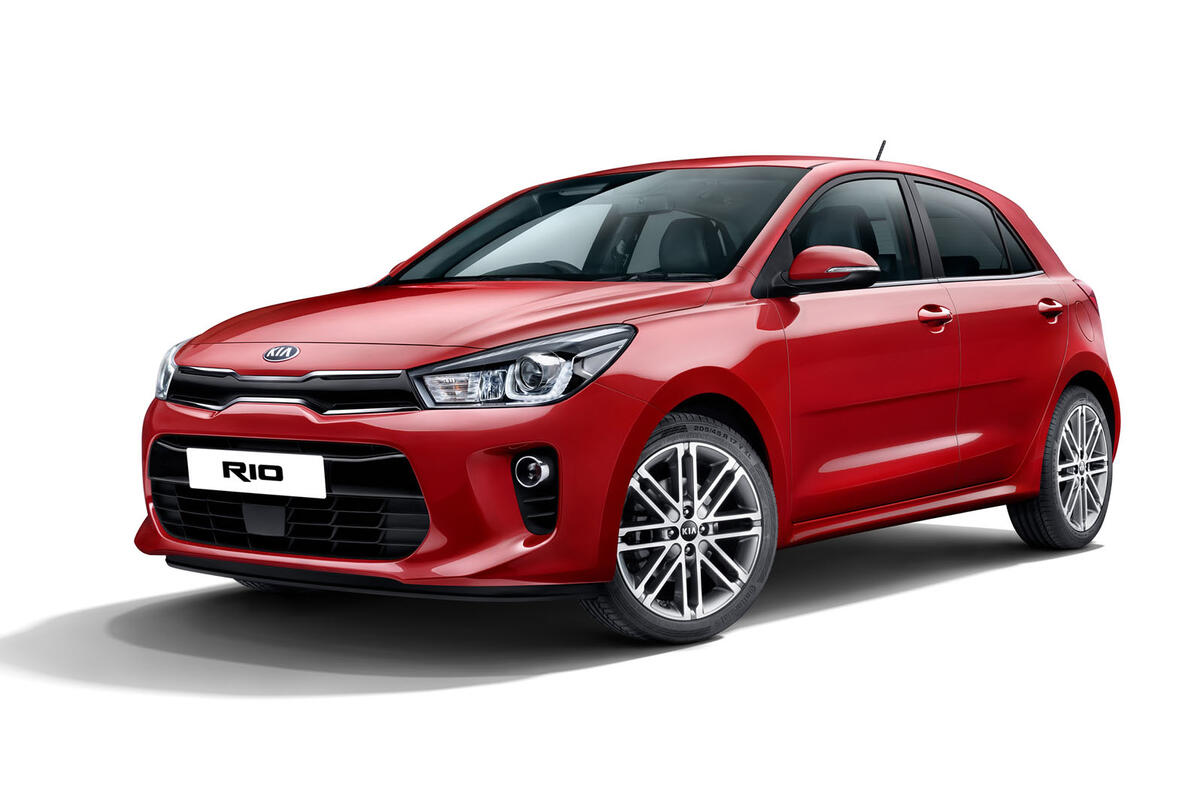
Kia announces prcing and specification for the new fourth Generation Rio hatchback.

  • Fourth generation of Kia's global best-seller
  • More size and space; greater style and equipment  
  • 1.0 T-GDi turbo engines now head more efficient powertrain line-up
  • Fuel economy of up to 80.7mpg with CO2 emissions as low as 92g/km
  • New suspension and steering for a more grown-up driving experience
  • Advanced connectivity features appear in Rio for the first time
  • Stiffer body shell and electronic driver aids add to safety
  • Priced from just £11,995 on the road
The fourth-generation Kia Rio, previewed at the Paris Motor Show last autumn, goes on sale in the UK today priced from just £11,995. With high-tech new engines, improved fuel efficiency and emissions, a more mature driving experience, greater space and style and the introduction of state-of-the-art connectivity and driver assistance systems for the first time, the latest Rio is the small car grown up.  
In line with customer demand, the Rio will now be sold as a five-door model only. There are 10 versions in three trim grades – badged 1, 2 and 3 for simplicity, in familiar Kia style – with a limited-run First Edition model as the pinnacle of the range, priced at £17,445.
All are extensively equipped, rising to truly luxurious. Even grade 1 is fitted as standard with air conditioning, front electric windows with an automatic function on the driver's side, remote locking, electrically adjustable heated door mirrors, a 3.8-inch display screen, Bluetooth, automatic light control, bi-function projection headlamps and cornering lights and LED daytime running lights. 
There are body-coloured bumpers, door mirror casings and door handles, steering wheel-mounted audio controls and 60:40 split rear seats.
 
A four-speaker audio system is standard, while safety provisions include Electronic Stability Control (ESC), Vehicle Stability Management (VSM) and Hill-start Assist Control (HAC).
Grade 2, priced from £13,745, supplements all this with 15-inch alloy wheels in place of similar-sized steel wheels, a leather-trimmed steering wheel and gearshifter, electric windows at the rear as well as the front, electric folding mirrors with LED indicator lights, a digital DAB radio, a 5-inch colour display screen, a six-speaker audio system, a reversing camera and rear parking sensors, a 3.5-inch premium supervision cluster, rear as well as front USB charging ports, cruise control with a speed limiter and Autonomous Emergency Braking and Lane Departure Warning systems. There is chrome trim around the black radiator grille, premium black cloth upholstery and a centre storage box.
Additional features on Grade 3, which starts at £16,295, include 16-inch alloy wheels, automatic air conditioning with a defogging system, black faux leather upholstery, a 7-inch display screen, heated front seats and a heated steering wheel, rain-sensing front wipers, privacy glass on the rear side windows and tailgate, satellite navigation, Android Auto and Apple CarPlay connectivity and Bluetooth with voice recognition.
Finally, the First Edition version adds 17-inch alloys, a smart key entry system and engine start/stop button, stainless steel pedals, black and red faux leather upholstery and LED rear lights.
Depending on model, the new Rio is available in a choice of seven exterior colours. Sienna Brown is the standard choice, with Clear White as a no-cost option and Satin Silver, Graphite, Midnignt Black, Smokey Blue and Blaze Red as premium options.
The latest in advanced driver aids and connectivity
The new Rio is the first car in its class with Autonomous Emergency Braking as part of Kia's advanced driver assistance systems (ADAS). It also features a Lane Departure Warning system. Both are standard from grade 2 upwards and optional with grade 1. And, in an increasingly connected world, the Rio now offers Kia Connected Services powered by TomTom and featuring Android Auto and Apple CarPlay smartphone integration. These are standard with grade 3 and the First Edition models.
Autonomous Emergency Braking with pedestrian recognition takes data from radar and a camera to detect sudden and potentially dangerous braking by a vehicle ahead, and activates the brakes. At speeds between 5mph and 50mph the Rio will come to a complete stop, avoiding many potential collisions. It is also able to detect pedestrians who wander into its path and apply the brakes in the same way.
The Lane Departure Warning system, which also relies on a camera that in this case recognises the lane markings on roads, senses when the car is about to veer off course without the indicators being activated and warns the driver to take corrective action.
A new feature – Straight Line Stability – senses any difference in applied brake pressure between the right and left of the car and intervenes to keep it straight, while another first for the Rio, Cornering Brake Control, delivers asymmetrical brake pressure when slowing in tight curves to counter loss of traction. Both are standard across the range.
Kia Connected Services with TomTom are accessed through a 7-inch touchscreen navigation system. The information available to drivers includes live traffic updates, weather reports, speed camera locations and local point-of-interest searches.
The system is compatible with Android Auto and Apple CarPlay through a suitable smartphone. Both allow occupants to connect to various apps and functions, including voice-guided, hands-free calls and texts and voice recognition. Android Auto gives access to Google Maps navigation and Google Play music, while Apple CarPlay links to pre-loaded maps, music, podcasts, texts and messages and audiobooks through Siri voice control.
More space, greater style and increased comfort
The new Rio is the largest and most spacious to date, and has new suspension and steering for a more grown-up feel on the road, while the acclaimed styling has a more mature and polished appearance. No wonder the Rio is known within Kia as 'a little Titan'.
It adds a new twist to the award-winning styling which permeates every model from Kia. The brand's instantly recognisable 'tiger-nose' main front grille is more slender and wider, and it integrates neatly with the new highly sculpted halogen bi-function projection headlights with U-shaped LED running lights.
The styling was a joint effort by Kia's design teams in Germany and the United States, with the involvement of the main design office at Namyang in South Korea. It is characterised by straight lines, smooth surfaces and revised proportions and balance. There is a longer wheelbase, bonnet and front overhang, a lower roofline and a more upright and more compact back end. Detailing inside and out has been designed to emphasise the car's interior space and its stability on the road.
The increased leg and shoulder room are among the best in class, as is headroom – despite the lower roofline. A further benefit from the new proportions is increased boot capacity – up by almost 13 per cent to 325 litres – while the fuel tank is two litres larger at 45 litres.
The interior has been designed around the touchscreens for the new connectivity technologies.
The horizontal theme evident in the exterior styling is repeated in the cabin, emphasising width and space while separating the upper information and lower control areas. The touchscreens have allowed the number of buttons and switches to be reduced, giving a neater look and greater functionality. The Rio is the first car in class with USB ports front and rear, so that mobile devices can be charged from any seat.
The new Rio relies on a similar suspension system to its predecessor, but there has been extensive work to enhance comfort and driver enjoyment.
Much of the improvement is due to a stiffer body shell, which is made of 51 per cent advanced high-strength steel compared with 33 per cent in the outgoing car. The stiffer the body shell, the less the suspension has to compensate for flexing under load. Advanced high-strength steels also contribute towards weight reduction, as vital sections of the body construction do not need to be as thick.
The new Rio has more rigid front suspension struts than its predecessor and a raised torsion beam to improve stability; revised springs and shock absorbers to improve compliance and comfort; vertical rear shock absorbers and front shock absorbers with advanced new valve technology for more consistent responses; and a repositioned power steering gearbox which results in improved feel when the steering wheel is in the straight-ahead position. The overall effect is more immediate handling responses and greater confidence for the driver.
A stiffer body shell also enhances crash safety by keeping the passenger cell intact in an accident while the front, rear and side crumple zones absorb impact energy. This is supported in the Rio by the advanced driver assistance systems ESC and VSM, which together mitigate against skids when cornering or accelerating on surfaces with uneven levels of grip. All versions also have HAC to prevent the car from rolling backwards when setting off on steep inclines. 
T-GDi engines head more efficient powertrain line-up
Kia's 1.0-litre T-GDi (Turbocharged Gasoline Direct-injection) engines are offered in the Rio for the first time and head a seven-strong powertrain line-up which shows improvements in fuel efficiency and CO2 emissions over the outgoing Rio.
The new engines showcase Kia's advanced engine technology capabilities through downsizing, turbocharging, direct fuel injection and weight reduction, and feature a number of detailed engineering solutions to minimise throttle lag – the delay between the driver pressing the accelerator and the turbocharger delivering boost – and reduce internal friction.
They join revised versions of Kia's 1.25-litre and 1.4-litre petrol engines, and two versions of the European-designed and European-built 1.4-litre CRDi turbodiesel.
The 1.0-litre T-GDi engine is available with either 99 or 118bhp, in both cases with 171Nm of torque across a wide rev band, starting at only 1,500rpm, for effortless driveability. The lesser-powered version has fuel consumption and CO2 emissions of 62.8mpg and 102g/km, while the sparkling 118bhp version is not far behind, with 60.1mpg and 107g/km. Both are capable of more than 50mpg in city driving. The respective 0-60mph acceleration times are 10.3 and 9.8 seconds, and both versions have a top speed of at least 115mph.
The fuel economy champion of the new Rio range is the lesser-powered, 76bhp 1.4-litre diesel, a new option in Rio. Both 1.4-litre diesels have a healthy 240Nm of torque and have CO2 emissions below 100g/km – 92g/km and 98g/km respectively – while fuel consumption figures are 80.7 and 74.3mpg. The 240Nm of torque is available from just 1,500rpm, giving sprightly acceleration from 0-60mph in either 13.5 or 11.6 seconds, with top speeds of more than 100mph.
The 1.25-litre petrol engine develops 83bhp and 121Nm of torque, and has fuel economy and CO2 emissions of 58.8mpg and 109g/km. This easy-going entry-level power unit is ideally suited to urban driving, but is far from out of its depth at highway speeds. It can accelerate from 0-60mph in 12.5 seconds on the way to a top speed of 107mph.
The final option is a new-to-Rio multi-point injection unit with a capacity of 1.4 litres and power and torque outputs of 98bhp and 133Nm. Economy is 56.5mpg, with CO2 emissions of 114g/km. The 0-60mph and top speed figures are 11.8 seconds and 108mph.   
This engine is also available with a four-speed automatic gearbox for the convenience of drivers who spend most of their time in heavy traffic or who have physical disabilities which prevent them from driving a manual. In this configuration, economy and CO2 emissions are 46.3mpg and 140g/km, while the performance figures are 0-60mph in 13.4 seconds and a top speed of 103mph.
All manual versions of the new Rio have Kia's Intelligent Stop & Go (ISG) engine stop-start system to eliminate tailpipe emissions and fuel consumption while stationary in traffic.
Warranty and Servicing
In common with all Kias, the Rio comes with the best warranty in the business ­­– a seven-year/100,000-mile declaration of faith in the reliability and quality of the car, covering all labour and parts except those subject to normal wear and tear. The warranty is transferable if the car is sold before the time/mileage limit expires.
The new Rio is also available with Care 3 and Care 3 Plus servicing packages for retail customers. These cover the cost of all routine servicing work for three or five years respectively and, like the warranty, can be passed on if the car is sold before they expire.
Globally, the Rio is Kia's best-seller, with sales close to 475,000 a year, and while it is overshadowed in the UK by the European-built Sportage crossover and cee'd range, it is still a highly significant model, accounting for almost one-sixth of the company's sales.      
UK Rio line-up:
ModelPower bhpTorque
Nm
0-60 secMax
speed
mph
Comb. mpgCO2 g/km
Rio ‘1’ 1.25 5-speed manual ISG8312112.510758.8109
Rio ‘1’ 1.4 CRDi 76bhp 6-speed manual ISG7624013.510280.792
Rio ‘2’ 1.25 5-speed manual ISG8312112.510758.8109
Rio ‘2’ 1.4 6-speed manual ISG9813311.810856.5114
Rio ‘2’ 1.4 4-speed automatic9813313.410346.3140
Rio ‘2’ 1.0 T-GDi 99bhp 6-speed manual ISG9917110.311562.8102
Rio ‘2’ 1.4 CRDi 76bhp 6-speed manual ISG7624013.510280.792
Rio ‘3’ 1.0 T-GDi 99bhp 6-speed manual ISG9917110.311562.8102
Rio ‘3’ 1.4 CRDi 89bhp 6-speed manual ISG8924011.610874.398
Rio ‘First Edition’ 1.0 T-GDi 118bhp  6-speed manual ISG1181719.811860.1107
UK Rio pricing:
Model Price
Rio 1 1.25 5-speed manual ISG£11,995
Rio 1 1.4 CRDi 6-speed manual ISG£13,495
Rio 2 1.25 5-speed manual ISG£13,745
Rio 2 1.4 6-speed manual ISG£14,245
Rio 2 1.4 4-speed automatic£14,995
Rio 2 1.0 T-GDi (99bhp) 6-speed manual ISG£14,545
Rio 2 1.4 CRDi 6-speed manual ISG£15,245
Rio 3 1.0 T-GDi 6-speed manual ISG£16,295
Rio 3 1.4 CRDi 6-speed manual ISG£17,245
Rio First Edition 1.0 T-GDi) 6-speed manual ISG£17,445