Purpose

I will try my best to provide detailed info on various cars and what is like to live with them, I have already produced a few for Jaguar-car-forums, I will do my best to be unbiased, but it will be hard for some cars. I will re-produce press releases and copy from other motoring news.
Showing posts with label NEXT GENERATION. Show all posts

Friday, 12 May 2017

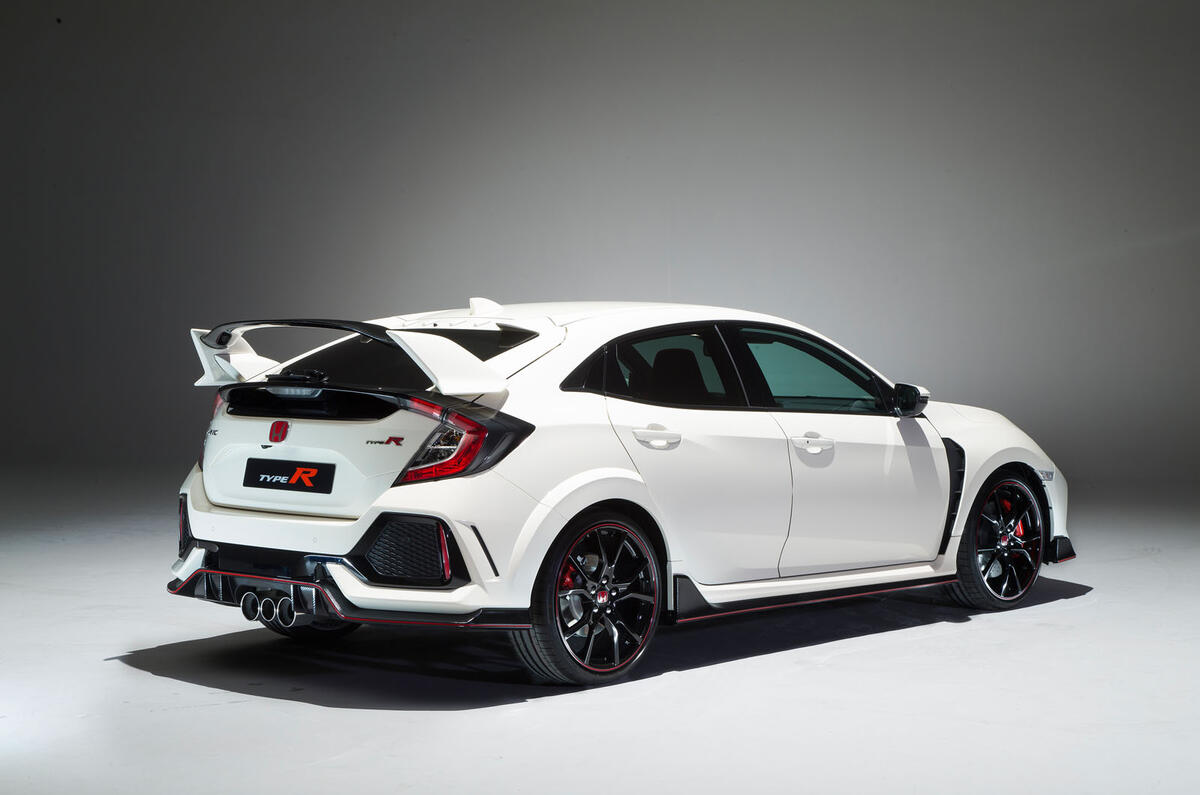
Honda announces pricing and specification for the new Civic Type R Hatchback.

  • Entry level model comes in at £30,995 with GT version an additional £2,000
  • PCP pricing to be under £300 a month for entry level version
  • Cars to hit retail forecourts in July
Honda UK has today announced pricing for the hotly-anticipated next generation Civic Type R. Set to hit retail forecourts in July, the entry level model will cost £30,995 and the GT version will cost an additional £2,000 at £32,995 on the road and will come with a host of extras. 
PCP pricing has also been confirmed for the new car, which is built at Honda’s UK manufacturing plant in Swindon; with monthly payments in line with the current car and starting at £299 a month on a three year 5.9% contract for the entry level version of the new Civic Type R. 
As with the outgoing model, GT drivers will benefit from blind spot information including cross traffic monitor, dual zone climate control, auto dimming rear view mirror, Honda CONNECT with Garmin Navigation, wireless charging, high power audio, and LED front fog lights. 
Unveiled at the Geneva Motor Show, the 2017 Civic Type R shares the same fundamentals as the new Civic hatchback and has been engineered from the ground up to deliver the most rewarding drive in the hot-hatch segment – both on road and on the race track. 
The 2.0-litre VTEC TURBO of the previous generation Civic Type R has been optimised and refined to produce 320 PS with peak torque of 400 Nm, while the six-speed manual transmission is further improved by a rev match control system. 
Phil Webb, Head of Cars at Honda UK, commented: “As with the previous generation, we are fully expecting a huge demand for the Civic Type R. The order bank is already open and we are experiencing strong interest off the back of the launch at the Geneva Motor Show in March – and this is before our customers have even taken a test drive.” 

Wednesday, 26 April 2017

Mercedes launches a new concept to further expand the range of compact vehicles.

With the Concept A Sedan at Auto Shanghai (April 20 to 27, 2017) Mercedes-Benz is providing an outlook of the next generation of compact vehicles and a potential, new body type.
The Concept A Sedan show car specifies the evolved Mercedes-Benz design language. Thanks to its purist, surface-focused design featuring reduced lines and flat surfaces the show car is hot and cool at the same time. The "Aesthetics A" sculpture already demonstrated that the upcoming compact class generation marks the dawn of an even more rigorous implementation of the design idiom of "sensual purity".

"Our Concept A Sedan shows, that the time of creases is over”, say Gorden Wagener, Chief Design Officer Daimler AG. “With its perfect proportions and a sensual treatment of surfaces with reduced lines, it is the next milestone of Sensual Purity and has the potential to introduce a new design era."
The current compact vehicle generation is crucially contributing to Mercedes‑Benz's most successful and rejuvenated appearance ever to make 2016 the sixth year of records in succession. More than two million compact vehicles have been sold around the globe since 2012. In addition to the contemporary design language, innovative assistance systems, connectivity, and driving pleasure, model variety is a crucial factor for success: with the A and B‑Class, CLA and CLA Shooting Brake, as well as the SUV crossover GLA five differently positioned variants are available on the market.
"Their success shows that our customers are absolutely delighted with the current generation of Mercedes-Benz compact cars", says Britta Seeger, member of the Board of Management of Daimler AG responsible for
Mercedes‑Benz Cars Marketing & Sales. "We are therefore extremely confident that the planned expansion will lead to a continuation of this success story."
The Concept A Sedan: study of a compact premium sedan
The Concept A Sedan (length/width/height: 4570/1870/1462 mm) has been designed with the proportions of a dynamic, coupé-like and simultaneously compact, premium sedan. This aim is emphasized by the traditional three-box design featuring short overhangs, especially at the rear, as well as the slim greenhouse that has been offset towards the rear. Additional sedan characteristics are the relatively vertical C‑pillar, larger side windows and the higher beltline.
The wheel arch design featuring a reduced arch dimension emphasises the exclusive 20‑inch wheels. The light alloy wheels radiate technical precision with their sporty aerowheel look featuring a structured surface between the spokes. The door handles of the show car are flush with the body, while the outside mirrors, in a contemporary reinterpretation, stand proud of the beltlines.
The striking front expresses self-confidence: this is crucially highlighted by the deep Panamericana grille tilted towards the front, featuring vertical chrome inserts and a star in the centre, as well as the stretched bonnet with Powerdomes. The large, lower air inlet featuring a diamond grid structure and a striking trim strip in dark chrome is also amongst the most eye-catching features.
The headlamps with their eyebrows as a typical feature of the brand as well as the striking grid structure on the inside guarantee a confident look – and a simultaneously high recognition value. The structural sculpture that has been broken down in detail represents a technically based counterpole to the sensual exterior – "stimulating contrast" is one of the six guiding principles of Mercedes-Benz design. The grid structure in the lamps has been coated with a UV paint and it is exposed to ultraviolet light. As a result, the headlamps "glow" in different colours, depending on the light medium – the daytime running lamps, for instance, are white.
This unusual lighting technology is also used at the rear: The striking tail light image has also been designed as a structural sculpture. In line with the evolved design philosophy the lines and gaps at the rear have been reduced. As a contrast to the paintwork the rear bumper features a diffuser-look lower part trimmed in black and a chrome trim strip that emphasises the width and underlines the car's premium appeal. The integrated exhaust deflectors are finished in dark chrome. Additional features of the roadworthy show car are dark privacy windows all-round as well as a large, panoramic glass roof.

Monday, 20 March 2017

Ford Performance reveals next generation Ford Fiesta ST powered by an all-new 200PS, three-cylinder, 1.5‑litre EcoBoost engine

  • Ford Performance reveals next generation Ford Fiesta ST powered by an all-new 200PS, three-cylinder, 1.5‑litre EcoBoost engine at the Geneva Motor Show
  • First three-cylinder Ford Performance model also features Drive Modes that adjust engine, steering, stability controls and even exhaust sound for optimised driving fun
  • Electronic Sound Enhancement and active exhaust valve amplify sporty sound of three-cylinder engine that also features cylinder deactivation for further reduced CO2*
  • Enhanced range of personalisation options and technology includes new styling packs, SYNC 3 connectivity with eight-inch touchscreen and B&O Play high-end audio

Ford Performance today announced the next generation Ford Fiesta ST, powered by an all-new three-cylinder, 1.5-litre EcoBoost engine.
Shown for the first time ahead of its global public debut at the Geneva Motor Show next month, the next‑generation Fiesta ST will deliver 200PS, 290Nm of torque and anticipated 0‑62mph acceleration in 6.7sec.
The third generation of Fiesta ST will be the first ever Ford Performance model powered by a three-cylinder engine, and the first Fiesta ST to feature selectable Drive Modes – enabling engine, steering and stability controls to be configured to Normal, Sport and Track settings for an optimised fun-to-drive experience in conditions from motorways to track days.
Drive Modes will also adjust Fiesta ST’s Electronic Sound Enhancement (ESE) technology and active exhaust noise control valve to deliver an even more satisfying driving experience. The technologies amplify the naturally sporty sound of the new 1.5-litre EcoBoost engine that also features Ford’s industry-first cylinder deactivation system for a three-cylinder engine, for further reduced CO2 emissions of an anticipated 114g/km.*
Available from launch in early 2018 in both three-door and five-door bodystyles, the next generation Fiesta ST will be offered with a greater variety of interior trim and personalisation options than ever before, with bold and distinctive exterior styling that includes a unique race-car-inspired mesh grille and exclusive 18in alloy wheels.
“Our next generation Fiesta ST is true to the philosophy of delivering cutting-edge technology to enhance every facet of the responsive Ford Performance chassis and powertrain,” said Joe Bakaj, vice president, Product Development, Ford of Europe. “With selectable Drive Modes and an all-new EcoBoost engine delivering an unprecedented combination of performance and fuel-efficiency, the new model will deliver the most versatile, fun, engaging and rewarding Fiesta ST driving experience yet.”
All-new 1-5-litre EcoBoost engine
Part of Ford’s EcoBoost range of petrol engines that also includes the multi-award-winning 1.0‑litre EcoBoost, the all-new 1.5-litre EcoBoost engine uses technology including turbocharging, high-pressure fuel injection and Twin-independent Variable Cam Timing to deliver optimised performance and fuel efficiency.
The engine’s three-cylinder architecture delivers naturally high torque at low rpm. Performance is further boosted by a new turbocharger that uses an optimised turbine design to build boost pressure faster and minimise lag for a more responsive and fun driving experience.
A new combination of port fuel injection and direct fuel injection technology helps deliver high power and responsiveness alongside reduced CO2 emissions,* with a particular increase in fuel efficiency under light engine loads.
Ford’s new cylinder deactivation technology – first announced for the 1.0-litre EcoBoost engine and a world first for a three-cylinder engine – will further improve fuel efficiency for Fiesta ST customers without affecting performance by automatically stopping fuel delivery and valve operation for one of the engine’s cylinders in conditions where full capacity is not needed, such as when coasting or cruising with light demand on the engine. The technology can disengage or re-engage one cylinder in 14 milliseconds – 20 times faster than the blink of an eye – to seamlessly deliver full performance on demand.
The all-aluminium engine also features an integrated exhaust manifold thatimproves efficiency by helping the engine reach optimal temperatures faster, and delivers torque more rapidly by minimising the distance exhaust gasses travel between cylinders and turbocharger. Gas particulate filter technology that reduces soot emissions will also feature.
New Drive Modes
Selectable Drive Modes add even more versatility for the next generation Fiesta ST, enabling drivers to optimise the driving experience to suit scenarios from school run to the race track:
  • In Normal mode, engine mapping, traction control, electronic stability control (ESC), ESE, exhaust sound and electronic power assisted steering (EPAS) are configured to deliver natural responsiveness and a connected feel
  • In Sport mode, engine mapping and throttle pedal response are sharpened, and EPAS settings adjusted to deliver more feedback and finer control for fast road driving. The active noise control valve opens and ESE is adjusted to intensify the sporty exhaust note and engine noise within the cabin
  • In Track mode, all vehicle dynamics features are tuned for the fastest possible lap times, traction control is disabled and ESC interventions are set to wide-slip mode for hard circuit driving 
The agile and responsive Ford Performance-tuned chassis will be supported by enhanced Torque Vectoring Control technology that improves road holding and reduces understeer by applying brake force to the inside front wheel when cornering. Three-mode ESC will enable drivers to choose between full system intervention; wide-slip mode with limited intervention; and full system de-activation.
Greater personalisation
The next generation Fiesta ST will offer more personalisation options than ever before. Customers will be able to choose from a range of trim elements for the gear lever, steering wheel, door pulls and decorative dashboard spear, and select from distinctive styling packs.
The ergonomic Fiesta ST interior will feature supportive Recaro seats and a flat-bottomed steering wheel. Exterior colour options will include new Liquid Blue and the Fiesta ST will feature exclusive 18in alloy wheels.
“Our ST models are designed to make a Ford Performance driving experience accessible to customers regardless of lifestyle,” said Matthias Tonn, Fiesta ST chief programme engineer. “With three- and five-door bodystyles and distinctive styling options that complement the model’s performance characteristics available from day-one, the next generation Fiesta ST will deliver a broader appeal for an even wider range of car-buyers.”
Ford’s SYNC 3 communications and entertainment system will enable Fiesta ST drivers to control audio, navigation and connected smartphones using simple, conversational voice commands. Compatible with Apple CarPlay and Android Auto™, SYNC 3 is supported by floating, tablet-inspired touchscreens up to eight inches in size that can be operated using pinch and swipe gestures.
The next generation Fiesta ST also will be offered with a high quality B&O PLAY Sound System for a high-end audio experience – among features Ford first announced last year for the next generation Fiesta.
he Ford Performance global organisation serves as an innovation laboratory and test-bed to create unique performance vehicles, parts, accessories and experiences for customers.
This includes developing innovations and technologies in aerodynamics, light-weighting, electronics, powertrain performance and fuel efficiency that can be applied more broadly to Ford’s product portfolio.
“Next generation Fiesta ST customers will benefit from innovations developed by Ford Performance for the Ford GT supercar and Focus RS hot hatchback, including high power EcoBoost and Drive Mode technologies,” said Dave Pericak, global director, Ford Performance. “Working as one unified Ford Performance team helps us better deliver our core fun-to-drive experience – and democratise sophisticated performance-enhancing features – for every customer.” 

Thursday, 23 February 2017

McLaren Automotive to in-source future production of the carbon fibre Monocell and Monocage chassis.

  • McLaren Automotive to in-source future production of the carbon fibre Monocell and Monocage chassis
  • More than 200 new jobs to be created
  • The company’s first bespoke facility outside of the McLaren Technology Centre campus, based close to the Advanced Manufacturing Research Centre at the University of Sheffield
McLaren Automotive has announced the first details of its new Composites Technology Centre. Based close to the campus of the Advanced Manufacturing Research Centre (AMRC) at the University of Sheffield, and built with support from Sheffield City Council, the new Centre will be responsible for the development and manufacturing of the Monocell and Monocage carbon fibre chassis in future McLaren cars. 
This next generation Monocell will be built using advanced automated manufacturing techniques developed in conjunction with the AMRC. 

The new facility is due to start construction in early 2017 with the first pre-production carbon fibre chassis expected to be delivered to the McLaren Technology Centre in the second half of 2017 using trial manufacturing processes in the AMRC before going into full production by 2020.
The creation of the new McLaren Composites Technology Centre represents the company’s first purpose-built facility outside of the current McLaren campus. 
Formed through a partnership between McLaren Automotive, the University of Sheffield’s AMRC and Sheffield City Council, the new Composites Technology Centre will create more than 200 jobs through a combined investment of nearly £50 million. 
The target is that the new Centre will deliver cost savings of around £10million when compared to costs of today and £100 million of GVA (gross value added) benefit to the local economy by 2028. 
Opportunities for expansion thereafter create an ambition of doubling that to £200 million. The in-sourcing of the manufacture of the carbon fibre chassis also increases the average percentage (by value) of a McLaren car sourced in the UK by around eight per cent from its average of around 50 percent, depending on model.
THE AMRC AND McLAREN COMPOSITES TECHNOLOGY CENTRE IN DETAIL
The AMRC was established in 2001 as a £15 million collaboration between the University of Sheffield and aerospace giant Boeing with the purpose of using Sheffield’s traditional expertise in materials and machining, and applying those skills for future technological development. 
In 2004, the AMRC moved into the purpose-built Advanced Manufacturing Park in Sheffield and, in 2008, opened the Rolls-Royce plc Factory of the Future. In 2012, the Factory of the Future expanded to include an enlarged Composite Centre.
In 2015, the AMRCs Factory 2050 was opened as the UK’s first fully reconfigurable assembly and component manufacturing facility for collaborative research, capable of rapidly switching between different high-value components and one-off parts. 
The 7,000 sq m building is home to the ARMCs Integrated Manufacturing Group with open-plan desk space integrated with high-tech assembly and manufacturing – much like the existing McLaren Production Centre in Woking, Surrey. The new McLaren Composites Technology Centre will be sited near to the AMRC campus.
The McLaren Composites Technology Centre will be housed in a 7,000m2 building set over four acres and will be responsible for the research and development of future Monocell and Monocage carbon fibre chassis as well as the manufacturing of the chassis itself. 
The 200 new employees will comprise approximately 150 production staff and 50 manufacturing support staff.
McLAREN – PIONEERING IN CARBON FIBRE AND COMPOSITES TECHNOLOGY
For more than 30 years, McLaren has pioneered the use of carbon fibre in vehicle production. The McLaren MP4/1 was the first car on the Formula OneTM grid to feature a carbon fibre chassis. 
Compared to the aluminium structures of the time, carbon fibre was lighter but stronger and therefore faster but safer. By the following season, most competitors had adopted this new material in the construction of their cars, and it continues as the prevalent construction material today. 
And on the road, the now-iconic McLaren F1 from 1993 was the first road car ever to be built with a carbon fibre chassis. This car still holds the world record for the fastest naturally-aspired road car.
Since 1981, McLaren has not built a car without a carbon fibre chassis.
At the launch event at the AMRC in Sheffield, Mike Flewitt, Chief Executive Officer of McLaren Automotive commented: ‘In 1981, McLaren was the first company to recognise the exceptional properties of carbon fibre, and we have designed the highly-technical material it to be at the heart of every McLaren road and racing car ever since. 
The now-iconic McLaren F1 was the world’s first road car to be built with a carbon fibre chassis and every car built more recently by McLaren Automotive has the same. Creating a facility where we can manufacture our own carbon fibre chassis structures is therefore a logical next step.
He continued: ‘We evaluated several options to achieve this objective but the opportunity created by the Advanced Manufacturing Research Centre at the University of Sheffield was compelling. 
At the AMRC, we will have access to some of the world’s finest composites and materials research capabilities, and I look forward to building a world-class facility and talented team at the new McLaren Composites Technology Centre.’

Thursday, 5 January 2017

The INFINITI QX50 Concept, which will make its global premiere at the 2017 North American International Auto Show

  • Global debut awaits for new QX50 Concept, INFINITI's vision for a next-generation mid-size premium SUV
  • QX50 Concept demonstrates INFINITI design language in SUV form
  • INFINITI prepares for autonomous drive support technologies
  • Demonstrates a potential application for INFINITI's production-ready VC-Turbo variable compression ratio engine
The INFINITI QX50 Concept, which will make its global premiere at the 2017 North American International Auto Show in Detroit, showcases the brand's vision for a next-generation mid-size premium SUV.
An evolution of the 2016 QX Sport Inspiration, the QX50 Concept shows how the design of its conceptual forebear could be adapted for a future production model in the world's fastest-growing vehicle segment. 
INFINITI's latest concept confidently articulates the artistic influence of the designer through the brand's "Powerful Elegance" design language. A "cabin-forward" silhouette combines with taut, muscular lines and flowing surfaces telegraph it as a dynamic and practical SUV.

The organic forms of the "driver-centric, passenger-minded" cabin harmonize with the exterior. Blending progressive design with elevated levels of modern craftsmanship, the QX50 Concept's interior reflects INFINITI's desire to challenge conventional approaches to premium interior design.
"With the unveiling of the QX Sport Inspiration at the 2016 Beijing Auto Show, we showed the future of INFINITI QX models. The new QX50 Concept evolves this concept further and shows how INFINITI could develop its future presence in the fastest-growing vehicle segment globally."
Roland Krueger, President of INFINITI

INFINITI to reveal plans for autonomous driving technologies
INFINITI's QX50 Concept also previews the brand's roll out of its autonomous drive support technologies. Central to the strategy for the development of all future autonomous drive support systems is that they should ensure the driver retains ultimate control over their vehicle – in keeping with INFINITI's focus on driver engagement – while providing a proactive approach to safety.
INFINITI's autonomous drive technologies will act as a "co-pilot" for the driver, empowering rather than replacing them, and "delegate" more onerous driving tasks to the car – such as navigating stop-start traffic on the highway or keeping track of the positions of surrounding vehicles.
Since its inception in 1989, INFINITI has brought a number of pioneering driver-assistive technologies to the customer. The company has been responsible for a series of world-first semi-autonomous technologies, including Predictive Forward Collision Warning, drive-by-wire Direct Adaptive Steering and Active Lane Control.
The QX50 Concept's autonomous drive support systems preview the first production-ready incarnation of a technology package that will be developed further in future production models.
VC-Turbo: the first production-ready variable compression ratio engine
INFINITI will exhibit its ground breaking new VC-Turbo (Variable Compression Turbo) engine technology in Detroit. The VC-Turbo engine is the world's first production-ready variable compression ratio engine. VC-Turbo technology combines the power of a high-performance 2.0-liter turbo gasoline engine with the torque and efficiency of an advanced diesel powertrain. Such an advanced powertrain would be perfectly suited to the packaging of the QX50 Concept.
The production-ready 2.0-liter VC-Turbo engine represents a compelling alternative to diesel powertrains. Using an innovative multi-link system, the VC-Turbo engine is able to adapt its compression ratio according to driving conditions to deliver optimal levels of performance and efficiency. By seamlessly raising or lowering the reach of the pistons, it instantly selects the most suitable compression for current driving conditions. The engine is able to offer any compression ratio between 8:1 (for high performance) and 14:1 (for high efficiency).
With a development target power output of approximately 200 kW (268 hp / 272 ps) and 390 Nm torque, the VC-Turbo engine will be comparable to certain six-cylinder gasoline powertrains for performance, while significantly outperforming them in efficiency. INFINITI engineers are targeting a 27 percent improvement in fuel efficiency over V6 gasoline engines of similar power output.
INFINITI's VC-Turbo technology marks a significant leap forward for the internal combustion engine, joining other renowned powertrain innovations such as liquid cooling, fuel injection, catalytic convertors, and turbocharging. The arrival of the VC-Turbo will establish new benchmarks – for power, efficiency and emissions – against which future powertrains will be measured.

Tuesday, 20 December 2016

The next generation of the V12 Lamborghini flagship, the Aventador is modern and looks back to the past

• The next generation of the V12 Lamborghini flagship
• New iconic design features focused on aerodynamic performance
• New four-wheel steering system
• Significantly enhanced suspension and electronics, and customisable driving modes
• More powerful naturally aspirated V12 engine outputting 740 hp
• 0-100km/h in 2.9 seconds, top speed of 350 km/h

The new Lamborghini Aventador S is characterized by new aerodynamic design, redeveloped suspension, increased power and new driving dynamics. The ‘S’ is the suffix of previous enhanced Lamborghini models and defines a new benchmark for the V12 Lamborghini.
“This is the next generation Aventador as well as the expression of new technological and performance milestones in super sports car development,” says Automobili Lamborghini Chairman and Chief Executive Officer Stefano Domenicali. “The Aventador S is visionary design, cutting-edge technology and driving dynamics in pure harmony, and elevates the concept of super sports cars to a new level.”

Design and Aerodynamics
The design of the new Aventador S clearly indicates the new Aventador generation. The Aventador S features a number of exterior developments, particularly in front and rear, while its profile remains clearly an Aventador. 
Every modified component is redesigned for a purpose, achieving maximum aerodynamic efficiency while accenting the Aventador’s complex, muscular dynamism. 
Furthermore, Lamborghini Centro Stile has intelligently integrated certain elements of past icons, such as the lines of rear wheel arches reminiscent of the original Countach.
A more aggressive nose and longer front splitter redirect airflow for better aerodynamic efficiency, improved engine cooling and increased cooling to the radiators.  
Two air ducts in the side of the front bumper reduce aerodynamic interference from the front tires and optimize wake flow to the rear radiator.
The rear of the Aventador S is dominated by a black diffuser, available on request in carbon fiber, characterized by a number of vertical fins that amplify the airflow effects, reduce drag through pressure recovery and generate downforce. 
Three single exhaust outlets exit through the rear bumper.
The active rear wing is movable in three positions depending on speed and drive select mode, and optimizes the car’s improved overall balance, working with vortex generators created in the front and rear of the chassis’ underside that maximize air flow as well as assist in brake cooling.
The Aventador S design results in significantly enhanced aerodynamic performance. Front downforce has been improved by more than 130% over the previous Aventador coupé.  
When the wing is in its optimum position the overall efficiency at high downforce is improved by over 50%, and in low drag by more than 400% compared to the previous model.
Four masterpieces evolve driving emotion:
Four-wheel drive, new active suspension, new four-wheel steering system and the new EGO driving mode

The Aventador S chassis retains the Aventador’s unique and extremely rigid lightweight carbon fiber monocoque with attached aluminum frames resulting in a dry weight of just 1,575 kg.
The Aventador S is redeveloped around a ‘total control concept’ to provide a superior drive, ride and performance; every aspect of the car’s suspension and electronic control systems has been advanced, with the goal of particularly enhanced control and driving emotion.
Enhanced lateral control comes from new four-wheel steering, adopted for the first time on a series production Lamborghini. 
The system provides improved agility at low and medium speeds and more stability at high speed. On the front axle it is combined with Lamborghini Dynamic Steering (LDS), tuned for a more natural and responsive feel with a sharper turn-in. 
It is specially adapted to integrate with the active Lamborghini Rear-wheel Steering (LRS) on the rear axle: two separate actuators react in five milliseconds to driver’s steering movements, allowing a real-time angle and cornering stiffness adjustment. 
At low speeds, front wheels face in opposite direction to the steering angle, thereby virtually reducing the wheelbase. 
With less steering wheel angle required, the Aventador S is more agile with a reduced turning radius, ensuring higher performance in curves and making it easy to maneuver in town and at low speeds.
Conversely at higher speeds both front and rear wheels share the same steering angle, thus virtually extending the wheelbase, providing increased stability and optimizing the responsiveness of the car.
Vertical control comes from Lamborghini’s updated pushrod and Lamborghini Magneto-rheological Suspension (LMS), with revised kinematics adapted to the new four-wheel steering. 
New suspension geometry, optimized for Lamborghini Rear-wheel Steering, includes upper and lower arm and wheel carrier to reduce caster and load on the system. 
A new real-time variable damping system optimizes wheel and body control, and balance and ground stiffness is maximized. New rear springs also enhance the car’s balance.
Longitudinal control is achieved via an improved ESC strategy with faster and more precise control of traction control and vehicle dynamics, depending on the driving mode selected. 
Extensively tested on surfaces such as snow and ice, the Aventador S has improved adhesion detection to maximize grip in all conditions and enhance its handling capabilities. 
The Aventador S permanent four-wheel drive has been calibrated for the stabilizing effect of the new Lamborghini Rear-wheel Steering, allowing more torque to the rear axle: when powering off the throttle, less torque is shifted to the front axle to allow over-steer behavior and a sporty, but safe drive.
Lamborghini engineers have integrated the smart Lamborghini Dinamica Veicolo Attiva (LDVA) control unit to manage these systems in the car. LDVA is the new brain of the car, which receives real time and precise information on body motion via input from all sensors of the car. 
It instantly defines the best set-up of all active systems in order to guarantee the best vehicle dynamics in each and every condition.
EGO concept – customizable driving modes
The Aventador S allows the driver to select between four different driving modes: STRADA, SPORT, CORSA and the new EGO mode, which influence the behavior of traction (engine, gearbox, 4WD), steering (LRS, LDS, Servotronic) and suspension (LMS).
STRADA stands for maximum comfort and daily use. SPORT provides a sporty, rear-wheel drive feel and CORSA is suitable for maximum track performance.
EGO is the new driving mode option. This provides several additional and individual set-up profiles, customizable by the driver, selecting his preferred criteria for traction, steering and suspension within the STRADA, SPORT and CORSA settings.
All driving modes have been recalibrated in the Aventador S, improving ESC integration with all-wheel drive and the interface between engine torque management system and traction control reaction. 
The continuous torque split to front and rear axles in each driving mode is recalibrated for the Lamborghini Rear-wheel Steering and the differentiation between the driving modes is enhanced.
In STRADA, the progressive damping is smoothed for better comfort and stability on rough roads. Torque is split 60/40 to the rear and front as standard: safe and stable with maximum adhesion, the car is easily driven and controlled.
In SPORT mode, the stabilizing effect of the Lamborghini Rear-wheel Steering allows up to 90% torque to the rear wheels for maximum sportiness and driving fun on curving roads. 
Driving precision and driver feedback is improved, while maintaining safety and without compromising on comfort. When powering off the accelerator, less torque is shifted to the front axle to enhance the car’s agility, with oversteer and drifting easy using light throttle and steering wheel control.
In CORSA, drivers experience less intrusive dynamic and traction control intervention while maintaining driving precision and traction. 
High levels of damping force maximize driver feeling and feedback from driver inputs including steering, braking and throttle. Counter-phase steering is enhanced in high-performance situations and torque is balanced to both axles, with a maximum 80/20 split to rear and front for more neutral behavior and to maximize track-oriented performance.
The engine and exhaust
The Lamborghini Aventador’s naturally aspirated twelve cylinder, 6.5 liter engine outputs an additional 40 hp over its predecessor, to a maximum 740 hp, with a 690 Nm of torque at 5,500 rpm. 

To achieve the power increase, both VVT (Variable Valve Timing) and VIS (Variable Intake System) have been optimized in order to obtain an enriched torque curve. Additionally, the maximum engine revs have been increased from 8,350 to 8,500 rpm.

A dry weight of just 1,575 kg provides a weight-to-power ratio of just 2.13 kg/hp. 

Acceleration from 0-100 km/h is reached in 2.9 seconds, with a top speed of 350 km/h.  Transmission is provided by Lamborghini’s lightweight Independent Shifting Rod (ISR) 7-speed shifting system, providing robotized gear shifts in up to 50 milliseconds.

The Aventador S adopts a new exhaust system developed as the result of a significant R&D project. 
More than 20% lighter than its predecessor and the product of testing multiple configurations, the results are an enhanced Lamborghini sound and resonance from the already inimitable V12 aspirated engine, with the three single pipe outlets at the rear of the Aventador S a visual reminder of the new exhaust system.
As in its predecessor, the Aventador S is equipped with a stop-and-start system and cylinder deactivation for optimized engine efficiency. 
When full engine capacity is not required, six of the twelve cylinders are temporarily deactivated by switching off one cylinder bank. When the driver accelerates, the system switches back instantaneously to twelve-cylinder mode, with the changeover virtually impossible to detect by the driver.
Tires and braking system
The Aventador S sits on a new, specially developed set of Pirelli P Zero tires. Designed to optimize steering, traction, lane changes and braking efficiency, the tires are specifically designed to respond to the dynamic behavior induced by the Lamborghini Rear-wheel Steering, ensuring handling consistency and driver feedback. 
With improved force generation from both front and rear tires, the Pirelli P Zero tires provide a higher lateral acceleration and reduce understeer characteristics. 
Carbon ceramic brakes are standard equipment for the Aventador S. The ventilated and perforated carbon ceramic discs (Ø 400 x 38 mm – Ø 380 x 38 mm) enhance braking performance from 100 km/h to standstill in 31 m.

Aventador S – a driver’s environment 

The cockpit of the Aventador S brings new functionality and refinement. A new TFT digital dashboard can be customized according to the driver’s preferences, with different kombi screens for STRADA, SPORT and CORSA in conjunction with the EGO mode. Selected from the driving modes options on the control panel, the EGO button reveals further options on pop-up digital screens, allowing the driver to choose his preferred settings.  
AppleCarPlay comes as a standard specification, allowing the cockpit’s occupants to manage voice activated communications and entertainment from personal Apple devices. 
The Lamborghini telemetry system is an optional specification: recording lap times and track performance as well as trip data, the telemetry system is especially appealing to the owner who wants to take his car on track.
The interior specification of the Aventador S is virtually limitless through Lamborghini’s Ad Personam customization program.
Price of the Lamborghini Aventador S and market delivery
The first customers will take delivery of the new Lamborghini Aventador S in Spring 2017 at suggested retail prices as follows:

UK:   GBP 225.955,00 (suggested retail price taxes excluded)
USA:   USD 421.350,00 (suggested retail price – GGT included)
China:   RMB 6.739.673,00 (suggested retail price taxes included)
Japan:  YEN 41.578.179,00 (suggested retail price taxes included)
Europe:  EUR 281.555,00 (suggested retail price taxes excluded)