Purpose

I will try my best to provide detailed info on various cars and what is like to live with them, I have already produced a few for Jaguar-car-forums, I will do my best to be unbiased, but it will be hard for some cars. I will re-produce press releases and copy from other motoring news.
Showing posts with label AvtoVAZ. Show all posts

Monday, 15 August 2016

LADA outperforms the market in Russia with significant growth in a hugely declining market.

A product push by Lada, Russia's best-selling brand, is paying off after the marque defied the market's steep slump with rising sales last month.
Lada's new-car sales increased 4 percent year-on-year to 21,754 in July in a market where total volume plunged 17 percent in July to 109,410, according to a statement from the Moscow-based Association of European Businesses (AEB).
Driving Lada's revival are the new Vesta sedan and XRay crossover, two compact cars developed to be better rivals for models from Western automakers. The cars are underpinned by Renault-Nissan's BO platform, which is also used for low-cost Dacia cars. The Renault-Nissan alliance controls Lada parent AvtoVAZ.

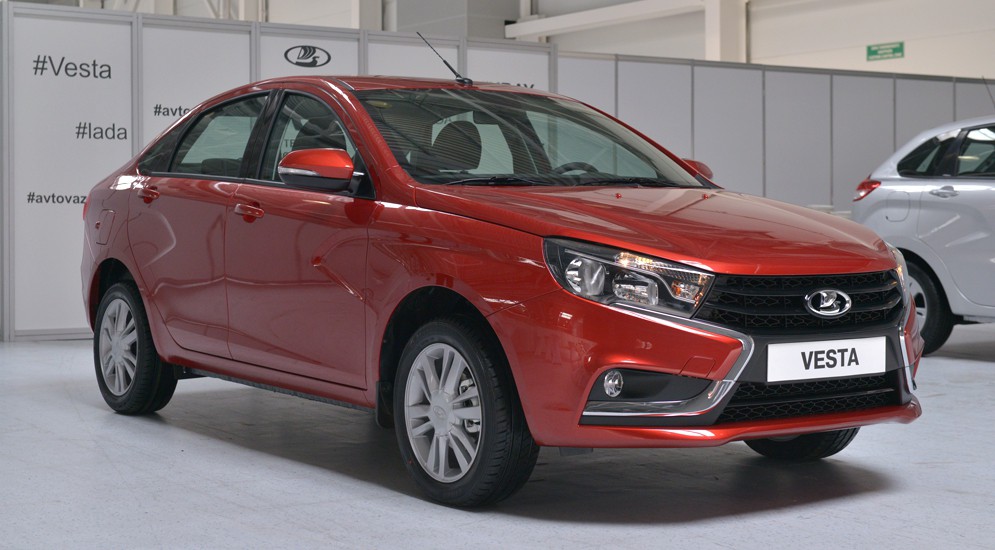
The Vesta was Russia's fourth best-selling model last month, with a volume of of 5,198, while the XRay sold 1,772, making it the No. 17 model.
Customer demand for the cars has exceeded expectations, Lada said.
The Vesta went on sale in November as Lada's flagship model. Through July, its sales were 28,092 in Russia. The XRay launched in February. Sales were 9,814 in the first seven months. Lada's total sales fell 10 percent to 146,107 through July.
Western brands suffer
Most Western brands suffered sales drops last month as the Russian market continued to fall.

Kia, the No. 2 brand by sales after Lada, saw its volume fall by 11 percent in July. Sales at Hyundai, the No. 3 brand, dropped by 12 percent. Volume at Renault, the No. 4 brand, fell 8 percent.
• Download PDF, above right, for sales by automaker, brand and model for July and seven months.
Among other brands, Ford sales fell by 7 percent while VW declined by 2 percent. VW Group's Skoda was a bright spot with volume up 12 percent.
Total market sales are down 14 percent to 781,605 in the first seven months.
Joerg Schreiber, chairman of the AEB's automobile manufacturers committee, said the Russian market is still in decline despite stable prices, high purchase incentives and continuing government support because many customers are still unwilling to spend money on a new car.
"Long term demand however remains high and is in fact building up as purchase decisions are being postponed. It is just a matter of time for this demand to be unlocked," he said in the statement.
After a decade of annual sales growth in excess of 10 percent and the expectation that the market could overtake Germany as Europe's biggest, the Russian auto industry has been badly hit by an economic crisis driven by low oil prices and Western sanctions over the Ukraine. Russian car sales have been declining for 19 months.
Automotive News Europe

Wednesday, 4 March 2015

Lada is taking advantage of civil unrest with growth in the Crimea.

Lada, Russia’s biggest car brand, has become a favorite in Crimea after its annexation by Vladimir Putin’s government. Having little competition helps.
AvtoVAZ, the maker of Lada cars, is enjoying booming demand in the Black Sea peninsula after international automakers vacated the contested region for fear of sanctions. Such concerns aren’t bothering AvtoVAZ, which enjoys close ties to the Kremlin even if Renault and Nissan Motor Corp. control a majority stake in the Russian automaker.
“We aren’t losing our time analyzing geopolitical issues if they don’t touch us directly,” said Vladimir Stepanov, an AvtoVAZ spokesman. “We have too much work to do.”

While the Russian automaker pushes to take advantage of opportunities in Crimea, Renault is caught in no man’s land and has suspended work at its own dealers in the region. The company can’t afford to rein in AvtoVAZ, which is a key part of its expansion in emerging markets. At the same time, Renault is 15 percent owned by the French government, which has been vocal in supporting tougher sanctions against Russia.
The first official Lada dealer opened in October and Crimean customers are now ordering 200 to 300 Lada cars a month, said Andrey Kudrin, director of the dealership. In 2013, when Crimea was part of Ukraine, China’s Geely was the biggest brand, while Lada’s sales totaled only 155 cars, according to Autostat.
“Demand for Lada cars is very high,” Kudrin said.
Little competition
AvtoVAZ CEO Bo Andersson participated in the opening ceremony of the dealership, one of the few official sales outlets in the region. Companies such as McDonald’s Corp. canceled business in the region. Apple Inc. products aren’t available in stores and Google Inc.’s services aren’t accessible on the peninsula.
“European or American car producers won’t risk opening car dealerships in Crimea,” said Oleg Datskiv, CEO at Auto-dealer.ru. “The market is too tiny.”
For AvtoVAZ -- which is partly owned by Russian state-held company Rostec -- every little bit helps. As Russia slides into a recession, car sales in the country are forecast to plunge about 24 percent this year after dropping 10 percent in 2014. In Russia, the brand delivered about 387,300 cars last year, giving it a 16 percent share of the market.

For 2015, AvtoVAZ expects to sell 3,000 Ladas in Crimea. That could help the company’s total deliveries rise 1 percent to 2 percent, said Andrey Rozhkov, an analyst at Metropol.
Lada sales in Crimea currently account for about 40 percent of the region’s demand, Kudrin said.
While AvtoVAZ expands in Crimea, Renault suspended work at dealerships in Simferopol and Sevastopol and is weighing ways to service clients in the region, said Ekaterina Tretyakova, a Renault spokeswoman in Moscow.
She declined to comment on AvtoVAZ’s activities in Crimea, while requests made to Renault’s headquarters in France were referred to its Russian partner.

Friday, 18 July 2014

Nissan Vows to Seize Market Opportunities Created by Rise of Mega-Cities and Changing Demographic Trends

Carlos Ghosn, president and CEO of Nissan Motor Co., Ltd., today announced the Japanese carmaker's launch timetable for the latest vehicle automation technologies aimed at accelerating consumer adoption of Autonomous Drive systems.
The Nissan CEO said new technologies including automated lane controls and highway traffic management systems, to be introduced over the next four years, would demonstrate to consumers the viability and value of Autonomous Drive systems, which Nissan intends to make commercially viable by 2020.
Autonomous Drive technologies, which are being introduced progressively by Nissan, are designed to enhance road safety and driving conditions by automating everyday tasks for motorists. Unlike pilot-projects for completely self-driving vehicles, currently undergoing preliminary tests elsewhere in the industry, drivers remain in control and "at the wheel" in Nissan models equipped with Autonomous Drive functions.
"By the end of 2016, Nissan will make available the next two technologies under its autonomous drive strategy," said Mr. Ghosn. "We are bringing to market a traffic-jam pilot, a technology enabling cars to drive autonomously – and safely – on congested highways. In the same timeframe, we will make fully-automated parking systems available across a wide range of vehicles."

In a speech to the Foreign Correspondents Club of Japan, he added: "This will be followed in 2018 by the introduction of multiple-lane controls, allowing cars to autonomously negotiate hazards and change lanes. And before the end of the decade, we will introduce intersection-autonomy, enabling vehicles to negotiate city cross-roads without driver intervention."

Nissan has been at the forefront of industry efforts to introduce greater automation in new vehicles, aimed at relieving motorists of mundane tasks while enhancing safety, reducing congestion and helping to lower emissions.

"In pursuit of those goals, Nissan must seize the growth opportunities created by major socio-economic trends affecting the world's car industry," added Mr. Ghosn.

He predicted that four major trends would drive demand for Autonomous Drive technologies, more zero-emission vehicles such as the Nissan LEAF, the world's best-selling electric vehicles, and greater in-car connectivity.

"The first is the rise of global mega-cities, which is increasing the need for innovations to ease congestion, reducing emissions and improve traffic management," said Mr. Ghosn. "Second, demand is growing for in-car communications that meet or exceed the high expectations of the digital generation. Our vehicles must be as connected as the smartphones and tablets that this generation depends upon day in and day out.
"Third, there is the need to bridge the generation gap by providing vehicles that appeal to the world's growing population of seniors. These consumers want technologies and automated systems that enable them to drive safely, for longer.
"Finally, the fourth mega-trend is the pressing need to embrace gender diversity. This means recognizing the vital role that women play as consumer-purchasers, decision-makers and managers throughout the car industry."
In a wide-ranging speech on new technology and changing market demographics, Ghosn said that the company expected more than 1.5 million Nissan vehicles to be connected to enhanced communications by next year, utilizing cloud-based systems to offer better access to social media, entertainment apps and voice recognition software among other services.
He predicted such services and greater vehicle automation would become more important amid the growth of mega-cities of more than 10 million people, with increasing road-use and need to cut both congestion and emissions. Among such road users, he cited demands from younger motorists for better in-car connectivity, the need to offer more automation for the senior generation and to make vehicle design, marketing and performance more attuned to women, who account for a large proportion of new car purchases.
"Nissan will be part of the transport solution in the growing number of megacities. We will continue to make our cars more connected. We plan to lead in delivering Autonomous Drive vehicles. And, in every part of the business, we are recognizing the unique needs of elderly drivers and the impact and influence of female customers." 

Tuesday, 15 July 2014

Second Datsun model for Russia has begun production.

  • Datsun on-DO production begins at AVTOVAZ plant in Togliatti
  • Datsun will start taking pre-orders in July
A new chapter in the Datsun story has begun with the start of production of Datsun on-DO, a new family sedan designed and engineered specifically for Russia.
Bringing affordable quality motoring within the reach of up-and-coming Russian customers, the four-door, five-seat car is being built at the Togliatti plant in Russia, a partnership between the Renault-Nissan Alliance and AVTOVAZ. A special ceremony took place today to mark the first Datsun on-DO coming off the production line.
The Datsun on-DO is being produced on one of the most modern lines in the AVTOVAZ facility. Plant personnel are using production techniques that have been developed and refined during the evolution of the Renault-Nissan Alliance, established 15 years ago.

More than 5,000 employees are involved in the production of the Datsun on-DO. Supervisors and shop managers have been trained to Alliance Production Way principles. Two dedicated training zones, manned by Nissan Motor specialists, ensure that the line staff uses Datsun assembly standards.
During the ceremony Vincent Cobee, global head of Datsun and member of the AVTOVAZ Board of Directors, said: "Today our plans have become reality. The start of Datsun on-DO production here at the AVTOVAZ plant in Togliatti is the pinnacle of the Datsun project in Russia and the result of months of collaboration and hard work. Datsun is coming to make the dream of purchasing a foreign car for the first time a reality for our Russian customers. Our brand provides access to worry-free ownership experience as well as trust by ensuring product reliability and transparency in services provided. The Datsun on-DO is a new choice for up-and-coming aspirational customers in Russia looking for new, high-quality, modern cars from a Japanese brand. I am confident that Datsun on-DO will be a success, and I would like to thank our partner, AVTOVAZ, for the effort that has made this day possible."
Bo Andersson, president of AVTOVAZ, added: "The launch of Datsun cars is a big success story for AVTOVAZ. I am proud of the contribution made during the Datsun on-DO's development and especially the way our engineers have been able to work with their Japanese colleagues. By benefiting from the manufacturing experience of our partners in the Alliance, and by virtue of working so well together, AVTOVAZ is stronger and more competitive. I am convinced that our employees are ready to reach the ambitious goals we have set."
Datsun on-DO is a modern, spacious, safe and well-equipped car created to tackle Russia's road and weather conditions. The result of joint development efforts of an international team of highly experienced engineers from Russia, Japan and other countries, Datsun on-DO was styled at the state-of-the-art Nissan Design Center in Atsugi, Japan.
Datsun on-DO pricing will start at 329,000 Roubles. The car will be available for pre-order at 25 dedicated Datsun brand dealerships in key regions of Russia from the second half of July. Start of sales is planned for the end of the summer.

Wednesday, 19 February 2014

Renault's Russian outpost posts loss for 2013, after large profit in 2012

Russia's largest carmaker, AvtoVAZ, reported a loss of 6.9 billion rubles ($196 million) for 2013 due to a slump in the country's auto market.

AvtoVAZ is owner of the country's best-selling brand, Lada. The loss compared to a profit of 211 million the previous year. Revenue fell 4 percent to 175 billion rubles, the company said, with sales of Ladas down 19 percent to 481,000 cars.


New AvtoVAZ CEO Bo Andersson announced plans recently to cut 2,500 jobs to help the company back to profit in a contracting market.

AvtoVAZ is due to come under the control of Renault-Nissan this year, with its new owners planning to win market share by taking the boxy Lada upmarket.


Russian auto sales have faltered as economic growth slowed, causing people to put off making large purchases. New-car sales fell by 6 percent in 2013, according to the Moscow-based Association of European Businesses (AEB), which expects deliveries to decline by 2 percent this year.

REPORT HERE