- Kia's first D-segment estate car
- Design remains faithful to 2015 SPORTSPACE concept
- Minimum 552 litres of cargo space with 40:20:40 split rear seats
- One-touch folding rear seats luggage rails and Smart Power Tailgate add to practicality
- Powered by an efficient and refined 1.7-litre diesel engine
- Up to 64.2mpg fuel economy, with CO2 emissions as low as 113g/km
- Available with a full range of advanced driver assistance systems
- Connectivity features include standard Android Auto or Apple CarPlay
- Priced from £22,295. On-sale 15 September 2016
A stylish and spacious large estate car, the Optima Sportswagon, joins the Kia range in the UK, priced from £22,295 on 15 September 2016. Kia's first ever D-segment estate car comes to the UK at the same time as a plug-in hybrid version of the Optima, giving the company two new opportunities to expand its business, especially in company fleets. In Europe, two-thirds of D-segment sales and 75 per cent of fleet sales in the class are taken by estate cars.
The Optima Sportswagon was designed in Europe and will be sold only in Europe. Its stylish exterior remains faithful to the highly praised SPORTSPACE concept revealed at the 2015 Geneva Motor Show. Style is not at the expense of practicality and versatility, however: the Optima Sportswagon has a minimum of 552 litres of cargo space, including two underfloor trays, and 1,686 litres with the rear seats folded. Stylish integrated roof rails are standard.
The Optima Sportswagon exudes the same exterior style and interior class as the saloon on which it is based – the two cars are identical in length (4,855mm) and width (1,860mm), but the Sportswagon is 5mm taller at 1,470mm because of the roof rails.
Like the Optima saloon, it is sold exclusively with a highly efficient, torquey and refined 1.7-litre turbodiesel engine. And it is available with a full suite of advanced connectivity and active driver assistance technologies, including Android Auto, Apple CarPlay (available later in the production run), Kia Connected Services powered by TomTom®, a harman/kardon eight-speaker audio system, Autonomous Emergency Braking, Smart Cruise Control and Rear Cross Traffic Alert.
The Optima Sportswagon in the UK
There are three trim lines for the new Optima Sportswagon – 2, 3 and GT-Line S – echoing those available for the Optima saloon. A sporty high-performance GT version will make that four variants early in 2017.
Standard equipment also matches what is available on the corresponding saloon and is unashamedly targeted at business users who make up the vast majority of buyers in this sector of the market. There are, however, certain additions exclusive to the estate. Roof rails are standard with all three trim lines, along with a luggage area DC power socket, a handle for one-touch folding of the rear seats, a luggage side partition and towing connection preparation. Level 3 adds a luggage rail system, boot lip trim and privacy glass in the rear doors, rear quarterlights and tailgate. GT-Line S is further distinguished by a Smart Powered Tailgate.
The entry-level 2 grade comes as standard with a 7.0-inch satellite navigation system with European mapping and a reversing camera, steering wheel-mounted controls, front and rear USB ports, dual automatic air conditioning with ioniser, a leather-trimmed steering wheel and gearshifter, cruise control with a speed limiter, electrically heated folding mirrors, a six-speaker DAB radio with MP3 compatibility and Bluetooth with music streaming. It has 17-inch alloy wheels, body-coloured door handles and mirrors, dual projection headlights with static cornering lights and LED daytime running lights, powered two-way driver's seat lumbar adjustment and remote central locking with a fold-away key, while the comprehensive safety provisions include Electronic Stability Control and Vehicle Stability Management, Hill-start Assist Control, Tyre Pressure Monitoring and an Electronic Parking Brake.
Grade 3 upgrades the navigation screen to 8.0 inches, has an eight-way power-adjustable driver's memory seat with four-way electronic lumbar adjustment, heated front seats and dual projection headlights. The exterior is distinguished by 18-inch alloy wheels, chrome and body colour exterior door handles, LED front foglights and rear combination lamps and chrome-coloured side sill mouldings. The black cloth seats have faux leather sections and there are satin chrome highlights on the touch-screen bezel. Rear electric windows with an auto up/down function and an anti-trap safety feature are also found on grade 3 along with a premium vision instrument cluster, satin chrome interior door handles and gloss black window switch panels. A harman/kardon Premium Sound system is also standard, while if the optional 7DCT automatic transmission is chosen there are paddle shifters for manual control and a Drive Mode Select function. Additional driver aids on grade 3 include Lane Keep Assist and a Speed Limit Warning.
GT-Line S supplements all this with different design 18-inch alloy wheels, a wireless mobile phone charger, 360-degree Around View Monitor, a Smart Park Assist System, Blind Spot Detection with Rear Cross Traffic Alert, Adaptive Smart Cruise Control, High Beam Assist, Autonomous Emergency Braking and a Smart Powered Tailgate. It has a tilting and sliding panoramic sunroof, LED headlights with automatic levelling, dynamic cornering lights, black leather upholstery with ventilated front seats and heated outer rear seats, alloy pedals, stainless steel door scuff plates, a smart key with illuminated start/stop button, LED front map lights and rear reading lights and ambient interior lighting.
Style AND practicality in one package
Some estate cars provide lots of space but are boxy and square. Others have sharper, more rakish lines, but sacrifice practicality as a result. The Optima Sportswagon is the best of all worlds – a sleek, beautifully proportioned D-segment car in its own right, but one with a vast amount of practicality and versatility for the business drivers who will be its primary customers.
Practicality was given parity with style throughout the design process. A wide tailgate and low lip make it easy to load heavy items, and the Smart Power Tailgate on GT-Line S opens automatically when the smart key comes into close proximity for more than three seconds. Integrated roof rails are standard across the range.
The 40:20:40 folding rear seats allow two people to travel in comfort while still leaving space for long loads. Grades 3 and GT-Line S have adjustable sliding luggage rails with built-in harnesses for securing cargo.
All this has been achieved with only minimal alteration to the dimensions of the acclaimed Optima saloon. The footprint of the two cars is identical, but the Sportswagon is 5mm taller because of its sleek roof rails. The Optima Sportswagon has 552 litres of cargo space behind the rear seats, including two underfloor storage boxes, and up to 1,686 litres with the 40:20:40 split rear seats folded.
The Optima Sportswagon is based on the SPORTSPACE concept which was one of the stars of the 2015 Geneva Motor Show, and has been modified only where legislation or practicality considerations demanded it. There are distinct treatments for grades 2/3 and the range-topping GT-Line S.
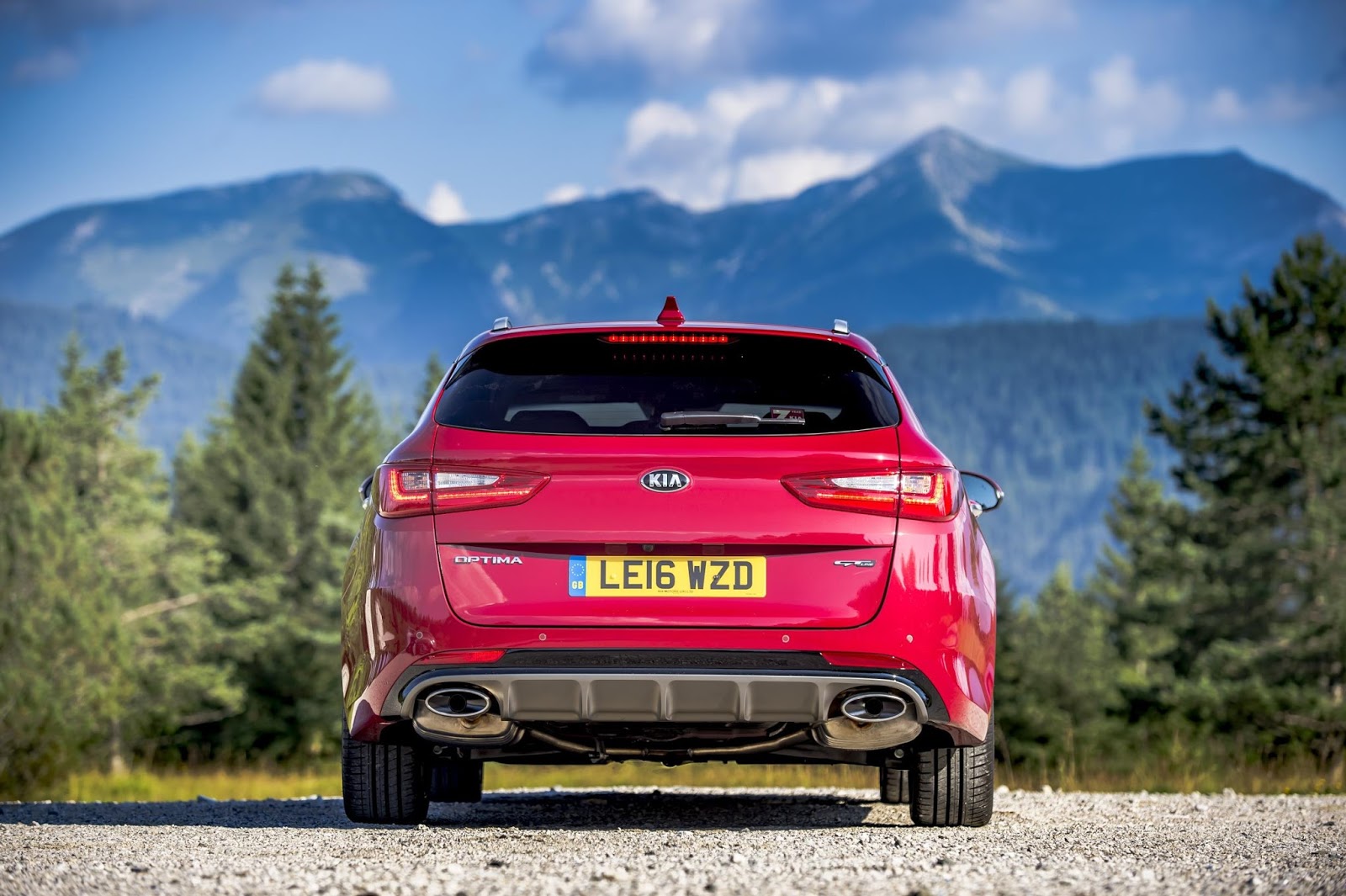
The front half of the Sportswagon, as far back as the B-pillar, is identical to the Optima saloon. From there, a rising shoulder line and more gently swept-back cabin with a raked rear window and tapering roof give the Sportswagon an elegant, sporty appearance. The rear lamps wrap around the corners and there is a single exhaust outlet.
The GT-Line S is distinguished by GT-Line bumpers and side sills, bespoke 18-inch alloy wheels, full LED front lamps with automatic levelling, dynamic cornering lights, LED rear combination lamps, a dual chrome-tipped exhaust system built into a rear diffuser, satin chrome and body-coloured exterior door handles and silver metallic-trimmed side sill mouldings.
A modern high-quality interior
The Optima Sportswagon has the same modern, horizontally structured dash layout as the saloon, and the same high-quality fit and finish. The centre console of the driver-focused fascia is angled at 8.5 degrees towards the person behind the wheel. The central 7.0- or 8.0-inch touch-screen is set at exactly the same height as the instruments in the main cluster to make it easier for the driver to absorb information quickly.
The fascia is divided into upper display and lower control zones, and the number of buttons and switches has been kept to a minimum because as many functions as possible are accessed via the touch-screen, simplifying use and giving the cabin a less cluttered look.
The interior is trimmed in black cloth, black cloth with faux leather or black leather, depending on model grade. A faux leather finish has been applied to the door and centre console armrests; black leather is standard on the gearlever and steering wheel; and the door switch panels, door handles and interior bezels are trimmed with either metallic paint or satin chrome.
The impressive quality is also apparent in the soft-touch materials, interior lighting – LED at the top of the range – and, on the road, greater refinement as a result of the extensive application of sound-proofing.
The seat frames, like those in the Optima saloon, are stiff and light, reducing the levels of vibration felt by occupants. For GT-Line S the black leather seat backrest and cushion areas are arranged into wide tubular sections for greater comfort, and the leg and torso bolsters are more pronounced than those in other grades. GT-Line S seats also feature red stitching, which is repeated on its D-shaped steering wheel. The range-topping model also has alloy pedals.
Fully connected with Android Auto and Apple CarPlay
The Optima Sportswagon comes with a full suite of connectivity features, including Android Auto and Apple CarPlay. Android Auto connects the car to the user's smartphone and, via pre-downloaded apps, gives access to Google Maps navigation, Google Play music, hands-free calls and texts and voice recognition. Apple CarPlay, available later in the production run, will enable full Siri voice control of the phone's apps and functions while linking the car to Apple Maps, calls and text dictation, music streaming and audiobooks.
At the heart of it all is the latest Kia audio-visual navigation (AVN) system, operated via either a 7.0- or 8.0-inch touch-screen and featuring Bluetooth hands-free mobile phone connectivity with audio streaming. The navigation screen is linked to a rear parking camera. The AVN system includes a DAB digital radio or, on grades 3 and GT-Line S, a 490-watt harman/kardon eight-speaker Premium Sound system with an external amplifier and sub-woofer and Clari-Fi technology to restore the sound usually lost when digital music files are heavily compressed.
There are USB charging points in the front and rear in every model, while the GT-Line S includes a wireless charger for topping up the batteries of smartphones.
The AVN system offers the full Kia Connected Services package powered by TomTom®. This provides live traffic updates, speed camera alerts and local point-of-interest and weather reports. It is provided free for seven years.
High-strength body and active safety technologies
Like the Optima saloon, which earned a five-star rating in Euro NCAP impact tests, the Sportswagon will provide exemplary passive and active safety thanks to its high-strength lightweight body, occupant restraint systems and advanced active driver assistance features.
Just over half of the body (51 per cent) is made of advanced high-strength steels, particularly to reinforce the A- and B-pillars, side sills, floor and front wheel arches. Special attention was given to the roof and C-pillars in the transition from saloon to estate. Six airbags are fitted as standard.
Electronic Stability Control and Vehicle Stability Management are also standard. These can automatically counteract any loss of traction when cornering or setting off on surfaces with differing levels of grip from left to right.
Depending on model, the Optima Sportswagon is available with a series of features to supplement the driver's vision and control. They include Lane Keep Assist and a Speed Limit Autonomous Information function on grades 3 and GT-Line S, plus Autonomous Emergency Braking, Blind Spot Detection with Rear Cross Traffic Alert and High Beam Assist for the range-topping model. Autonomous Emergency Braking with pedestrian detection brings the car to a halt at speeds of up to 50mph if the driver fails to react to a potential accident. Uniquely in class, this uses both short- and long-range radars to identify other vehicles and pedestrians over a wider range of speeds.
GT-Line S also has a 360-degree Around View Monitor which, through four strategically mounted cameras, gives the driver a bird's-eye view of the car when manoeuvring, plus a Smart Park Assist System which automatically steers the car into parallel or perpendicular parking slots while the driver works the accelerator and brakes. There is a reversing camera and audible front and rear parking sensors in every model.
Powertrain
The Optima Sportswagon is powered exclusively by Kia’s 1.7- CRDi turbodiesel engine, which develops 139bhp and 340Nm of torque. It delivers outstanding performance for an engine of this capacity with effortless driveability.
The engine was engineered at Kia’s European research and development centre in Germany and features high-pressure common-rail fuel injection for maximum efficiency and a variable geometry turbocharger to enhance low-speed driveability while ensuring strong top-end power.
With Kia's Idle Stop & Go (ISG) engine stop/start system as standard, CO2 emissions of manual models are 113g/km, only 3g/km more than the saloon, while fuel economy is a highly impressive 64.2mpg. With the 7DCT dual-clutch automatic gearbox, which is available in grades 3 (optional) and GT-Line S (standard), emissions are 120g/km, while fuel economy is 61.4mpg.
The manual has a 0-60mph acceleration time of 9.8 seconds, while with the 7DCT 0-60mph takes 10.7 seconds. With either transmission the top speed is 124mph.
The 7DCT versions have Drive Mode Select featuring three options – Normal, Eco and Sport – which alter the transmission shift timing, throttle mapping and steering wheel weighting accordingly. Steering wheel-mounted paddles allow the driver to take manual control of gearshifting at any stage.
Bespoke suspension settings
The Optima Sportswagon is a spacious, versatile estate car – but that doesn't mean it cannot be fun to drive. A stiff body structure, all-round independent suspension, crisp steering and powerful brakes combine to give sharp, sporty driving characteristics with supreme long-distance comfort and refinement, aided by extensive measures to reduce noise, vibration and harshness (NVH).
The Optima Sportswagon has the same fully independent suspension at all four corners as the saloon, with subframe-mounted MacPherson struts, coil springs and twin-tube gas-filled dampers at the front and a subframe-mounted multi-link system with coil springs and twin-tube gas-filled dampers at the rear. There are front and rear anti-roll bars. As a result, it delivers the same agile handling, smooth ride and high-speed stability as the saloon with which it shares its wheelbase and track widths. However, the spring and damper rates and alignment settings have been fine-tuned to take into account the Sportswagon's slightly more rear-biased weight distribution, and the fact that it is likely to be carrying heavier loads.
Like the saloon, the Sportswagon features Kia's rack-mounted motor-driven power assisted steering system (R-MDPS). By mounting the power steering function directly on the rack rather than the column, the engineers have been able to give the car quicker and more linear responses to driver inputs, particularly around the straight-ahead, with greater feel. The Optima Sportswagon is one of the most agile estate cars in its market segment. As an added benefit, R-MDPS gives approximately three per cent fuel savings because it draws on engine power only when the car is turning.
There are large disc brakes on all four wheels, ventilated at the front, with anti-lock (ABS), Electronic Brake-Force Distribution (EBD) and Brake Assist, giving the car powerful emergency stopping power, regardless of the force applied to the pedal by the driver. The Optima Sportswagon also comes with Hill-start Assist Control (HAC), which maintains brake pressure for two seconds after the driver releases the pedal to ensure smooth transitions when setting off on inclines.
Market, warranty and after-care
In keeping with every Kia, the Optima Sportswagon comes with the company’s unique-in-the-UK seven-year or 100,000-mile warranty, subject to certain wear and tear conditions. The warranty is fully transferable should the car be sold before the time or mileage limits have been reached. Should the car be sold through a Kia Used Approved dealership and the car is less than 18 months old or has fewer than 18,000 miles on the clock, it is topped up to match that of a new model.
For retail customers the Optima Sportswagon is available with Kia’s Care-3 and Care-3 Plus servicing packages, offering fixed-cost, inflation-proof servicing for the first three or five years. All packages cover the car, not the owner, so are transferable should the vehicle be sold.
UK Optima Sportswagon line-up
| Model | Power bhp | Torque Nm | 0–60 sec | Max speed mph | Average mpg | C02 g/km |
| 1.7 CRDi ‘2’ | 139 | 340 | 9.8 | 124 | 64.2 | 113 |
| 1.7 CRDi ‘3’ | 139 | 340 | 9.8 | 124 | 64.2 | 113 |
| 1.7 CRDi ‘3’ 7DCT | 139 | 340 | 10.7 | 124 | 61.4 | 120 |
| 1.7 CRDi ‘GT-Line S’ 7DCT | 139 | 340 | 10.7 | 124 | 61.4 | 120 |
Pricing
| Model | Price |
| 1.7 CRDi ‘2’ | £22,295 |
| 1.7 CRDi ‘3’ | £24,495 |
| 1.7 CRDi ‘3’ 7DCT | £25,895 |
| 1.7 CRDi ‘GT-Line S’ 7DCT | £30,595 |