Purpose

I will try my best to provide detailed info on various cars and what is like to live with them, I have already produced a few for Jaguar-car-forums, I will do my best to be unbiased, but it will be hard for some cars. I will re-produce press releases and copy from other motoring news.
Showing posts with label euro ncap. Show all posts

Sunday, 13 August 2017

The Insignia from Vauxhall gains the full five star result from Euro NCAP, both Saloon & Estate.

The all-new Vauxhall Insignia, in both Grand Sport and Sports Tourer body styles, has been awarded the maximum five stars from Euro NCAP making it one of the safest cars on the market. It achieved exceptionally high scores for its occupant protection for both adults and children, pedestrian protection and safety assist technology. 
In Vauxhall showrooms now, the Insignia has a number of new active and passive safety technologies available, and Euro NCAP made special mention of two of the car’s innovative safety features. The active bonnet, which lifts up in milliseconds in the event of a collision increasing the distance to the engine for improved pedestrian protection. Testers at Euro NCAP commented that it: “operated robustly for a variety of pedestrian statures and over a wide range of speeds.”
 
It was also noted that the Automatic Emergency Braking system, which can detect pedestrians and other vehicles, “performed well and showed good performance at highway speeds, with accidents avoided or mitigated.” 
“The five-star rating from Euro NCAP helps to demonstrate the design and innovation that can be found throughout the new Insignia, making it one of the safest models in its class,” said Dougie McColm, Vauxhall’s Brand Manager - Insignia. “The latest technologies included within the new Insignia work together to provide ultimate safety, not only for the car’s driver and passengers, but also for other road users and pedestrians.” 
The new Insignia features a wide range of intelligent safety technologies in addition to the active bonnet and Automatic Emergency Braking systems. One such technology is the next generation of Vauxhall’s innovative and award-winning IntelliLux LED matrix light, with 32 LED segments, all integrated in the new slimmer headlights of the Insignia. 
The increased number of LED elements enables the various light patterns to adapt to the prevailing traffic situation with seamless transitions between each mode. This results in an improvement in both the quality of light distribution and light intensity. 
New functions, including curve and spotlight illumination, improve long-range visibility especially when driving at night. If drivers find themselves taking a curve with the full beam engaged, the light intensity automatically rises based on the steering angle, in order to increase illumination and help the driver to see the road situation ahead. Each headlight also features a high-beam spotlight for additional illumination of up to 400m, further improving the Insignia Grand Sport’s long-range visibility. 
Head-up-Display technology is also available. This displays information on speed, traffic signs, speed limiter setting and navigation direction onto the windscreen in the driver’s direct line of sight ensuring that their eyes remain on the road. 
Available as part of the standard spec, the Lane Keep Assist with Lane Departure Warning (LDW) provides gentle steering wheel movements (and LDW alerts if necessary) to help drivers avoid accidents by unintentionally drifting out of their lane. The new Insignia is available with Adaptive Cruise Control (ACC), which measures the distance to the vehicle in front and adapts the speed accordingly. ACC will initiate automatic emergency braking if the distance decreases abruptly. 
The optional Rear Cross Traffic Alert system uses radar sensors in the rear bumper to detect objects coming from up to 20m at 90 degrees from the left or right side behind the vehicle. Forward Collision Alert assists drivers in avoiding or mitigating the impact of front-end collisions with situation-dependent emergency braking settings. If the Insignia nears the vehicle ahead too quickly, the system warns the driver with a loud audible alarm, a visual warning in the instrument cluster and an LED projection on the windscreen. 
Parking is easier too thanks to Advanced Park Assist. Ultrasound sensors on the Insignia’s front and rear bumpers identify suitable parking spaces and detect possible obstacles. When the parking spot is calculated, the system automatically parks the vehicle without the driver needing to touch the wheel, only requiring the driver control the pedals and gears.

Monday, 7 August 2017

A selection of cars gain the five stars, with one each for 3 and 4 in the latest Euro NCAP tests.

  • Retest of Ford Mustang shows safety improvement, secures Three Star Euro NCAP rating 
  • “This underlines the power of the Euro NCAP consumer testing programme,” says Thatcham Research 
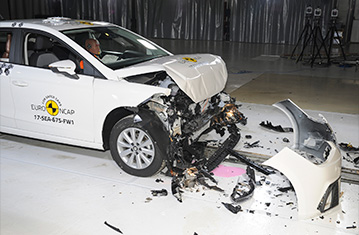
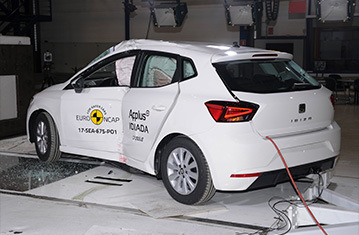
  • SEAT Ibiza the standout of other vehicles tested, raises the bar in Supermini safety 
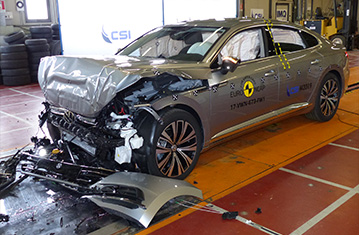
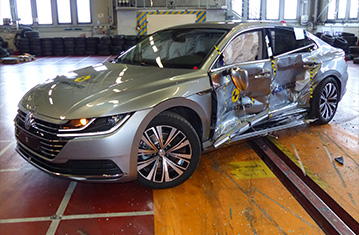
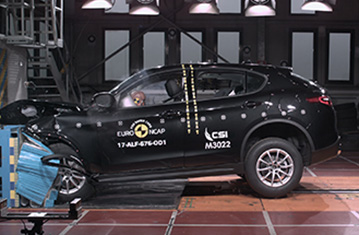
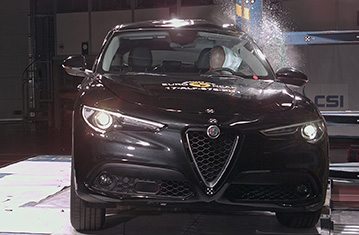
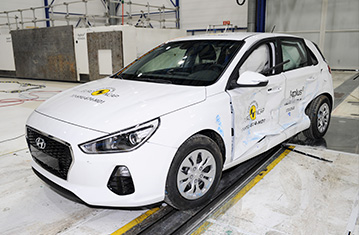
  • A further four vehicles tested – Five Star ratings for the Alfa Romeo Stelvio, VW Arteon and Hyundai i30, Four Stars for the Honda Civic
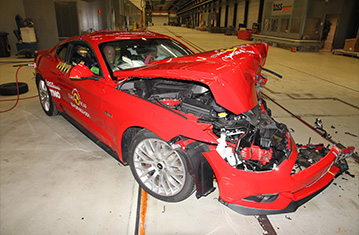
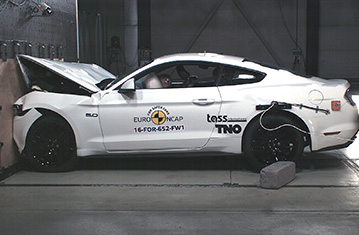
Following an unfavourable safety rating earlier this year, Ford has resubmitted its flagship Mustang sports car for testing, on this occasion earning a Three Star Euro NCAP rating. This follows the addition of standard-fit Pedestrian Detection, Forward Collision Warning, Autonomous Emergency Braking (AEB) and a Lane Keeping Aid, while rapidly addressing a ‘bottoming-out[1]’ issue with the driver’s airbag.

“In just a few months, Ford has responded to improve on the initial low safety rating given to the Mustang,” comments Matthew Avery, director of research at Thatcham Research. “Our advice to buyers is to always opt for a Euro NCAP Five Star car, so a Three Star Euro NCAP rating is never a cause for celebration. 
However, Ford’s rapid addition of a suite of standard-fit safety tech and its prompt updates to improve the performance of the airbags and restraints is to be applauded and underlines the power of the Euro NCAP consumer testing programme as a force for positive action. We will continue to apply pressure on carmakers to ensure UK drivers have the safest possible cars.”
Take a SEAT
July’s standout vehicle was the SEAT Ibiza, which at £13,000 is a relatively affordable and well-reviewed Supermini. Avery comments, “SEAT has set a new benchmark in safety for the Supermini price point category. The Ibiza not only comes with standard-fit AEB but also Pedestrian AEB – which is proven to reduce vulnerable road user deaths.
“The new VW Polo will be built on the same platform as the Ibiza which bodes well and with major new Supermini launches expected later in 2017, the safety game is now on for carmakers in this category.”
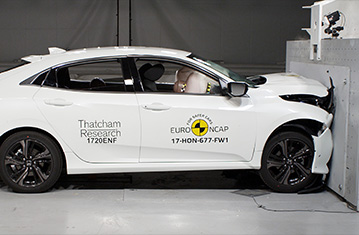
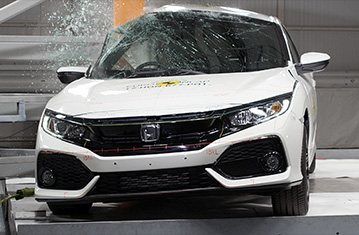
Four other vehicles were tested by Euro NCAP this month, with all but one achieving a Five Star rating. The Alfa Romeo Stelvio, VW Arteon and Hyundai i30 all received the maximum Five Stars. The Honda Civic was awarded a Four Star Euro NCAP rating, despite having standard-fit AEB. This was in part due to the head of the rear passenger dummy representing a 10 year old recording a hard impact through the curtain airbag

Thursday, 8 June 2017

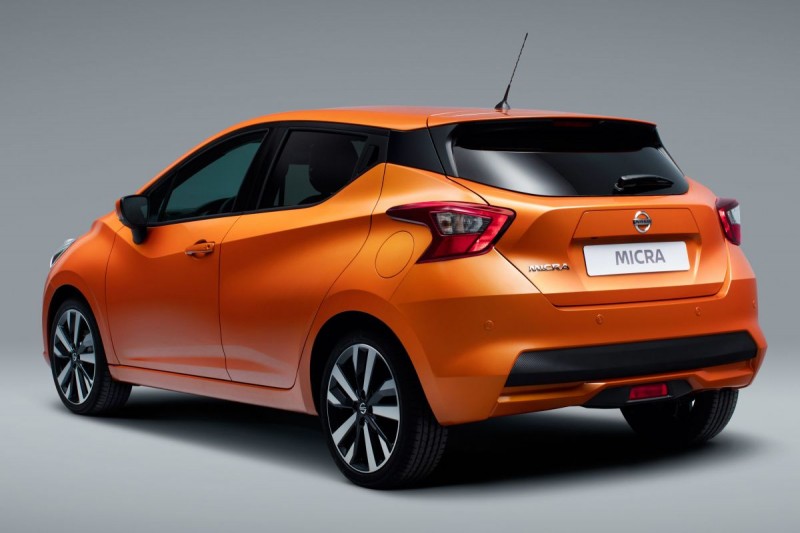
The all-new Nissan Micra now comes with the full five star Euro NCAP, gained with ease.

  • All-new Micra gets highest star-rating in the UK under latest dual-test system
  • Standard-fit Intelligent Emergency Braking with Pedestrian Recognition and Intelligent Lane Intervention helped secure the five star rating
  • All-new Micra on sale now across Europe and available for test drives 
The all-new Nissan Micra has been awarded a five-star safety rating in the UK from Euro NCAP, thanks to the standard fitment of intelligent driving technologies in the Safety Assist category of testing. 
The Micra was tested under Euro NCAP’s newest protocols. The UK range of Micra achieves the maximum possible five stars thanks to an extensive set of safety features standard across all grades. 
Every Micra is fitted with Intelligent Emergency Braking (IEB), an intelligent driving technology which can detect a slowing or stopping vehicle ahead and automatically apply the brakes. Depending on the relative speeds, this can avoid an impact or reduce the severity. 
Also standard across the range is Pedestrian Recognition technology, which is linked to IEB, and Intelligent Lane Intervention (ILI), a first for the B-hatchback segment. 
When ILI is activated – for example, by crossing a line in the centre of the road – the steering wheel gently vibrates. The car’s brakes are automatically applied, individually depending on the direction of travel required, to guide the driver smoothly back into the correct lane. 
When taken into account by Euro NCAP, this extensive set of features earned the new Micra a high Safety Assist score, contributing to an overall rating of five stars. 
Every new Micra comes with six airbags as standard, plus seat belt warnings and seat belt height adjustment in the front. The Isofix car child seat fitting system can be used with the new Micra, including in the front passenger seat, for the best possible child protection. 
Additional safety features on every Micra include Electronic Stability Program, anti-lock brakes and Hill Start Assist. A speed limiter, automatic headlight sensor, automatic hazard lights and a Tyre Pressure Monitoring System are also fitted. 

Monday, 5 June 2017

The latest round of Euro NCAP results cover four cars which gain four or five stars.

Today, Euro NCAP releases the results of four new cars.  The MINI Countryman and Å koda Kodiaq are both awarded a five-star rating.  
Nissan’s new Micra gets four stars with standard equipment and five stars with the optional safety pack (1).  The Suzuki Swift is rated as three stars as standard and four stars with the optional safety equipment.
All cars reach the five star levels for adult occupant protection, child protection and pedestrian protection.  The differences come in the fitment of advanced driver assistance systems.  
The Å koda Kodiaq is equipped as standard with an AEB system that detects pedestrians as well as other cars.  The Kodiaq’s five-star rating continues Å koda’s recent good form: all recently tested Å kodas have been rated as five stars. 
The MINI has AEB car-to-car as standard and pedestrian detection as an option.  Nissan put AEB pedestrian and lane assistance in the option pack (‘Euro NCAP 5* Pack’) of the Micra, nudging the four-star rating with standard equipment into five-star territory with the option pack fitted.  
Only the Suzuki Swift does not offer AEB pedestrian, with AEB car-to-car in its ‘Radar Brake Support’ option pack.
Euro NCAP Secretary General, Michiel van Ratingen, said, “Euro NCAP started rewarding AEB pedestrian systems last year and we have seen a rapid uptake of the technology.   
We hope to see as fast an adoption of AEB systems that detect cyclists when tests of those systems form part of the rating next year.  
For twenty years, Euro NCAP has been pushing manufacturers to fit new and better safety technologies: originally, such things as airbags and pre-tensioners and, nowadays, advanced driver assistance systems that will form the building blocks for the automated vehicles of tomorrow.”

Saturday, 22 April 2017

The latest round of testing for the Euro NCAP has taken place with results at either end of the star system.

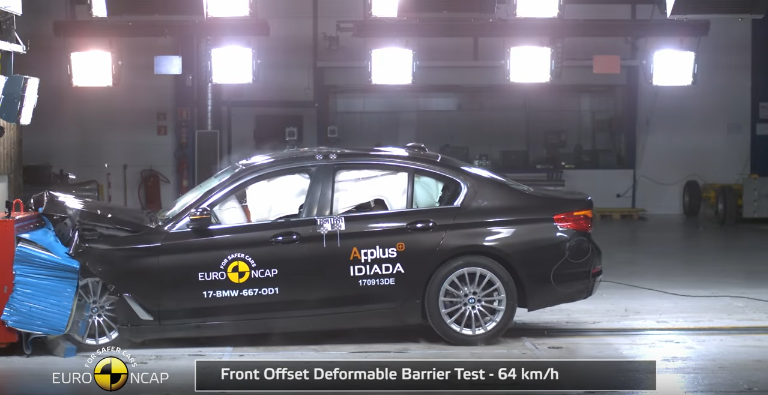
Euro NCAP releases the test results of two new cars. The BMW 5 Series gets a top five-star safety rating and FIAT’s made-over Doblò gets three stars.
Launched late last year, the seventh-generation BMW 5 Series continues its successful track record in Euro NCAP’s Executive Car segment. 
The car showed good all-round performance in crash protection and avoidance tests thanks to its new platform, body and updated safety features. 
Track tests demonstrated that the autonomous braking system can effectively assist the driver in avoiding or mitigating critical rear-end crashes with other cars and pedestrians. 
With an 81 percent score, the 5-series particularly impressed in pedestrian safety through its standard-fit “Person Warning” system and active bonnet.
Thirteen years after the tests on the original FIAT Doblò, Euro NCAP has taken another look at the versatile small MPV. The latest generation Doblò was already introduced in 2010 and is also sold by Opel and Vauxhall brands as Combo. 
The version tested by Euro NCAP is the 2015 Doblò facelift that includes, apart from small safety updates, cosmetic upgrades aimed at extending the lifecycle of the car. 
The three-star Euro NCAP safety rating, however, reveals the car’s true age and highlights the lack of ambition to compete on safety with other, more modern competitors in the segment. 
The Opel/Vauxhall Combo has not received a similar facelift, so would be expected to end up with even fewer stars, but Opel have their eyes fixed on the future.

Tuesday, 21 March 2017

Euro NCAP tests six new cars with ratings varying from 3 stars to the full 5 star rating.

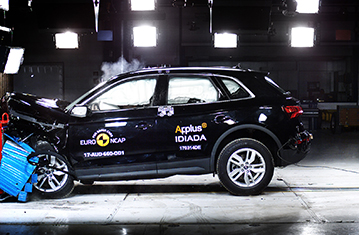
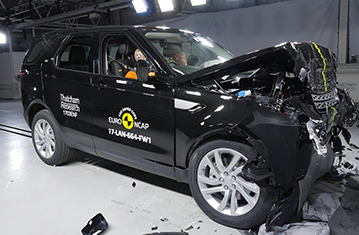
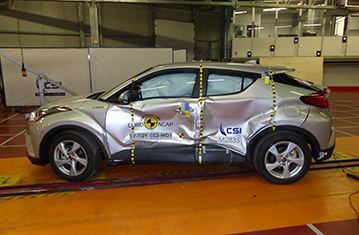
Euro NCAP releases the results of six new cars. The Audi Q5, Land Rover Discovery and Toyota C-HR all get a top five-star safety rating; Citroën’s C3 gets four stars; and FIAT’s ageing 500 and Ford’s brand new Ka+ notched up three out of five stars apiece.    
The new Audi Q5 and Toyota C-HR showed good all-round performance in all areas of assessment to earn their five-star ratings. The Land Rover Discovery scored highly enough to merit a five-star rating, but not without problems. 
In the frontal offset test, the driver airbag bottomed out owing to insufficient pressure and, in the side barrier test, the driver’s door became unlatched.
Grateful thanks to Euro NCAP for the use of the pictures.
Euro NCAP’s Secretary General, Michiel van Ratingen, said, “Jaguar Land Rover has an ambitious programme of new model releases in the coming years. We hope that this challenging schedule and tight development times do not compromise the safety of the vehicles offered, and we hope that they will take our findings onboard”.
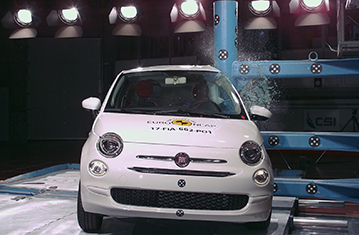
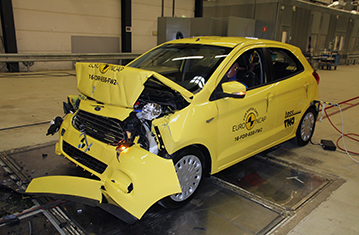
Still going strong more than 10 years after it first hit markets, FIAT’s reincarnation of the iconic 500 continues to be a popular choice in the supermini segment. Euro NCAP tested the recent facelift against the latest safety rules and benchmarked its performance with two newcomers in the same segment, the all-new Citroën C3 and the low-cost Ford Ka+. Superminis are extremely popular in the European new car market and the segment is very price-sensitive. To deliver attractive yet affordable cars, manufacturers are tempted to cut down on safety equipment, emphasising great looks and style instead. Case in point are the FIAT 500 and the Ford Ka+ that lack rear seatbelt pretensioners and load-limiters, by now standard on most cars on the market.
In the full-width frontal crash test, introduced in 2015, the 500 showed poor protection of both the driver and the rear seat passenger. In the Ka+, chest protection was rated as poor. Both cars also lack autonomous braking technology, already offered on half of new models today. The Citroën C3 on the other hand performed much more robustly: it narrowly missed a top five-star rating, falling only just short of the threshold in pedestrian protection.
Euro NCAP’s Secretary General, Michiel van Ratingen, said, “The 500 is an old car by now and the small improvements that FIAT have made on the facelift don’t hide that. Consumers may be better off waiting for the all-new 500 and hope that FIAT will take the opportunity to offer a vehicle that competes on safety with its competitors, as the original did 10 years ago. Unfortunately, high hopes for the segment are smashed by Ford by releasing a brand new Ka+ with mediocre safety performance. The car lacks the more sophisticated restraint systems offered by most of its rivals, let alone more sophisticated technology like autonomous braking. The new C3 shows that a respectful rating is achievable also for superminis.”               
Detailed results and crash test pictures of these cars are published on our website. All videos are available on our YouTube channel. For media requests, please contact Marie Brasseur at media@euroncap.com. More safety ratings will be released on April 12, 2017

Sunday, 5 February 2017

20 years ago, the new safety standard was introduced, today we compare a car from 1997 to one today.

  • 182,000 killed and seriously injured car occupants saved in the UK since car testing began in 1997, primarily through the ground-breaking work of Euro NCAP
  • UK car occupant deaths and injuries down by 63 per cent over 20 years
  • Cars ‘safest ever’ with 9 out of 10 cars sold on the European market holding a Euro NCAP rating
  • 2,700 deaths and serious injuries in the UK could be saved every year if AEB that can sense both pedestrians and cyclists became standard on every new car
  • Consumers urged to ONLY buy Euro NCAP Five Star-rated cars with collision avoidance technology like AEB and Lane Assist systems
  • New tests in 2018 to address lane control, pedestrian night-time safety, junction crashes and cyclist protection
MORE than 182,000 killed and serious injuries have been saved on UK roads since revolutionary Euro NCAP car safety tests were launched 20 years ago. This equates to 15,000 per annum.
The tests, introduced in February 1997 and in the face of fierce motor industry opposition, exposed hidden dangers in top-selling family cars, forcing a fundamental rethink in the way vehicles were designed to prevent injuries and save lives.  Twenty years on, 9 out of 10 cars sold on the European market hold a Euro NCAP rating.

Today, as the results of a crash-test between two family cars built 20 years apart (a 1997 Rover 100 and a current Honda Jazz) underline major advances in vehicle safety, Thatcham Research, who conduct UK tests for Euro NCAP, estimates that advances driven by rigorous testing has helped deliver a 63 per cent reduction in car occupants killed and seriously injured, from 23,000 in 1997 to 8,500 in 2015.
Over the same period the number of pedestrians and cyclists killed or seriously injured has fallen by 40 per cent, from 14,500 in 1997 to 8,500 in 2015.
Demanding safety as standard
Thatcham Research is marking the 20th anniversary by urging consumers to further boost Britain’s road safety record by making a commitment to buy only models with a five star Euro NCAP rating and a collision avoidance technology like AEB and Lane Assist systems.  They also called on manufacturers to make AEB (Autonomous Emergency Braking) standard fitment, to prevent thousands of accidents.
The call came as Thatcham Research, which conducts Euro NCAP tests in the UK, estimated that if AEB that can sense pedestrians and cyclists became standard on every new car sold in the UK, it would save 2,700 pedestrian and cyclist deaths and serious injuries every year.  Over 20 years, this would mean 54,000 fewer.
“As we mark 20 years at the forefront of road safety, we are very proud that Euro NCAP’s programme of safety tests has achieved major, life-saving improvements in cars and has helped Europe reach the lowest road fatality rate for any region in the world,” said Euro NCAP’s Secretary General, Michiel van Ratingen.
“Euro NCAP has given millions of consumers the knowledge and confidence to choose the safest cars possible. Recent years have shown a slowdown in the progress rate, however, so we mustn’t take our foot off the gas. We want to ensure that Europe’s roads get even safer in the next 20 years, not just for car occupants but for all participants in traffic. We already test many more aspects of a car’s safety than we did when we started in 1997, and that is set to continue. Next year, we will test systems that recognise and avoid crashes with cyclists, and we’re lining up a very challenging roadmap for 2020 to 2025.”
Consumer outcry, manufacturers under scrutiny
Since 1997 Euro NCAP has assessed 629 different car models, resulting in nine out of 10 cars now sold in Europe holding an official Euro NCAP rating. Safety technologies that were non-existent or optional at best - such as driver and passenger airbags, side curtain airbags, seatbelt reminders and electronic stability control – are now standard on most cars sold in Europe.
Backed by the UK Government, the FIA (Federation Internationale de l’Automobile) and the Swedish and Dutch Governments, the first Euro NCAP crash test results were revealed on February 4 1997. Until then car makers had to meet only basic legislative crash test requirements for new cars. They conducted their own crash tests but they were not standardised - and the results were not published. It was impossible for consumers to compare the safety of one car with another.
Euro NCAP’s programme turned these principles on their head. 1997 was the first time that realistic, like-for-like tests had been conducted by independent experts and the results sparked outrage from consumer groups, the public and the media.
“Euro NCAP has fundamentally changed the way that vehicle buyers and vehicle manufacturers value safety,” said Peter Shaw, chief executive at Thatcham Research. “In 1997, many motorists were still choosing not to wear seatbelts. Only a few years later we were demanding airbags, side impact protection and other safety systems. You’re now twice as likely to walk away from a car cash compared with twenty years ago. These major changes in the way people and manufacturers prioritise safety are all thanks to Euro NCAP.
“The focus now is all about crash prevention. Making sure that Britain’s roads continue to become even safer, not just for car occupants but for every road user.  We have come a long way since the days when manufacturers met only the most basic, mandatory, safety requirements but we must continue to apply pressure.”
Major industry pushback
In the first test, of seven popular ‘super-mini’ sized cars, the Ford Fiesta and Volkswagen Polo each achieved three stars out of the then-maximum of four, based on protection levels offered to adult occupants.
The top-selling Rover 100 (formerly the ‘Metro’) achieved only one star while the Fiat Punto, Nissan Micra, Vauxhall Corsa and Renault Clio achieved only two stars. When pedestrian protection was assessed, no vehicle scored more than two points, suggesting that manufacturers were not designing front ends with vulnerable road users in mind.
Leading car manufacturers attacked the tests, claiming they were so severe that it was ‘impossible’ to achieve four stars. Five months later, however, Volvo’s S40 became the first four-star car for occupant protection. Manufacturers now compete to out-perform rivals in Euro NCAP tests - and regularly use the ratings in their advertisements.
Today, leading figures hailed the Euro NCAP tests as a major turning point in delivering safer cars. 
Max Mosley, the first Chairman of Euro NCAP and Chairman of Global NCAP said: “Twenty years on from what started as a controversial programme, rejected by manufacturers, and supposedly aiming for unrealistic safety standards, Euro NCAP is now firmly part of the automotive mainstream. Thousands of fatalities have been prevented, consumer demand for safety is high, manufacturers compete on safety rating results, and vehicle safety standards continue to improve.”
“The consumer awareness model deployed so effectively by Euro NCAP has not just fundamentally changed the European market, it has helped to catalyse other NCAPs across the world in middle and low income countries. Consumer pressure informed by crash tests is helping to make rapid changes in levels of safety in India, Latin America and the ASEAN region. Euro NCAP has truly had a global impact, a proud road safety legacy that has saved countless lives.”
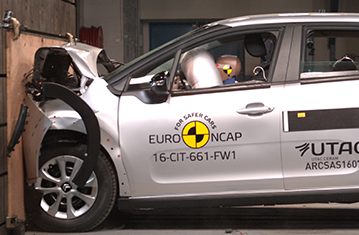
Euro NCAP President and Thatcham Research Chief Technical Officer, Andrew Miller: “The impact of these tests cannot be overstated. Until Euro NCAP, consumers only had the manufacturers’ word for it. Now we have the safest cars ever and the safety levels of each car are there for all to see. This success could only be achieved by actively working together in Europe under one umbrella and by continuing to invest in better safety.”
Since 1997, Euro NCAP tests have become ever more demanding and cars can now achieve a maximum of five stars, awarded not just for how they protect occupants and pedestrians in a collision, but on the car’s ability to avoid a crash in the first place. The tests represent real-life accident scenarios that could result in the death or injury. Top achievers must demonstrate that their cars are fitted as standard with technology that avoids or mitigates such crashes and, where a crash is not avoidable, adequate protection is offered to car occupants and other road users.
New tests for 2018
Other new technologies being tested by Euro NCAP for inclusion in the 2018 rating system, include: Lane Assist systems to control steering if there are potential risks; tests to reduce crashes at junctions; Pedestrian AEB that works at night time and new AEB cyclist detection tests to encourage manufacturers to further enhance these important technologies.