Purpose

I will try my best to provide detailed info on various cars and what is like to live with them, I have already produced a few for Jaguar-car-forums, I will do my best to be unbiased, but it will be hard for some cars. I will re-produce press releases and copy from other motoring news.
Showing posts with label Sandouville plant in Normandy. Show all posts

Sunday, 21 February 2016

Nissan's new NV300 van to be built at Renault's Sandouville Plant, at the rate of 10,000 units per year.

  • Renault develops and manufactures new NV300 model for Nissan, which will boost Sandouville plant production by 100,000 units between 2016 and 2026
  • Three-year, €230 million investment transforms Sandouville into key plant for light van production for Renault and partners
  • NV300 and Trafic engines manufactured at Groupe Renault’s Cléon plant in Normandy
  • Groupe Renault engineers and produces not only for its own brands but also for several other manufacturers.
Groupe Renault today announced that its Sandouville plant in northwest France will build the next-generation light commercial vehicle for Nissan. Nissan NV300 production shall increase the factory’s output by 100,000 units between 2016 and 2026.
There are currently NO pictures of the new van available.
Once they are released i will replace some of these ones with the actual product.

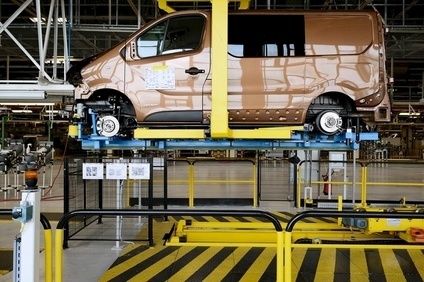
A three-year work and €230 million investment have transformed Sandouville, near Le Havre, into a centre of excellence for van production. The Nissan NV300 will be made on the same line as the new Renault Trafic.
“The production of the Nissan NV300 at the Sandouville plant is a win-win for Renault and for Nissan. We maximise Renault manufacturing expertise and Nissan gets a top quality production site in the heart of the European market,” said Carlos Ghosn, Renault Chief Executive Officer.
Sandouville also produces a version of Vivaro for Opel and Vauxhall. The plant will soon begin production of the next-generation Fiat mid-size van.
Nissan and Renault are also developing a one-tonne pickup for Renault that will share select architectural features of the Nissan NP300.
LASER FOCUS ON LIGHT COMMERCIAL VEHICLES (LCV)
Sandouville produced 93,000 Trafic LCVs last year. The plant produces more than 460 vans per day for Renault and its partners. Renault is adding 183 new positions at the plant.
The Renault Agreement: “Contract for a new dynamic of Renault growth and social development in France”, signed on March 2013, between Renault and union representatives, paved the way for increased efficiency at Renault’s plants throughout France. It opened the door to strategic partnerships that promote growth like the production of Nissan NV300 in Sandouville plant.
Engines for Trafic and Nissan NV300 are produced by Groupe Renault’s Cléon plant in Normandy, which specialises in high-precision powertrain production.
In 2015, Renault was Europe’s best-selling LCV brand for the 18th consecutive year.
Renault’s expertise has earned recognition in the demanding and growing LCV segment. Groupe Renault engineers and produces not only for its own brands but also for other manufacturers.
Mercedes Citan and Renault Kangoo are produced at the Renault factory in Maubeuge (North of France). At the Batilly plant, Renault manufactures vans for Nissan (NV400), Opel and Vauxhall (Movano) as well as Master for Renault and Renault Trucks.

Tuesday, 2 June 2015

Happy 50th Birthday to teh Renault 16 - My favourite Renault car of all time

  • 2015 marks the 50th anniversary of one of the most ingenuous cars of its day – the Renault 16
  • R16 was first prestige vehicle to feature a tailgate, providing unprecedented versatility for its day
  • Modern and avant-garde equipment specification
  • Voted ‘Car of the Year’ in 1966
  • Over 1.8million were made during the model’s lifetime
1965: The Renault 16, the original family ‘Voiture à Vivre’
The history of Renault’s family cars started 50 years ago in France during the post-war boom. In early 1965, the brand unveiled an innovative new vehicle at the Geneva Motor Show: the Renault 16. 

This new hatchback featured an original body shape founded on a two-box design complete with a tailgate for access to the boot. The model combined functional qualities with elegant looks and no fewer than six windows, carrying over the ingredients that were behind the success of the Renault 4 to an upmarket family vehicle. It was the perfect family car.
Renault’s determination to innovate
The project to design a successor to the Frégate was an ambitious one, especially as Pierre Dreyfus – Renault’s CEO from 1955 to 1975 – wanted it to stand out from its rivals. “We have to take a different approach,” he proclaimed. “Cars can’t just be four seats and a boot any longer. They must be viewed as a volume.”
The result was the Renault 16, a radical car penned by Gaston Juchet and signed off by Dreyfus who predicted it would be “a car for families drawn by modern consumer society.”
Crossover thinking
The Renault 16 was a cross between a saloon and a van, a design that made it exceptionally versatile for the era. The boot could be arranged in four different ways, with a carrying capacity ranging from 346dm3 to 1,200dm3 thanks to a sliding, folding and removable rear bench.
The seats were designed to suit all types of use, from fixing a child seat to a reclined position for resting, and even a couchette position for two. From the outset, the Renault 16 was thought through as a family car which was fundamentally different from anything produced by rival makes.
Technically avant-garde
The Renault 16 also marked its time thanks to its modern, avant-garde equipment specification. Front-wheel drive was still unusual in its class at the time, while the front-central engine ensured first class road manners. The engine, like the gearbox and cylinder head, were made of aluminium and produced using a pressure-die casting process.
From 1968, with the introduction of a TS version (‘Tourisme Sportif’), a range of innovative new features became standard, including a defrosting rear window, additional iodine headlights, two-speed windscreen wipers with four-jet washers and an interior rear-view mirror with day/night settings.
In 1969, the Renault 16 gained reversing lights, along with front power windows, an electric sunroof and leather upholstery. This rich equipment list made the Renault 16 a prestige car, in perfect keeping with the day’s consumer society trends, and represented a new way to go motoring.
Car of the Year 1966
Unveiled at the 1965 Geneva Motor Show, the Renault 16 surprised visitors with its offbeat styling. However, it quickly won the public over by meeting its demand for simplicity. The gamble was acclaimed by the industry, too: in 1966, the model was named Car of the Year, ahead of the Rolls-Royce Silver Shadow, no less!
The range-topping Renault 16 TX
From 1973 until the end of the model’s career in 1980, the Renault 16 was available with a 93hp 1,647cc engine for the TX version. Top speed round a circuit was 109mph (175kph), while equipment included central locking and inertia reel seatbelts, innovative features that contributed to improving the quality of Renault 16 owners’ everyday lives.
In the course of the Renault 16’s career, 1,851,502 units were made, chiefly at Renault’s purpose-built Sandouville plant in Normandy.