Purpose

I will try my best to provide detailed info on various cars and what is like to live with them, I have already produced a few for Jaguar-car-forums, I will do my best to be unbiased, but it will be hard for some cars. I will re-produce press releases and copy from other motoring news.
Showing posts with label Sony. Show all posts

Thursday, 12 November 2015

Ford’s Active Noise Control works like noise-cancelling headphones – emitting sound waves that cancel out unwanted sounds

  • Ford’s Active Noise Control works like noise-cancelling headphones – emitting sound waves that cancel out unwanted sounds in the cabin such as engine, transmission and wind noise
  • Active Noise Control debuts on the all-new Ford Mondeo Vignale and will soon be offered on other Ford vehicles, including the all-new Ford Edge coming in 2016
  • Engineers from Sony tune the Vignale audio system for an exceptional acoustical experience with a customised stereo mode, and true surround experience
Whether used for minimising background noise on a business flight, or silencing the babble of commuters on a train, noise-cancelling headphones have made journeys more serene and enjoyable for millions. Now, Ford has applied the same thinking to its cars.
Ford’s Active Noise Control uses three microphones, strategically placed in the cabin, to detect undesirable noises from the engine and transmission. 

The system counteracts those noises with opposing sound waves from the audio system – without affecting volume levels of music and conversation. Driver and vehicle behaviour is recorded and anticipated, for example when a driver is accelerating in a lower gear.
“Whether listening to a favourite playlist, tuning into a much-loved station, or simply enjoying a respite from the demands of modern life, the experience of sound – and just as importantly silence – can be a fundamental part of an enjoyable car journey,” said Dr Ralf Heinrichs, supervisor, Noise Vibration Harshness, Ford of Europe, “Our new Mondeo Vignale with Active Noise Control offers drivers enhanced levels of comfort, and fewer distractions.”
Active Noise Control is part of a range of innovations for the flagship Ford Mondeo Vignale that enhance sound quality. Another example is acoustic glass that can improve the sound-proofing qualities of the windscreen and front windows. 
Containing a layer of acoustic film thinner than a human hair, acoustic glass reduces the intrusion of wind noise caused by air flow around the window pillars.
“Noise is intrusive and reduces the driver’s mental processing power, and can lead to distraction and stress,” said Dr John Cartwright, chief medical officer, Ford of Britain. “By removing unwanted powertrain noise, Ford is helping customers to complete their journey calmly and in comfort.”
Great sound by design
Every Ford vehicle undergoes extensive testing to help minimise noise, vibration and harshness. 
This includes driving on some of the world’s most challenging surfaces, both in the real world and at Ford test facilities (including Ford Dunton Technical Centre in Essex) where conditions include gravel roads and some of the worst potholes found worldwide. 
From the ground up, the Mondeo Vignale’s cabin has been designed to offer the optimum sound experience.
For example, by using foam rather than fibreglass for engine bay insulation, the Mondeo Vignale achieves a reduction in powertrain noise transferred to the cabin of up to 2 dB. 
Sound‑proofing within the underbody shields, wheel arch liners and front and rear doors block tyre noise, and the new integral link rear suspension also contributes to a reduction in road noise experienced of up to 3 dB.
The Mondeo Vignale also is one of the first European Ford vehicles to benefit from the newly established global Vehicle Harmony team. 
Testing includes ensuring all sounds in the cabin, interior illumination, and the feel of surfaces are appropriate and complementary – from the sound made by the indicators, to that which is made when the heated rear window switch is depressed.
“Vehicle interiors are a precious yet complex space with hundreds of carefully positioned individual functional elements, just like instruments in an orchestra. 
To bring harmony to the customer experience, these instruments must be in tune with one another. That’s where the Vehicle Harmony team comes in,” said Erika Tsubaki, design supervisor, Ford of Europe.
Vignale and Sony
Sound engineers from Sony Corporation spent extensive hours tuning the Vignale audio system to deliver an exceptional acoustical experience on the road with a customised stereo mode, and a true surround experience.
“Our engineers have gone to extreme lengths to develop the audio system for the Mondeo Vignale to ensure a world class luxury audio experience. 
Delivering this luxury depends on reproducing sound as the artist intended and underpinning the acoustic emotion with the look, touch and feel delivered by our elegantly styled and carefully constructed centre panel design,” said Ian Hubbard, global automotive entertainment director, Sony Europe Limited.
Comprising 12 high-quality speakers and a sophisticated DSP (digital signal processing) amplifier, the audio system from Sony transforms the in-car listening experience. The Class D amplifier, with 10 independent channels, is built for efficiency. 
This amplifier is smaller and requires less power from the car's electrical system than conventional amplifiers. Additionally, it offers features such as stereo and surround DSP modes, and speed sensitive volume control.
The speakers have been optimised by Sony to create exceptional linearity and tonal balance. Low and midrange speakers in the audio system from Sony make extensive use of polypropylene material. 
Polypropylene provides stable performance over the life of the vehicle in a way that even the best fibre material cannot. The multi-layer soft dome tweeters provide crisp and clean high frequency sound. 
Advanced production checks
Mondeo Vignale is produced at the company’s state-of-the-art mega-plant in Valencia, Spain, and hand finished at Ford’s Vignale Centre, where vehicles are subjected to 100 additional tests.
The Valencia facility includes a 300m ‘rattle and squeak’ circuit that helps engineers ensure everything sounds right inside the vehicle, and all components fit snugly and securely. Ford also has recently introduced an industry-first test that reflects increasing use of audio streamed via Bluetooth from external devices such as smartphones. 
A full register of musical notes played through the speakers via the auxiliary port and a wired connection ensures that playback meets the same customer expectations as audio enjoyed through the system’s own CD player and radio.

Friday, 21 November 2014

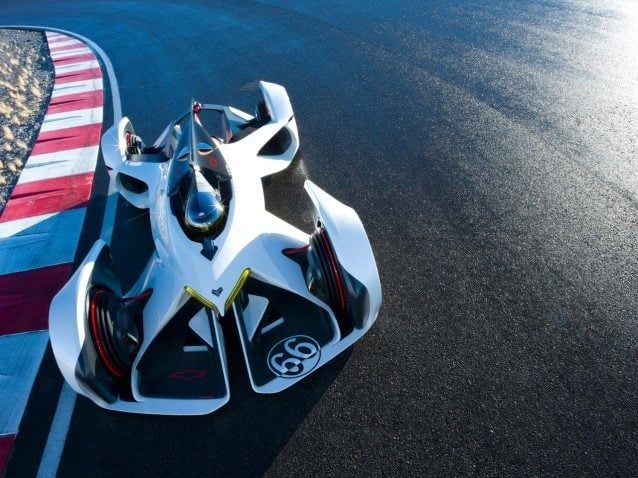
USA - Chevrolet launches Chaparral 2X Vision Gran Tursimo (VGT) concept at L.A.

Radical concept developed for racing franchise’s 15th anniversary

Chevrolet today revealed the Chaparral 2X Vision Gran Tursimo (VGT) concept – a revolutionary interpretation of the ultimate race car, developed exclusively for fans of the PlayStation® 3 racing game, Gran Turismo® 6.

Developed as part of the Vision Gran Turismo project, which celebrates the future of automotive design and innovation, the Chaparral 2X VGT concept is inspired by the innovative race cars Chaparral Racing and Chevrolet partnered on more than 45 years ago.

Gamers can race the Chaparral 2X VGT this holiday season by downloading an online update for Gran Turismo 6, the latest iteration of the best-selling PlayStation franchise that has sold more than 72 million copies worldwide since its 1998 debut.


“This concept is an audacious and ambitious vision – and one that demonstrates to a new audience how Chevy’s engineering and design teams challenge norms and explore the technologies of tomorrow,” said Clay Dean, executive director of advanced design. “It also an ode to a unique partnership that pioneered ground-breaking technologies that are used today on the track and the street.”

Known for unconventional, boundary-pushing race cars that shook up the motorsports world, Texas-based Chaparral Racing partnered with Chevrolet Research and Development more than 45 years ago, pioneering now-standard methods and materials used in contemporary racing and production vehicles, including the composite monocoque chassis, lightweight-alloy powertrain systems, automatic transmissions for racing and progressive, active aerodynamics. 
The partnership also spawned ground-breaking vehicle data acquisition technology. Chevrolet continues to use racing programs to test and develop new technologies and materials.
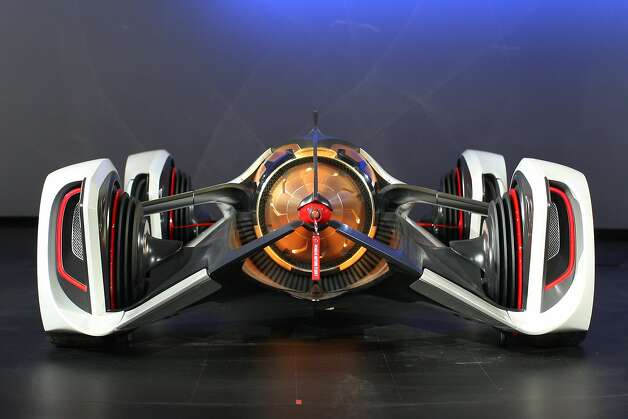
The Chevrolet Chaparral 2X VGT channels that spirit of innovation into a vision of what the future of racing could hold, with a radical form and an advanced, laser-based propulsion system.

“It was created in a no-rules atmosphere to challenge designers and test engineers to deliver the most exhilarating sensations. This is a fantasy car by design,” said Frank Saucedo, who oversaw the team that worked on the concept. “Like the original Chaparral race cars decades ago, the Chaparral 2X VGT weaves advanced aerospace technologies into the design to help achieve its performance goals.”

The Chaparral 2X VGT’s concept propulsion system is inspired by technology derived from advanced work targeted at space travel and future aircraft design. It features a mid-mounted laser beamed-energy propulsion system, which pulses beams of light that focus in a shroud, creating shock waves that generate tremendous thrust in the lightweight race car.

With a 671-kW laser, powered by a pack of lithium-ion batteries, and an air-powered generator to provide 900 horsepower worth of thrust, the Chaparral 2X VGT will be capable of a 240-mph top speed in the video game with 0-60 acceleration capability of 1.5 seconds.

The propulsion system’s position in the composite chassis complements an unconventional yet highly active prone driver configuration – face down with the driver’s arms and legs splayed toward the wheels. In fact, the race car’s propulsion and suspension systems are built around the driver, enabling progressive strategies of active and driver-adjustable aerodynamics.

“Think of it as adapting a wing suit to a racing car, where the driver’s movements control certain aspects of the aero package,” said Saucedo. “In many ways, the Chaparral 2X VGT is like racing wing suit, with a protective fuselage for ‘flying’ very low to the ground.” 

The driver-enabled aerodynamics eliminate the need for large, conventional wings and other aero devices used to generate grip-enhancing downforce – an attribute that helps reduce the overall mass of the Chaparral 2X VGT’s minimalist structure. Only essential elements are on board, with instrumentation, for example, projected on the driver’s helmet visor.

Additionally, lightweight chassis components reduce the sprung weight of the race car, enabling the car to provide tremendous cornering grip with a relatively small footprint. It rolls on 17-inch front wheels wrapped with racing tires.

“The Chaparral 2X VGT is a vision of how advanced technology may shape the look and driving experience of racing,” said Saucedo. “Chaparral’s race cars and methods were seen as outlandish four decades ago, and with the innovative spirit still burning at Chevrolet, the Chaparral 2X Vision Gran Turismo concept might just be a harbinger of motorsports in the next four decades.”

Other manufacturers have developed concept race cars for the Vision Gran Turismo project, but Chevrolet is one of the few to transfer it from the digital world to a physical concept vehicle.
The Chevrolet Chaparral 2X VGT concept is on display at the Los Angeles Auto Show through November 30.

Sunday, 16 November 2014

USA - Second concept for VW, the GTi Roadster, follows the R 400 into Los Angeles.

Spectacular concept car blurs the boundaries between the virtual and real worlds

Volkswagen will show the spectacular GTI Roadster concept car in North America for the first time at the Los Angeles International Auto Show. 

First seen at the Wörthersee enthusiast festival in Austria in May, this car erases the boundaries between the virtual and real worlds and further demonstrates the bandwidth of the Modular Transverse Matrix (MQB) architecture that underpins the new Golf, Golf GTI, e-Golf, and Golf R models.

The GTI Roadster is a Golf GTI show car that was originally created as a purely electronic CGI entity for the Sony PlayStation®3 classic "Gran Turismo 6" ("GT6"). The two-seat convertible is powered by a 3.0-litre V6 twin-turbocharged TSI® engine that produces 503 horsepower and a mighty 413 pound-feet of torque between 4,000 and 6,000 rpm; from just 2,000 revs, 369 lb-ft of that torque is available. 

The power of the TSI engine is transferred to the 20-inch wheel-and-tire combination via a seven-speed DSG® dual-clutch automatic transmission and a 4MOTION® all-wheel-drive system. The lightweight, 3,133- pound sports car sprints from 0 to 60 mph in an estimated 3.5 seconds and goes onto a top track speed of 192 mph.

Volkswagen and Sony. 

The GTI Roadster is the result of cooperation between Volkswagen and Sony Computer Entertainment. Klaus Bischoff, Head of Design at Volkswagen remarks: "When Sony asked us if we would develop a Vision GTI vehicle exclusively for the game to mark the 15th anniversary of Gran Turismo we didn't hesitate for a moment." 

An in-house competition was immediately launched and young Volkswagen designers submitted their designs. The submissions were judged by Bischoff and none other than Kazunori Yamauchi, Director of Polyphony Digital and Vice-President of Sony Computer Entertainment—and the inventor of the "Gran Turismo series".


Yamauchi is a GTI fan. The Japanese executive has his own stable of sports cars that includes a Golf GTI, the iconic sporty compact. Bischoff and Yamauchi finally chose two designs, which were then developed further. Designers Malte Hammerbeck and Domen Rucigaj were in charge of developing the exterior, whilst Guillermo Mignot was responsible for the interior. The entire development process was realized on the computer and even the 3D model of the vehicle was virtual.

Together, the three colleagues formed a sort of "Vision GTI -GT6 task force", working with other designers. Just a few weeks later, their GTI Roadster was ready. Sony and Volkswagen unveiled the version for the virtual world of PlayStation®3 on 26 May and three days later, Volkswagen unveiled the real GTI Roadster at the GTI festival in Reifnitz, Austria as a tribute to fans of the Golf GTI and of "GT6". From mid-June, "GT6" players were able to download the GTI Roadster, Vision Gran Turismo for PS3.

Most spectacular GTI ever. 

Since Volkswagen designers gave their imagination free rein in designing the "GTI Roadster" for the "GT6" game—and were able to overlook production constraints like price and production feasibility—the resulting car is certainly the most spectacular Golf GTI ever. Klaus Bischoff: 

"The Vision GT project offered a wonderful opportunity to sketch out extreme ideas and design elements of the GTI that are portrayed as vibrantly, dynamically and emotionally as possible. Further development of an unmistakable design and a love for detail reflect the high standards shared by the Volkswagen GTI and the 'Gran Turismo' by Sony PlayStation® product brands.”

In designing the GTI Roadster, Volkswagen revolutionized the visual concept of the Design Vision GTI concept car that was presented at Wörthersee and the Los Angeles Auto Show in 2013. It was further developed, reinvented and sent into the future as a roadster, although there is still a link to the earlier car since Volkswagen used the Design Vision GTI to show how a race version of the Golf GTI might look. 

Like the Design Vision GTI, the Roadster keeps the principles of Volkswagen’s Design DNA and also incorporates the wild C-posts and side skirts, but expressed to a whole new level.

Both concept cars show the potential of Volkswagen’s Design DNA, and that the GTI will be around for a long time to come. The goal of the GTI Roadster was to push the Design Vision GTI concept to even greater extremes. The 98.2-inch wheelbase of the Roadster is significantly shorter than that of the production GTI and the "Design Vision GTI". With its minimal overhangs, low, 42.9-inch height, and 74.6-inch width, the 163.7-inch-long Roadster has jaw-dropping proportions.

Exterior design


The design of the GTI Roadster launches the GTI far into the future. The visual image of the visionary two-seater already promises a direct, visceral driving experience. The driver sits in the monocoque and races around the tracks of the GT6 world from the height and perspective of a formula race car.


The roadster body was aerodynamically optimized, with the most prominent visual feature being the large rear wing. This creates plenty of downforce that aids traction, along with the all-wheel-drive system. Ahead of the wing, the C-pillars—which are a defining design element of the Design Vision GTI, extending into the roof—form a roll-over bar. The rear spoiler gives the appearance of a wing hovering behind the roadster.

The GTI Roadster sports a radiant, intensive red metallic color, a new interpretation of the classic Golf GTI "Tornado Red". Designers gave the name "Gran Turismo Red" to the new color. Malte Hammerbeck says: 

"We were looking for a very provocative and aggressive red. The car should look fast, even when it is standing still, and the paint should emphasize its surface contours." All bolt-on parts are designed in matte carbon as an accent that complements the high-gloss red of the body. Only the radiator grille and the screen over the engine compartment vent are finished in high-gloss black.

The doors swivel up and forward, visually splitting a prominent character line into an upper and lower half. The contours of the doors are also very distinctive, because they are framed by the side skirts (trimmed with the "Gran Turismo" badge at the rear), the C-pillar and the heavily flared wheelarches. A small but exclusive detail on the sides is the illuminated GTI badge that is integrated in the "tornado" line. On the upper door section, the side window forms a line that rises forward with the low-profile windscreen, like a speedboat’s.

The 20-inch Golf GTI centerlock aluminum-alloy wheels have body-color elements and are 8.5J wide at the front and 9.5J at the back, with 235/35 ZR20 front and 275/30 ZR20 tires. The brakes are suitably large to cope with the car’s performance: 15.0 inches in diameter at the front and 14.0 inches at the rear.

Front end design: 

Viewed directly from the front, the roadster looks like a Golf GTI—except, one from the future. The GTI front end has a three-dimensional design with bumper elements that appear to hover and a splitter that is designed to increase downforce at the front end. 

Classic Golf GTI design elements such as the prominent VW badge, the red radiator cross strip, and GTI logo are offset by dual LED headlights and LED daytime running lights that have an unmistakable light signature. On the race courses of the GT6 world, this unmistakable and charismatic front-end will cause some uneasiness when competitors see it approaching in their digital rear-view mirrors. 

The closer the GTI approaches, the more noticeable is its wedge-shaped air scoop on the hood.

Sculpted rear section. 

Viewed from the rear, the carbon blades at the front continue uninterrupted across the side skirts and into the rear section as a wrap-around element. At the rear, they serve as aerodynamically optimized air ducts. The rear diffuser is highlighted by metal slats and two low-slung rear lights. The trapezoidal dual exhaust tailpipes (with GTI badging) are positioned in the middle of the car above the diffuser. Adding to the layered look at the back are the narrow three-dimensional lights and the spoiler above it.

Interior design


The driver and passenger sit in a carbonfiber monocoque. The two sides are partitioned by an open bar that ascends from rear to front, with a fire extinguisher beneath it. The GTI Roadster is equipped with two race-style buckets, placed low. The seats and the four-spoke grip-style steering wheel are covered with Alcantara. 

Another motorsport-style feature is the cockpit display mounted directly to the steering column, far ahead of the driver. The steering wheel is mounted on a very long, exposed steering column, which is typical of a race car too. Designers located the red, illuminated rotary light switch and shift paddles to the left and right of the steering wheel's central axis, so the driver never has to move his or her hand off the wheel.


The interior and exterior materials and colors were intentionally differentiated: the typical GTI red is used for some interior accents, such as the five-point safety belts, contrasting stitching on the seats, the door handles and the steering-wheel controls on the steering wheel, but the rest of the color selections were trimmed to "Black" and "Anthracite". 

Inside the GTI Roadster, most decorative elements were omitted in favor of an uncompromising motorsport ambience so that the driver can focus exclusively on both the real and virtual race track.

Sunday, 3 August 2014

MG Parent company moves back into Fortune 500 top 100 companies, beating Disney, Coke and Sony.

  • MG Motor parent company, SAIC Motor placed 85th in Global Fortune 500
  • SAIC’s 2013 yearly sales revenue total of $92 billion
  • MG Motor UK fastest growing automotive brand in the UK for seventh month running
  • News announced as MG celebrates its 90th anniversary and rapid expansion of retailer network in the UK
MG parent company, SAIC Motor, has entered the Global Fortune top 100 with the company’s tenth appearance in the annual Fortune 500 list, moving up 18 places from last year’s result to reach 85th position, with 2013 yearly sales revenues of $92 billion.
The US based Fortune publication announced this year’s Global Fortune 500, with US giant Wal- Mart retaining the number one spot. SAIC’s 85th position, saw the Chinese national placed ahead of many well known brands such as Microsoft (104th), Sony (105th), Amazon.com (112th), Google (162nd), Coca- Cola (224th) and Walt Disney (232nd).
SAIC Motor is the market leader for sales in China, last year achieving record global manufacturing and sales of over 5.1 million units, an increase of 13.71% on 2012 sales and the first Chinese automotive manufacturer to exceed five million units in a year. 230,000 units of this extraordinary end of year figure can be attributed to global sales of the MG and Roewe marques.

SAIC Motor continues to grow as a leader in independent technology innovation, with recently announced new powertrain developments and the industrialisation of new energies, as well as the launch of the first manufacturer-owned O2O commerce platform. SAIC has sought to strengthen overseas operation and expand distributions in developing markets like ASEAN, Middle East, South America, specifically with the opening of a SAIC manufacturing facility in Thailand this year, enabling the company to expand into South East Asia, with production capacity expected to be around 50,000 vehicles a year.
2014 celebrates the 90th anniversary of the MG marque and the most successful year to date for MG Motor UK. Last month, MG announced that the Birmingham based manufacturer had exceeded 2013 total sales in just the first five months 2014. This exceptional growth is set to continue as SMMT figures for June show a 791 per cent month on month, and a phenomenal 833 per cent year to date increase.
The success of the iconic marque has been due to the September 2013 launch of the MG3 supermini and expansion of the MG6 diesel powertrain family, with a new 129g, 350 Nm performance diesel recently added.
The MG3 supermini is fun to buy, fun to drive and fun to own with over one million personalisation options, class leading chassis and driving dynamics, and exceptional value for money aftercare packages. The successful supermini is priced from only £8,399 to £9,999, or on PCP from only £99 a month or from zero deposits. The MG3 benefits from an ultra low 4E insurance group, strong residuals of up to 61 per cent, class leading interior and boot space, and high levels of equipment on all specifications as standard, as well as complete peace of mind with the three years fixed servicing package MG CARE3, the ultimate in carefree ownership.
Voted by customers as the winner of Best Handling and sixth overall Best Car to Own in the 2014 Auto Express Driver Power Awards, the MG6 is already a favourite with MG owners for its drivability, affordability and exceptionally high levels of equipment included as standard. Now the MG6 is even more appealing as all specifications are available from just £15,455 to £19,995, and with the current ‘High 5’ offer, MG6 customers can buy and drive away with complete peace of mind. With servicing, warranty and breakdown cover free for five years, as well as fuel subsidies and affordable finance deals.
Since the launch of the MG3, MG has become the fastest growing automotive brand in the UK with 50 retailers in total, 22 of which opened in 2014 including; Havant, Torquay, south Sheffield, Dudley, Gloucester, north Sheffield, Woking, Spalding, Barnes in West London, Newcastle, Leicester, Harrogate, Doncaster, Northampton, Swindon, Norwich, Falmouth, Brecon, Maidstone, Wareham on the Purbeck peninsula, Oxfordshire and Exeter. 

Friday, 27 June 2014

GOODWOOD - Aston Martin DP-100 Vision Gran Turismo Global Launch


  • Design Prototype 100 joins stable of Vision Gran Turismo racers in popular racing game for PlayStation®3
  • Designed and engineered over six months by Aston Martin Design team
  • Downloadable for in-game play in July 2014
Aston Martin is unveiling an exceptional new addition to the hugely popular PlayStation®3 exclusive racing game Gran Turismo®6 (GT6™) in the shape of the stunning Design Prototype 100 – DP-100 Vision Gran Turismo.
Developed in-house by the Design team at Aston Martin, led by Design Director Marek Reichman, DP-100 Vision Gran Turismo is a new, virtual-only GT racer that will be available for Gran Turismo®6 (GT6™) owners to download in July 2014, following the global launch at Goodwood Festival of Speed.
Starting with nothing but the traditional ‘blank sheet of paper’ the design team and design engineers worked for six months to create the new addition to the Vision Gran Turismo stable of race cars. Clearly pushing the boundaries of what an Aston Martin could be, DP-100 not only looks beautiful but also boasts a high degree of engineering integrity.

The twin-turbo V12 mid-engined racer offers up to 800bhp, endowing it with blistering performance fully in keeping with the high octane nature of the game.
Created utilising many of the same techniques as applied in the development of  Aston Martin production sports cars – hand sketches and 3D modelling, followed by full realisation in the virtual world – DP-100 provides an exceptional level of detail with a fully functioning suspension system and state-of-the-art electronics.
Design Director Marek Reichman said: “DP-100 has been an exciting and intensive project for the team here at Gaydon.
“Features such as the car’s revolutionary ‘active aerodynamics’ are there not just as a way of enhancing form, but also to support the car’s function in-game.
“As with the CC100 Speedster Concept, many of the design cues visible in DP-100, such as the light blade rear lamps, could also feed through into future sports cars that we’ll launch in the offline world so the importance of this project should not be underestimated.”
Aston Martin has supported previous editions of the long-running and hugely successful Gran Turismo®series, debuting in the very first game with the Aston Martin DB7 Coupé and Volante. The stunning 2011 Aston Martin One-77 is already a popular car in the Gran Turismo® 6 stable.
Kazunori Yamauchi, the creator of Gran Turismo and President of Polyphony Digital Inc, enthused: “When I first came face to face with this car at the Aston Martin Headquarters in Gaydon, UK, I was at a loss for words seeing the level of perfection in its design. I was surprised by the bold proposal of the car being the first midship layout model in Aston Martin history. And while it is clean and classy in design, it is also very emotional. Not only that, there was this future Aston Martin in front of me, that was so detailed it could be released on the market pretty much as is.”