Purpose

I will try my best to provide detailed info on various cars and what is like to live with them, I have already produced a few for Jaguar-car-forums, I will do my best to be unbiased, but it will be hard for some cars. I will re-produce press releases and copy from other motoring news.
Showing posts with label Gran Turismo 6. Show all posts

Saturday, 21 May 2016

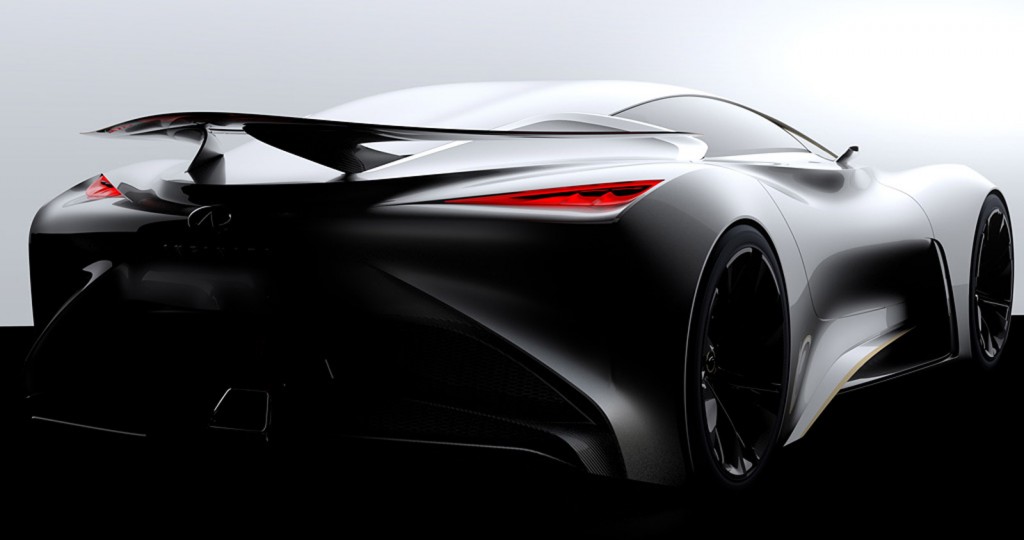
Infiniti Concept Vision displayed at Gran Turismo® GT Sport Launch.

Displayed alongside seven other full-size concept cars, the largest ever gathering of GT concept vision cars in one place, the vehicle provides a visualisation of what a high performance Infiniti could look like in the future.

The car was developed through close collaboration with the creators of Gran Turismo®, the racing game franchise developed by Polyphony Digital Inc. that has sold more than 72 million copies worldwide. The Infiniti Concept Vision Gran Turismo will be featured in the new GT-Sport game when it is released in November.

The Infiniti Concept Vision Gran Turismo is a project that started as an ambitious global Infiniti Design competition to "design a pure Infiniti GT car". The winning model was born from the theme put forward by Infiniti's Design team in Beijing. Part beauty, part beast, its shape is powerful, sensual and audacious – a mix of a track machine and the dream of our Chinese design team to create an ambitious racing language for Infiniti.
The process of developing the design of the Infiniti Concept Vision Gran Turismo started with hand sketching, then refined digitally, refined again by hand sculpting, and then returned to digital for final refinement.
This project went much further than being a mere design exercise. It included thorough examinations and calculations of technical features such as aerodynamics and engine performance. The front mid-ship/trans-axle powertrain enables the finely distributed 45:55 front/rear weight balance that fills users with the joy of driving by actively drifting the rear.
As for aerodynamics, the under-floor airflow control, front and back diffusers, and uniquely shaped rear spoiler enable this car to demonstrate high performance without compromising the impact of the body design.

Friday, 21 November 2014

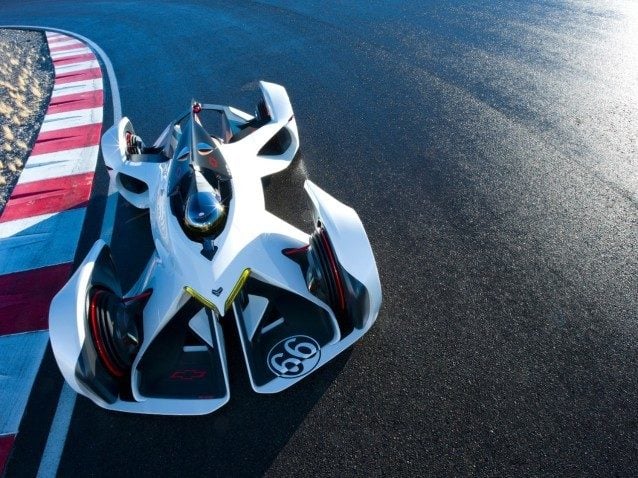
USA - Chevrolet launches Chaparral 2X Vision Gran Tursimo (VGT) concept at L.A.

Radical concept developed for racing franchise’s 15th anniversary

Chevrolet today revealed the Chaparral 2X Vision Gran Tursimo (VGT) concept – a revolutionary interpretation of the ultimate race car, developed exclusively for fans of the PlayStation® 3 racing game, Gran Turismo® 6.

Developed as part of the Vision Gran Turismo project, which celebrates the future of automotive design and innovation, the Chaparral 2X VGT concept is inspired by the innovative race cars Chaparral Racing and Chevrolet partnered on more than 45 years ago.

Gamers can race the Chaparral 2X VGT this holiday season by downloading an online update for Gran Turismo 6, the latest iteration of the best-selling PlayStation franchise that has sold more than 72 million copies worldwide since its 1998 debut.


“This concept is an audacious and ambitious vision – and one that demonstrates to a new audience how Chevy’s engineering and design teams challenge norms and explore the technologies of tomorrow,” said Clay Dean, executive director of advanced design. “It also an ode to a unique partnership that pioneered ground-breaking technologies that are used today on the track and the street.”

Known for unconventional, boundary-pushing race cars that shook up the motorsports world, Texas-based Chaparral Racing partnered with Chevrolet Research and Development more than 45 years ago, pioneering now-standard methods and materials used in contemporary racing and production vehicles, including the composite monocoque chassis, lightweight-alloy powertrain systems, automatic transmissions for racing and progressive, active aerodynamics. 
The partnership also spawned ground-breaking vehicle data acquisition technology. Chevrolet continues to use racing programs to test and develop new technologies and materials.
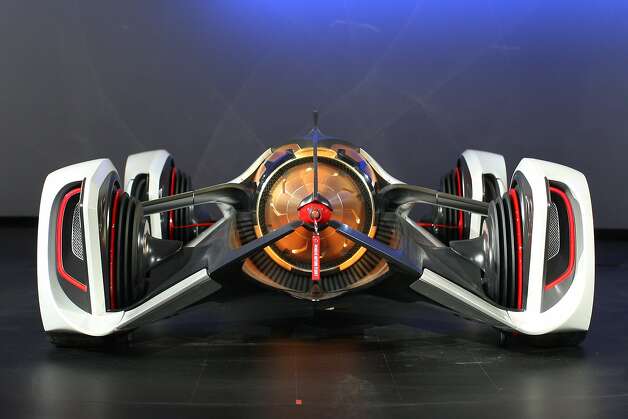
The Chevrolet Chaparral 2X VGT channels that spirit of innovation into a vision of what the future of racing could hold, with a radical form and an advanced, laser-based propulsion system.

“It was created in a no-rules atmosphere to challenge designers and test engineers to deliver the most exhilarating sensations. This is a fantasy car by design,” said Frank Saucedo, who oversaw the team that worked on the concept. “Like the original Chaparral race cars decades ago, the Chaparral 2X VGT weaves advanced aerospace technologies into the design to help achieve its performance goals.”

The Chaparral 2X VGT’s concept propulsion system is inspired by technology derived from advanced work targeted at space travel and future aircraft design. It features a mid-mounted laser beamed-energy propulsion system, which pulses beams of light that focus in a shroud, creating shock waves that generate tremendous thrust in the lightweight race car.

With a 671-kW laser, powered by a pack of lithium-ion batteries, and an air-powered generator to provide 900 horsepower worth of thrust, the Chaparral 2X VGT will be capable of a 240-mph top speed in the video game with 0-60 acceleration capability of 1.5 seconds.

The propulsion system’s position in the composite chassis complements an unconventional yet highly active prone driver configuration – face down with the driver’s arms and legs splayed toward the wheels. In fact, the race car’s propulsion and suspension systems are built around the driver, enabling progressive strategies of active and driver-adjustable aerodynamics.

“Think of it as adapting a wing suit to a racing car, where the driver’s movements control certain aspects of the aero package,” said Saucedo. “In many ways, the Chaparral 2X VGT is like racing wing suit, with a protective fuselage for ‘flying’ very low to the ground.” 

The driver-enabled aerodynamics eliminate the need for large, conventional wings and other aero devices used to generate grip-enhancing downforce – an attribute that helps reduce the overall mass of the Chaparral 2X VGT’s minimalist structure. Only essential elements are on board, with instrumentation, for example, projected on the driver’s helmet visor.

Additionally, lightweight chassis components reduce the sprung weight of the race car, enabling the car to provide tremendous cornering grip with a relatively small footprint. It rolls on 17-inch front wheels wrapped with racing tires.

“The Chaparral 2X VGT is a vision of how advanced technology may shape the look and driving experience of racing,” said Saucedo. “Chaparral’s race cars and methods were seen as outlandish four decades ago, and with the innovative spirit still burning at Chevrolet, the Chaparral 2X Vision Gran Turismo concept might just be a harbinger of motorsports in the next four decades.”

Other manufacturers have developed concept race cars for the Vision Gran Turismo project, but Chevrolet is one of the few to transfer it from the digital world to a physical concept vehicle.
The Chevrolet Chaparral 2X VGT concept is on display at the Los Angeles Auto Show through November 30.

Sunday, 16 November 2014

USA - Second concept for VW, the GTi Roadster, follows the R 400 into Los Angeles.

Spectacular concept car blurs the boundaries between the virtual and real worlds

Volkswagen will show the spectacular GTI Roadster concept car in North America for the first time at the Los Angeles International Auto Show. 

First seen at the Wörthersee enthusiast festival in Austria in May, this car erases the boundaries between the virtual and real worlds and further demonstrates the bandwidth of the Modular Transverse Matrix (MQB) architecture that underpins the new Golf, Golf GTI, e-Golf, and Golf R models.

The GTI Roadster is a Golf GTI show car that was originally created as a purely electronic CGI entity for the Sony PlayStation®3 classic "Gran Turismo 6" ("GT6"). The two-seat convertible is powered by a 3.0-litre V6 twin-turbocharged TSI® engine that produces 503 horsepower and a mighty 413 pound-feet of torque between 4,000 and 6,000 rpm; from just 2,000 revs, 369 lb-ft of that torque is available. 

The power of the TSI engine is transferred to the 20-inch wheel-and-tire combination via a seven-speed DSG® dual-clutch automatic transmission and a 4MOTION® all-wheel-drive system. The lightweight, 3,133- pound sports car sprints from 0 to 60 mph in an estimated 3.5 seconds and goes onto a top track speed of 192 mph.

Volkswagen and Sony. 

The GTI Roadster is the result of cooperation between Volkswagen and Sony Computer Entertainment. Klaus Bischoff, Head of Design at Volkswagen remarks: "When Sony asked us if we would develop a Vision GTI vehicle exclusively for the game to mark the 15th anniversary of Gran Turismo we didn't hesitate for a moment." 

An in-house competition was immediately launched and young Volkswagen designers submitted their designs. The submissions were judged by Bischoff and none other than Kazunori Yamauchi, Director of Polyphony Digital and Vice-President of Sony Computer Entertainment—and the inventor of the "Gran Turismo series".


Yamauchi is a GTI fan. The Japanese executive has his own stable of sports cars that includes a Golf GTI, the iconic sporty compact. Bischoff and Yamauchi finally chose two designs, which were then developed further. Designers Malte Hammerbeck and Domen Rucigaj were in charge of developing the exterior, whilst Guillermo Mignot was responsible for the interior. The entire development process was realized on the computer and even the 3D model of the vehicle was virtual.

Together, the three colleagues formed a sort of "Vision GTI -GT6 task force", working with other designers. Just a few weeks later, their GTI Roadster was ready. Sony and Volkswagen unveiled the version for the virtual world of PlayStation®3 on 26 May and three days later, Volkswagen unveiled the real GTI Roadster at the GTI festival in Reifnitz, Austria as a tribute to fans of the Golf GTI and of "GT6". From mid-June, "GT6" players were able to download the GTI Roadster, Vision Gran Turismo for PS3.

Most spectacular GTI ever. 

Since Volkswagen designers gave their imagination free rein in designing the "GTI Roadster" for the "GT6" game—and were able to overlook production constraints like price and production feasibility—the resulting car is certainly the most spectacular Golf GTI ever. Klaus Bischoff: 

"The Vision GT project offered a wonderful opportunity to sketch out extreme ideas and design elements of the GTI that are portrayed as vibrantly, dynamically and emotionally as possible. Further development of an unmistakable design and a love for detail reflect the high standards shared by the Volkswagen GTI and the 'Gran Turismo' by Sony PlayStation® product brands.”

In designing the GTI Roadster, Volkswagen revolutionized the visual concept of the Design Vision GTI concept car that was presented at Wörthersee and the Los Angeles Auto Show in 2013. It was further developed, reinvented and sent into the future as a roadster, although there is still a link to the earlier car since Volkswagen used the Design Vision GTI to show how a race version of the Golf GTI might look. 

Like the Design Vision GTI, the Roadster keeps the principles of Volkswagen’s Design DNA and also incorporates the wild C-posts and side skirts, but expressed to a whole new level.

Both concept cars show the potential of Volkswagen’s Design DNA, and that the GTI will be around for a long time to come. The goal of the GTI Roadster was to push the Design Vision GTI concept to even greater extremes. The 98.2-inch wheelbase of the Roadster is significantly shorter than that of the production GTI and the "Design Vision GTI". With its minimal overhangs, low, 42.9-inch height, and 74.6-inch width, the 163.7-inch-long Roadster has jaw-dropping proportions.

Exterior design


The design of the GTI Roadster launches the GTI far into the future. The visual image of the visionary two-seater already promises a direct, visceral driving experience. The driver sits in the monocoque and races around the tracks of the GT6 world from the height and perspective of a formula race car.


The roadster body was aerodynamically optimized, with the most prominent visual feature being the large rear wing. This creates plenty of downforce that aids traction, along with the all-wheel-drive system. Ahead of the wing, the C-pillars—which are a defining design element of the Design Vision GTI, extending into the roof—form a roll-over bar. The rear spoiler gives the appearance of a wing hovering behind the roadster.

The GTI Roadster sports a radiant, intensive red metallic color, a new interpretation of the classic Golf GTI "Tornado Red". Designers gave the name "Gran Turismo Red" to the new color. Malte Hammerbeck says: 

"We were looking for a very provocative and aggressive red. The car should look fast, even when it is standing still, and the paint should emphasize its surface contours." All bolt-on parts are designed in matte carbon as an accent that complements the high-gloss red of the body. Only the radiator grille and the screen over the engine compartment vent are finished in high-gloss black.

The doors swivel up and forward, visually splitting a prominent character line into an upper and lower half. The contours of the doors are also very distinctive, because they are framed by the side skirts (trimmed with the "Gran Turismo" badge at the rear), the C-pillar and the heavily flared wheelarches. A small but exclusive detail on the sides is the illuminated GTI badge that is integrated in the "tornado" line. On the upper door section, the side window forms a line that rises forward with the low-profile windscreen, like a speedboat’s.

The 20-inch Golf GTI centerlock aluminum-alloy wheels have body-color elements and are 8.5J wide at the front and 9.5J at the back, with 235/35 ZR20 front and 275/30 ZR20 tires. The brakes are suitably large to cope with the car’s performance: 15.0 inches in diameter at the front and 14.0 inches at the rear.

Front end design: 

Viewed directly from the front, the roadster looks like a Golf GTI—except, one from the future. The GTI front end has a three-dimensional design with bumper elements that appear to hover and a splitter that is designed to increase downforce at the front end. 

Classic Golf GTI design elements such as the prominent VW badge, the red radiator cross strip, and GTI logo are offset by dual LED headlights and LED daytime running lights that have an unmistakable light signature. On the race courses of the GT6 world, this unmistakable and charismatic front-end will cause some uneasiness when competitors see it approaching in their digital rear-view mirrors. 

The closer the GTI approaches, the more noticeable is its wedge-shaped air scoop on the hood.

Sculpted rear section. 

Viewed from the rear, the carbon blades at the front continue uninterrupted across the side skirts and into the rear section as a wrap-around element. At the rear, they serve as aerodynamically optimized air ducts. The rear diffuser is highlighted by metal slats and two low-slung rear lights. The trapezoidal dual exhaust tailpipes (with GTI badging) are positioned in the middle of the car above the diffuser. Adding to the layered look at the back are the narrow three-dimensional lights and the spoiler above it.

Interior design


The driver and passenger sit in a carbonfiber monocoque. The two sides are partitioned by an open bar that ascends from rear to front, with a fire extinguisher beneath it. The GTI Roadster is equipped with two race-style buckets, placed low. The seats and the four-spoke grip-style steering wheel are covered with Alcantara. 

Another motorsport-style feature is the cockpit display mounted directly to the steering column, far ahead of the driver. The steering wheel is mounted on a very long, exposed steering column, which is typical of a race car too. Designers located the red, illuminated rotary light switch and shift paddles to the left and right of the steering wheel's central axis, so the driver never has to move his or her hand off the wheel.


The interior and exterior materials and colors were intentionally differentiated: the typical GTI red is used for some interior accents, such as the five-point safety belts, contrasting stitching on the seats, the door handles and the steering-wheel controls on the steering wheel, but the rest of the color selections were trimmed to "Black" and "Anthracite". 

Inside the GTI Roadster, most decorative elements were omitted in favor of an uncompromising motorsport ambience so that the driver can focus exclusively on both the real and virtual race track.

Friday, 30 May 2014

VW reveals 503PS Worthersee GTi Concept roadster.

Volkswagen is turning the virtual world into reality this weekend, as it presents the GTI Roadster concept at the famous Woerthersee GTI meeting in Austria. 
The GTI Roadster was originally created as a purely electronic car, to feature in the Sony PlayStation® 3 classic, Gran Turismo 6 (GT6).  The result of cooperation between Volkswagen and Sony Computer Entertainment, the GTI Roadster is the work of three young Volkswagen designers, winners of an in-house competition to design a vehicle to celebrate the 15th anniversary of the Gran Turismo game.
Unconstrained by the constraints of production models – for example feasibility and price – designers Malte Hammerbeck, Domen Rucigaj and Guillermo Mignot came up with a winning design that was selected by Klaus Bischoff, Head of Design for the Volkswagen Brand, and Kazunori Yamauchi of Sony Computer Entertainment, the creator of the Gran Turismo series.

The virtual car was unveiled on 26 May, and just days later, Volkswagen is presenting it made real, at the annual gathering of GTI fans on the shores of Woerthersee, which runs from 18-31 May.
The GTI Roadster draws on last year’s Woerthersee car, the Design Vision GTI, but with an even more extreme design.  Its 2,494 mm wheelbase is 137 mm shorter than that of the production Golf GTI, and also shorter than the wheelbase of the Design Vision GTI.  The GTI Roadster’s minimal height (1,090 mm) and extreme width (1,894 mm) versus its overall length (4,158 mm) help create jaw-dropping proportions.
Power for the two-seat GTI Roadster comes from a 3.0-litre V6 biturbo TSI engine that produces 503 PS, and maximum torque of 560 Nm between 4,000 and 6,000 rpm.  Some 500 Nm of torque is available from just 2,000 rpm.  Power is delivered via a seven-speed DSG gearbox and 4MOTION four-wheel drive, helping to propel the 1,420 kg GTI Roadster from zero to 62 mph in just 3.6 seconds, and on to a top speed of 190 mph.  Stopping power is suitably prodigious, thanks to ceramic brakes that nestle behind 8.5 J x 20-inch wheels with 235/35 tyres at the front and 9.5 J x 20-inch wheels with 275/30 tyres at the rear.
The exterior of the car is painted a new colour, called Gran Turismo Red, which is designed to make the GTI Roadster look fast, even when it is standing still.  The interior features black- and anthracite-coloured sections, contrasted by classic GTI red on the stitching and also on the five-point safety harnesses.
While there are no plans for production, players of GT6 will be able to download the virtual GTI Roadster from mid-June.