Purpose

I will try my best to provide detailed info on various cars and what is like to live with them, I have already produced a few for Jaguar-car-forums, I will do my best to be unbiased, but it will be hard for some cars. I will re-produce press releases and copy from other motoring news.
Showing posts with label Thirty Years. Show all posts

Wednesday, 11 May 2016

GM Parts Online, compares the 1986 Chevy Suburban against todays model, carry on reading to see the differences.

Comparison of 2016 and 1986 Chevy Suburban Shows Performance and Fuel Economy Gains, But Less Capability At Nearly Twice The Price
A new comparison from GM Parts Online shows that the 2016 Chevy Suburban is nearly twice the price of the 1986 Chevy Suburban, even after adjusting for inflation. The 2016 Suburban is also 1,200lbs heavier, seats 1 fewer passenger, and has a lower payload rating than the 1986 model. However, the 2016 Suburban does outperform the 1986 model in terms of engine power and fuel economy.
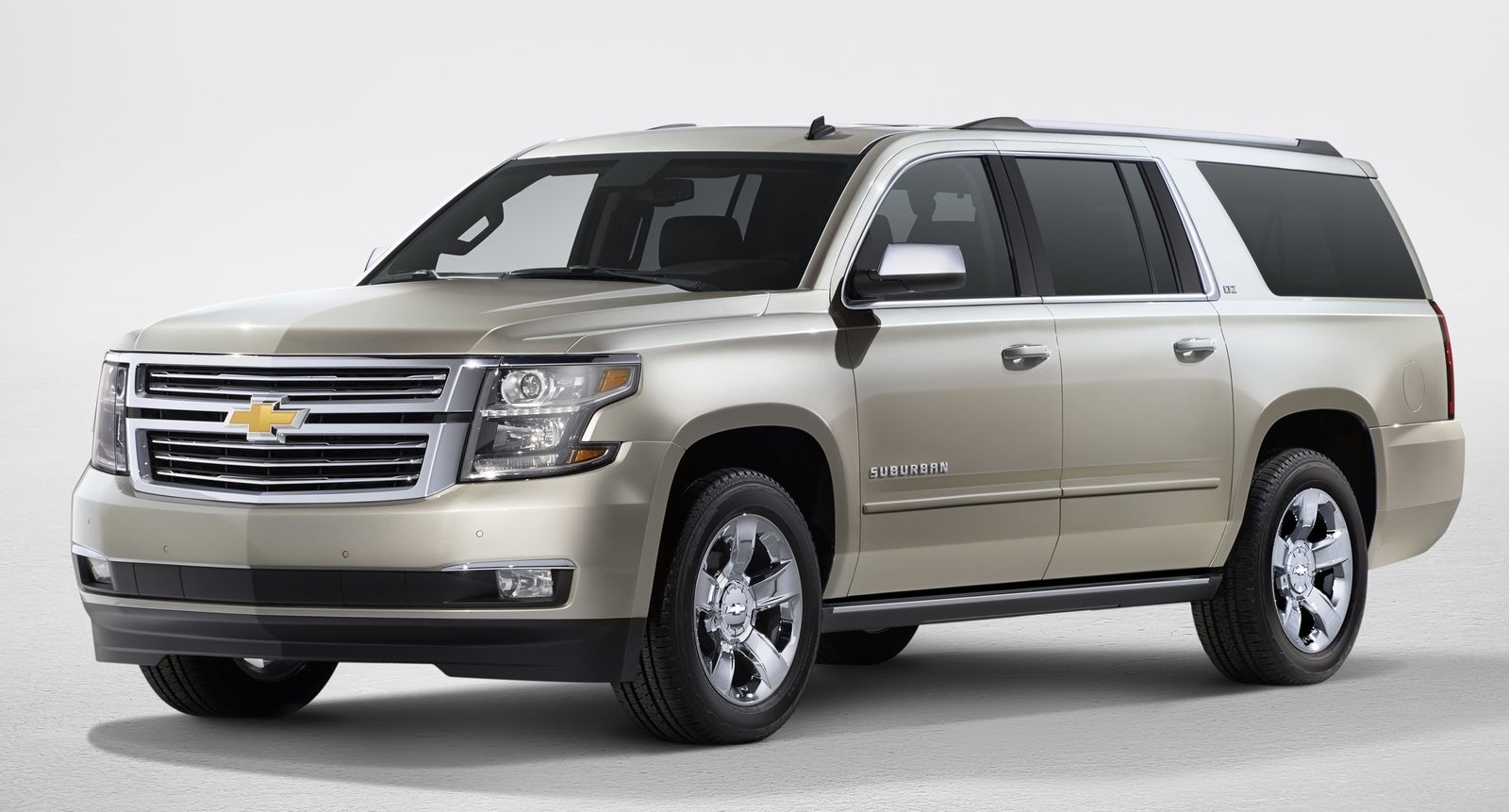
"The new Suburban is one of my favorite Chevrolet vehicles, but I think it's fair to say the Suburban's asking price has exploded since 1986," says Gib Goodrich, director of GMPartsOnline.net. "Our comparison shows a 95% increase in MSRP, even after we adjust for inflation. While some of that price increase is explained by the 2016 model's superior fuel economy, engine power, and safety ratings, it's hard for me to understand the price almost doubling," offers Goodrich.
The comparison of the 1986 and 2016 Chevy Suburban shows that the 2016 model has added some capabilities but also lost some:
  • The 1986 model could seat 9 passengers, while the 2016 model maxes out at 8
  • The 1986 model had a slightly higher payload rating (about 300lbs more capacity)
  • The engine displacement for the 2016 model is slightly smaller, but the power output is dramatically better - nearly 200 more horsepower and 100 more lb-ft of torque
  • Despite the 2016 Suburban's vastly superior powertrain, the max tow rating hasn't increased compared to 1986
  • The EPA fuel economy rating of the 2016 model is quite a bit better, improving roughly 40%
  • The curb weight of the 2016 model is higher by roughly 1200lbs
"The 2016 Suburban is an excellent vehicle, but at $52,000, it's hard for a lot of families to afford. Maybe if Chevy offered a Suburban without heated side mirrors, built-in WiFi, and some of the other standard features, the price wouldn't be so high compared to 30 years ago," says Goodrich

Sunday, 28 February 2016

It Has been THIRTY years since the unveiling of the Volvo 480 ES at Geneva, where has the time gone.

The Volvo 480 ES was the first front-wheel-drive car with a transverse engine produced by Volvo. It's now been 30 years since this wedge-shaped car made its official premiere at the Geneva Motor Show.
When the annual motor show in Geneva opened on 6 March 1986, the Volvo 480 ES was one of the cars that attracted the most attention. It was not just the premiere of the first sports car from Volvo in more than a decade; the 480 ES was also the brand's first front-wheel-drive car in series production. 

The model designation was tied to the 1800 ES sports wagon, which ended production in 1973. The low, wedge-shaped body with its pointed nose and pop-up headlights provided a hint of the future, while the abruptly ending rear section with its glass tailgate was yet another way to pay homage to the 1800 ES.
Several sketches had been prepared by designers such as Carozzeria Bertone and Volvo Cars' Chief Designer Jan Wilsgaard, but the proposal that got the green light was created by John De Vries of Volvo's subsidiary in the Netherlands. Dynamics and personality were key words guiding the design.
The interior was also innovative, with an instrument panel angled towards the driver and adjustable backrests in the individual rear seats. The interior was designed by Peter Horbury, who would later become Volvo's Chief Designer.
The level of technology in the car was high, and the 480 ES was well equipped even in the standard version. A new feature was the trip computer. This “electronic information centre” could give the driver information about average fuel consumption, average speed, range and outside temperature. Digitally, of course.
The 1.7-litre engine came from Renault and produced 109 hp thanks to the help of catalytic converters. This was enough to produce a top speed of 118 mph and enabled the car to sprint to 62 mph in 9.5 seconds. While the engine's power output was not particularly high, the 480 ES was a road car with driving properties that could match its sporty appearance. 
1998 saw the launch of the 480 Turbo, which had a 120 hp engine with the help of its exhaust turbo and intercooler. In 1993, a new 2.0-litre engine was added to the 480 ES series, with 110 hp and, above all, improved torque.
The 480 series was designed to be a niche model and was not a big seller for Volvo. However, it was more important for Volvo than many realised at the Geneva Motor Show in 1986.
The 480 was namely the first car in a large and comprehensive project – internally called Galaxy. The name implied that they were aiming for the stars. For Volvo, it meant that a new era of technology was beginning. Rear-wheel drive was replaced with front-wheel or all-wheel drive, and a range of new engines was developed.
Project Galaxy began in 1978. Two years later, the first front-wheel-drive prototype was ready. The project was then split up so that Volvo Cars in Sweden was responsible for the larger car that would become the 850, and the Dutch subsidiary Volvo Cars B.V. was responsible for the smaller models – the 440, 460 and 480.
There were plans for an open 480 ES, and a prototype of a convertible version of the 480 was unveiled at the Geneva Motor Show in 1990. However, it never made it into production. Neither did the Targa version that was also developed for study purposes. Three of the prototypes of an open 480 ES are currently preserved at the Volvo Museum in Gothenburg.
The Volvo 480 ES was primarily marketed in Europe. The largest single market was the UK, where 22,000 cars were sold. Production of the car in Volvo's plant in Born, Netherlands ended in September 1995. At the same time, the new compact model S40 was picked up. 76,375 Volvo 480s were built in total.