Purpose

I will try my best to provide detailed info on various cars and what is like to live with them, I have already produced a few for Jaguar-car-forums, I will do my best to be unbiased, but it will be hard for some cars. I will re-produce press releases and copy from other motoring news.
Showing posts with label cancelled. Show all posts

Wednesday, 4 February 2015

USA - Mitsubishi cancels plans for all new Sedan for the US, die to exchange rate issues.

Punishing foreign exchange rates have torpedoed plans to add a Korea-built midsize sedan to Mitsubishi Motors Corp.’s U.S. lineup. U.S. dealers had been banking on the sedan, sourced from a Renault-Nissan Alliance assembly plant in Busan, South Korea, since the plan was disclosed in November 2013.
But Mitsubishi pulled the plug last month, saying it ended the feasibility study after failing to reach a “win-win” outcome for the project. The main sticking point, according to one executive: The sudden appreciation of the Korean won against the dollar and Japanese yen made the car simply too expensive.

A spokesman said Mitsubishi is looking into other options for introducing a sedan to reinforce a lineup hurt by an aging Lancer compact sedan and the discontinuation of the larger Galant.
To be sure, the vagaries of foreign exchange rates and international trade underscore why the plan to source a car from Korea built by rival Renault-Nissan was always less than optimal.
The plan plugged a hole in Mitsubishi’s lineup and helped Renault-Nissan put underutilized capacity at its Korean plant to work. But if Mitsubishi wanted a new sedan to sell stateside, wouldn’t the natural first choice have been to source it from a Nissan Motor Corp. plant in North America?
The hitch: Nissan’s North American plants are bursting at the seams. And some of that output already is being shipped overseas, thanks to favorable exchange rates.
Indeed, just as Mitsubishi disclosed the breakdown in its sedan plans, Nissan trumpeted separately that it had shipped its one-millionth U.S.-built export. That car, made in Tennessee, was exported to Korea. Nissan exports the Leaf electric vehicle, the Altima sedan, the Pathfinder crossover and the Infiniti QX60 crossover to Korea.
Even the Korean brands try to limit shipments from Korea to the U.S., despite benefiting from a free-trade pact that eliminates U.S. tariffs. Hyundai-Kia Group imports only 38 percent of the vehicles it sells in the U.S.; the rest are built locally.

Mitsubishi could turn to its underused assembly plant in Normal, Ill. More than half of the Outlander Sport compact crossovers it makes there are exported. Facing few alternatives, executives may now be thinking of ways to turn Normal into an export base for a sedan it can sell in the U.S. as well as abroad. But it would be a tall order to retool the plant for a new vehicle that would likely have limited volume.
Mitsubishi’s U.S. sales rose 25 percent in 2014 to 77,643 units, largely on the Outlander Sport and the Mirage compact hatchback.
The brand, which is positioning SUVs and crossovers at the center of its revival, has been absent from the midsize sedan segment since dropping the Galant in 2012.
Hans Greimel

Thursday, 22 January 2015

MINI to end production of three models in order to stabalise profits across the rest of the range.

To boost Mini’s prospects of long-term profitability parent BMW Group has decided the British brand needs to shrink its lineup to five models from eight. Mini is expected to discontinue three slow-selling vehicles -- the Coupe, Roadster and Paceman – so it can concentrate on the five model lines that accounted for about 95 percent of the 325,000 vehicles it built last year, according to data from IHS Automotive. 

BMW Group does not report individual financial results for the BMW, Mini and Rolls-Royce brands, which has left analysts wondering whether Mini has ever made any money.

“BMW has struggled to make Mini into a profit center from the beginning,” said Max Warburton, an auto analyst at Bernstein Research. He said that Mini’s cars are built on a low-volume platform and that the automaker has undergone “all sorts of complex model line proliferation -- it’s hardly a recipe for making money, at least compared to some of their BMW-branded products.” Mini’s industrial matrix is complex. It builds eight models underpinned by three different platforms in three different plants and has had an average annual volume of about 313,000 units in the last three years.
Warburton expects Mini to become more financially viable once it starts offering a smaller, more consistent range underpinned by a single architecture, which will be shared by BMW brand models such as the 2-series Active Tourer and the next-generation 1 series.

Peter Schwarzenbauer, the BMW board member in charge of Mini, has been a strong advocate for a radical review of the Mini range. “It is important to find the right balance between growth and profitability,” he said late last year while announcing that Mini’s range would be trimmed. Schwarzenbauer said Mini would focus on “superhero” vehicles including the three- and five-door versions of its core hatchback, the Countryman and the Clubman station wagon, which will be renewed this year.
“Like a superhero, each of these cars has its own personality and unique capabilities,” Schwarzenbauer said, without identifying which Minis would be cut and when. However, Oliver Friedmann, the Mini’s head of product management, told Automotive News Europe last year that the Coupe, Roadster and Paceman are not “a priority” in the automaker’s renewal plan. The Coupe and Roadster were conceived as small-volume variants that would help maintain interest in the brand as it transitioned to the fourth generation of its top-seller, the Mini three-door hatch, which debuted last year. IHS Automotive expects Mini to discontinue the Coupe and Roadster this year.
Industrial revamp
Mini also is counting on profits to rise following a radical industrial reorganization of its main factory in Oxford, England, that has boosted daily output to 1,000 vehicles a day from about 700. A key part of that was the switch to making cars using BMW Group’s UKL platform at the plant. The first Mini cars to be underpinned by the UKL architecture are the new three- and five-door hatchbacks. The second-generation Clubman also will use the platform when production starts in Oxford later this year. Oxford builds the Convertible, Coupe and Roadster on the platform BMW created to relaunch Mini in 2001.
Magna Steyr’s plant in Graz, Austria, builds the Countryman and Paceman using a dedicated platform. BMW confirmed it will build another model in Graz after it shifts the next-generation Countryman to another plant. IHS expects production of the new Countryman to start in 2016 at the VDL NedCar plant in Born, Netherlands. VDL began making the Mini three-door hatchback in July 2014 using the UKL platform.
Nick Gibbs and Bloomberg

Saturday, 8 March 2014

MINI to can the Roadster, Coupe and Paceman, about time too !

Mini may not replace its Coupe/Roadster and Paceman cars. Instead the BMW Group subsidiary will focus on three "pillar" models.
Mini needs to be “more relevant for more people,” Oliver Friedmann, the brand'a head of product management, told Automotive News Europe at the auto show here. “Our first priority is to roll out a portfolio that has strong pillars and to be absolutely clear what each stands for.”

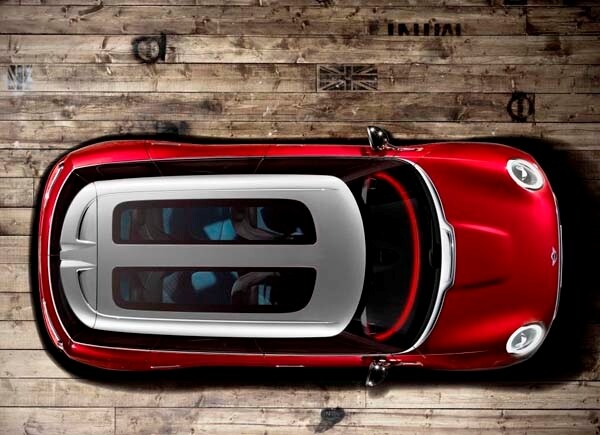
Friedmann identified the Mini hatchback and the Countryman SUV as two pillars of the brand. The potential third pillar is a compact-sized model based on the Clubman concept shown in Geneva. If the concept is built, "it will be a separate strong pillar,” he said.
With the new focus, the hatchback-based Coupe and Roadster are unlikely to continue. “It’s not decided but most probably this is not a priority,” Friedmann said.
The Paceman, which is a coupe version of the five-door Countryman, could also be dropped when the Countryman is eventually replaced. "The Paceman is also not a first priority,” Friedmann said.
The Paceman was launched as a lower, more sporty version of the Countryman.

The Coupe/Roadster and Paceman are niche models for Mini.
According to researchers IHS Automotive, Mini sold 3,858 Coupes, 2,678 Roadsters, 7,485 Clubmans and 8,229 Pacemans in Europe. This contrasts with sales of 47,177 Countrymans and 78,102 hatchbacks.
“The Coupe and Roadster are selling far below where Mini’s key models are and I think in some respects are quite poorly executed,” IHS senior analyst Ian Fletcher told Automotive News Europe.
New Clubman
IHS predicts that Mini will launch the new Clubman based on the Geneva show concept in 2015.
The Clubman concept is 260mm longer than the current model and has four conventional doors instead of the current Clubman’s quirky single half-door arrangement that provides rear seat access.

Mini's latest-generation three-door hatchback is being rolled out at dealerships. It uses BMW's new front-wheel-drive platform and BMW's a new 1.5-liter gasoline turbocharged three-cylinder engine which has improved fuel economy and lower CO2 emissions.
Mini's Clubman concept, shown, is longer, wider and taller than the current Clubman.

A five-door version is likely to go on sale before the end of this year. IHS estimates the revised hatchback's extra appeal could push its sales to more than 100,000 this year