Purpose

I will try my best to provide detailed info on various cars and what is like to live with them, I have already produced a few for Jaguar-car-forums, I will do my best to be unbiased, but it will be hard for some cars. I will re-produce press releases and copy from other motoring news.
Showing posts with label exige. Show all posts

Thursday, 26 January 2017

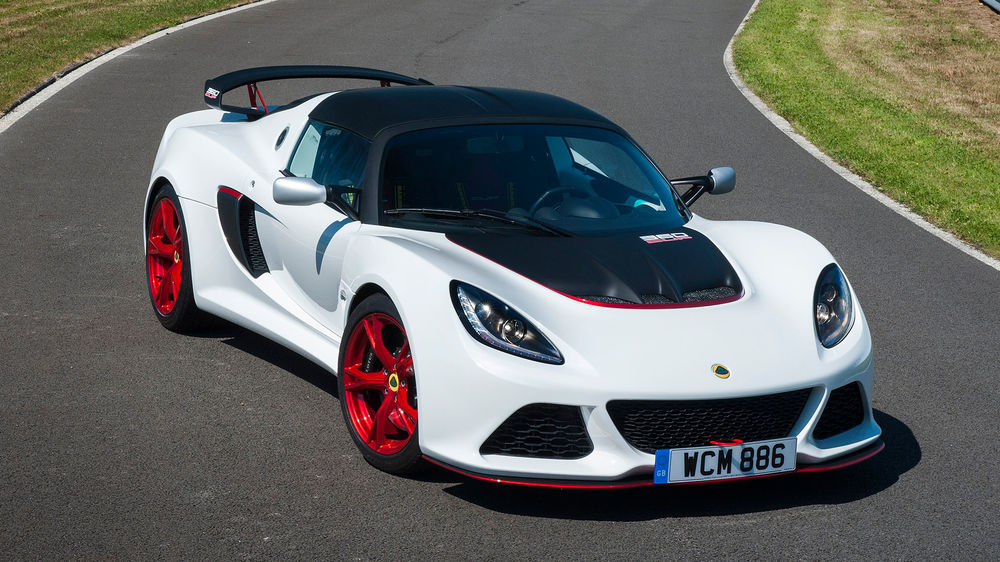
Unapologetic, uncompromising and built to win, Lotus has announced the development of the mighty Exige Race 380

• Race only version of sensational Exige Sport 380
375 hp and 410 Nm
• Weight cut to just 998 kg dry
0-60 mph in 3.2 secs
• Laps Hethel 1.5 seconds quicker than Exige Cup R
• Aerodynamic downforce boosted to 240 kg

Unapologetic, uncompromising and built to win, Lotus has announced the development of the mighty Exige Race 380 - the track-only sibling of what has been hailed as one of the marque’s most significant and sensational cars, the critically acclaimed Exige Sport 380.
Combining Lotus’ vehicle development skills with its motorsport pedigree, the class-leading competition car will set the pace when the first production cars reach owners in May 2017. 

As part of the current Exige’s development cycle, the Race 380 will become the race car of choice for teams as well as privateers for the 2017 / 2018 season.

Taking one of the world’s best supercars, the Exige Sport 380, the new model provides the ultimate in race-bred engineering and comes with a host of competition-focused components as standard.
Gearbox, suspension, aerodynamics and electrical systems are among the items that have been modified to reflect the car’s role but, despite the fact that the new Race model is not available in a road-legal specification, the majority of the original car’s configuration is retained, thanks to the Exige Sport 380’s highly advanced development.
Unveiled late last year, the Lotus Exige Sport 380 has proved to be one of Lotus’ most successful new models in recent years, with orders for the next four months’ production already allocated.
Jean-Marc Gales, CEO of Group Lotus plc, commented: “The Lotus Exige Sport 380 is a real giant slayer on the road, and one of the quickest A to B supercars around. It gave us the ideal platform from which to develop the new Exige Race 380 - a peerless competition car designed to beat the best. By setting its weight below 1000kg, its power to weight is unsurpassed in its class. When lapping Hethel, it’s a phenomenal 1.5 seconds faster than the previous Exige Cup R - a massive performance gain. It’s an unparalleled race car that follows the philosophy of Colin Chapman and we can’t wait for customers to experience its capabilities.”
The Lotus Exige Race 380 in more detail
In keeping with its name, the new Exige Race 380 includes a wide range of competition-orientated options as standard, covering everything from drivetrain to driver information system – all designed to increase the car’s capabilities. Developed to be eligible for the world-wide Lotus Cup series and a number of clubman championships, this race car is every inch a winner.
Retaining the race-proven 3.5-litre supercharged V6 engine, the Exige Race 380 boasts 375 hp at 6,700 rpm and 410 Nm (302 lbft) of torque at 5,000 rpm. However, in order to extract every ounce of performance, the car comes with an Xtrac 6-speed sequential transmission, oil cooler, and cassette-type plate limited slip differential, and is operated by carbon paddles located behind the steering wheel. Opting for the full exhaust system in titanium removes a further 10 kg from beyond the rear axle. Extremely quick off the line, the Exige Race 380 sprints from 0-60 in just 3.2 secs, and laps the Hethel track in an outstanding 1 minute 23.5 seconds - the fastest ever for an Exige.
Generating even more downforce from the car’s aerodynamics, the Race 380 produces a phenomenal 240 kg at 170 mph, thanks to some careful revisions. Vents are incorporated into the front bodywork and rear bumper to reduce pressure around the wheels and increase downforce; and a grille mounted at the rear aids air circulation through the engine bay. A new front splitter reduces pressure beneath the Exige, whilst the rear diffuser and larger and a straight-cut motorsport rear wing mounted to the bodywork helps modify airflow at the rear of the car.
Helping the Exige exploit its performance, the Race 380 employs Michelin Pilot Sport Cup 2 tyres as standard (wider 215/45 ZR17 at the front; 265/35 ZR18 at the rear), renowned for their predictable handling and high grip, which are complemented by the car’s ultra-lightweight forged alloy wheels. The same attention to detail has been applied to the brakes, with AP Racing forged, four-piston callipers and grooved two-piece brake disc providing the stopping power.
The Exige has long set the benchmark for handling and, to ensure it remains perfectly poised and agile, the Race 380 uses a revised suspension configuration, incorporating 2-way adjustable Öhlins dampers and adjustable front and rear anti-roll bars. This, together with the Lotus Traction Control System, where the amount of wheel slip can be adjusted by the driver from the cockpit, allows owners to fine tune the vehicle’s handling characteristics.
The Exige Race 380 features a full, integrated roll cage, lightweight FIA Carbon driver seat (HANS compatible) and a six-point harness, as well as ultra-lightweight polycarbonate side windows, competition specification fire extinguisher, battery isolator and front and rear motorsport towing eyes. An ultra-lightweight carbon fibre motorsport specific louvered tailgate panel is fitted over the engine and carbon fibre air intake pods are fitted to either side of the car forward of the rear wheels. As with other race cars in the Lotus range, headlamps are replaced by matt black covers and airbags are not included in the specification.
Helping the driver stay on pace, the new Exige Race 380’s colour TFT instrument cluster offers numerous user customisable and programmable screen configurations. Incorporating a track data logger and GPS unit, owners have the opportunity to upgrade this logger with professional data analysis software.
As well as being designed to win, the Exige Race 380 looks exceptional and retains many of the hand-made carbon-fibre components from the Exige Sport 380 including the front inspection cover, hard top and diffuser surround.
The Exige Race 380 is available to order now, priced £99,500 excluding VAT.

Saturday, 26 November 2016

The new Lotus Exige 380, the top of the range car that will shame supercars, lighter, lower and more power.

  • Fastest Exige ever: 0-60 mph in 3.5 secs
  • 375 hp and 352 hp per tonne
  • Weighs from 1,066 kg dry and 1,100 kg kerb
  • Aerodynamic downforce of 140 kg at top speed
  • Nose-to-tail carbon components as standard
High powered, highly evolved, and ferociously fast, the Lotus Exige Sport 380 is the most aggressive iteration yet for the Exige model line up.
Taking the fight straight to six-figure supercars, this new, top-of-the-range model carries over the lessons learnt in the development of the acclaimed Exige Sport 350, launched last year, but with significant revisions lowering weight, boosting power and enhancing aerodynamics.
Rather than relying excessively on electronics, or allow sterile interfaces to dull the experience, the extreme Exige Sport 380 offers a pure, undiluted drive that has to be experienced to be fully appreciated.
Unrivalled in its class: faster, sharper, and more direct than adversaries, the Exige Sport 380 is definitely not for the timid. With a dry weight of just 1,066 kg with lightweight options, and boasting a potent power-to-weight ratio of 352 hp per tonne, the new, pure-bred Lotus has been conceived to out perform and out manoeuvre so called supercars. The new Exige is blisteringly fast off the line, dispatching 0-60mph in 3.5 seconds before reaching a top speed of 178 mph.

From the intricately engineered exposed-gear-change linkage, to the swathes of carbon-fibre components and Michelin Pilot Sport Cup 2 tyres as standard, every inch of the Exige has been carefully cultivated. Firmly defined as a Lotus for the enthusiast, the car can be seen as an expression of intense engineering - challenging accomplished drivers to extract the car’s true potential.
Jean-Marc Gales, CEO of Group Lotus plc, commented: “We’ve saved something special for our last new car of 2016. We have built upon the foundations of the excellent Exige Sport 350 and developed a perfectly proportioned, intuitive and attainable supercar for real roads. The cut in weight is nothing short of drastic and, combined with the hike in power and its enhanced agility, we’ve created something exceptional - far greater than the sum of its parts. The Exige Sport 380 is so good, that it is no longer the best in class, it’s now in a class of its own.”
Unashamedly analogue and unfiltered
Lotus’ approach to developing the perfect sports car has allowed the Exige Sport 380 to lay claim to the title of the best sports car under £100,000. A true supercar car for the road, the Exige focuses on the three key attributes that have made the company a firm favourite with driving enthusiasts: reduced weight, higher performance and honed aerodynamics.
Raised on the roads around Hethel, and exercised on the company’s famous test track, the new car can trace its lineage back to the very first Exige, launched in 2000. Now the headline car of the range, sitting above the Sport 350 model, it is instilled with Lotus’ DNA and packed with a potent 375 hp engine into Lotus’ acclaimed two-seater.
Weight less
While employing some of the high-performance components premiered on the Exige Sport 350, Lotus returned to the Lightweight Laboratory in order to cut kilos from the kerb weight. Infused with carbon fibre from front to back, the Exige Sport 380 features hand-made, high-gloss visible weave components as standard to deliver a weight saving when compared to the Exige Sport 350. This includes the front splitter, revised front access panel, new rear wing and rear diffuser surround, which together save 2.7 kg. A lightweight, transparent polycarbonate rear window saves 0.9 kg over the glass equivalent in the Exige Sport 350. In addition, the carbon race seats (-6 kg), lithium- ion battery (-10.3 kg), ultra-lightweight forged wheels and grooved two-piece brake discs (-10 kg) combine to cut a massive 26.3 kg. A new design of rear transom panel now has two rear light clusters, rather than the four on the Exige Sport 350, with reversing and fog lights now mounted inboard, cutting weight by a further 0.3 kg.
In line with its illustrious lineage, the Exige Sport 380 employs Lotus’ lightweight extruded and bonded aluminium structure, as the company continues to lead in the field of advanced automotive construction techniques. Lotus is working continuously to engineer out the excess mass from its cars, and the company’s chassis technology remains the benchmark.
Power play
The company’s powertrain division has left its mark on the car, with the uprated 3.5-litre supercharged V6 engine generating 375 hp at 6,700 rpm and 410 Nm (302 lbft) of torque at 5,000 rpm. Refined from extensive testing and development, it’s a design that’s proved its mettle by powering some of Lotus’ latest supercars, including the track-focused 3-Eleven and the recently revealed Evora Sport 410.
The power boost comes from a revised supercharger pulley, which increases charge pressure, an uprated fuel pump, a recalibrated ECU and the introduction of a revised exhaust system – as used in the Evora 400 and Evora Sport 410. Allowing owners to enjoy the new Exige for longer between fuel stops, it also comes with an enlarged, 48-litre petrol tank.
Providing faster, cleaner changes, the Exige Sport 380’s six-speed manual gearbox uses Lotus’ acclaimed open-gate design. Eliminating lateral movement, by precisely aligning components, it features light-weight machined and cast aluminium parts. Aesthetically appealing, the open transmission mechanism also helps contribute to the car’s reduced weight. The manual gearbox has been further enhanced through the introduction of a new oil cooler, ensuring the gears operate at the optimal temperature no matter how hard they are performing.
The Lotus Exige Sport 380 is also available with an optional six-speed automatic gearbox, where drivers can select gears sequentially via the forged aluminium paddles located behind the steering wheel, or rely on the gearbox’s fully automatic mode. The automatic gearbox option will be available from Spring 2017.
The Lotus Exige Sport 380 features Lotus’ Dynamic Performance Management (DPM) which provides enhanced ‘Sport’ and ‘Race’ settings. Proportionally increasing throttle response, lowering traction slip thresholds and removing understeer recognition, it provides the driver with a finer level of control before the system intervenes. DPM also utilises an engine exhaust bypass valve at mid-to-high engine speeds, further reducing back pressure to boost throttle response and engine performance in both ‘Sport’ and ‘Race’ settings.
Aero advantage
As with all Lotus cars, aerodynamic efficiency plays a key role in the Exige, helping it to drastically expand its performance envelope. Extensive CFD modelling work has allowed Lotus’ design team to fine tune specific areas, in order to deliver a substantial overall improvement. The revised front access panel modifies the air flow exiting the car’s horizontally mounted radiators, before it travels over the car, while the carbon front spoiler and rubber lip spoiler combined with the carbon barge boards reduce pressure under the vehicle.
In addition, twin pairs of front canard wings, mounted forward of the front wheels, a carbon rear wing and air blades behind the rear wheels, all work to help raise downforce to a massive 140 kg at maximum speed - a 60% gain over the Exige Sport 350, which generates 88 kg at its maximum speed. This increase in downforce does not come at the penalty of drag which remains the same as the Exige Sport 350.
Favouring mechanical solutions over electronic systems, including key parts such as unassisted steering, means that the Exige Sport 380 delivers the driver an intuitive experience. The extensive use of carbon fibre on the bodywork has lowered the centre of gravity, helping contribute to the Exige’s exemplary steering feel and precision handling characteristics.
Making the most of its performance potential, the Exige Sport 380 is fitted with Michelin Pilot Sport Cup 2 tyres as standard (265/35 ZR18 rear and 215/45 ZR17 front). Selected for their tenacity, and 10mm wider at the front that on the Exige Sport 350, the increased mechanical grip is complemented by the car’s ultra-lightweight forged alloy wheels, which are available in either black or silver. Either option is complemented by AP Racing forged, four-piston brake callipers and grooved performance two-piece brake discs.
In addition to its already impressive credentials, it’s possible to sharpen the Exige further still. Opting for the full exhaust system in titanium improves the car’s overall balance, by removing 10 kg from beyond the rear axle. For customers who frequently go to the track, the optional Track Pack provides Nitron two-way adjustable dampers and Eibach adjustable front and rear anti-roll bars.
The optional Carbon Exterior Pack contains a one-piece carbon roof panel and a distinctive carbon louvered tailgate. The carbon roof panel is 2 kg heavier than the standard soft-top but this weight increase is offset by the carbon louvered tailgate which saves 2 kg.
As befitting such a stand-out car, the Exige Sport 380 is sprayed and hand finished in one of ten individual colours. Providing some drama and drawing the eye to the beautiful composite carbon components, an optional exterior accent pack is also available in one of five key colours to deliver some finer detailing to the car’s undeniable presence.
The car’s kerb appeal is enhanced by revisions to the Exige’s design front and back. Distinctive blackened headlamp surrounds provide a more aggressive demeanour, whilst to visually accentuate the width of rear of the car, a new rear transom features two lamp clusters rather than four.
The hand finished detailing continues inside, with the carbon fibre sports seats trimmed with either Alcantara®, leather or tartan, with all featuring contrast stitching.
The optional lightweight carbon fibre sill covers provide a motorsport theme when entering or exiting the Exige Sport 380 and, thanks to their lower profile and contoured finish, aid ingress and egress. The Interior Colour Pack provides contrasting surrounds to the transmission console, HVAC surround, carbon seat eyelets and electric window bezels in one of four colours. A new integrated entertainment system can also be specified, including iPod® connectivity and Bluetooth® functionality, along with air conditioning.
For owners wanting more, the new Exige Sport 380 can be personalised through the increasingly popular Lotus Exclusive programme. Combining traditional British craftsmanship with modern design, the service inspires customers to spend time tailoring the character of their Lotus with a comprehensive array of options.
The Lotus Exige Sport 380 is available as a roadster as standard and as a coupe as an option.
Manufacturer’s Suggested Retail Price
UK (Pound Sterling)£67,900
Germany (Euros)€89,900
Japan (¥ Yen)¥12,760,000
Technical Specification:
PERFORMANCEManualAutomatic
Max power375 hp (380 PS, 280 kW) at 6,700 rpm
Max torque410 Nm (302 lbft) at 5,000 rpm
0-60 mph3.5 seconds3.5 seconds
0-100 km/h3.7 seconds3.7 seconds
Max Speed178 mph (286 km/h)170 mph (274 km/h)
Kerb Weight
with lightweight options
1,110 kg
1,100 kg
1,121 kg
1,111 kg
Dry Weight
with lightweight options
1076 kg
1,066 kg
1,087 kg
1,077 kg
Downforce at maximum speed140 kg140 kg
Fuel Consumption mpg (l/100 km) *
Urban
Extra Urban
Combined
19.5 (14.1)
37.2 (8.3)
28.0 (10.4)
21.1 (13.3)
39.8 (7.6)
30.1 (9.7)
COemissions242 g/km225 g/km
* Final fuel consumption and emissions figures to be confirmed

Thursday, 18 August 2016

Lotus Cars are looking like they will make a profit this year, the first in nearly two decades.

It’s been a little more than two years since seasoned auto executive Jean-Marc Gales took over as CEO of struggling British sports car maker Lotus. 
When the former Opel, Mercedes-Benz and PSA Group executive arrived there was no money to replace Lotus’ aging three-model range. 
That forced him to cut costs while also finding ways to inexpensively enhance his portfolio to achieve his goal of making the company profitable. 

Gales expects to reach the key target in Lotus’ current fiscal year, he told Automotive News Europe Correspondent Nick Gibbs.
Are you closer to profitability?
We will be profitable this financial year that started in April. We had a three-year plan from when I arrived in 2014. The first two years were basically building up, this year is the year of profitability.
Where are you now?
I can’t give any numbers, but we are better than the year before. We are continuously improving as 2013 was better than 2012, 2014 was better than 2013, 2015 was better than 2014. Now comes the big year 2016-17 where we will be profitable.

What does that mean in models sold?
Probably 2,200 to 2,300 in this financial year. But we believe we could do even more because we will have the full-year effect of the U.S., where we launched the Evora in May and we expect sales of 400 cars. We already have 250 orders.
Will all U.S. sales be Evora coupes?
Yes. The roadster will arrive about a year after the coupe. Right now almost the whole factory is [building] U.S. orders.
Are you still cutting costs?
We are continuing with the cost-cutting exercise. The worst is behind us, but it’s a continuous exercise to review costs.
What are your targets on that front?
The last two years we have achieved them. We are very lean. We have about 900 staff now, down from more than 1,200. We have reduced the number of hours it takes to build each car by 10 percent. We are continuously looking at reducing cost of the parts. It was one of the prerequisites of becoming profitable, and we will get there -- after 20 years of not being profitable.
Is the Elise or Evora your top-seller?
The Evora will be our biggest seller this financial year with its entry into the U.S. Next year it will be Evora as well.
When we last spoke you were about to finish a prototype SUV to show to Chinese authorities with a view to making it there. How did that that go?
We are making progress. I won’t say more, but it’s going well.
How is the development of the new architecture going?
There’s so much life left in the current one. There will be a new architecture coming but give us another four years for the [Elise] small car and a bit longer for the [Evora] large car. The basic architecture is 20 years old, yes, but the Porsche 911 architecture is 50 years old and that’s still going strong. We’ve continuously updated it. Look at all the competitors who try to copy our cars. Either they get too heavy or too slow or both.
Will you stick with aluminum for the next architecture?
Probably. It’s what we do best. I like it because it’s so flexible, on the same car you can do both open or closed. It gives you so much more flexibility than a carbon chassis. We are still working on reducing the weight.
When will you upgrade the Elise?
I can’t give a precise date, but I can say will upgrade the Elise before the new architecture comes. We have concrete ideas of what we’re going to do with the car regarding improved infotainment, lower weight and more power.
Will you sell that car in the U.S.?
No. But with the next architecture certainly. We currently offer the Evora and we will also offer the [more powerful] Evora 410 Sport in the U.S. Then the roadster. Three different cars.
How is business for Lotus Group’s engineering arm?
It provided turnover of 10 to 15 million pounds, which is up from last year. That’s about 10 to 15 percent of our total turnover.
Does a hybrid powertrain make sense in a Lotus?
For a sports car, no. For an SUV, yes. Why add two powertrains and batteries when I can add one powertrain and optimize. It would be completely against Lotus’ philosophy of lightweight. It would add 100kg of batteries and 50kg for the second drivetrain. Hybrid is favored by the current emissions cycle. When the emissions cycle changes it won’t be favored as much.
Lotus has battled with the EU over emissions. Have you been given a target?
We fall under the small manufacturer clause like McLaren and Aston Martin. However, in the U.S. we need to fulfill some reductions. Over a five-year period, we need to show a gradual 3 percent-per-year reduction. We can get there. In Europe we are working on remapping the electronics and reducing weight.
How can you get 3 percent out annually?
One option is to take out the supercharger [from the Evora’s Toyota-sourced 3.5-liter V-6]. Another is to go for extreme lightweight, but that is in our DNA anyway. The third is have longer gear ratios, which I don’t like much because it takes away the liveliness of the car. I don’t believe a four-cylinder fits there.
Nick Gibbs
Automotive News Europe