New Concept showcases new MEB electric platform and offers a glimpse of next-generation connectivity and infotainment concepts
- First VW based on the new Modular Electric Toolkit (MEB)
- Features 101 kWh battery that enables up to 373** miles of pure electric range
- New interfaces signal next-generation display and ergonomic concepts
- BUDD-e becomes integral part in the Internet of Things and links Smart Home and Smart Car technology
- Gesture control 2.0 enables intuitive operation of interior and exterior features
- Bold design captures brand’s heritage while providing a hint at future design direction
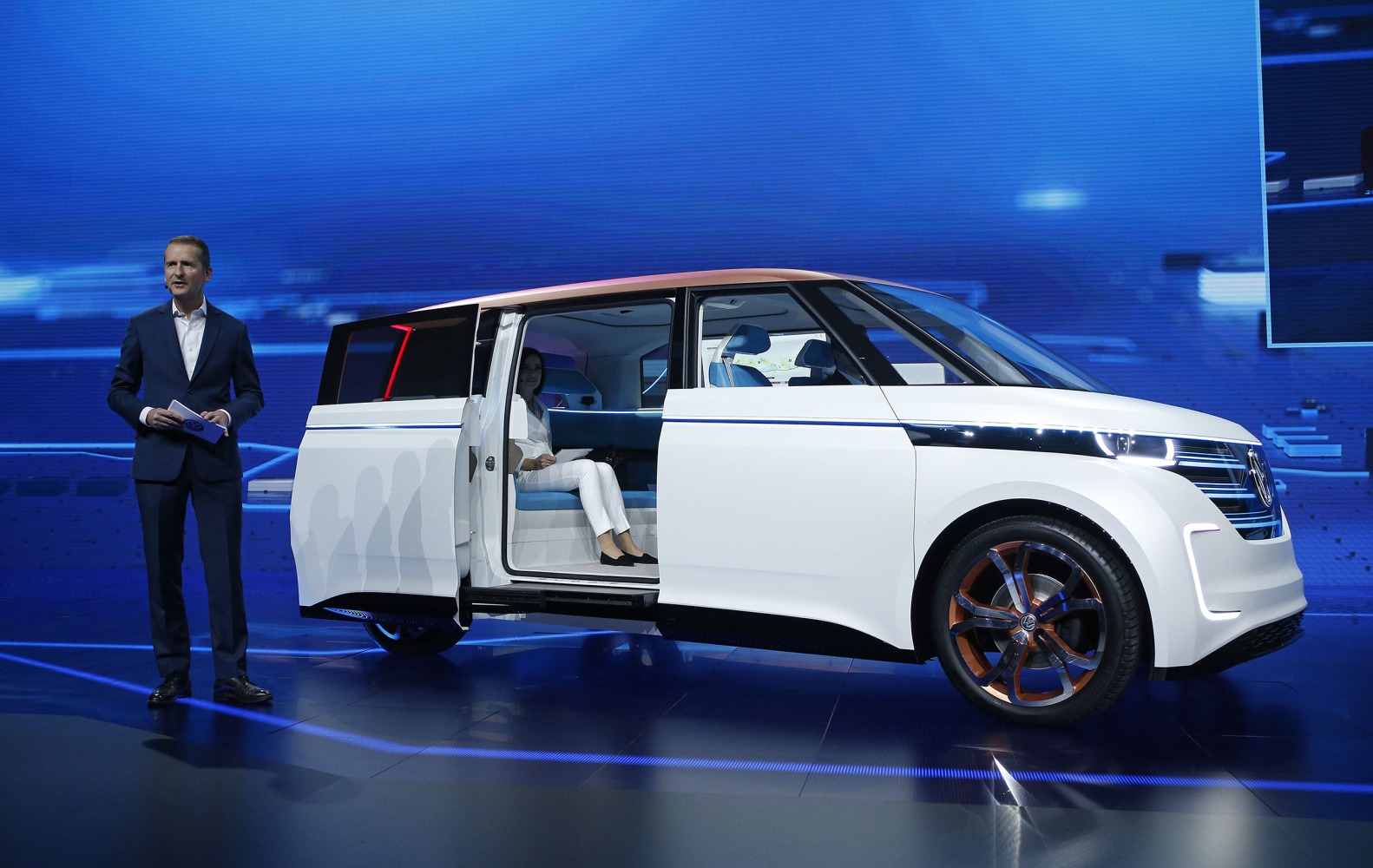
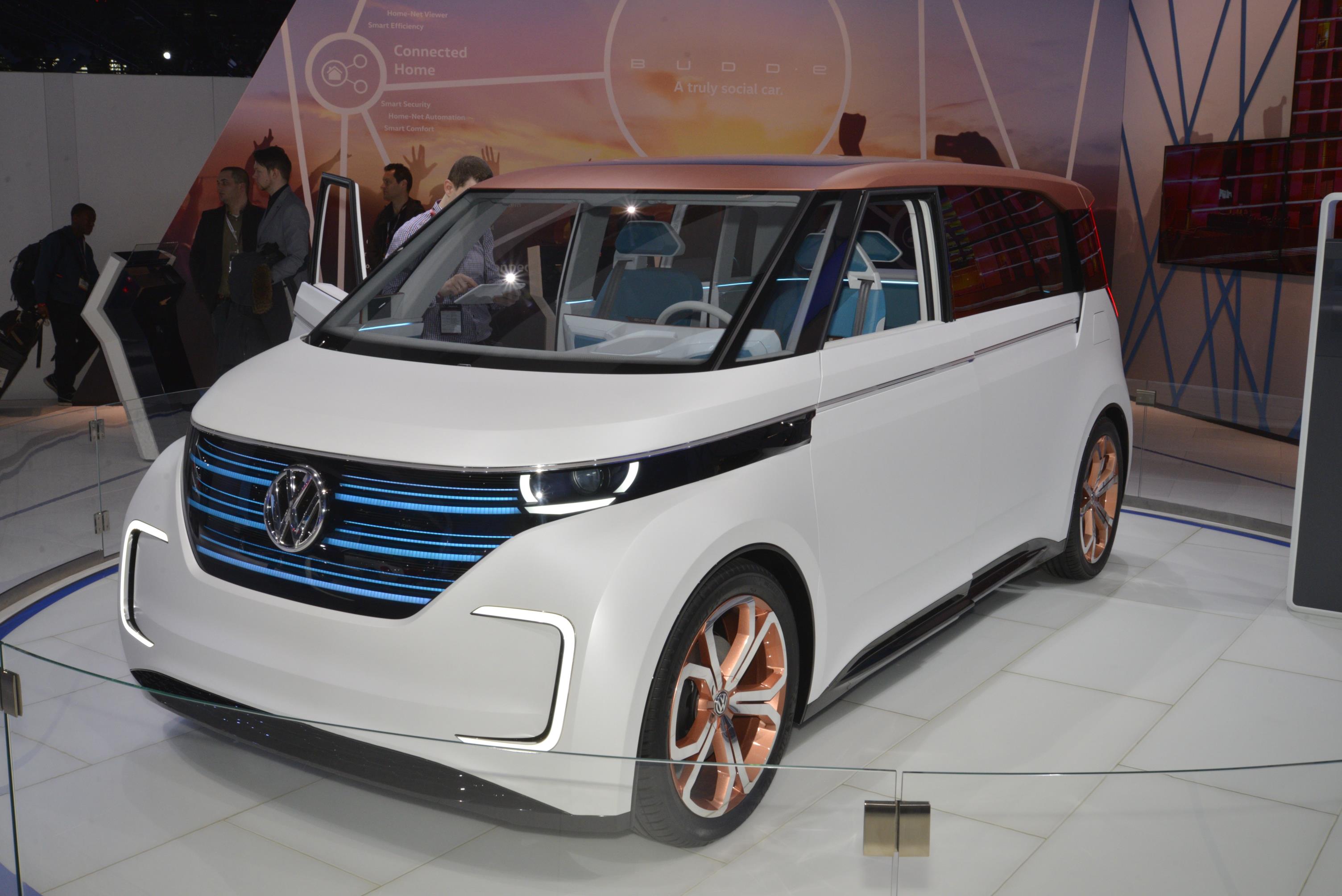
Building on the successful unveiling at January’s Consumer Electronics Show (CES) in Las Vegas, the Volkswagen BUDD-e makes its U.S. auto show debut at the New York International Auto Show. This is the first vehicle based on the all-new Modular Electric Platform (MEB) that is designed specifically for plug-in vehicles.
With a range of up to 373** (estimate based on the New European Drive Cycle (NEDC), 233 miles estimate when based on EPA drive cycle) miles coupled with a charismatic, iconic design, this vehicle successfully incorporates Volkswagen’s heritage while providing a glimpse into the brand’s future.
Completely and thoroughly networked, BUDD-e is a mobile interface which connects the vehicle with the world around it. With the BUDD-e Volkswagen has developed a vehicle that is more thoroughly connected with its surroundings than any car before it.
An integral automotive component in the Internet of Things (IoT), BUDD-e is capable of seamlessly communicating with your Smart Home or office. Featuring next-generation infotainment technologies and offering an advanced new method of operation and information processing, BUDD-e turns travel into a fully interactive, intuitive experience.
Utilizing the latest in user interface innovation, touch and gesture control merge seamlessly and result in the removal of switches and buttons inside the cabin, individual displays that blend into large infotainment panels, and digital screens instead of analog mirrors.
The convergence of these new, interactive infotainment and operating systems provides a view of potential applications in Volkswagen products in the next decade.
MEB: The new architecture for Volkswagen’s electric vehicles
With BUDD-e, Volkswagen demonstrates what electric mobility could be like by the year 2019. Volkswagen’s new MEB platform will enable a series production car to have pure electric range that is on par with today’s gasoline-powered cars by the end of the decade. The time required to charge the batteries to 80 percent of capacity is anticipated to be reduced to about 30 minutes by then, marking an operational breakthrough for EVs.
BUDD-e is the first concept car developed by the Volkswagen Group that is underpinned by the new Modular Electric Toolkit (MEB). This architecture heralds a fundamental change in electric cars and ushers in a revolution in automotive technology, leaving today’s fossil-fuel powered internal combustion engines and drivetrains in the past. This significant innovation will lead to huge changes in the development of electric-powered Volkswagens in the years to come, from body and interior design, to packaging and drive characteristics.
The new platform is designed to have the space for electric drive components and large batteries while maintaining interior space and driving dynamics. MEB will allow for spacious interiors with the smallest possible footprint to enable easy and nimble transportation. In addition to their space, MEB vehicles will offer high levels of functionality and networking thanks to the new vehicle architecture, instrumentation, and operating systems. New and enhanced assistance systems will provide passengers with safer transport.
Dynamic performance is, and will remain, a key part of Volkswagen’s DNA, and MEB vehicles will be no exception. With a focus on optimal balance, future VW vehicles based off the platform will offer the kind of agility, strong acceleration and handling that VW customers have come to expect. New battery and electric drive componentry will enable inexpensive access to e-mobility: a much longer purely electric range will allow these vehicles to become the primary transportation in many consumers’ households.
The new MEB delivers a drivetrain architecture that is specifically tailored for the integration of compact electric motors and high-performance, highly-efficient batteries. The 101 kWh battery is flat, to save space, and integrated into almost the entire vehicle floor. It powers two electric motors, one to drive each axle.
The front and rear motors power all four wheels and enable a top speed of 93 mph. The total range of up to 373** (estimate based on the New European Drive Cycle (NEDC), 233 miles estimate when based on EPA drive cycle) miles is achieved on a full charge, putting the BUDD-e on a level playing field with today’s gasoline-powered cars. Like today’s electric vehicles, the BUDDE-e offers several levels of plugged-in charging with the added benefit of cordless inductive charging.
Another benefit of the new MEB is entirely new packaging opportunities, highlighted throughout the BUDD-e concept. One significant enhancement is illustrated by the arrangement of the heating and air conditioning unit. For instance, the innovative new heating and air conditioning unit has been completely integrated in the front end of the car which allows for significantly more available space, improves air quality (thanks to larger and more robust filters), and results in a reduction of fan noise inside the cabin for excellent acoustics.
The concept van is 181 inches long, 76.3 inches wide and 72.2 inches high, placing it between two very successful Volkswagen models sold in Europe, the Touran and the Multivan T6. Due to its generous width, relatively long wheelbase (124.1 inches), and very short overhangs (27 inches at the front and 28.9 inches and the rear), the BUDD-e’s proportions are very appealing.
Exterior design
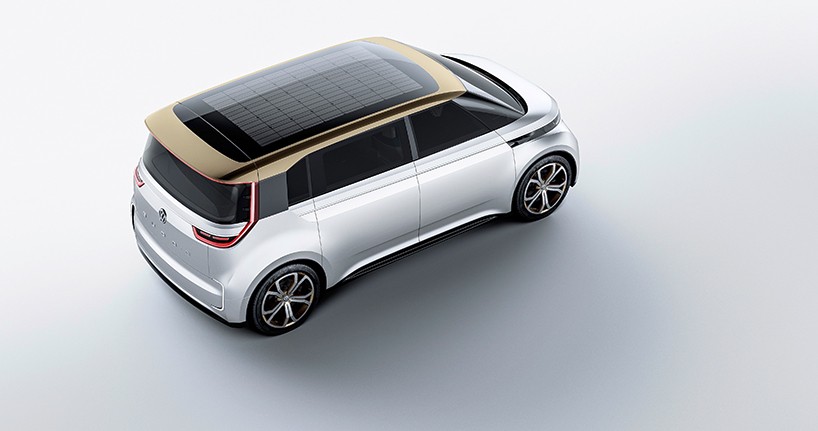
Inspired by the iconic charm of classic Volkswagen vans, the BUDD-e’s design focuses on the aesthetics of functionality. Practical, clean, innovative, powerful and appealing, the concept has a two-tone color scheme, with its body painted in “Nevada White” below the window edge, and the roof in “Phoenix Copper.”
The front end design of the BUDD-e is unmistakably Volkswagen. The area around the VW logo can be backlit by integrated LED modules in a number of different ways, creating an external ambient light that tapers towards the sides, and a narrow stripe that continues all the way around the van.
The main headlights, which also use LED technology, are placed high up, while transparent surfaces to the left and right of the headlights house integrated LED indicators that carry into the vehicle’s silhouette. Viewed from the front, the V-shaped design of these styling cues resemble elements from the original Volkswagen Microbus and Beetle, with a futuristic flare that provides an entirely new interpretation of the brand’s design DNA.
The van’s silhouette is characterized by a flat and elongated roof line, long windows with glazed A-pillars, 21-inch aluminium-alloy wheels, and light modules that start at the front and reach around the vehicle’s flanks. A narrow LED stripe, which runs all the way round the car, acts as a character line and delivers exterior ambient lighting.
The silhouette comes across as especially clean, thanks to an absence of door handles and wing mirrors, as these components have been completely redesigned and replaced by electronic solutions. Flared D-pillars, which also contain the LED strip for the rear lights, accentuate the design further.
At the rear, the BUDD-e’s aerodynamic design promotes airflow through the gloss black D-pillars, reducing aerodynamic drag and simultaneously optimizing rear downforce. Its clean and iconic design continues all the way to the rear, with a large tailgate, reminiscent of the original Volkswagen bus. LED taillight strips reach up into the D-pillars, and the circumferential ambient light give BUDD-e a unique design unlike anything on the road. Last but not least, a C-shaped LED signature surrounds the extractable Drop Box.
Next generation human-machine interface
The interior style of the BUDD-e is characterized by a completely new and innovative human-machine interface—the instrumentation and operating concept of the future. The design is extremely clean and intuitive to use. The technical architecture of the infotainment and control systems, as well as their design, make a quantum leap akin to the jump from flip phones to smartphones or from analog timepieces to smart watches.
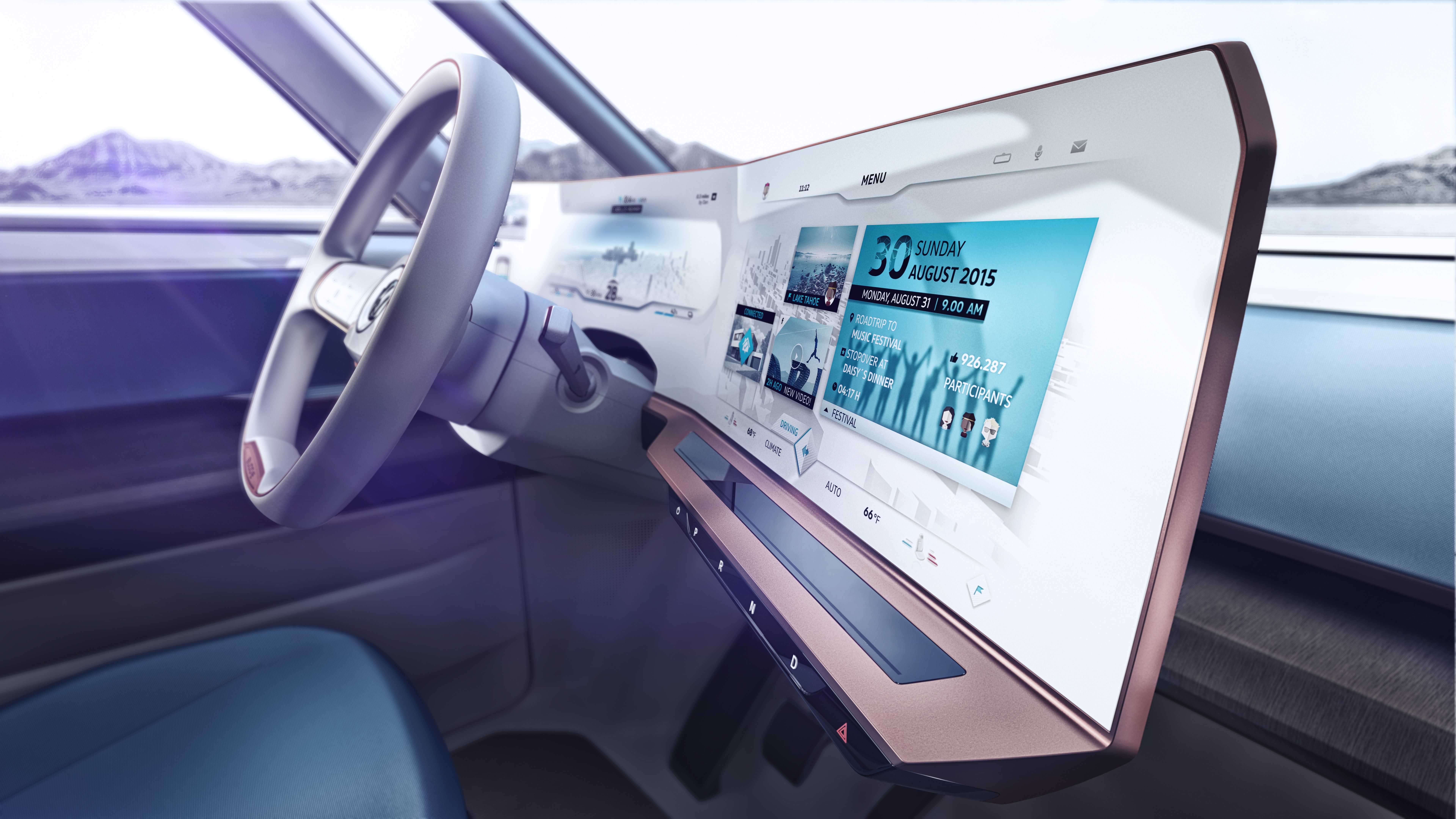
With BUDD-e’s interface design, Volkswagen eliminates the traditional distinction between the electronic instrument cluster in front of the driver and the center console infotainment system. In a move towards comprehensive digitalization and the individualization of the driver’s workplace, these two areas have been merged to form a single information hub.
The idea behind the navigation panel is rooted in the car’s original function: driving. Behind the panel resides a sliding 3D navigation map with graphics, which becomes the matrix of an interactive human-machine interface (HMI). This is accomplished via two physically separate displays that blend into one, both optically and functionally.
The first component, Active Info Display, is a freely programmable instrument cluster located in front of the driver; the second is a head unit which was once a separate screen for the infotainment system. Active Info Display captures the conceptual focus on drive information, while the head unit caters to the infotainment needs of all passengers on board. Both of these areas form a united visual and textual environment, as the navigation graphics and the arrangement of media content such as the display of Points of Interest (POI), playlists, apps (App-Connect) and online services (Car-Net) are freely configurable. In addition, the main points and content can also be swapped between the Active Info Display and the head unit.
All of BUDD-e’s systems are operated intuitively by gesture control, touchscreen (displays and touch slider) or voice control. The driver can choose between various intuitive control modes (multi-modal interaction). For example, a simple “Hello BUDD-e” activates the vehicle’s voice control. The system also offers completely natural speech interaction. For example, if the driver asks “turn the heat up a bit, please”, the car will respond immediately and appropriately. The system is also able to locate the passenger giving the commands, and react accordingly. If, for instance, someone sitting in the left rear seat says “It’s too hot here”, BUDD-e can immediately lower the temperature in that passenger’s zone.
The BUDD-e’s freely programmable instrument cluster is an evolution of the Active Info Display first introduced by Volkswagen in 2015. A 12.3-inch curved display with a surface consisting of three individually configurable sections is centrally positioned, right in front of the driver.
Drive, control, consume. In Section I, “Drive”, the center of the Active Info Display, the current travel route is highlighted through a 3D map including buildings and points of interest (POI) as well as navigation instructions. The edges of the navigation image are simultaneously the background of the entire display. In Section II, “Control”, vehicle status and assistance system information is displayed, as well as the current trip data from the on-board computer, left of the Active Info Display.
In Section III, “Consume”, infotainment content such as “Audio”, “Messages”, “Calendar” and “Weather” are displayed on the right. This layout, designed to concentrate on the route and primarily for driver use, is “Driving mode”. Alternatively, as previously outlined, there is a “Travel mode”, in which the details of the route are displayed on the head unit instead, allowing route guidance and planning by the passengers. The fuel consumption data (left), speed indicator (middle) and information on the energy reserves and range (right) are always displayed in a constant position at the bottom section of the display.
The head unit, the part of the new HMI easily seen and used by front-and rear-seat passengers, is located in the middle of the dashboard. Its 13.3-inch display is linked to the Active Info Display, both graphically and via software. The head unit displays the extended 3D navigation map (including buildings) as a default setting. The top level of its surface consists of freely assignable tiles that are available in two different sizes. Up to eight tiles in total can be arranged next to each other. Through this, passengers can display “Trip data“, “Audio” (playlist/song/cover) or “Messages” in “Driving mode.” “Travel mode” puts the emphasis on graphical representations of travel content. A Home button in the middle of the head unit takes the user straight out of each menu, back to the top level menu.
Similar to smartphones, a menu tab is integrated at the top of the screen. Opening this menu permits quick and easy access to key functions and menu items. These include vehicle functions such as opening and closing the hatch or sliding door, and menu items like “Music”, “Places”, “Images”, “Phone”, “Connected Home”, and “Videos.” Information on basic functions such as climate control and seat heating is also shown at the bottom of the display, where the all-important button for switching between different modes also resides. An “inbox“ sited to the right of the display can be used to send passenger content to the head unit. The head unit is fitted with proximity sensors that detect an approaching hand and smoothly switch its screen from display to operating mode, allowing users to scroll through audio playlists and other functionality.
Drivers can also toggle from “Driving mode” to “Travel mode” at any given moment. The Active Info Display will continue to focus on specific navigation information, while the representation of the current route is moved to the right onto the head unit, allowing it to correspond to points of interest, which are now shown in greater detail. This functionality makes it easier and more straightforward for anyone on board to locate POIs. Meanwhile, the default displays on the Active Info Display continue to provide the driver with the most important information for the journey. Switching between modes can be done by gesture control, using the Home button, or through the redesigned multifunction steering wheel.
e-Mirror. This feature integrates the displays of the digital wing mirrors (e-Mirror). Images come from two external cameras, which feed into multifunction displays. When stationary, the driver and front-seat passenger can also use these panels to open and close the electric doors. The display on the driver’s side is 7.9 inches in size and the front-seat passenger has a 5.9-inch screen.
Multifunction steering wheel 3.0. Volkswagen’s new multifunction steering wheel is completely switchless, operating via haptic feedback on its smooth surfaces. Individual functions are activated by pressure, or through a swipe gesture. Touching the surface gives the driver palpable haptic “pre-sensing” feedback, allowing them to localize the function. Upon activation of a function, there is another, stronger haptic reaction, making operation more intuitive than present day solutions.
Operation is also no longer limited to the shift paddle, but extends over the entire surface of the operating stack. Raised patterns on the buttons make it easy to find one’s way around the wheel. The driver is also given visual feedback on the selected functions by the Active Info Display. For example, the cover of the song that is currently being played is displayed in the appropriate window. At the same time, icons appear at the edges of the square window—in all four corners. These four icons (scroll up or down, sound and menu) directly match the corresponding directions of the switches on the steering wheel’s operating area, making even the most complex operating sequences simple and intuitive.
Functions such as volume control or zooming into the navigation display can alternatively be controlled through a new touch slider. This is a further enhancement of the system presented at CES in 2015 in the Golf R Touch concept. This new stage of development is characterized by higher sensor resolution, clearly noticeable for driver and front-seat passenger alike, due to the system’s optimized precision and performance. This enables the touch slider to recognize not only the number of fingers on the slider, but their motion as well.
Gesture control 2.0. Volkswagen has significantly enhanced the gesture control system presented in the Golf R Touch at CES in 2015. In the BUDD-e, experts from the Body Electronics division have incorporated sensor technology already capable of recognizing people as they are approaching the vehicle. For the exterior, this is accomplished through the use of infra-red sensors. An intuitive hand gesture opens the BUDD-e’s sliding door. A simple foot movement of the “Virtual Pedal 3.0” opens the electrically operated tailgate, marking a further development of the “Easy Open” function. The gesture control system inside the BUDD-e’s interior is more intuitive than ever before, with the maximum operating distance having been significantly increased. Cameras are used to register if a passenger in the rear compartment wants to open the sliding door, for instance. Interactive displays and projections also assist the driver and passengers during operation. Gestures are recognized without the gesture control system needing to be explicitly activated—as was the case in the Golf R Touch—making it an integral part of operating procedures.
Personalized light. Volkswagen has demonstrated how the dominant color of the display illumination and matching ambient lighting can be individually adapted using the touch slider in the Golf R Touch concept. Now, this functionality also includes opening/start-up and parking/closing of the new BUDD-e. When the car is opened, cockpit and ambient lighting bring the interior to life: when parked, standby mode is initiated. The ambient lighting system implemented in the BUDD-e is a further development of this system. While the previous application was primarily influenced by the driver and the front-seat passenger, controls now extend to the entire interior of the car. It is the first car in which ambient lighting interacts with the gesture control system, and can also be adjusted to suit the surrounding environment.
A car for the Internet of Things
Not only does the BUDD-e’s completely new infotainment concept make travelling more interactive and media more tangible, it also creates a link between the car and the outside world. With BUDD-e, passengers will be able to access their homes and workplaces to perform tasks such as controlling the air conditioning, turning lights on or off, or simply looking to see if their kids are home yet.
BUDD-e will not only provide a connection to an interconnected world, but create an interactive interface to its surroundings. It is conceivable that in the near future, consumables—such as windshield wiper blades—or other kinds of personal items could not only be ordered from the car, but also delivered to it using a “Drop Box” that is accessible from the outside. The vehicle “reads” an access code to open the Drop Box for authorized parcel delivery services, using a digital key, essentially making the vehicle a mobile mailbox.
At home on the road. Most modern day smart home functions are controlled using smartphone apps, produced by various manufacturers. Volkswagen has found a solution that allows users to access smart home functions while remaining focused on the road ahead. With App-Connect—Volkswagen’s advanced smartphone integration platform—the BUDD-e makes it possible to control certain “Connected Home” functions from the car, while driving. In cooperation with Korean electronics firm LG, Volkswagen will show how it is possible to obtain information about a smart fridge from the BUDD-e. It’s also possible to put the whole house into an energy-saving sleep mode while still in the vehicle. In the future, the BUDD-e will also automatically turn on lights in and around the house as soon as it approaches through home net automation.
At CES, Volkswagen demonstrated, together with the German manufacturer Doorbird, how MirrorLink™ can be used in connection with the newly developed Home-Net Viewer. The interface can display images from cameras mounted in and around the house on one of the car’s multiple screens (a function equally conceivable with future Apple CarPlay® and Android Auto™ applications). If a visitor rings the doorbell at home, a picture of them, taken by the home camera, is sent to the screen of the infotainment system. The functionality even makes it possible to speak to the visitor using the car’s hands-free kit and, if desired, open the door for them.
Don’t forget anything. BUDD-e can remind its occupants if they have forgotten anything in the car, via their smart watch and/or smartphone. You can also find things in the car using “Home-Net don’t forget”. Through an inventory list, the driver or passengers can see everything that has been put in the car, and if they are still there. The intelligent “Reminder” also informs when particular items should be remembered. For example, if rain is forecast, BUDD-e will notify the driver if there is an umbrella in the car. Relevant items are fitted with a transmitter (a small sticker) in advance, making it possible for the car to locate them. The “Home-Net don’t forget” app uses an encrypted wireless interface, meaning that it is impossible for the items to be located from outside the car, or by unauthorized users.
Smart Gesture. Volkswagen plans to become one of the first manufacturers to integrate gesture control into affordable, mass production cars. BUDD-e demonstrates a broad range of what is possible in the future. Functionality will include in-car control functions which operate certain things at home. A good example of this is the familiar “Easy Open” function, where the BUDD-e can use a laser to project a virtual footprint in front of its hatch. If an authorized user kicks this position, the hatch opens automatically. Opening the door at home will work in the same manner: BUDD-e will project a footprint in front of the door and if the person who lives there puts their foot on it, the door opens—which is very handy if you have your arms full with groceries or children.