Purpose

I will try my best to provide detailed info on various cars and what is like to live with them, I have already produced a few for Jaguar-car-forums, I will do my best to be unbiased, but it will be hard for some cars. I will re-produce press releases and copy from other motoring news.
Showing posts with label fcv. Show all posts

Wednesday, 28 October 2015

TOKYO SHOW - Honda showcases it's new Clarity Hydrogen Fuel cell Vehicle, as well as a raft of new models.

  • Global debut of Clarity Fuel Cell Vehicle
  • New models for Japanese market, including European-built Civic Type R
  • New concepts showcase innovative mobility solutions 
The Clarity Fuel Cell, Honda’s new hydrogen fuel cell vehicle was joined by production models making their Japanese debut including the European-built Civic Type R , Honda NSX, and Odyssey Hybrid.
Following its world debut at 2015 Frankfurt Motor Show, the Honda Project 2&4 powered by RC213V will be shown as well as innovative mobility solutions, The WANDER WALKER and WANDER STAND. This broad portfolio of models is united by Honda’s global brand slogan – The Power of Dreams.

Clarity Fuel Cell
The Clarity Fuel Cell is the world’s first production hydrogen fuel cell vehicle sedan to house the fuel cell stack and drivetrain system under the bonnet. Incorporating Honda’s design principle of man maximum, machine minimum, this unique configuration provides outstanding roominess with seating for five. The size of the fuel cell stack and power generation system is reduced by 33 per cent compared to Honda’s previous hydrogen FCV, the FCX Clarity.
The fuel cell stack is not only more compact, it also produces a higher output with a maximum fuel cell output of over 100 kW and a fuel cell stack power density of 3.1 kW/L.
Leveraging the high output of the fuel cell stack and the power assist of the lithium-ion battery, the electric motor provides 130kW (177 PS) of output, enabling powerful acceleration and a feeling of smooth acceleration from standstill to maximum speed.
Honda has achieved a best in class fuel cell vehicle range per full tank of over 700 km (435 miles) all with a short refuelling time of around 3 minutes, providing similar day-to-day convenience to that of a traditional petrol or diesel powered vehicle.
The Clarity Fuel Cell will be commercially available in Japan from early 2016. Further information on the launch of Clarity in Europe will follow in 2016. 
Civic Type R
Billed as a ‘race car for the road’, the all-new Civic Type R is powered by the most extreme and high-performing Type R engine ever built, and will set new standards in the high-performance front-wheel drive hatchback segment. Produced at Honda of the (UK) Manufacturing, the car will be exported back to the company’s home market. Sales in Japan of the all-new Type R will commence towards the end of 2015.
Honda NSX
The NSX is a super sports car for a new era. The new model features lightweight body construction and a new inline 3.5-litre V6 twin turbo engine as part of the three-motor SPORT HYBRID SH-AWD (Super Handling All-Wheel Drive) system. The engine is combined with three electric motors (two of which are housed in the front wheels) via a 9-speed Dual Clutch Transmission. The all-new NSX will be launched in Europe during 2016.
Japanese market models
Other new models for the Japanese market include the Odyssey hybrid, a premium minivan which brings together a generously roomy cabin, distinctive styling and an exhilarating drive.
Honda will also be displaying the all-new S660 open-top sports mini-vehicle. The S660, has been designed to deliver the same excitement as a fully-fledged sports car in a compact and efficient package.
The N-Box, Japans best-selling minicar, will also be on the stand with a new package designed to minimise the chances of occupants getting sunburnt. The special package blocks 99% of UV rays as well as IR (heat) rays and is the first application of this technology in the world.
Honda Project 2&4 powered by RC213V
Following its global debut at Frankfurt Motor Show in September, the Honda Project 2&4 powered by RC213V will be on display at Tokyo Motor Show. Designed to deliver an immersive driving experience, Honda Project 2&4 utilises Honda’s expertise on two and four wheels to provide the freedom of a motorcycle and the manoeuvrability of a car.
The Honda Project 2&4 powered by RC213V is the winning entry from Honda’s ‘Global Design Project’, a competition amongst Honda’s global design team. . With a 14,000 rpm red line, the 1,000 cc engine is mated to a six-speed DCT gearbox and delivers peak power of 215 PS at 13,000 rpm, and peak torque of 118 Nm at 10,500 rpm.
WANDER STAND and WANDER WALKER concepts
The WANDER STAND allows two adults to ride side by side to experience a new way to drive. Honda’s Omni Traction Drive System allows complete freedom of movement forwards, backwards, laterally and diagonally. The width of the concept allows it to access the most narrow of streets, while an automatic drive mode allows occupants to relax and explore new territory.
The WANDER WALKER is designed with the city of the near future in mind, where personal mobility solutions will give riders free access to all parts of their environment. The highly compact design is 540mm wide and can easily fit down narrow streets thanks to its innovative steering system. The concept also features a display tablet, which doubles as the key for the vehicle.

Wednesday, 30 September 2015

Honda has a range of concepts, production cars and motorcycles that it will show at the 44th Tokyo Motor Show.

  • Honda to display future mobility solutions, including the global debut of all new fuel cell vehicle (FCV)
  • Innovative new production models are accompanied by futuristic concepts
  • Versatile and varied line-up is united under the principle of ‘The Power of Dreams’
Honda has announced a wide range of concepts, production cars and motorcycles that it will present at the 44th Tokyo Motor Show (press days: 28 - 29 October, 2015, public days: 30 October – 8 November 2015).

Covering the largest floor area of any single brand at the show, Honda’s stand highlights the diversity of its current product line-up and includes innovative mobility solutions designed to improve the day-to-day lives of Honda’s customers. 


This broad portfolio of models is united by its global brand slogan – The Power of Dreams. Highlights include the first chance to see its all-new fuel cell vehicle, provisionally called the FCV, the all-new NSX hybrid supercar and a range of racing machines from a range of international race series. 
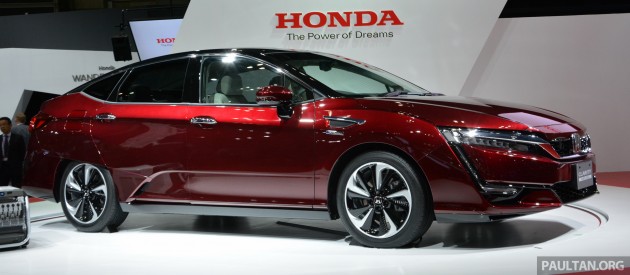
Honda FCV

Honda’s original technologies have made the tentatively-named FCV, the world’s first production model of a fuel-cell powered saloon to house the entire fuel-cell powertrain in the space normally occupied by the engine and transmission. 

This powertrain layout has enabled a full cabin package that seats five adults comfortably. Moreover, the all-new FCV features a cruising range of more than 700 km while exhilarating driving is made possible by the high-output motors. 

The Japanese specification FCV can also act as a mobile power plant thanks to its external power feeding inverter, meaning that it will generate and provide electricity to communities in the case of an emergency. 

New models for Japan

Following strong sales in Europe this summer, the all-new Civic Type R will make its Japanese debut at the show. Produced at Honda of the (UK) Manufacturing in Swindon, sales in Japan of the all-new CivicType R will commence later this year.

Honda will also be displaying the all-new S660 open-top sports mini-vehicle. The S660, which is sold exclusively in Japan, has been designed to deliver the same excitement as a fully-fledged sports car in a compact and efficient package.

Innovative modern concepts

Honda will be exhibiting several concept models, including Honda Project 2&4 powered by RC213V, which made its global debut at the Frankfurt Motor Show in September. Designed to deliver an immersive driving environment, Honda Project 2&4 utilises Honda’s experience to provide the freedom of a motorcycle and the manoeuvrability of a car. 

Other concepts on display that address the challenge of future mobility are Honda’s WANDER STAND and WANDER WALKER. Both have been designed to explore the joy and freedom of mobility, and the WANDER WALKER was specifically designed to manoeuvre freely among pedestrians. 

Philip Crossman, Managing Director at Honda UK, commented: “The Tokyo Motor Show is the Honda brand’s home turf and we can expect to see some fantastic products on the biggest stand in the show.  Honda is unique in that we manufacture everything from a 25cc leaf blower to a $4.5m business jet and it is this depth and breadth of our offering that makes us stand out.  

“We’ve had a fantastic year for new products and innovation and look forward to the next wave arriving into the UK, including the new FCV and all-new NSX.”

Tuesday, 3 March 2015

GENEVA - Toyota launches three distinctive new cars at Geneva.

Toyota takes the wraps off new versions of its British-built Auris and Avensis at the Geneva motor show on Tuesday 3 March and reveals the new 1.2T turbo petrol engine that will make its debut in Auris this year.
It also presents the production-ready Mirai fuel cell saloon that will be introduced in the UK and other selected European markets later in 2015.
New Auris
The Auris range of hatchbacks and Touring Sports wagons has been extensively revised for 2015 to increase its appeal to a wider range of customers. The engine line-up in particular has been redrawn with the introduction of the new 1.2T turbo petrol unit and a new 1.6-litre D-4D diesel. The established 1.4 D-4D diesel has been substantially upgraded to give improved emissions and fuel economy.


Auris remains unique in its class in being available with full hybrid, petrol and diesel powertrains. Where hybrid is concerned, the smooth, refined, reliable and highly efficient Toyota system has sealed its status as a mainstream rather than niche choice, powering more than 50 per cent of all new Auris sold in western Europe in 2014.
All Auris powertrains now meet Euro 6 emissions standards.
Auris further gains refreshed exterior and interior styling. In the cabin the focus is on higher levels of ensory quality, using premium quality trims and finishes. Additional measures to reduce NVH levels have been taken and detail adjustments to steering and suspension have improved handling, comfort and driver involvement.
New Avensis
The new Avensis – saloon and Touring Sports – has been conceived as a model that can meet the demands of private buyers for more prestige and luxury and fleet/business users’ priorities for extra sportiness and style.

Toyota’s programme of improvements thus focuses on five main areas: styling, sensory quality, safety, equipment/value for money and driving pleasure/running costs.

Avensis benefits from new exterior styling, including the adoption of new LED lamp technology, while the cabin is all-new, with higher levels of quality and comfort and new colour-ways. Where safety is concerned, Avensis adopts the new Toyota Safety Sense package across the range.
A new equipment grade structure promises class-leading equipment levels and wider use of advanced technologies, including a new eight-inch multimedia screen.
Like Auris, the engine line-up becomes fully Euro 6 compliant, with two new D-4D diesel units and significant improvements to the efficiency of the established Valvematic petrol engines.
1.2 turbo petrol engine
Toyota’s all-new, direct-injection turbocharged petrol engine makes its debut in new Auris, part of a programme of 14 new engine introductions Toyota is making globally between April 2014 and the end of this year.

The four-cylinder unit, like the 1.0-litre engine that powers new Aygo, is able to switch between different operating cycles to achieve optimum efficiency or performance, according to driving conditions.
Compact and lightweight, it produces 114bhp and 185Nm of torque, giving 0 – 62mph acceleration in 10.1 seconds. Provisional (pre-homologation) data indicate combined cycle fuel economy of 60.1mpg with 109g/km CO2 emissions.
Mirai fuel cell saloon

Mirai, Toyota’s ground-breaking hydrogen fuel cell saloon, is being shown in Europe for the first time in full production guise. Its arrival follows its market launch in Japan late last year and precedes its staged introduction in the UK and other selected European markets from around September this year.

GENEVA - Honda debuts to Europe the new FCV, ready for a 2016 Euro launch.

  • Demonstrates evolution of next-generation fuel cell vehicle
  • Previews production fuel cell vehicle due to launch in 2016
  • Part of Honda’s contribution to the forthcoming ‘hydrogen energy society’
  • Continues an unrivalled track record in fuel cell vehicle development
The Honda FCV CONCEPT, unveiled in Tokyo in November 2014, makes its European debut at the 2015 Geneva Motor Show.
The futuristically styled FCV CONCEPT previews an all-new fuel cell road car that is scheduled to go on sale in Japan in the first half of 2016, and subsequently in the USA and Europe within the following 12 months.
Next generation technologies for greater performance
Honda’s next-generation fuel cell vehicle will succeed the brand’s two previous production fuel cell cars, the FCX and FCX Clarity, and will feature significant improvements in performance and costs. The newly-developed fuel cell stack installed in the FCV CONCEPT is 33% smaller than its predecessor, and yet realises an output of more than 100 kW and an output density as high as 3.1 kW/L. This contributes to an overall performance improvement of approximately 60%.

At its launch next year, Honda’s third production fuel cell vehicle will be the world’s first[1] fuel cell car with the entire powertrain, including the downsized fuel cell stack, housed under the bonnet of a conventional sedan body shape. This packaging layout enables designers and engineers to develop a full cabin package that seats five adults comfortably. This in turn provides a future pathway to evolve Honda’s fuel cell-specific platform to provide the foundation for further body styles, which will contribute to promoting the more widespread acceptance and adoption of this zero emissions technology by an ever broadening section of motorists.
The Honda FCV CONCEPT is equipped with a 70 MPa high-pressure hydrogen storage tank that provides a cruising range of more than 700 km[2] (435 miles). The tank can be refilled in approximately three minutes[3], making refuelling as quick and easy as today’s conventionally-fuelled cars.
Developed in conjunction with ‘hydrogen society’ enabling technologies
As part of its holistic approach to promoting the adoption of the forthcoming ‘hydrogen energy society’, Honda continues to tackle the challenges facing the uptake of the fuel cell vehicle by developing new enabler hydrogen technologies beyond the vehicle itself.
One such innovation installed in the FCV CONCEPT is the Honda Power Exporter Concept, an external power feeding function[4], which underwent a large number of verification tests with the FCX Clarity. This system enables the car to function as a small mobile power plant that generates and provides electricity to the community in times of disaster or other events. It is capable of producing up to 9kW[5] of AC power.
Furthermore, Honda will continue to promote the application of the Smart Hydrogen Station (SHS), a packaged hydrogen station unit that adopts Honda’s original high-differential-pressure electrolyser.
Together, the Power Exporter Concept, FCV CONCEPT and Smart Hydrogen Station embody Honda’s vision for the forthcoming ‘hydrogen society’, respectively representing the ‘generate’, ‘use’ and ‘get connected’ functions. Through these interrelated technologies, and other research and development activities, Honda is working tirelessly towards a CO2-free society.
Honda’s pioneering track record in fuel cell vehicle technologies
Honda views hydrogen as a high-potential, next-generation energy solution as it can be generated from various energy sources and is easily transportable and storable. Based on this view, Honda has been positioning the fuel cell vehicle – which uses electricity generated through the chemical reaction of hydrogen and oxygen as a power source for the motor – as the ultimate environmentally responsible vehicle. As a result, Honda has taken a proactive approach to the research and development of fuel cell vehicles since the late 1980s.
In 2002, the Honda FCX became the first[6] fuel cell vehicle in the world to be certified by the U.S. Environmental Protection Agency (EPA) and the California Air Resources Board (CARB). With these certifications, Honda began lease sales of the Honda FCX in Japan and the U.S. In 2003, Honda developed the Honda FC STACK, the world’s first fuel cell stack able to start at below-freezing temperatures. Then, in 2005, Honda became the world’s first vehicle manufacturer to begin lease sales of fuel cell vehicles to individual customers in the USA.
In 2008, Honda began lease sales of the FCX Clarity, a fuel cell vehicle that offers not only the ultimate in clean performance, but also innovative sedan-type package and sophisticated driving feel.
Honda has been a leading company in the development of fuel cell vehicles, amassing real-world data through lease sales in Japan and the USA, including actual feedback from individual users and also driving data from the vehicles.
Honda’s involvement in Hydrogen Programmes in Europe
In Europe, Honda is involved in a number of Hydrogen-related programmes both at a national and Europe-wide level.

Sunday, 25 January 2015

Toyota to increase Mirai fuel cell car production, comes with free eye test :-)

Toyota announced today it is to increase production of its Mirai fuel cell car. The hydrogen-powered saloon was launched in Japan on 15 December last year and will be introduced in the UK and other selected European markets during 2015.

The new plan calls for production to increase from 700 units this year to approximately 2,000 in 2016 and around 3,000 in 2017.


Toyota decided the supply structure should be adjusted to reflect the level of demand for the vehicle, in view of around 1,500 orders being received in the first month of sales in Japan and the prospect of the model being launched in Europe and the USA later this year.

Following the production increases, sales plans for Japan, the US and Europe will be formulated, taking into consideration the level of hydrogen infrastructure development, energy policies, car purchasing subsidies, consumer demand, environmental regulations and other factors in each region.

Tuesday, 20 January 2015

Toyota's Mirai has gained a large number of orders, I would suggest the new owners are totally blind

TME THOUGHTS
I am really sorry to have to say this, but, WHO designed this car, were they on drugs or just on a a very bad day, and then WHO okayed it, this car is without doubt the UGLIEST car i have seen for many years, it even makes some of the stunners from Ssangyong look like super models, this car should not be allowed on the roads for fear of causing accidents when other drivers stare in disbelief at how dreadfully ugly this is.

-------------------

Mirai, Toyota’s first hydrogen-powered production car, has amassed an exceptional 1,500 orders in its first month on sale in Japan. Due for introduction in the UK later this year, the ground-breaking saloon has far exceeded expectations: Toyota’s initial plan was to sell about 400 units by the end of this year.

Due to the large volume of orders received, Toyota expects some customers will experience longer waits for delivery than originally expected. The orders taken so far divide roughly 60:40 between government/fleet customers and private individuals.


These early adopters of Toyota’s hydrogen fuel cell technology will be the first to experience a new chapter in zero-emissions driving. Mirai’s motor is powered by electricity generated through a chemical reaction between air-borne oxygen and hydrogen in an on-board fuel cell.

The car combines excellent environmental performance – the only tailpipe emission is water – with a fun-to-drive character. Its market launch has the potential to further accelerate energy diversification and help build a future society in which hydrogen is a core energy source.

To help encourage the development of hydrogen-fuelled vehicles, Toyota recently made thousands of its global hydrogen fuel cell patents available to others, free of any royalties.

Friday, 21 November 2014

USA - VW launches their version of the new Hydrogen Fuel Cell vehicle, the Golf Sportwagen HyMotion.

  • Golf SportWagen HyMotion transfers fuel cell technology to high-volume production
  • Golf is the world's first car to offer all drive types that can be implemented today
Volkswagen has presented at the Los Angeles Auto Show the world premiere of the Golf SportWagen HyMotion – a progressive research vehicle with a fuel cell drive.

As the power source of the future, hydrogen andoxygen are combined in the fuel cell to form pure water. Energy is released in this "cold combustion" process – drive energy for an electric motor that turns with zero emissions. 

The front wheel drive Golf SportWagen HyMotion accelerates to 62 mph in 10.0 seconds. The hydrogen is stored safely in four high-tech carbon-fibre tanks, which are located in a space-saving way in the underbody. Their fuel capacity enables a driving range of 310 miles. Refilling ofthe fuel tank of the concept car takes just three minutes.

The key drive components of the Golf SportWagen HyMotion were developed by Volkswagen Group Research in Germany. The fuel cell system, which hasa driving power of 100 kW, was conceptualised at the Volkswagen Technology Centre for Electric Traction. 


In addition, the concept car has a high-voltage lithium-ion battery, which stores the kinetic energy recovered from regenerative braking, assists in the starting phase of the fuel cell and adds a dynamic boost to the maximum acceleration of the Golf SportWagen. The fuel cell andbattery drive an electric motor adapted from the e-Golf.

The mechanical design for this innovative car build is based on the modular transverse matrix (MQB) which was developed by Volkswagen and is used throughout the Group. Thanks to use of MQB, the current Golf hatchback versions and the new Golf SportWagen have advanced to become the world's first vehicle model series that can host all conceivable drive types. 

Today, the Golf is already offered with petrol engines  (TSI), diesel engines (TDI), a natural gasdrive (TGI)1, an electric drive (e-Golf)2 and a plug-in hybrid drive (Golf GTE)3. No other car offers such a variety of drive types.

Volkswagen is showing the Golf SportWagen HyMotion to demonstrate for the first time how a hydrogen fuel cell could be implemented based on the MQB as soon as research and development work has been completed and a solution could be developed whose price would be acceptable to new car buyers. 

Before market launch, a hydrogen infrastructure must first be created. This means not only a broad network of hydrogen fuel stations, but also the production of the hydrogen itself, because hydrogen only makes sense as a source of drive energy if the primary energy used to produce it comes from renewable energy sources.

Unlike many of its competitors, Volkswagen is following the strategy of implementing its alternative drives in high-volume production vehicles. Just as the all-electric e-Golf and the Golf GTE that is equipped with a plug-in hybrid drive are integrated in a production model that has everyday practicality, so future fuel cell drives would also be integrated into production models that have been optimally engineered and are offered at an attractive price. 

It was with this objective in mind that several research vehicles were built based on the American Passat, in which the same drive components from the Golf SportWagen HyMotion are used. The fleet of Passat HyMotion vehicles is currently being tested on the streets of California.