My thoughts on all things motoring, press releases, reviews & techie stuff, from around the world.
Please note that the pictures of vehicles within this blog are used as examples of the specific press releases, on occasions, due to the lack of available official pictures, examples are re-produced.
ANY AND ALL PROFANITIES WILL BE REMOVED AND THE PERSON/S RESPONSIBLE WILL BE BANNED, NO EXCEPTIONS.
Purpose
I will try my best to provide detailed info on various cars and what is like to live with them, I have already produced a few for Jaguar-car-forums, I will do my best to be unbiased, but it will be hard for some cars. I will re-produce press releases and copy from other motoring news.
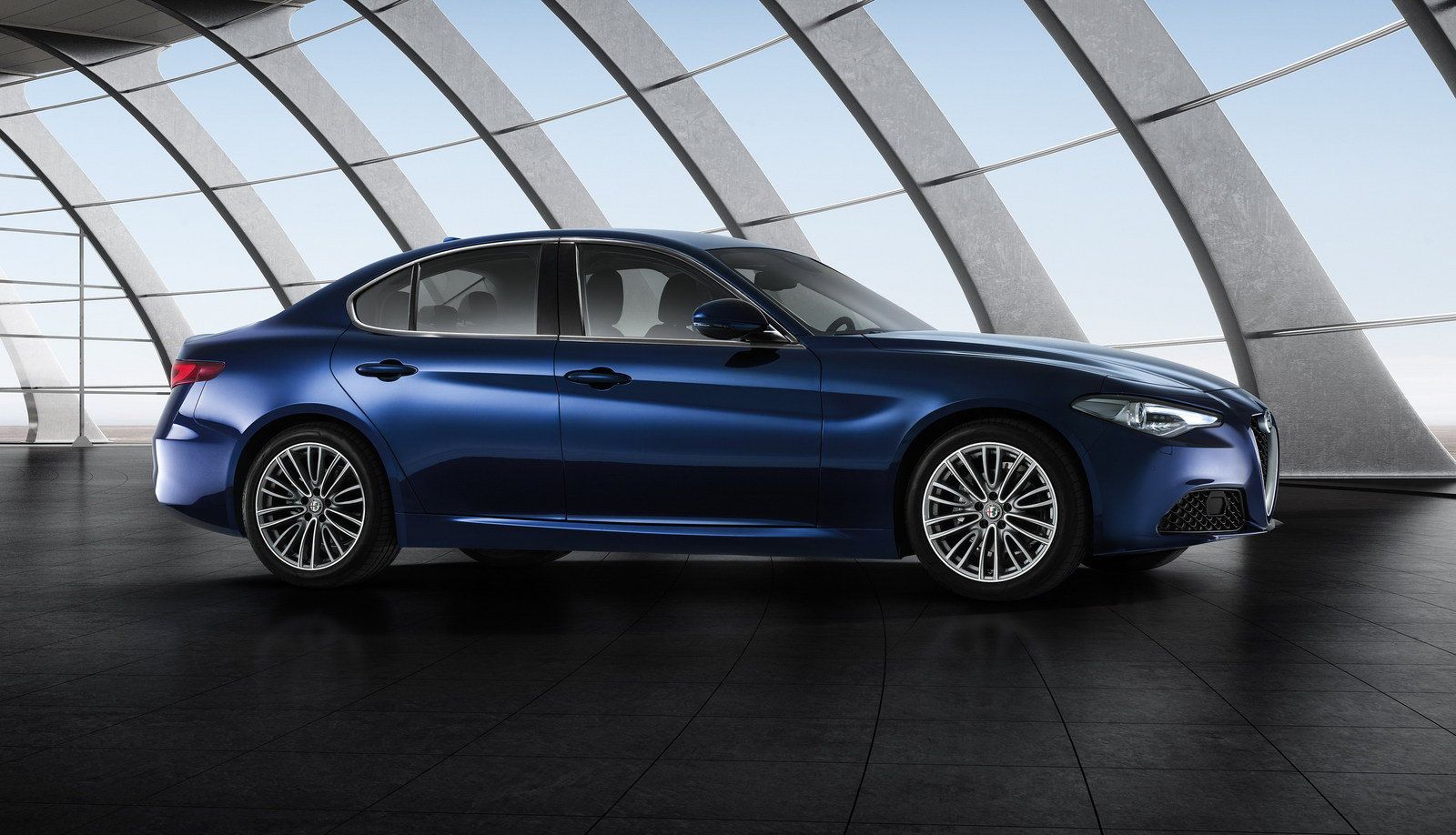
Industry accolade comes courtesy of The Car Connection as the Alfa Romeo Giulia secured 55 percent of the vote with nearly 1,000 users selecting the premium mid-size sedan as the "Best New Luxury Car" out of a field of 10 new luxury cars and SUVs
Giulia won the distinction by earning four times as many votes as the second place finisher
The all-new Giulia combines Italian craftsmanship, class-leading performance, state-of-the-art technology and a passion for driving to the premium mid-size market
Giulia and Giulia Ti feature an all-new, all-aluminum, 2.0-liter, direct-injection turbo engine with an eight-speed automatic transmission delivering a class-leading, standard 280 horsepower and 306 lb.-ft. of torque, allowing it to launch from 0 to 60 miles per hour (mph) in 5.1 seconds and achieve a top speed of 149 mph
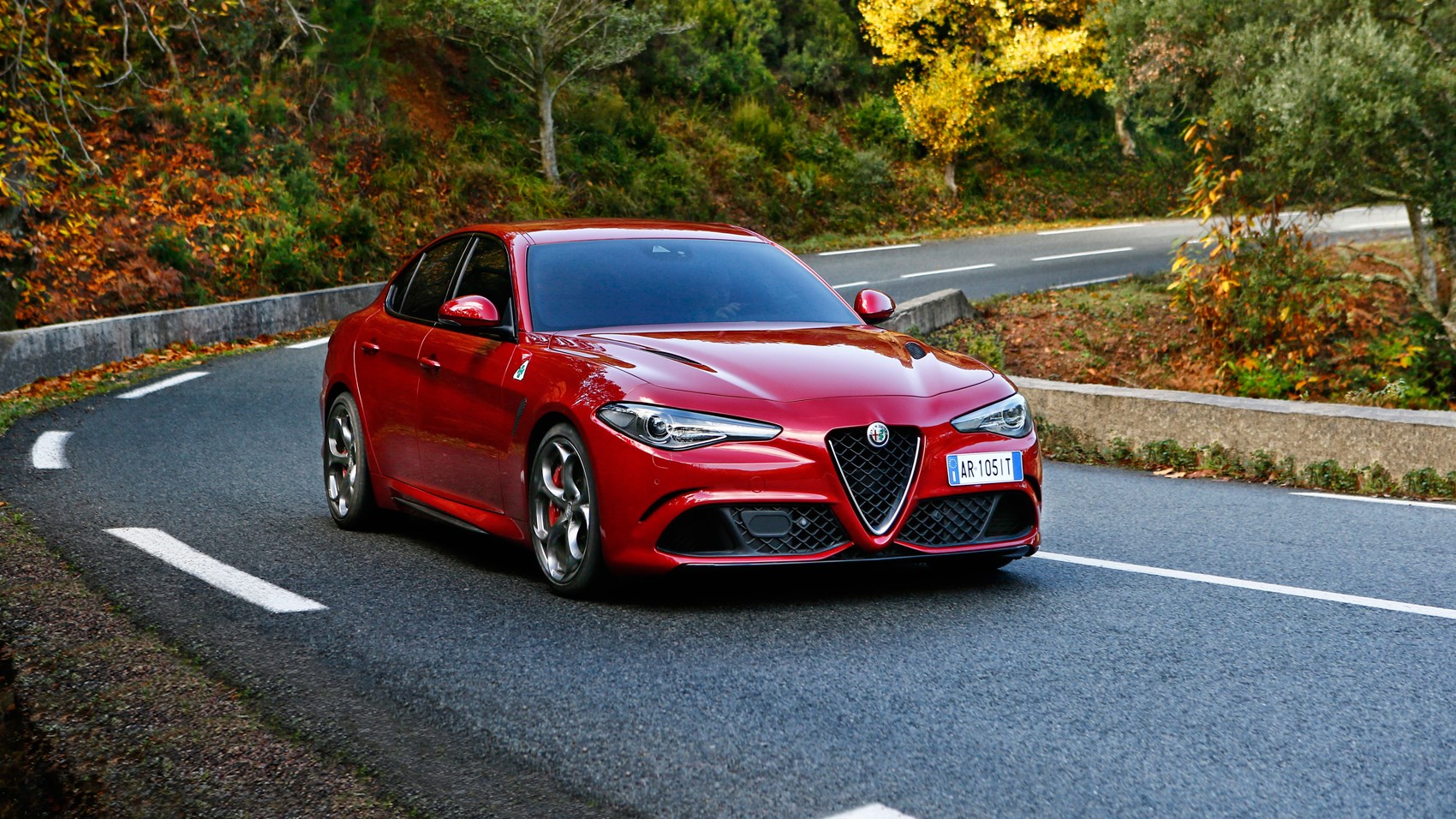
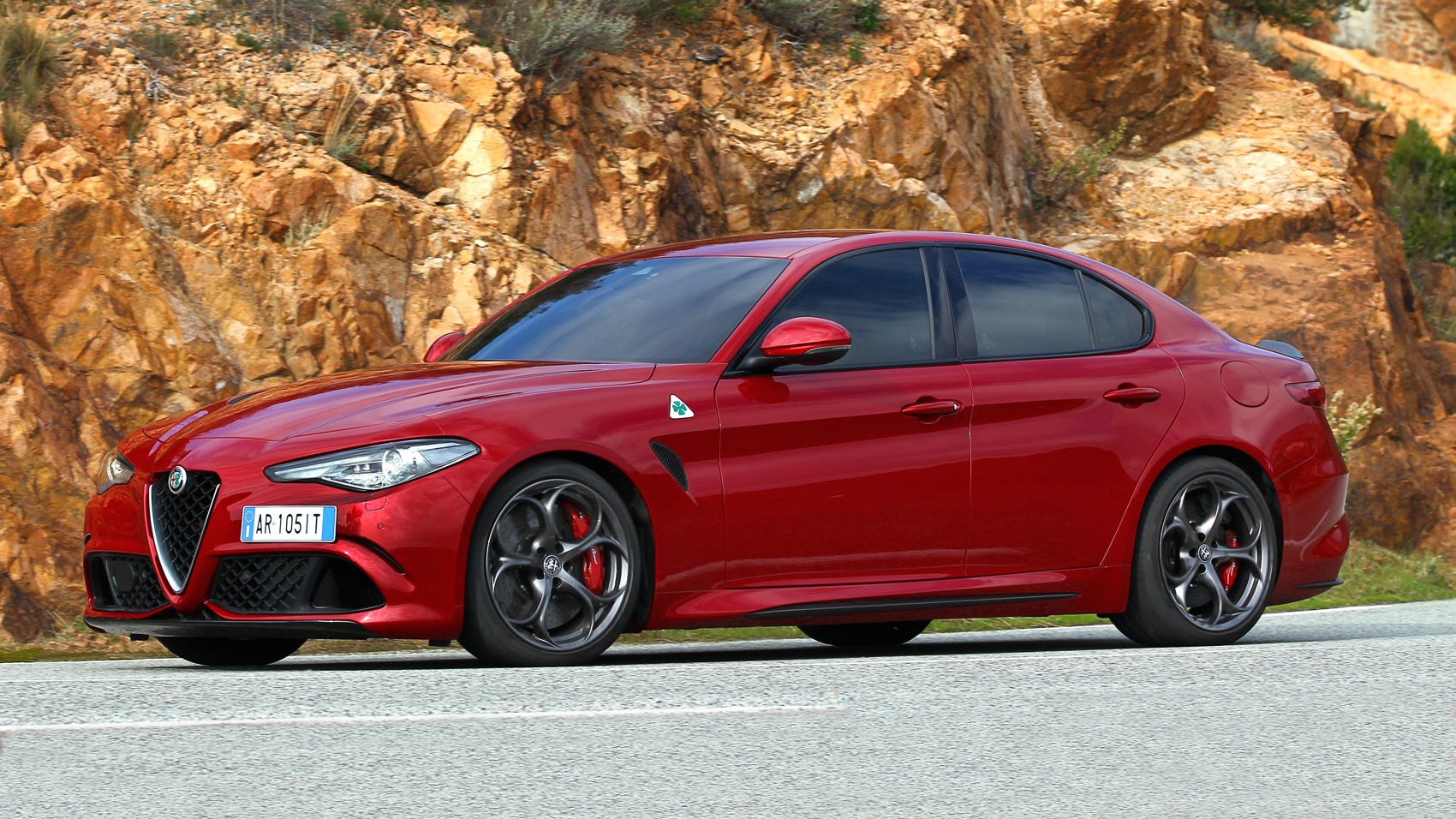
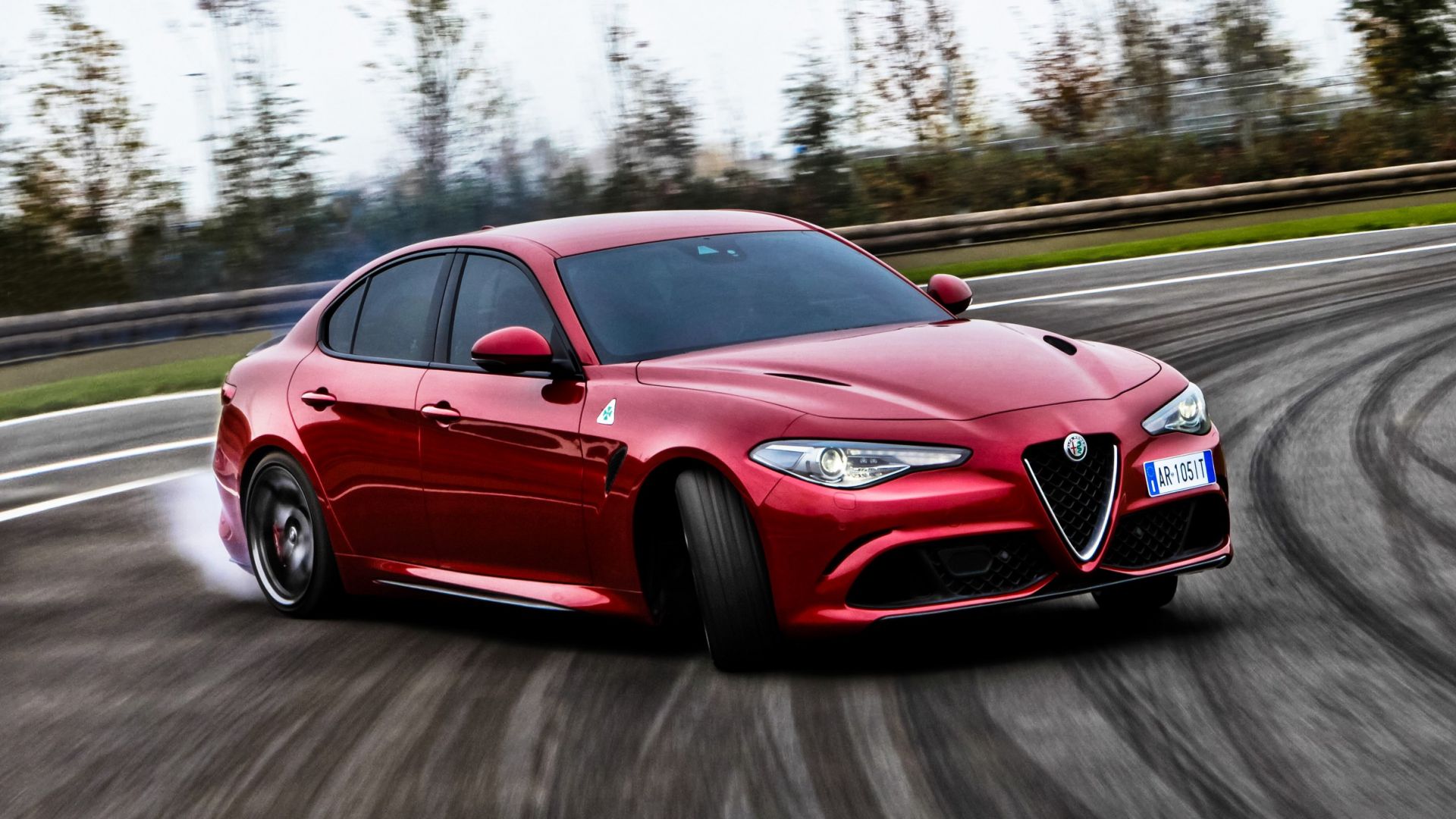
All-new 2.9L bi-turbo V-6 with 505 hp makes the Giulia Quadrifoglio the most powerful Alfa Romeo production car ever, delivering 0-60 mph in a class-leading 3.8 seconds, a top speed of 191 mph and a record-setting Nürburgring lap time of 7:32
The all-new 2017 Alfa Romeo Giulia won the “Driver’s Choice” award for “Best New Luxury Car” as it secured 55 percent of the category’s votes, in a field of 10 new cars and SUVs, thanks to nearly 1,000 user-submitted ballots on The Car Connection, a car review and research website.
"Our readers have voted and with the Alfa Romeo Giulia's win for 'Best New Luxury Car,' it's clear that readers, drivers and shoppers are keen to get behind the wheel,” said Marty Padgett, editorial director of Internet Brands Automotive, parent company of The Car Connection, Motor Authority and Green Car Reports.
As the first of a new generation of vehicles built on an all-new platform, the 2017 Giulia embodies Alfa Romeo’s La meccanica delleemozioni (the mechanics of emotion), delivering race-inspired performance, advanced technologies, seductive Italian style and an exhilarating driving experience to the premium mid-size sedan segment.
Alfa Romeo’s passion for Italian style, craftsmanship and performance carries throughout the entire lineup. Giulia Quadrifoglio stands as the “halo” model with its 2.9L bi-turbo V-6 engine producing a class-leading 505 horsepower and 443 lb.-ft. of torque. The Giulia and Giulia Ti models feature an all-new, all-aluminum, 2.0-liter, direct-injection turbo engine with an eight-speed automatic transmission delivering a class-leading, standard 280 hp and 306 lb.-ft. of torque.
Through innovation, Alfa Romeo created an all-new rear-wheel-drive architecture that integrates lightweight, state-of-the-art materials that enable and deliver a near perfect 50/50 weight distribution, segment-leading torsional rigidity and the most direct steering ratio on the market. Giulia and Giulia Ti offer even more all-season capabilities and performance with an available state-of-the-art Q4 all-wheel-drive system.
The all-new Giulia was designed to have a commanding presence and a menacing face to take on the world’s best roadways. Giulia exudes stunning and functional Italian style with a finesse of Alfa Romeo heritage, athletically taut lines and sculptural details.
Crafted by Alfa Romeo artisans at the Cassino plant in Italy, the all-new 2017 Giulia is the high-performance model in the lineup and a testament to Alfa Romeo’s perfect balance of engineering and emotion, creating a premium sport sedan for driving enthusiasts that stands out in the segment.
Industry accolade comes courtesy of the Southern Automotive Media Association (SAMA) with the 2017 Alfa Romeo Giulia Quadrifoglio’s Miami Auto Show debut
Alfa Romeo – the heart and soul of the automotive industry – is returning to the U.S. with an all-new lineup of vehicles, starting with the award-winning 4C Coupe and 4C Spider, inspired by the timeless 33 Stradale, and now the all-new Giulia premium mid-size sedan
All-new 2.9-liter bi-turbo V-6 with 505 horsepower makes the Giulia Quadrifoglio the most powerful Alfa Romeo production car ever, delivering 0-60 miles per hour (mph) in a class-leading 3.8 seconds and a top speed of 191 mph and a record-setting Nürburgring lap time
The2017 Alfa Romeo Giulia Quadrifogliowas awarded the "Star of the Show" from the Southern Automotive Media Association (SAMA) at the 2016 Miami International Auto Show late last week.
"The 2017 Alfa Romeo Giulia Quadrifoglio is an exciting addition to the Miami International Auto Show," said Pepe Delfino, SAMA president. "SAMA judges were impressed by the storied history, beautiful craftsmanship and technological advances that make the new Giulia Quadrifoglio a serious contender in the luxury sedan market."
As the first of a new generation of vehicles built on an all-new platform, the 2017 Giulia Quadrifoglio embodies Alfa Romeo’sLa meccanica delleemozioni(the mechanics of emotion), delivering race-inspired performance, advanced technologies, seductive Italian style and an exhilarating driving experience to the premium mid-size sedan segment.
“We’re honored to receive this prestigious award from the Southern Automotive Media Association recognizing not only Alfa Romeo’s rich 105-year heritage, but also the excitement surrounding the all-new Giulia,” said Reid Bigland, CEO of Alfa Romeo. “We’re proud that in its Miami Auto Show debut, the Giulia took top honors for its Italian craftsmanship, performance and style – hallmarks of the Alfa Romeo Brand.”
Alfa Romeo’s passion for Italian style, craftsmanship and performance carries throughout the entire lineup. Giulia Quadrifoglio stands as the “halo” model with its 2.9-liter bi-turbo V-6 engine producing a class-leading 505 hp. The Giulia and Giulia Ti models feature an all-new, all-aluminum, 2.0-liter, direct-injection turbo engine with an eight-speed automatic transmission delivering a class-leading, standard 276 horsepower.
Through innovation, Alfa Romeo created an all-new rear-wheel-drive architecture that integrates lightweight, state-of-the-art materials to enable and deliver a near perfect 50/50 weight distribution, segment-leading torsional rigidity and the most direct steering ratio on the market. Giulia and Giulia Ti offer even more all-season capabilities and performance with an available state-of-the-art Q4 all-wheel-drive system.
The all-new Giulia was designed to have a commanding presence and a menacing face to take on the world’s best roadways. The Giulia exudes stunning and functional Italian style with a finesse of Alfa Romeo heritage, athletically taut lines and sculptural details.
Crafted by Alfa Romeo artisans at the Cassino plant in Italy, the all-new 2017 Giulia Quadrifoglio is the high-performance model in the lineup and a testament to Alfa Romeo’s perfect balance of engineering and emotion, creating a premium sport sedan for driving enthusiasts that stands out in the segment.
New Alfa Romeo Giulia Quadrifoglio high performance saloon makes its public debut on a spectacular new stand which highlights both Alfa Romeo’s illustrious history and technologically advanced future
Five cars are on display, each in a different colour which will also be available on the production range
More technical and performance details are announced, including the headline 0-62mph time of 3.9 seconds and top speed of 191 mph
Light weight and advanced technologies result in class-leading emissions of just 198g/km
Drive-centred interior features advanced new human-machine interface and state-of-the-art Harmon Kardon audio system
Pricing for LHD markets is announced – UK pricing will be announced at a later date
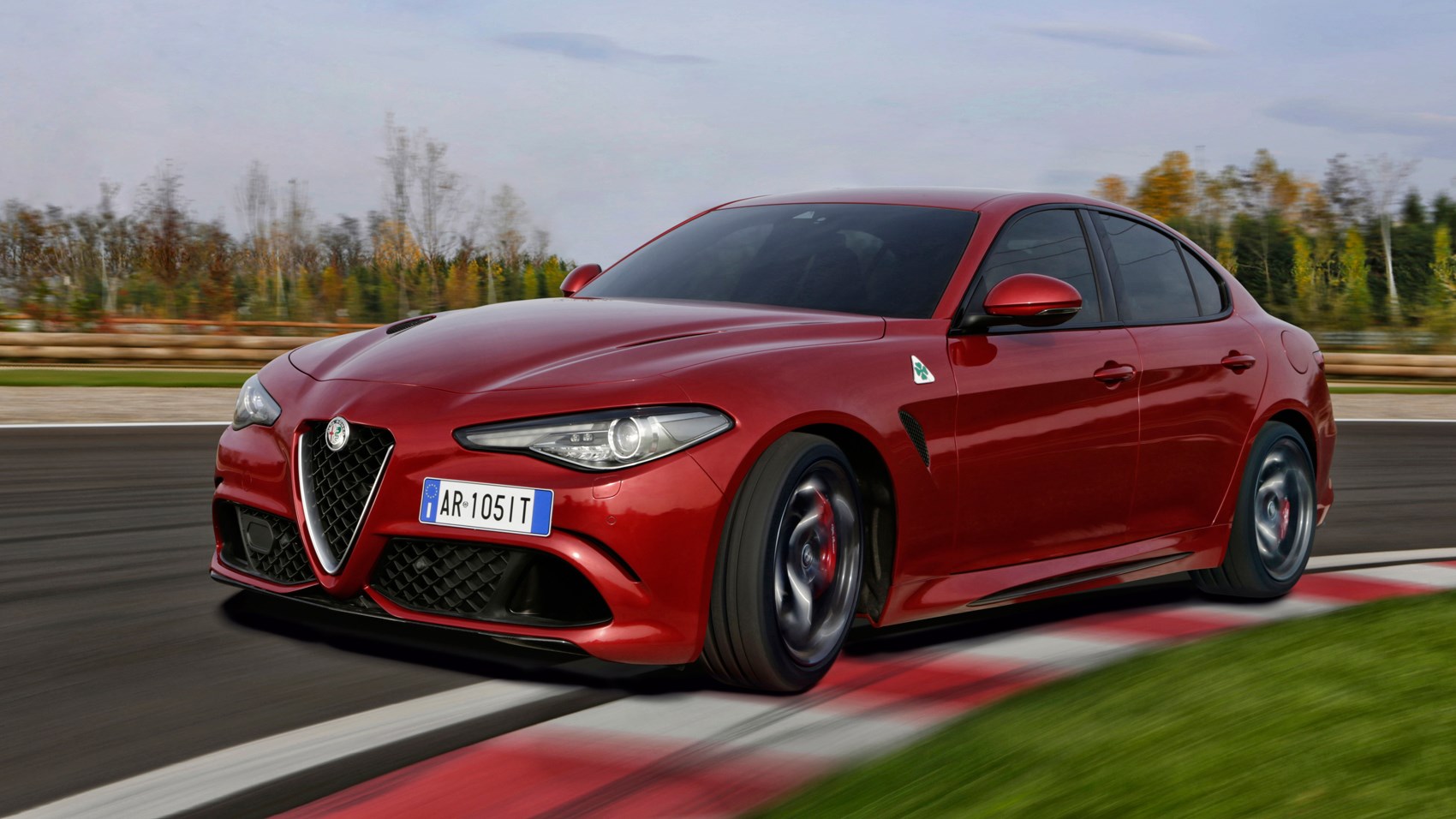
The all-new Alfa Romeo Giulia Quadrifoglio makes its public debut at the Frankfurt Motor Show (Sept 17 – 27) with no fewer than five examples of the high-performance saloon on display across Alfa Romeo’s striking and impressive new stand, each finished in a different colour: Competizione Red, Trofeo White, Vulcano Black, Vesuvio Grey and Montecarlo Blue.
Built on an all-new, rear-wheel drive platform with an emphasis on light weight and agility, the sporty underpinnings of the new Giulia define its shape and strongly influence its design with Alfa Romeo stylists wrapping the mechanical components in a taut, muscular package dominated by its long bonnet, short overhangs, muscular haunches and the longest wheelbase in its class. Simple, natural lines enhance its shape and proportions, while the surface is finished with elegance and restraint, exuding the purity and style one comes to expect of Italian design.
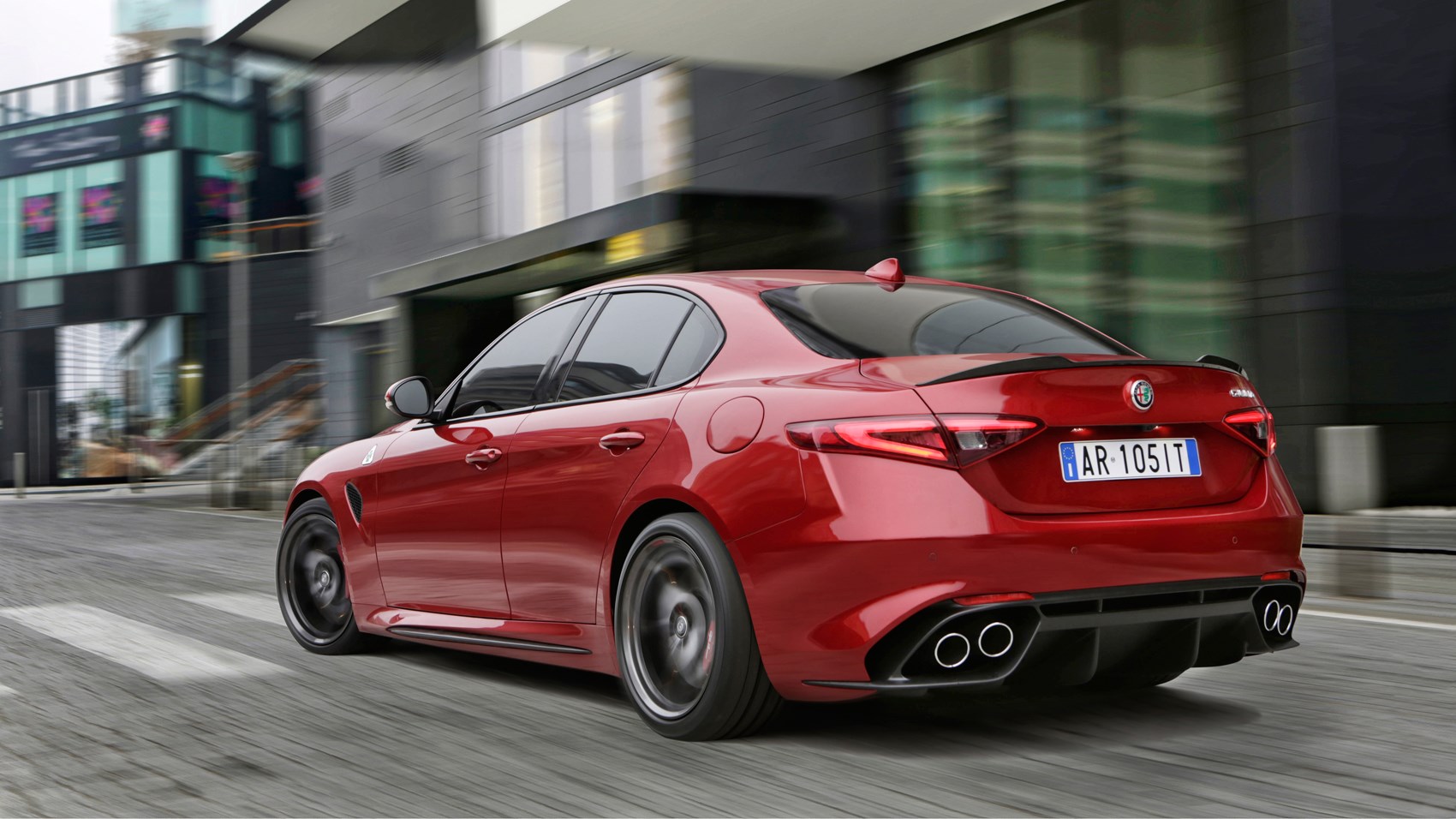
Under the bonnet beats the heart of the Alfa Romeo Giulia Quadrifoglio, an all-aluminium, 2.9-litre turbo petrol V6 engine, inspired by Ferrari technology and expertise, which produces 510hp and 600Nm of torque, resulting in a top speed of 191mph (307 km/h) and a 0 – 62mph (100 km/h) time of just 3.9 seconds. Despite this high levels of performance, the Alfa Romeo Giulia Quadrifoglio also returns best in class CO2 emissions levels at just 198g/km, largely thanks to its electronically-controlled cylinder disabling system and excellent aerodynamics.
Transmitting this performance to the road is a sophisticated and advanced suspension system:
The front employs a new double wishbone suspension with semi-virtual steering axis that was developed to optimise the filtering effect and guarantee rapid, accurate steering – the quickest steering ratio in its class, in fact! This exclusive Alfa Romeo feature keeps the caster trail constant in corners allowing higher levels of lateral accelerations thanks to its always-perfect footprint.
The rear is underpinned by an advanced multi-link set up, with electronically-controlled Torque Vectoring on the rear differential allowing the driver explore the Alfa Romeo Giulia Quadrifoglio’s handling without ever having running up against an invasive stability control system. A new Integrated Brake System (IBS) – an innovative electromechanical system which combines stability control and a traditional servo brake for instantaneous brake response and consequent record-breaking stopping distances – is also being introduced on the new Alfa Romeo, resulting in a stopping distance from 62mph (100km/h) of just 32m. A new Active Aero Splitter, a front aerodynamic aid which actively manages downforce for higher performance and better grip at higher cornering speeds, also debuts on the new Alfa Romeo Giulia.
All of the Alfa Romeo Giulia’s state-of-the-art systems are governed by the Chassis Domain Control (CDC), a technology developed jointly with Magneti Marelli which acts like the car's 'brains' and coordinates all the on-board electronics. The system manages the action of the various features – Torque Vectoring, Active Aero Splitter, active suspension, brakes, steering and ESC system – according to the mode selected by the driver using the new Alfa DNA Pro. Four driving configurations are available: Dynamic, Natural, Advanced Efficiency (a new energy efficiency mode) and, of course, Race on high performance versions. Underpinning the dynamic capabilities of the new Alfa Romeo Giulia Quadrifoglio are its low kerb weight of just 1,524kg and perfect 50:50 weight distribution which are achieved by using ultralight materials including carbon fibre (prop shaft, bonnet, roof), aluminium (engine, brakes, suspension, front suspension turrets, rear subframe, doors, wings) and aluminium composite and plastic (rear crossmember). Carbon ceramic disc brakes and ultra-light carbon fibre Sparco seats are also available.
The same attention to detail has been lavished on the interior of the new Alfa Romeo Giulia, offering the best in terms of quality, safety, equipment and comfort. All the main controls, including the start button, are incorporated in the steering wheel as on a Formula 1 car, while the human-machine interface consists of two simple, user-friendly knobs for adjusting the Alfa DNA Pro selector and the Connect 3D Nav infotainment system.
The Connect 3D Nav of Alfa Romeo Giulia – also developed with Magneti Marelli – offers a sophisticated series of features and functions, including a next-generation HMI human-machine interface. The system is mostly controlled by means of the Rotary Pad and viewed using the 8.8-inch TFT display integrated in the dashboard but it can also be controlled via an advanced voice recognition system and a gesture recognition system with which the driver can interact by simply moving their fingers on the Rotary Pad.
Connect 3D Nav also allows full connectivity with all mobile devices running Apple iOS and Android operating systems, while the navigation system employs high-resolution 3D TomTom maps and Dead Reckoning technology to compensate for areas with poor GPS reception.
Audiophiles will welcome the availability of a sophisticated Harman Kardon Sound Theatre system, which debuts on Alfa Romeo Giulia and uses a 12-channel class D amplifier and Logic 7® technology to distributes rich, clear 5.1 surround sound through high-quality 14 speakers.
UK sales of the new Alfa Romeo Giulia Quadrifoglio will begin in the autumn of 2016 with pricing to be announced at a later date. Pricing for left-hand drive markets has been announced at the Frankfurt Motor Show, positioning it in direct competition with key performance car rivals while offer higher levels of performance and more advanced technologies.
New engines, an advanced chassis, new Porsche Communication Management
A new Porsche 911 is always highly anticipated - and the latest generation announced today is no exception.
The core appeal of the rear-mounted flat-six engine in the 911 and its characteristic sporting driving experience resonate with owners and enthusiasts alike. This reputation for responsive and dynamic performance, forged both on the road and race track, coupled with unparalleled everyday usability, underpins the unstinting appeal of the 911.
The 911 has been the world’s best-selling sports car for decades. Now, the new generation has arrived, equipped to extend this status ever ahead into the future. New highlights include innovative twin-turbocharged flat-six engines, an advanced chassis with an even greater spread between performance and comfort, and a new infotainment system.
With the benefit of more than four decades of experience with turbocharging – in both motor racing and production sports cars – the new engines in the new 911 Carrera set benchmarks in terms of performance, driving pleasure and efficiency.
The new option of rear-axle steering, available on the Carrera S models for the first time, further extends the range of dynamic virtuosity. The fastest lap time around the North Loop of the Nürburgring is reduced to 7 minutes and 30 seconds – ten seconds faster than before.
Many exterior features of the 911 Carrera have been visually refined: these include new headlights with four-point daytime running lights, handles inset to the door panel without recess covers, a redesigned engine lid with vertical louvres and new tail lights – including the now characteristic four-point brake light Porsche motif. Inside, a new Porsche Communication Management with an enhanced multi-touch display console offers a considerably expanded range of functions and greatly simplified operation.
New turbocharged engines: 20 hp more and increased efficiency
The completely new engine generation with twin turbocharging now featured in the 911 Carrera has raised power, efficiency and also intensified the emotional driving experience. As is typical of the 911, at the rear of the Carrera lies a 3.0-litre flat-six engine, developing 370 hp (272 kW).
The 3.0-litre flat-six in the Carrera S now delivers 420 hp (309 kW). In both cases this represents a power boost of 20 hp (15 kW) over the prior model. The 911 Carrera S produces more horsepower courtesy of turbochargers with modified turbine compressors, a specific exhaust system and tuned engine management.
The new Porsche engines are characterised by significantly increased torque (60 Nm in each case), and with maximum torque of 450 Nm and 500 Nm respectively delivered constantly from 1,700 rpm up to 5,000 rpm in both cases, thus ensuring responsive performance.
At the same time, with a maximum engine speed of 7,500 rpm the new generation clearly exceeds the top revs of conventional turbo engines – and, of course, both are underscored by the typical sonorous Porsche flat-six engine sound.
Every new 911 generation boasts enhanced performance and efficiency compared with their predecessors. The 911 Carrera Coupé with Porsche-Doppelkupplung (PDK) and Sport Chrono Package sprints from zero to 62 mph in 4.2 seconds – making it two tenths of a second faster than its predecessor.
The 911 Carrera S with PDK and Sport Chrono Package achieves this benchmark in just 3.9 seconds (also 0.2 secs swifter). This means that it is the first 911 in the Carrera family to undercut the magic four second mark.
And the top speeds of both models have also increased further: the 911 Carrera now has a top speed of 183 mph (an increase of 4 mph), while the 911 Carrera S now reaches 191 mph (an increase of 3 mph).
The Porsche 911 has always balanced performance and efficiency, sportiness and everyday usability. The new engines further extend the span of these apparent contradictions.
Depending on the model, the 911 is now almost 12 per cent more efficient. The 911 Carrera with PDK transmission returns 38.2 mpg Combined (an increase of 3.8 mpg), while the 911 Carrera S with PDK consumes 36.7 mpg Combined (an increase of 4.2 mpg).
In terms of emissions, this translates to 169 g/km CO2 for the Carrera PDK and 174 g/km CO2 for the Carrera S PDK – placing both these models in Band H for the purposes of vehicle excise duty.
Enhanced Sport Chrono Package option with ‘mode switch’
In conjunction with the optional Sport Chrono Package, the 911 Carrera now features a ‘mode switch’ on the steering wheel, derived from the hybrid mode switch of the 918 Spyder. The mode switch consists of a rotary control with four positions for the driving settings “Normal”, “Sport”, “Sport Plus” and “Individual”.
Depending on the car’s specification, the latter setting enables drivers to configure their own individual vehicle set-up; eg Porsche Active Suspension Management (PASM), PDK transmission shifting strategy and sports exhaust system.
In combination with the PDK, the mode switch has an additional “Sport Response Button”. When this is pressed, the drivetrain is pre-conditioned for maximum acceleration for 20 seconds, in anticipation of an overtaking manoeuvre, for example. For a short time, the optimum gear is engaged and the engine management adjusted to an even more spontaneous response.
A standard feature: re-engineered PASM chassis lowers ride height by 10mm
The 911 Carrera is the benchmark for driving dynamics of all-round sports cars. With every new generation, Porsche further increases the spread between everyday comfort and track driving performance.
For the first time, the new PASM (Porsche Active Suspension Management) chassis, which lowers the ride height by ten millimetres, is a standard feature of every Carrera model. It further improves stability during fast cornering. At the same time, new dampers enhance comfort thanks to an even more precise response characteristic as well as improving body control during dynamic driving.
The new wheel designs with five slim twin spokes carry tyres with reduced rolling resistance and enhanced performance. Furthermore, on all variants the width of the rear rims has increased by 0.5 to 11.5 inches. The rear tyres of the 911 Carrera S now measure 305 instead of 295 millimetres.
The active rear-axle steering that is available as an option for the 911 Carrera S is chassis technology adopted from the 911 Turbo and 911 GT3 (and 918 Spyder).
It further enhances the turn-in behaviour of the 911. In addition, it makes for high driving stability when changing lanes at high speeds. It also ensures greater manoeuvrability in city traffic thanks to the turning circle reduction of 0.5 metres.
The improved handling is transmitted to the driver via the new steering wheel design, based on that fitted in the 918 Spyder. The basic steering wheel has a diameter of 375 millimetres; the optional ‘GT sport’ steering wheel measures 360 millimetres.
For unlimited everyday practicality, customers can choose a hydraulic lift system with integrated lifting cylinders in the struts of the front axle.
Pressing a button increases the ground clearance at the nose by 40 millimetres within five seconds and thus prevents the vehicle underbody from hitting the ground, when traversing steep garage exits for example.
New Porsche Communication Management including Online navigation
The new 911 Carrera models feature a development of the Porsche Communication Management System (PCM) including Online satellite navigation and voice control. The PCM can be operated by performing multi-touch gestures on the seven-inch display, similar to operating a smartphone.
User inputs by handwriting are also possible. Mobile phones and smartphones can now also be connected via Wi-Fi and Bluetooth™.
The smartphone tray is integrated for the first time in the centre armrest, offering battery-saving charging and optimised mobile phone reception. Also new is the option of connecting an iPhone® to the PCM to use Apple CarPlay®.
Real-time traffic information is available for significantly improved route navigation. It gives the driver a quick overview of the traffic situation and guarantees dynamic adaptation of the route to this information.
Google Earth® and Google Streetview® are also being integrated for the first time to offer better orientation. Other components of the PCM are Porsche Car Connect and the Porsche Connect app, which can be used for such functions as remote control of vehicle functions, transfer of destinations to the PCM for navigation and use of music streaming services by third-party providers via the PCM.
New and extended optional assistance systems
An extended range of new and improved assistance systems are available on the new 911.
The optional automatic speed control can now also brake moderately when the pre-set speed is exceeded, for example when driving downhill.
Furthermore, the Adaptive Cruise Control (ACC) option now has a coasting function in conjunction with the PDK transmission. When driving in a queue the clutches are disengaged, thus saving fuel with unpowered coasting.
The optional Lane Change Assist monitors traffic behind with radar and uses LED lamps in the left and right of the mirror triangle to warn the driver about approaching vehicles in the blind spot. In addition, Porsche increases active safety with the multi-collision braking system as a standard feature.
Market launch in December
The new Porsche 911 Carrera models are on sale now in the UK and Ireland, and first deliveries will arrive in Porsche Centres in December.
911 Carrera Coupe
£76,412 (RRP)
911 Carrera S Coupe
£85,857 (RRP)
911 Carrera Cabriolet
£85,253 (RRP)
911 Carrera S Cabriolet
£94,698 (RRP)
Standard equipment on every 911 Carrera includes leather interior, sports seats, Porsche Communication Management (PCM) including satellite navigation system with seven-inch colour touchscreen, universal audio interface offering telephone module and MP3 connectivity, dual-zone automatic climate control, SPORT button, Bi-Xenon headlights, Porsche Active Suspension Management (PASM), Porsche Stability Management (PSM), tyre pressure monitoring, Porsche Vehicle Tracking anti-theft system, three year warranty and three year roadside assistance package.
Customers will also be able to explore the potential of their new car by participating in a complimentary course at the Porsche Experience Centre, Silverstone.
40 years' turbo experience in motorsport and series production
At Porsche, innovations and developments that have proved themselves under extreme racing conditions always benefit production models, too. Testing in motorsport in particular ensures the performance and resilience of new engines for production sports cars. In the development of turbocharged six-cylinder ‘boxer’ engines Porsche can therefore look back on more than 40 years' experience.
For example, turbocharging with a bypass valve was first used in 1972 in the 917/10 racing car before entering series production two years later in 1974, in the first 911 Turbo. In 1974, charge air cooling was also first introduced in the 917/10. In 1977, this technology then celebrated its premiere in the 911 Turbo 3.3.
Further milestones in the development of turbo engines include sequential turbocharging with two consecutive turbos (for the first time in the 959 supercar), twin-turbocharging with two parallel turbos (for the first time in the 911 Turbo, Type 993) and adjustable intake valves (for the first time in the 911 Turbo, Type 996).