Purpose

I will try my best to provide detailed info on various cars and what is like to live with them, I have already produced a few for Jaguar-car-forums, I will do my best to be unbiased, but it will be hard for some cars. I will re-produce press releases and copy from other motoring news.
Showing posts with label A8. Show all posts

Tuesday, 5 December 2017

The new Audi A8 is the first car in the world developed for conditional automated driving at Level 3.

  • Conference for artificial intelligence in California
  • Audi innovation project: Neural network generates highly precise 3D models of the environment
On the road to autonomous driving, Audi continues powering ahead at top speed: The company is exhibiting an innovative pre-development project at the world’s most important symposium for artificial intelligence (AI) – the NIPS conference in Long Beach, California (USA). The project uses a mono camera that uses AI to generate an extremely precise 3D model of a vehicle’s environment. The conference is co-sponsored by Audi and takes place December 4 to 9.
The new Audi A8 is the first car in the world developed for conditional automated driving at Level 3 (SAE). The Audi AI traffic jam pilot handles the task of driving in slow-moving traffic up to 37mph, provided that laws in the market allow it and the driver selects it. A requirement for automated driving is a mapped image of the environment that is as precise as possible – at all times. Artificial intelligence is a key technology for this.
A project team from the Audi subsidiary Audi Electronics Venture (AEV) now is presenting a mono camera at the Conference and Workshop on Neural Information Processing Systems (NIPS) that uses artificial intelligence to generate an extremely precise 3D model of the environment. This technology makes it possible to capture the exact surroundings of the car.
A conventional front camera acts as the sensor. It captures the area in front of the car within an angle of about 120 degrees and delivers 15 images per second at a resolution of 1.3 megapixels. These images are then processed in a neural network.
This is where semantic segmenting occurs, in which each pixel is classified into one of 13 object classes. This enables the system to identify and differentiate other cars, trucks, houses, road markings, people and traffic signs.
Utilising neural networks
The system also uses neural networks for distance information. The visualisation is performed here via ISO lines – virtual boundaries that define a constant distance. This combination of semantic segmenting and estimates of depth produces a precise 3D model of the actual environment.
Audi engineers had previously trained the neural network with the help of “unsupervised learning.” In contrast to supervised learning, unsupervised learning is a method of learning from observations of circumstances and scenarios that does not require pre-sorted and classified data. 
The neural network received numerous videos to view of road situations that had been recorded with a stereo camera. As a result, the network learned to independently understand rules, which it uses to produce 3D information from the images of the mono camera. The project of AEV holds great potential for the interpretation of traffic situations.
Along with the AEV, two partners from the Volkswagen Group are also presenting their own AI topics at the Audi booth for this year’s NIPS. The Fundamental AI Research department within the Group IT’s Data:Lab focuses on unsupervised learning and optimized control through variational inference, an efficient method for representing probability distributions.
Finally, the Audi team from the Electronics Research Laboratory of Belmont, California, are demonstrating a solution for purely AI-based parking and driving in parking lots and on highways. In this process, lateral guidance of the car is completely carried out through neural networks. The AI learns to independently generate a model of the environment from camera data and to steer the car. This approach requires no highly precise localization or highly precise map data.
In developing autonomous driving cars, Audi is benefiting from a large network in the artificial intelligence field of technology. The network includes companies in the hotspots of Silicon Valley, in Europe and in Israel.
In 2016, Audi became the first automobile manufacturer to participate at NIPS with its own exhibition booth. The brand appears again this year as a sponsor of NIPS and is seeking to further develop its network in California. AI specialists can also learn about employment opportunities with Audi there.

Tuesday, 11 July 2017

The world debut of the Luxury Flagship model from Audi, we give you the Audi A8.

All-new luxury saloon which pushes technological limits in numerous areas, including full driving automation, makes its world debut
  • World debut for flagship model at Audi Summit in Barcelona
  • New design language and a pioneering touch operating concept
  • Piloted driving functions to be rolled out in production Audi A8 versions from 2018
  • Available to order in the UK from September, UK pricing TBC, first deliveries in late 2017
Today is where the future begins in the luxury class: The new Audi A8 makes its world debut at the Audi Summit in Barcelona. In its fourth generation, the flagship model again sets the benchmark for Vorsprung durch Technik with a new design language, an innovative touchscreen operating concept and systematic drivetrain electrification. 
The Audi A8 is also the first production car in the world to have been developed for highly automated driving. From 2018, Audi will gradually be taking piloted driving functions such as parking pilot, garage pilot and traffic jam pilot into production.
Doyen of style: the exterior design
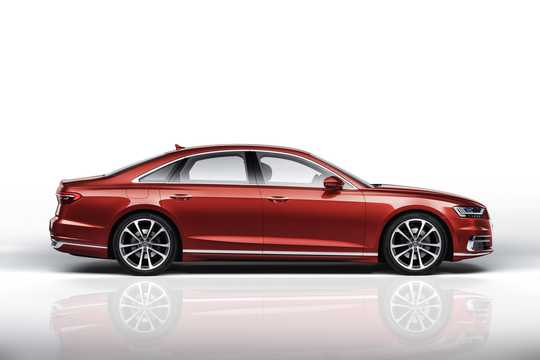
The new Audi A8 is stylistically defining – it signals the beginning of a new design era for the entire brand. The front end with its wide, upright Singleframe grille and the fluid, muscular body convey power, elegance, sophistication and modernity, and deliver on the promise made by the Audi prologue design study. 
The luxury saloon makes a suitably emphatic statement whether in 5.17-metre ‘standard’ form or as the A8 L, which has a 13 centimetre longer wheelbase.
The Audi brand is renowned worldwide for consistent innovation in design and engineering, for lightweight construction and for quattro permanent all-wheel drive – and every facet of the new A8 reflects these values.
The balanced proportions emphasise all four wheels in equal measure, and the muscular definition above the wheel arches gives visual expression to the quattro drive. Viewed side-on, the upright front end combined with the gently inclined rear create visual tension which is intensified, particularly at night, by the striking HD Matrix LED headlights with Audi laser lighting, and the LED light strip combined with OLED technology at the rear. These produce unique light animations as the driver approaches and leaves the car.
Luxury from head-to-toe: the interior
Space is often considered to be the ultimate luxury, and compared to its predecessor the new A8 has grown substantially in length in both body styles. Occupants can also now relax in even more sublime surroundings, with every detail radiating superlative bespoke quality – from the perforation in the seat upholstery to the electrically opening and closing shutters on the air vents.
The most sought-after seat in the new Audi flagship model could quite possibly be the rear left – the optional relaxation seat in the A8 L that comes with four different adjustment options and a footrest. In this seat, the passenger can warm and massage the soles of their feet on a unit with multiple settings incorporated into the back of the front-passenger seat. The new comfort head restraints complete the experience. 
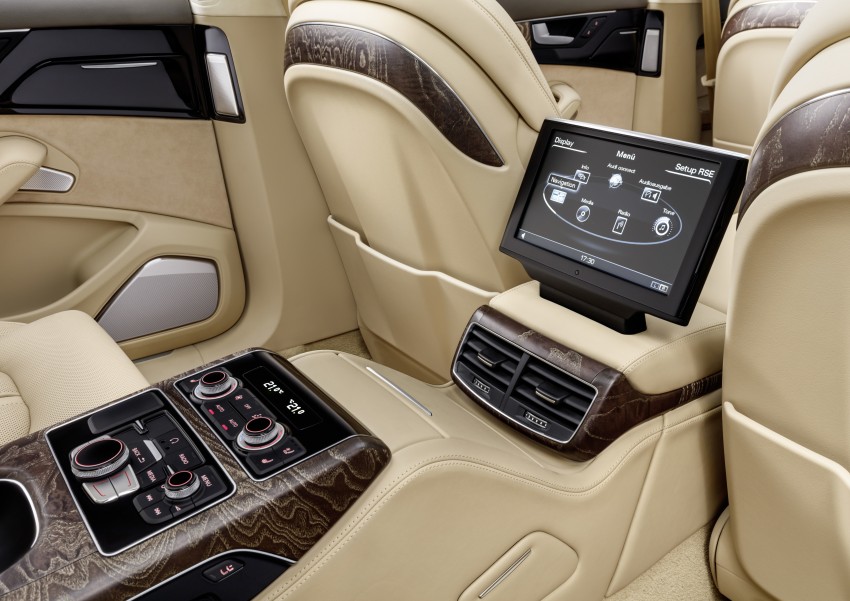
Rear passengers can also control an array of functions such as ambient lighting, the new HD Matrix reading lights and seat massage, and can make private phone calls via a separate operating unit. The rear seat remote control, with its smartphone-size OLED display, is a removable unit housed in the centre armrest.
Fingertip response: the controls
The luxury saloon’s interior deliberately adopts a reductive design; the interior architecture is clear and with a strictly horizontal orientation. Audi carries its high quality standards into the digital age with a radically new operating concept. 
It dispenses with the familiar rotary pushbutton and touchpad of the predecessor model in favour of an instrument panel which is largely free of buttons and switches. At its centre is a 10.1-inch touchscreen display which, when off, blends almost invisibly into the high-gloss black surround thanks to its black-panel look.
The user interface appears as soon as the car is opened. The driver controls the Infotainment system with a fingertip on the large display. He or she can use a second touchscreen display on the centre tunnel console to access the air conditioning and comfort functions as well as make text inputs. 
When the driver activates a function in the upper or lower display, a click is heard and felt by way of confirmation. The glass-look operating buttons respond in the same way. 
The combination of acoustic and tactile feedback along with the use of common touch gestures such as swiping make the new MMI touch response especially safe, intuitive and quick to use.
The A8 can also engage in intelligent conversation. The driver can activate an array of functions using a new, natural form of voice control. Information on destinations and media is either available on board or is delivered from the cloud at LTE speed. The extensive Audi connect range also includes traffic sign recognition and hazard information – innovative car-to-X services that draw on the swarm intelligence of the Audi fleet.
The navigation system has also evolved in line with the car which houses it: It is self-learning, based on the route just driven. This provides the driver with intelligent search suggestions. The map also incorporates highly detailed 3D models of major European cities.
World premiere: the pilot-driving Audi A8
The new A8 is the first production car to have been developed specially for highly automated driving. The Audi AI traffic jam pilot takes charge of driving in slow-moving traffic at up to 37mph on major roads where a physical barrier separates the two carriageways. The system is activated using the AI button on the centre console.
The traffic jam pilot manages starting, accelerating, steering and braking. The driver no longer needs to monitor the car permanently. They can take their hands off the steering wheel permanently and, depending on the national laws, focus on a different activity that is supported by the car, such as watching the on-board TV. As soon as the system reaches its limits, it calls on the driver to take back control of the task of driving.
The introduction of the Audi AI traffic jam pilot means the statutory framework will need to be clarified in each individual market, along with the country-specific definition of the application and testing of the system. 
The brand’s high quality standards are equally applicable in the realm of highly automated driving. In addition, a range of approval procedures and their corresponding timescales will need to be observed worldwide. Audi will therefore be adopting a step-by-step approach to the introduction of the traffic jam pilot in production models.
From a technical perspective the traffic jam pilot is revolutionary. During piloted driving, a central driver assistance controller (zFAS) now permanently computes an image of the surroundings by merging the sensor data. As well as the radar sensors, a front camera and the ultrasonic sensors, Audi is the first car manufacturer also to use a laser scanner.
The Audi AI remote parking pilot and the Audi AI remote garage pilot autonomously steer the A8 into and out of a parking space or a garage, while the manoeuvre is monitored by the driver. The driver does not need to be sitting in the car – he or she can start the appropriate system from their smartphone using the new myAudi app. It broadcasts a live feed of the parking manoeuvre taken from the car’s 360-degree cameras on their handheld device for easy monitoring.
New dimension: the suspension
With a whole package of innovations, the suspension pushes the very limits of what is physically possible. One such innovation is dynamic all-wheel steering, which combines quick and direct response with unshakable stability. 
The steering ratio for the front wheels varies as a function of speed; the rear wheels are turned in or against the direction of steering depending on the speed range. The car’s handling becomes even more dynamic and precise with the sport differential. This actively distributes torque between the rear wheels, complementing the quattro permanent all-wheel drive that is standard in the new A8.
The second new technology, Audi AI active suspension, is a fully active suspension system. Depending on the driver’s wishes and the driving situation, it is capable of raising or lowering each wheel separately with electric actuators. 
This newfound latitude enables it to deliver the polished ride comfort of a classic luxury saloon and the taut, composed agility of a more driver-oriented performance car in equal measure. In combination with pre sense 360°, the car is rapidly raised if there is an impending lateral collision, reducing the potential consequences of the accident for all occupants.
This highly innovative suspension system obtains the energy it requires from a 48-volt electrical circuit. The A8 is the first Audi model to use this more powerful network as its primary electrical system, and all versions reap its benefit. In conjunction with the advanced air suspension for the A8, the innovative fully active suspension concept delivers an utterly new driving experience.
Mild hybrid and e-tron
The new A8 makes its debut with two extensively reengineered V6 turbo engines: a 3.0 TDI and a 3.0 TFSI. The diesel develops 286PS, and the petrol version 340PS. An eight-cylinder TDI – a 4.0-litre with 435PS – will follow slightly later. The exclusive top engine version is the W12 with a displacement of 6.0 litres.
All five engines operate in conjunction with a belt alternator starter (BAS), which is the nerve centre of the 48-volt electrical system. This mild hybrid technology (MHEV, mild hybrid electric vehicle) enables the car to coast with the engine switched off, and to restart smoothly. 
It also has an extended start/stop function and an energy recovery output of up to 12 kW. The combined effect of these measures is to bring down the fuel consumption of the already efficient engines even further – by as much as 0.7 litres for every 100 kilometres (62.1 miles) covered in real world driving conditions.
The A8 L e-tron quattro with its powerful plug-in hybrid drivetrain will follow at a later date: Its 3.0 TFSI engine and powerful electric motor achieve 449PS of system power and 700 Nm (516.3 lb-ft) of system torque. 
The lithium-ion battery stores enough power for about 31 miles of electric driving. It can optionally be charged by Audi Wireless Charging. A pad in the garage floor transfers the power inductively to a receiver coil in the car with a power output of 3.6 kW.
The new Audi A8 and A8 L are being built at the Neckarsulm plant in Germany and will be appearing on UK roads in late 2017 following initial availability for ordering in September.
Monday, 10 July 2017

The world Debut of the All-New A8 gets shown to the world on the 11th July, cant wait.

Forthcoming Audi luxury saloon to feature advanced new camera-linked adaptive suspension for exceptional ride and handling composure
  • Global first: Raising the body during a side impact improves passive safety
  • Fully active suspension for maximum comfort and dynamism
  • 48-volt main electrical system powers electromechanical suspension system
  • Dynamic all-wheel steering resolves the conflict of aims between agility and stability
  • The new Audi A8 makes its world debut at the Audi Summit in Barcelona on July 11
  • Turning circle smaller than an A4 thanks to the option of all-wheel steering
Befitting of the premium brand’s flagship luxury saloon, the all-new Audi A8 makes its world debut at the first ever Audi Summit on July 11 with a host of innovative new technologies that will again elevate it to the pinnacle of Vorsprung durch Technik.
One of the myriad new features available for the most advanced Audi model ever launched will be active suspension, which through the use of advanced camera technology linked to individual electric motors for each wheel can adapt incredibly precisely to changes in the road surface and provide a more finely differentiated balance than ever before between a cosseting ride for the driven and a rewarding experience for the driver. 
This flexibility is made possible thanks to the new active suspension based on the 48-volt electrical system, which is used for the first time as the main electrical system.
The all-new active suspension on the Audi A8 is a fully active, electromechanical suspension system, which drives each wheel individually and adapts to the prevailing road conditions. The electric motor at each wheel is powered by the 48-volt main electrical system. Additional components include gears, a rotary tube together with internal titanium torsion bar and a lever which exerts up to 1,100 Nm (811.3 lb-ft) on the suspension via a coupling rod.
Predictive and preventative
Thanks to the front camera, the luxury saloon detects bumps in the road early on and predictively adjusts the active suspension. Even before the car reaches a bump in the road, the preview function developed by Audi transmits the right amount of travel to the actuators and actively controls the suspension.
In this way the suspension reacts precisely at the right time, virtually completely eliminating any vibrations and jolts. This complex process takes just a few milliseconds, with the camera generating information about the road surface condition 18 times a second.
The electronic chassis platform (ECP) processes the road surface information and precisely controls all suspension components almost in real time. In conjunction with the air suspension fine-tuned for the A8, the innovative suspension concept delivers an entirely new driving experience in this way. Irrespective of the high level of comfort, the new luxury saloon sits close to the road even with a dynamic driving style.
The active suspension specifically influences and minimises rolling movements when cornering, and pitching movements when braking or accelerating, for instance. The customer can drive dynamically while keeping the vehicle under control or work undisturbed in the rear.
The innovative combination of dynamic and rear axle steering resolves the conflict of aims between agility and stability in the shape of dynamic all-wheel steering: The steering characteristics are direct while ensuring a high level of handling stability; the steering feel encompasses a wide spread from comfortable through to intense feedback. The turning circle of the A8 is smaller than that of an A4.
In conjunction with the Audi pre sense 360˚ safety system, the active suspension on the new Audi A8 takes passive safety to a new level. The system uses the sensors networked in the central driver assistance controller (zFAS) to detect risks of a collision around the car. In the event of an imminent side impact at more than 15mph the suspension actuators raise the body on the exposed side by up to 80 mm within half a second. As a result, the collision is directed to the even stronger areas of the luxury saloon, such as side sills and floor structure. Hence the load on the occupants is reduced by up to 50 percent compared with a side impact where the body is not raised.

Wednesday, 19 April 2017

The Next Gen Audi A8 will have an Intelligent mix of four materials including, Aluminium and CFRP.

  • Luxury saloon lives up to its reputation as an innovation driver in lightweight design
  • Comfortable entry and improved view thanks to roller hemming
  • Extraordinary torsional rigidity delivers gains in driving dynamics and acoustics
  • Intelligent mix of four materials: aluminium, steel, magnesium and CFRP
  • Know-how based on more than one million series cars with Audi Space Frames
Audi is writing a new chapter in its lightweight design success story. For the next generation of the Audi A8, an intelligent mix of four materials is being used for the first time in the weight-bearing body structure – more materials than in any of the brand’s previous production models. 
The luxury saloon is thus once again rightfully claiming its role as an innovation driver in automotive lightweight design: Its low weight and impressive rigidity offer greater performance, efficiency and safety.
The lightweight design experts at Audi long ago abandoned the fixation on using a single material in lightweight design. With a mix of aluminium, steel, magnesium and carbon fibre-reinforced polymer (CFRP) they are establishing a new stage in multi-material construction in the Audi Space Frame (ASF) for the next generation of the Audi A8 – in keeping with the principle “the right material in the right place and in the right amount.”
Audi consistently applies new material technologies and designs that directly benefit the customer – and not only in terms of weight. The upcoming flagship’s torsional rigidity – the critical parameter for precise handling and pleasing acoustics – surpasses the excellent values of its predecessor by a factor of about one quarter.
Innovative production process – the carbon rear panel in the new Audi A8
In terms of its overall dimensions, an ultra-high-strength, torsionally rigid rear panel made of CFRP is the largest component in the occupant cell of the new Audi A8, and it contributes 33 percent to the torsional rigidity of the total vehicle. To optimally absorb longitudinal and transverse loads as well as shearing force, between six and 19 fibre layers are placed one on top of the other, ensuring a load-optimised layout. 
These individual fibre layers consist of tapes 50 millimetres wide and can be placed individually in a finished layered package, with any desired fibre angle and minimal trimming of the fibres. The innovative direct-fibre layering process specially developed for this purpose makes it possible to entirely dispense with the normally needed intermediary step of manufacturing entire sheets. 
Using another newly developed process, the layered package is wetted with epoxide resin and sets within minutes.
A high-strength combination of hot-formed steel components make up the occupant cell, which comprises the lower section of the front bulkhead, the side sills, the B-pillars and the front section of the roof line. Some of these sheet metal blanks are produced in varying thicknesses using tailoring technologies – meaning they are customised – and others also undergo partial heat treatment. 
That reduces weight and increases the strength, especially in areas of the vehicle that are particularly critical for safety.
The aluminium components make up 58 percent of the new Audi A8 body, the largest share in the mix of materials. Cast nodes, extruded profiles and sheets are the elements characteristic of the ASF design. And here too the competition of materials has been driving progress. 
New heat-treated, ultra-high-strength cast alloys attain a tensile strength of over 230 MPa (megapascals). The corresponding yield strength in the tensile test is over 180 MPa, and for the profile alloys it is higher than 280, i.e. 320 MPa – significantly higher values than seen previously.
Rounding out the intelligent mix of materials is the magnesium strut brace. A comparison with the predecessor model shows that it contributes a 28-percent weight savings. Aluminium bolts secure the connection to the strut tower domes, making them a guarantor of the body’s high torsional rigidity.
In the event of a frontal collision, the forces generated are distributed to three impact buffers in the front end.
Benefits for customers and the environment – the new body shop for the Audi A8
In addition to the complete redevelopment of the Audi Space Frame for the next generation A8, the production halls at the Neckarsulm location were specially built for the upcoming flagship. A total of 14,400 metric tonnes of steel were needed just for construction of the new, 41-metre-high body shop, twice as much steel as was used for the Eiffel Tower in Paris.
The highly complex yet energy-efficient production operation uses 14 different joining processes, including roller hemming at the front and rear door cutouts. This mechanical, “cold” technology is used to join the aluminium side wall frame to the hot-formed, ultra-strong steel sheets at the B-pillar, roof line and sills. The engineers thus realised improvements of up to 36 millimetres at the door cutouts compared to the predecessor model. That in turn makes getting in and out of the car even more comfortable and widens the driver’s field of vision around the A-pillar, an area that is key to safe driving.
As for the “warm” joining processes, Audi stands alone among the premium automakers by virtue of its development of remote laser welding for use with aluminium. Exact positioning of the laser beam in relation to the welding edge considerably reduces the risk of hot cracking during the production process. The new process makes it possible to precisely control the penetration depth of the laser by means of the heat input. In this way, process control can immediately determine the gap width between parts being joined, and this can effectively be closed using regulating controls. The laser beam’s high feed rate and low energy use reduce the CO2 emissions of this production step by about one fourth.
This new process also results in a 95 percent savings on recurring costs in series production because it eliminates the need for costly process controls required with conventional laser welding. The remote laser welding technology perfectly symbolises the entire production of the new Audi A8.
In 1994 it was the first generation of this luxury saloon, with its aluminium unitary body, that made the Audi Space Frame an established presence in the automotive world. Since then the company has built more than one million production cars in accordance with this design principle, and it has been continually building upon its know-how in the use of materials and joining techniques.

Thursday, 21 July 2016

USA RECALL #10 - Audi is recalling 2007-2009 models of its flagship A8/S8 for possible sunroof detachment.

RECALL Subject : Sunroof Glass may Detach from Vehicle

Saturday, 16 April 2016

One-off 6-seater Audi limo took almost a year to develop to the same exacting standards as a standard A8

One-off six-seater Audi limousine took almost a year to develop and finesse to the same exacting standards as a production-ready A8
  • Premium manufacturer develops and builds 6.36-metre luxury saloon to special customer order
  • Comfortable and spacious seating for six
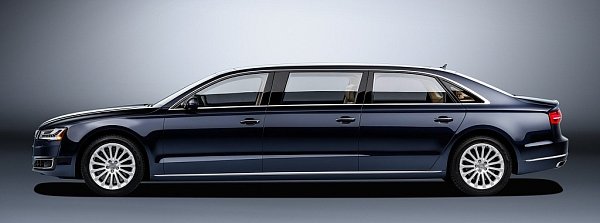
  • Wheelbase extended by almost 1.1 metres over the A8 L, with a completely reworked outer skin starting from the A-pillar backwards
  • Additional use of aluminium to lengthen and strengthen the Audi Space Frame
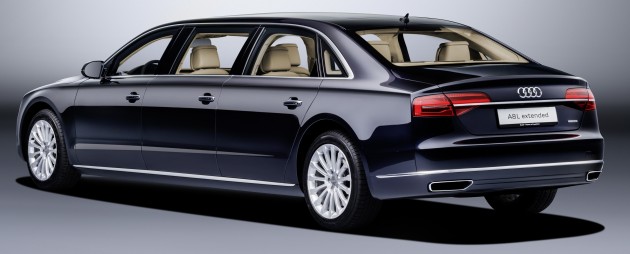
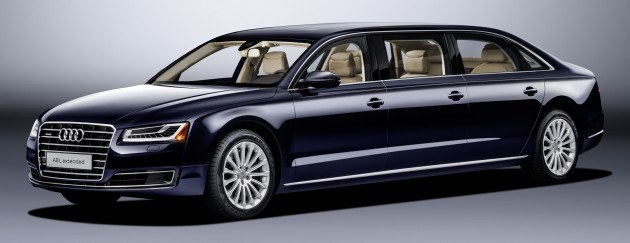
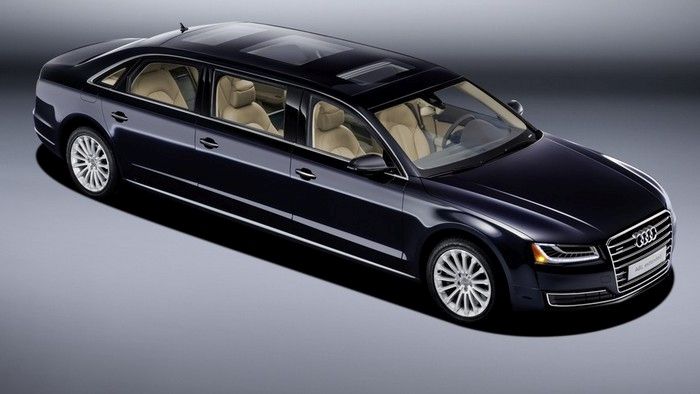
Audi has gone to even greater lengths to deliver all of the familiar trappings associated with its flagship A8 L model in an entirely unique format of considerable proportions. At the special request of a European customer, the premium brand has created the Audi A8 L extended, a built-to-order model measuring 6.36 metres (20.9 ft) in length and with a wheelbase of 4.22 metres (13.8 ft)
The A8 L extended affords exquisite comfort for passengers occupying all of its six seats. Audi has further requests for the custom product already.

Experts invested almost a year in developing and building the exceptionally long luxury saloon. The result was an exclusive one-off specimen that meets the high standards of the production model in every domain. The major challenges concerned the safety and rigidity of the extra-large body, as well as the styling of the silhouette.
The Audi A8 L extended benefits from the low weight of the production model’s body, which uses an Audi Space Frame design and is made almost entirely from aluminium. For the built-to-order version the engineers extended the side sills and centre tunnel using extruded aluminium sections.
Inside the tunnel, these also assist with the air routing. A double rear bulkhead separates the passenger compartment from the luggage compartment; the roof incorporates additional aluminium profiled tubes and cross-braces. These measures provide torsional and flexural rigidity almost on a par with the A8 L.
The representative XXL saloon in discreet moonlight blue, metallic offers 1.09 metres (3.6 ft) more wheelbase and overall length than the Audi A8. To maintain a harmonious roof line, the entire body from the A-pillar back has been reworked.
The experts embedded a 2.40-metre (7.9 ft) glass panel in the roof skin to enhance the sense of spaciousness.
The sun blinds – one for each row of seats – prevent overheating of the interior in strong sunlight. The headlights and rear lights incorporate small side marker lights, as is prescribed by law for vehicles of this length.
All passengers face the direction of travel in the Audi A8 L extended. The six seats are upholstered in extra-supple Valcona leather, in the colour velvet beige. Rows two and three feature electrically adjustable individual seats. The third row has a continuous centre console, a Rear Seat Entertainment display and a cool box.
The one-off A8 version is powered by a 3.0 TFSI engine developing 310 PS, delivering up to 440 Nm(324.5 lb‑ft) of torque. This propels the saloon from 0 to 62 mph in 7.1 seconds and up to an electronically governed top speed of 155 mph. 
An eight-speed tiptronic transfers engine power to the quattro permanent all-wheel drive system. The 19‑inch wheels in 15‑spoke design conceal the brake system of the Audi S8, which assures outstanding deceleration of the over six-metre-long (19.7 ft) luxury saloon, with its unladen weight of 2,418 kilograms.