V10 supercar is reborn with advanced new quattro all-wheel-drive and up to 610 PS propelling less weight to a top speed of 205mph
- Second generation of the acclaimed supercar makes its debut in Geneva
- Available to order in the UK in May 2015, first deliveries in quarter four – pricing expected to be confirmed soon after Geneva unveiling
- First UK customer deposits are already being taken
- 5.2 FSI engine with up to 610 PS, 0-62 mph in just 3.2 seconds
- New multimaterial Audi Space Frame with high proportion of aluminium and CFRP
- Up to 50kg lighter than its predecessor
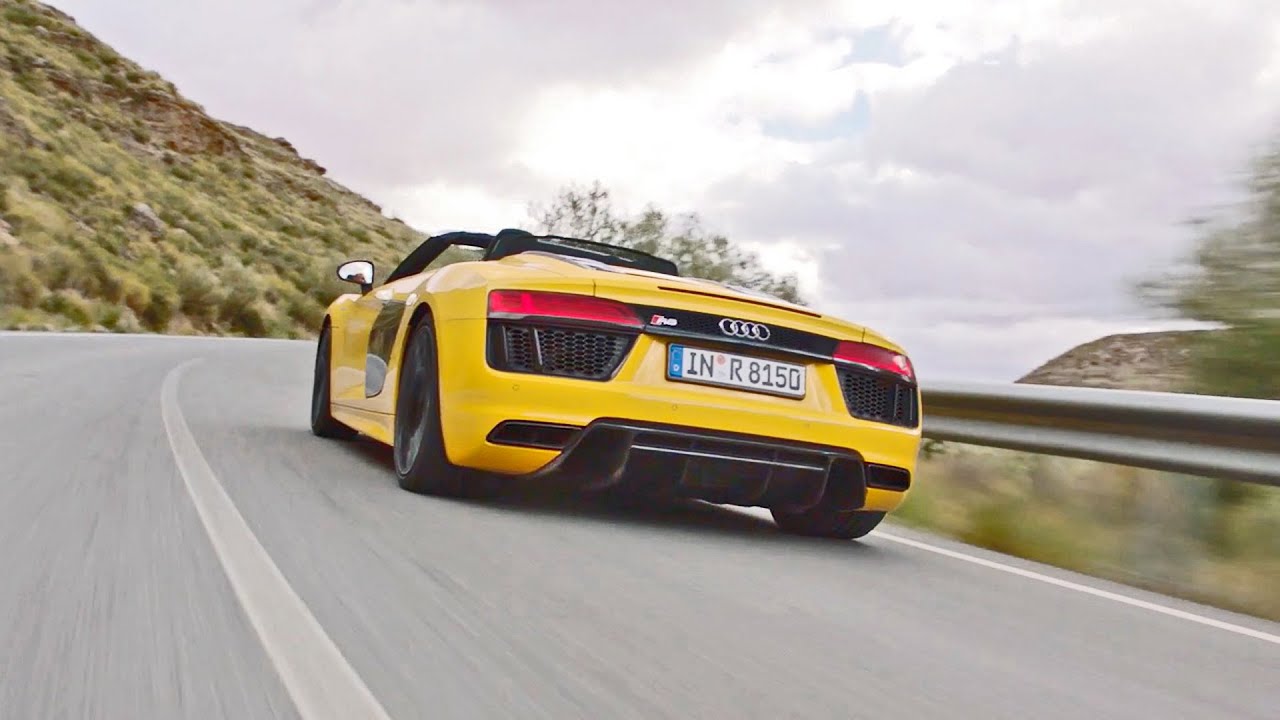
No model bearing the four rings is closer to motorsport, none is more striking and more dynamic: at the Geneva Motor Show, Audi will present the second generation of its high-performance R8 sports car. The mid-mounted V10 and newly developed quattro all-wheel-drive system ensure breathtaking performance, especially in the top-of-the-range version with 610PS, which not only powers to 62mph from rest more rapidly than any series production Audi in history but is also the first to be capable of officially pushing beyond 200mph.
The R8 has been newly developed from the ground up – it is more taut, more striking and more focused both on the race track and on the road. Key contributions to the marked improvements over its critically acclaimed predecessor are made by the high-revving mid-mounted engine with significantly enhanced performance, the architecture with its even greater emphasis on lightweight construction principles and the advanced chassis with quattro drive system and fully variable torque control.
“Motorsport is in Audi’s genes, it has always been a permanent feature of our brand’s character,” says Prof. Dr. Ulrich Hackenberg, Board Member for Technical Development at Audi. “With the new Audi R8, our engineers are bringing accumulated racing expertise from the race track onto the road.
No other model of ours evokes more dynamic emotion. The new R8 V10 plus is therefore the most powerful and fastest series-production Audi of all time.” Thanks to the close cooperation between racing engineers, racing drivers and developers, the Audi R8 has seen a clear performance increase – this benefits both the series production car and the R8 LMS developed on the basis of this.
The engines: 10 cylinders in two versions
The 5.2-litre FSI engine at the heart of the new R8 is available in two versions: one with 540 PS and another producing 610 PS. The range-topping model accelerates in a mere 3.2 seconds from rest to 62 mph and keeps going to its maximum speed of 205 mph. The sound of the naturally aspirated V10 engine, whose maximum torque is available at 6,500 rpm, has become even fuller and sharper.
A seven-speed S tronic transmission and a newly developed quattro drive system transmit the power to the road. The distribution of the drive torque is highly adaptable to prevailing driving conditions – in extreme cases, 100 percent of the torque can be transmitted to the front or rear axle. The new performance mode in the Audi drive select dynamic handling system enables adaptation of the most important ride dynamics parameters to the friction coefficient of the road.
Lightweight construction: only 1,454 kg dry weight
The dynamic spearhead of the range – the R8 V10 plus - has a dry weight of 1,454 kilograms. Despite considerable extra equipment and greater rigidity, the new Audi R8 weighs up to 50 kilograms less than its predecessor.
The multimaterial Audi Space Frame (ASF) ensures low weight and optimum axle load distribution. The combination of aluminium and carbon fibre reinforced plastics (CFRP) in the Audi Space Frame opens up new dimensions with regard to weight, rigidity and crash behaviour. The aerodynamic underbody, which integrates a long diffuser, boosts downforce. The chassis, too, with its double wishbone suspension demonstrates how close the new Audi R8 is to motorsport.
Design: flat, wide, muscular
The design reflects the powerful character of the R8. A visual distinguishing feature which also provides enhanced safety comes in the form of the all-LED headlights or, for an extended field of vision and more brightness, with the laser spot for the high beam – complemented by dynamic turn signals with their scrolling function in the intended turn direction at the front. Dynamic turn signals are standard at the rear.
In the new Audi virtual cockpit, the displays are digital. The most important controls are grouped together in button clusters on the steering wheel, also known as satellites. In the interior, the driver has the impression of sitting in a racing car. The air conditioning controls emphasise the simplicity of the control panel with its floating effect. MMI navigation plus with MMI touch is standard.
New factory for quattro GmbH: production at the “Böllinger Höfe” site
The new Audi R8 is produced at a new quattro GmbH production site that was specially built for the sports car – the “Böllinger Höfe” site in Heilbronn. An elaborate manufacturing technique ensures that Audi-typical quality is delivered.
Specialists: the Audi R8 e-tron and Audi R8 LMS
The second generation of the Audi R8 forms the basis for more models. The latest evolutionary version of the electrically-powered high-performance R8 e-tron sports car achieves a performance figure of 462 PS and 920 Nm (678.6 lb-ft) of torque. It sprints from a standstill to 62 mph in 3.9 seconds. Thanks to new battery cells, the range could be more than doubled compared to the first version of this technological wonder – it now exceeds 280 miles.
The new Audi R8 LMS race car was developed based on the new GT3 regulations due to come into effect worldwide from 2016. This year it will already be put through its paces at the factory. Despite massive performance increases, around 50 percent of its components are the same as the series-production car.
The R8 is the dynamic spearhead of the Audi range. In its second generation, the high-performance sports car has been newly developed from the ground up – it is more taut, more striking and more focused. The high-revving V10 engine is available in two performance variants. In the top-of-the-range version with 610PS, it develops breathtaking power.
“Motorsport is in Audi’s DNA, it is part of our brand’s character,” says
Prof. Dr. Ulrich Hackenberg, Board Member for Technical Development at Audi. “With the new R8, our engineers are bringing accumulated racing expertise from the race track onto the road. No other model of ours evokes more dynamic emotion, none is closer to a race car. The new R8 V10 plus is the most powerful and fastest series production Audi of all time.”
The mid-engine principle used for the Audi R8 is not only a classic concept in motorsport but also an important piece of Audi tradition. The powerful engines were located in front of the rear axle even in the Grand Prix race cars brought to the start line by Auto Union in the 1930s – a revolutionary step at the time.
In 2000, Audi won the 24-hour Le Mans endurance race with the LMP R8 prototype for the first time. By 2005, the car which provided the name for today’s series-production high-performance sports car had secured five overall victories at the Sarthe – the name chosen for the road version of the super sports car from Audi, R8, indicates the technological relationship between the two winners.
As the R8 LMS, the Audi R8 is also highly successful in customer racing. The basis for its success: motorsport was part of the development strategy from the very beginning. In 2009, the R8 LMS customer racing car began its success story which would lead it to more than 190 victories and 23 championship titles worldwide. Technically speaking, it is closely related to the road version of the sports car with around 50 percent of the same parts.
Up to 610PS: the two V10 engines
The new generation of the Audi R8 uses the latest development of the ten-cylinder engine. With its keen throttle response and ability to rev freely and quickly to 6,500 rpm accompanied by a glorious engine note, the naturally aspirated 5.2-litre FSI is a fittingly emotive power source. In the new R8, the naturally aspirated V10 engine offers even more power and torque than before. Controllable flaps in the exhaust system and an optional sports exhaust make the car sound even more formidable.
The ten-cylinder engine is available in two versions. In the R8 V10, it develops 540PS from its 5,204 cc displacement and peak torque of 540 Nm (398.3 lb-ft) at 6,500 rpm. The sprint from 0 to 62mph takes just 3.5 seconds, and it can reach a top speed of 200mph. The R8 V10 plus is even more powerful and is the fastest series-production Audi of all time. It develops 610PS and its maximum torque of 560 Nm (413.0 lb-ft)is available at 6,500 rpm. The performance figures are equally impressive: 0 to 62mph in 3.2 seconds, 0 to 124mph in 9.9 seconds, and a top speed of 205mph.
Cylinder-on-demand new to R8
A further innovation in the 5.2 FSI engine is the addition of indirect injection. It complements the FSI direct petrol injection, lowers fuel consumption and enhances engine output. Equally importantly, the latest R8 also employs COD (cylinder on demand) technology for the first time.
The system shuts off one of the two cylinder banks by deactivating injection and ignition. The R8 V10 can return up to 23.9mpg with CO2 emissions of 275 grams per kilometre, for the R8 V10 plus those values are 22.8mpg and 289 grams per kilometre (preliminary data). These figures represent a 10 percent improvement in fuel economy compared with the previous model, due in no small part to the new start-stop system.
The dry sump lubrication completes the technology package of the 5.2 FSI. The ten-cylinder engine is hand built in the Hungarian engine plant in Györ. As a traditional motorsport technology, it allows for low installation of the engine, which is particularly beneficial for the car’s centre of gravity. What's more, it also ensures oil supply even under extreme lateral acceleration.
Fast as lightning and highly variable: the power transmission
In both engine versions, power is transmitted to a rapid-shifting seven-speed S tronic transmission installed behind the engine. The S tronic has three automatic modes and can also be controlled manually. Shift commands are transmitted electronically (shift-by-wire). The launch control system manages full-throttle acceleration from a standing start.
Another function of the S tronic comes into play when the driver’s foot is removed from the accelerator pedal at speeds above 34mph. In such cases, both clutches open and the car enters coasting mode. This function saves a considerable amount of fuel, especially in everyday use.
The quattro permanent all-wheel drive system gives the new R8 a decisive advantage in terms of stability and traction when compared with two-wheel-drive competitors. On the front axle, an electrohydraulic multi-plate clutch replaces the Visco clutch of the predecessor model.
The newly developed quattro drive system enables completely unrestricted and fully variable distribution of the drive torque to the front and rear axles depending on the driving situation and weather. In normal operation, up to 100 percent is transmitted to the rear wheels and, if required, the clutch continuously diverts up to 100 percent of this torque to the front wheels. Thanks to the mechanical differential lock on the rear axle, the driver experiences maximum traction without any slip.
Audi drive select: the chassis
In the chassis of the new Audi R8, double wishbones made from aluminium guide all four wheels. The R8 V10 plus has a particularly focused setup – for both engine variants, variable adaptively controlled Audi magnetic ride shock absorbers are available as an option. The newly developed electromechanical power steering system provides close contact with the road surface and makes a further contribution to reducing CO2 emissions. As an option, Audi offers dynamic steering, whereby the steering ratio varies in accordance with the road speed and the settings in the Audi drive select dynamic handling system.
As standard, the new Audi R8 V10 has 19-inch wheels with size 245/35 tyres at the front and 295/35 at the rear. The steel brake discs have a weight-saving wave design and the calipers can be painted red upon request. In the R8 V10 plus, high-tech discs made from carbon fibre ceramic are responsible for deceleration of the 19-inch wheels.
Also new to the R8 is the Audi drive select dynamic handling system, which offers the driver a choice of four modes (comfort, auto, dynamic and individual) to control the way in which important technical components operate.
As standard, the system takes into account the engine characteristics, steering, S tronic transmission and quattro drive system as well as optional extras such as Audi magnetic ride, the exhaust flaps and dynamic steering. On top of that, there is also a new performance mode (available as an option for the V10 and standard for the V10 plus). The driver activates it by pressing a separate button on the steering wheel.
He or she can select between the programs dry, wet and snow using a rotary wheel. These programs support dynamic handling on dry, wet and snow-covered surfaces. In performance mode, Audi drive select also makes use of the ESC stabilisation control function.
New Audi Space Frame with high proportion of aluminium and CFRP
The R8 V10 plus has a dry weight of 1,454 kilograms. The key factor behind the consistent lightweight design is the body shell with multimaterial Audi Space Frame (ASF): It weighs only 200 kilograms. The resulting unladen weight of 1,555 kilograms leads to a superior power-to-weight ratio of 392PS per ton.
The ASF body shell features a completely new multimaterial lightweight construction concept. Components made from carbon fibre reinforced plastics (CFRP) form the B‑pillars, the central tunnel and the rear wall. The front section of the vehicle, the roof arch and the rear section form a framework made from cast aluminium nodes and aluminium profiles which, in some cases, employ new alloys.
As always with the ASF, each component is precisely designed for its location and purpose. Accordingly, the engineers have now integrated some components into the body shell due to their function. Leaving aside its components, the body shell is now around 15 percent lighter than its predecessor. At the same time, a 40 percent improvement in torsional rigidity has also been achieved - the body of the new Audi R8 sets a new benchmark here. The resulting lightweight construction is unparalleled among the competition.
The multimaterial Audi Space Frame in the new Audi R8 is extremely light and rigid, whilst also being acoustically comfortable and offering a high level of safety. The outer skin is made entirely of aluminium, but as an optional extra (or as standard for the V10 plus), Audi also offers attachment parts made from clear-coated carbon fibre, for example the front splitter, the diffuser or the side blades. A long, rising diffuser in the underbody produces downforce on the rear axle at higher speeds.
Design: flat, wide, muscular
A cockpit positioned very far forward, a long, flowing back and a relatively short wheelbase – the exterior design makes the technical concept of the mid-engine, high-performance Audi R8 sports car clear upon first sight.
At 4.42 metres long, 1.24 metres high and with a wheelbase measuring 2.65 metres, its dimensions have only slightly changed in comparison to the previous model. Its width now measures 1.94 metres and has thus grown by about four centimetres. The car’s proportions convey more of a race car character, with characteristic design ideas from the previous model now more pronounced.
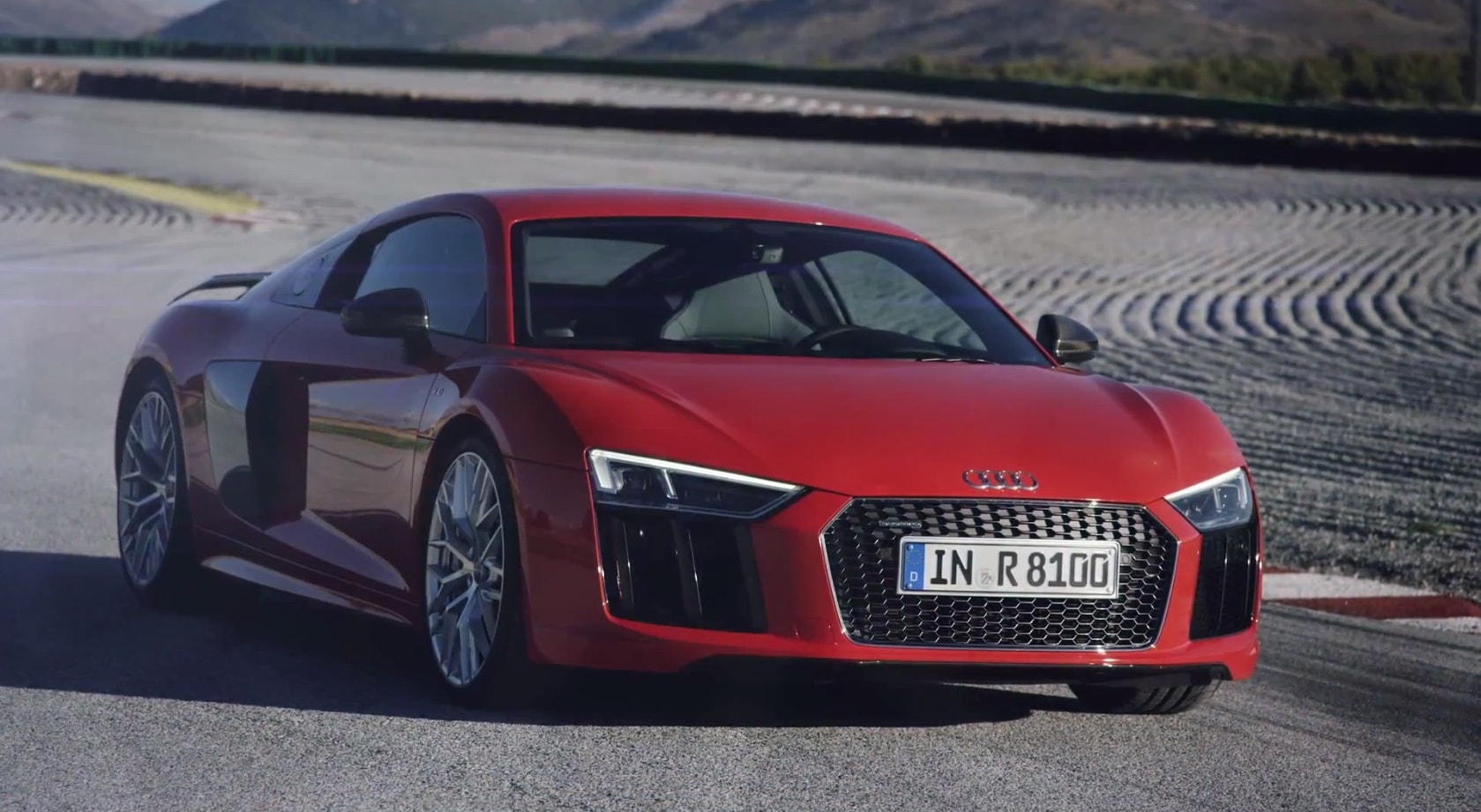
The four rings sit proudly on the bonnet, the Singleframe radiator grille with honeycomb design is wide and flat. Moulded plastic surfaces allow it to merge into the flat headlights – facets of the vehicle which highlight tension, provide an impression of depth and add an air of logic to the design.
The grid-type signature of the all-LED headlights with vertical elements replicates the structure of the air inlets and emphasises the width of the car. The entire appearance of the Audi R8 conveys a feeling of lightness and technical precision. The dynamic turn signals are standard at the rear. The rear lighting signature also combines two vertical elements with a horizontal line. This gives the Audi R8 an even more powerful appearance.
As part of the new laser high beams, one laser module per headlight generates a cone of light with twice the range of the all-LED headlamp at 600 metres. Each module comprises four high-power laser diodes. With a diameter of just 300 micrometers, these generate a blue laser beam with a wavelength of 450 nanometers. A phosphor converter transforms it into white light suitable for roadway use with a colour temperature of 5,500 Kelvin – ideal conditions for the human eye that enable the driver to recognise contrast more easily and help to prevent fatigue.
The laser spot is active from a speed of 37mph to supplement the LED high beam of the R8 and, thanks to its long range, greatly enhances the driver’s field of vision as well as safety. An intelligent camera-based sensor system detects other road users and actively adjusts the light pattern to exclude them.
Dynamic turn signals are also integrated into the front headlight units.
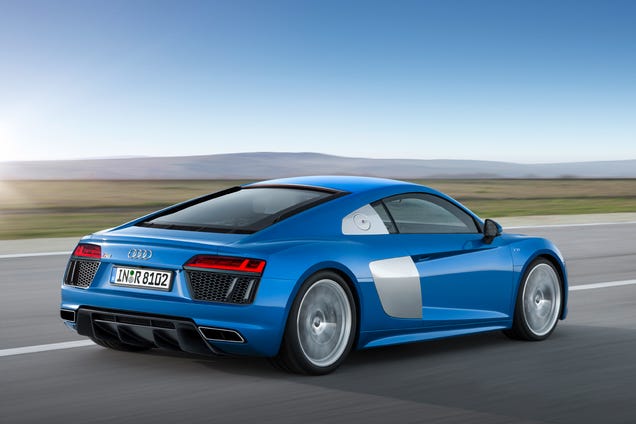
On the high-performance sports car’s flanks, characteristically curved contours are drawn over the wheels. The shoulder line, shaped like a powerful muscle, connects the wheels with one another while at the same time dividing the side blade in two to leave an upper and a lower half. This new design solution makes the car appear even longer and more dynamic.
At the rear, as well, the lights and the air inlets visually connect to one another. The two tailpipes of the exhaust system have a trapezoidal design and the rear window offers a clear view of the illuminated engine compartment. The R8 is equipped with an electrically extending spoiler, the R8 V10 plus with a fixed wing made from CFRP.
Just like in a race car: the interior and the controls
Behind the steering wheel of the new Audi R8, the driver feels like a racing driver.
All functions are driver-oriented and allow easy operation even when the critical limits are reached – and all without the driver having to take his or her hands off the steering wheel. The newly designed sport seats with integrated headrest provide excellent lateral support. Even more radical seating for a sports car comes in the form of the newly developed R8 bucket seats. These make a clear statement confirming the relationship between lightweight construction and comfort (optional in the V10 and standard in the V10 plus).
The start-stop button and the Audi drive select button are located on several satellites on the new multifunction plus steering wheel. The Performance steering wheel in the Audi R8 V10 plus features two more satellites. One button is for performance mode together with a rotary wheel for selecting the dry, wet and snow programs as well as a button for controlling the sports exhaust system.
The Audi virtual cockpit is set in a free-standing housing and presents all the information on its 12.3-inch display with elaborate and pin sharp graphics. The driver can toggle between different display modes and also adjust the digital instrument cluster to suit in individual mode. In performance mode, the driver is presented with information on the driving programs, acceleration, deceleration and lateral forces as well as power and torque.
The Audi virtual cockpit also displays a shift light which illuminates when the rev limit has been reached. The driver operates the Audi virtual cockpit using the multifunction plus steering wheel. The driver’s hands remain on the steering wheel and he or she can concentrate on the road. Alternatively, operation can take place via the touch wheel or the buttons in the centre console.
In the design of the interior too, the taut geometric lines emphasise the aesthetic lightweight construction principles which the brand holds so dear. Its characteristic element is the monoposto, a large arc in the area around the driver’s seat. The three central control elements of the air conditioning system now reside where the MMI monitor was situated in the previous model.
The three-dimensional design of the air outlet vents bring to mind the air inlets of a race car. The dashboard appears to float weightlessly. The wide console of the central tunnel accommodates the standard MMI terminal as well as the newly designed flat selector lever of the S tronic transmission.
When it comes to upholstery, customers can choose between Alcantara/pearl Nappa leather and fine Nappa leather. Also available are trim elements in clear coated carbon fibre, two leather packages and a new diamond stitching pattern.
There are numerous customisation possibilities for customers of the new Audi R8 – for both the exterior and the interior. The colours for the body have been newly mixed and can be freely combined with the colours of the side blades – a blade made from glossy carbon is a particular highlight of the range. Ten standard exterior colours are available - for the R8 V10 plus there is an additional Camouflage Green matt paint finish available.
Five colours are available for the interior, and there are numerous options to further customise it, for example with headlining in Alcantara with dynamic diamond stitching pattern. Offering a wealth of exterior and interior embellishments, the Audi exclusive programme offers enormous scope to turn the new R8 into a one-of-a-kind model.
Completely connected: infotainment
In the new Audi R8, the Audi virtual cockpit replaces the analogue instruments and the MMI monitor. The driver can switch the all-digital display between two different view modes. These bring either the virtual dial instruments or the large navigation map into focus.
The Audi R8 makes use of the latest technology in terms of infotainment. MMI navigation plus is installed as standard; the MMI touch touch wheel is the central control element. In the background, the second generation of the modular infotainment platform sets about its work – just like the Audi virtual cockpit, it integrates a super-fast T30 chip from Audi’s partner, NVIDIA.
MMI navigation plus is complemented by the Audi connect module. The passenger can connect a smartphone or tablet via the system’s integrated Wi-Fi hotspot.
Tailored online services from Audi connect are displayed on the Audi virtual cockpit. The internet connection uses the fast LTE (Long Term Evolution) network. Optional components such as the fine-tuned sound system from Bang & Olufsen with a system performance of 500 watts or the Audi phone box for convenient mobile phone integration round off the infotainment programme.
New factory for quattro GmbH: production at the “Böllinger Höfe” site
The new Audi R8 is produced at the new “Böllinger Höfe” quattro GmbH production site, close to the Neckarsulm plant. The production area covering 30,000 m2 (322,917.3 sq ft) comprises a body shop and assembly facilities. The entire production facility is highly flexible, while technical and ergonomic innovations such as the CFRP body shell construction and driverless transport systems ensure top quality.
As was the case for the previous model, production follows an elaborate manufacturing process. In cycle times of about 30 minutes and with up to 400 highly qualified employees, the R8 is created using highly precise craftsmanship. Following completion, each R8 is subjected to a strict quality acceptance process on the internal plant test track and an approximately one-hour test drive on public roads.
With the new R8 manufacturing site, quattro GmbH – the high-performance subsidiary of AUDI AG – is further enhancing its small-series expertise, thus creating the opportunity to realise ever more exciting derivatives of the R8.
Electrified: Audi R8 e-tron
The second generation of the Audi R8 forms the basis for two more models. Audi has made major engineering developments in its high-performance electric sports car, the R8 e-tron. The latest evolution of the vehicle takes up the multimaterial Audi Space Frame from the new series-production model.
The supporting structure was enhanced by a CFRP rear-section module comprising the luggage compartment. The walls of the CFRP luggage compartment well are corrugated. This way, in the event of a rear-end collision, more energy can be absorbed despite the reduced material weight.
Thanks to targeted modifications to the outer shell and on the wheels, the Audi R8 e‑tron achieves an aerodynamic drag coefficient (cd) value of 0.28. In terms of performance and range, the car enters an entirely new dimension.
The large T-shaped battery is structurally integrated into the centre tunnel and behind the occupant cell – optimally positioned in the car. It supports the dynamics of the R8 e-tron with its low centre of gravity. Audi produces the high-voltage battery itself, for the first time based on a newly developed lithium-ion technology which was specially conceived for a purely electric vehicle drive. In comparison to the first technology platform, the battery capacity has grown from 49 kWh to approximately 92 kWh. This progress was possible without changing the package.
The R8 e-tron achieves an electric range of approximately 280 miles - a considerable improvement over the technology platform’s 133 miles - with an energy density that has been increased from 84 Wh/kg to 154 Wh/kg and some other modifications to the car.
The electrically powered high-performance sports car has the Combined Charging System (CCS) on board, which allows charging with direct and alternating current. Using this system, it is possible to fully charge the battery in significantly less than two hours.
The power is now 462PS and the maximum torque 920Nm. The R8 e-tron 2.0 accelerates from 0 to 62mph in 3.9 seconds on its way to an electronically restricted top speed of 130mph or 155mph. Intelligent energy management and an electromechanical brake system enable high energy recuperation rates. Targeted torque vectoring – needs-based distribution of power transmission between the rear wheels – ensures maximum stability and dynamism.
The R8 e-tron will become available for order in 2015 as an electrically powered sports car offering supreme hand-built quality.
New racing car: the Audi R8 LMS
Alongside the new R8 series-production model, the second-generation R8 LMS racing car is also making its debut, with colleagues from motorsport and series production working in close harmony as part of its development. Both the series-production model of the R8 and the R8 LMS have seen clear increases in power and performance compared with their predecessors. Both cars have around 50 percent of the same parts.
The body shell of the rear-wheel-drive GT3 sports car is based on a selectively reinforced multimaterial ASF. Engineers have supplemented this feature with a safety cage. Its outer shell consists mainly of carbon fibre reinforced plastics. The vehicle’s type approval weight is 1,225 kilograms. The V10 engine is virtually identical to the series-production engine and produces around 585PS, depending on the applicable regulations and the restrictor required.
Sales of the new R8 LMS to customer teams worldwide will start with the 2016 season. This year, the new racing car will be put through its paces by the works team at international long-distance and sprint races, as well as being available to customers as part of the Audi driving experience.