Purpose

I will try my best to provide detailed info on various cars and what is like to live with them, I have already produced a few for Jaguar-car-forums, I will do my best to be unbiased, but it will be hard for some cars. I will re-produce press releases and copy from other motoring news.
Showing posts with label Geely. Show all posts

Saturday, 8 April 2017

The London Taxi Company will produce a second vehicle at the new premises, a Light Commercial vehicle.

  • Second vehicle from brand new facility to be a Light Commercial Van
  • Purpose built, range extended EV to meet needs of the commercial sector across the globe
  • Advanced technology to help tackle urban pollution crisis
  • Targeting “last mile” delivery, distribution and maintenance sectors
  • Incremental additional investment of around £25m bringing the total investment by parent Geely to £325m
Following today’s official opening of the London Taxi Company’s brand new R&D and manufacturing facility in Ansty, the company is delighted to announce that the second vehicle to come off the line will be a dedicated, range extended electric light commercial van (LCV).
This all new, highly flexible, commercially competitive electric vehicle will help fleet owners lower their running costs, improve air quality and support cities in tackling the pollution crisis in urban areas.
Chris Gubbey, CEO of the London Taxi Company said: “This is going to be the future proofed ’white van’ that people have been waiting for. Designed solely for the urban commercial sector, dedicated to the people who keep our cities working, it will be clean, competitive and ready for cities of the future.”
The air quality crisis in many urban environments has highlighted the scale of the opportunity and demand for zero emissions capable commercial vehicles in major cities across the world. 
Electrification is a key component of the global strategy to reduce emissions and the London Taxi Company is determined to apply its expertise in advanced electric vehicle technology, and the taxi market, to urban commercial vehicles.
Carl-Peter Forster, Chairman of the London Taxi Company said: “In addition to our brand-new taxi, the manufacturing of this all new light commercial van is a transformative step for the company as we will move from a single product, single market organization to a multi-product, multi market organization. 
We remain absolutely committed to designing and manufacturing dedicated, range extended EVs that build upon our deep knowledge of advanced technologies and the needs of the urban commercial sector.”
The London Taxi Company’s research and development team of around 200 people, now based in Ansty, has been working around the clock, building upon its new core EV platform architecture, to develop an outstanding LCV that is fit for the world’s cities in the 21st century. 
Its ground-breaking work in developing the all new taxi underpins the LCV strategy having been created on the same range extended EV technology platform. 
With this platform and manufacturing capability already in place, designed for flexible production from day one, the company can bring to market the new LCV through an incremental additional investment of around £30m taking the total investment from parent company Geely to £325 million.
The new vehicle will help to meet emissions targets in cities around the world, as well as being able to handle the toughest urban environments. Importantly for drivers, the vehicle will be city ready and lower running costs, even as electric charging infrastructure continues to develop. 
Zhou Jianqan, the head of Geely’s Commercial Vehicle Division, said: “I am extremely proud to see Geely’s investment in the London Taxi Company allow it to evolve beyond the taxi market. The light commercial van sector in cities across the globe holds enormous potential and urban leaders are embracing zero emissions at an incredibly rapid pace. This vehicle is a result of the new R&D team based at Ansty and will complement Geely’s global expertise in electric vehicle technology adding to the world class talent across the group.
ENDS 

Friday, 20 November 2015

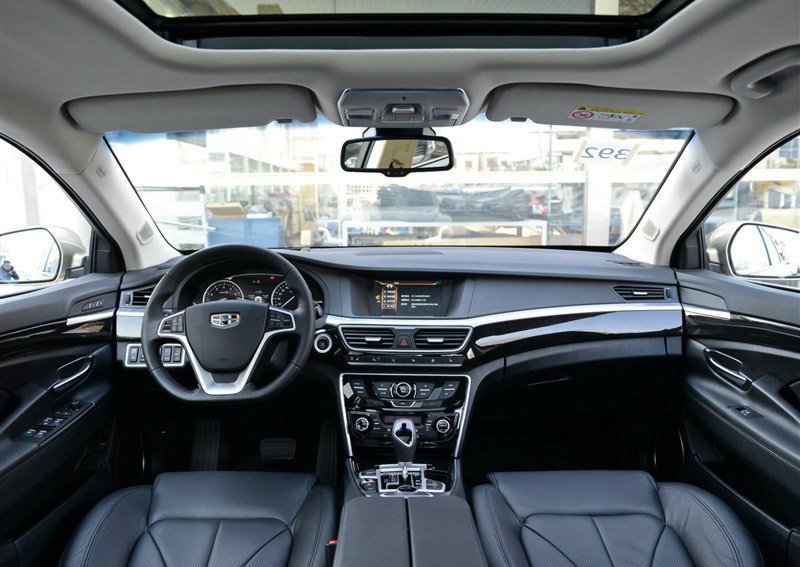
Chinese brand Geely wins the China car Of The Year 2016 with the new Geely GC9 Saloon, the 1st Home winner.

At an awards ceremony during the Guangzhou Auto Show, the Geely GC9 was declared 2016 China Car of the Year. The prize was received by President and CEO of Geely Mr. An Conghui, who stated that “Geely is of great honour to be awarded China Car of the Year. 
The GC9 is just the beginning of a new series of highly competitive models. 
And as a Chinese domestic brand, we will give everything to improve the reputation of Chinese manufacturers.”
The Geely GC9 is the first domestic model to win the prestigious China Car of the Year title. There was a long list of hopefuls, with 140 candidates eligible for the honour of winning the award.

The Geely GC9 was whittled down from the initial entry list, a shortlist of ten and then three finalists, who had to convince the 22 jurors at the CCOTY Beijing test drives beginning of November.
The China Car Awards jurors reason the success of the Geely GC9 with “a perfect blend of a new modern Chinese design language with state of the art technology from Volvo. 
The GC9 is spacious, luxurious with appealing quality and overall highly competitive within the mid-size segment. It’s a leap forward compared to former Chinese domestic models.”
Jens Meiners, Vice Chairman of the World Car Awards comments, that "the China Car Awards have quickly grown into a standard of excellence on the Chinese market - a market with unique demands and preferences. 
This year's winner demonstrates that the Chinese auto industry is fully capable of creating cars that take the lead in a tough and fair competition. 
As vice chairman of the World Car Awards, I would like to convey our congratulations to the participants and winners, as well as the distinguished jury of the China Car Awards. We are proud of our inspiring and successful relationship."
The other four award’s results are as follows:
  • 2016 China Design Car of the Year – Mercedes-Benz AMG GT S | 61 points
  • 2016 China Performance Car of the Year – Ferrari 488 GTB | 116 points
  • 2016 China Green Car of the Year – Lexus NX 300h | 92 points
  • 2016 China SUV of the Year – Volvo XC 90 | 72 points
Over 80 international guests from the automotive industry came together at the award ceremony in Guangzhou to witness the final results of the China Car Awards.
The 2016 China Car Awards are based upon the expertise of 22 jurors and are hosted by the China Professional Automotive Media Editors Club (C-Club), a group of 10 highly influential Chinese automotive journalists and experts, and PRIME Research International, a global leader in strategic communication research and consultancy. 
All cars that entered the Mainland Chinese market between September 30, 2014 and October 1, 2015 have been eligible. The evaluation rules allow all jurors to vote in three rounds for the top three finalists of each award. 
After the test-drives in Beijing, two weeks before the final awards ceremony, the voting round for the final results starts.

Wednesday, 17 December 2014

Volvo to dump the majority of world motor shows in favour of "online marketting" - oh dear, really ?!?!

Volvo Cars said it will start selling vehicles online as it rolls out new models to compete with German luxury rivals BMW, Audi and Mercedes-Benz.
The Swedish carmaker, controlled by China's Geely, will gradually introduce web sales and spend more on digital advertising, the company said today as it outlined changes to its global marketing strategy.
"The plan is to have all our car lines in all our markets offered digitally," Volvo sales chief Alain Visser said in an interview.
"We know from research that more and more of our customers are ready to buy online," Visser said. "The reason why they are willing to buy is not to get a cheaper price, but to avoid the hassle around negotiating the deal."

Few manufacturers have tried selling directly online. A notable exception is Tesla, whose electric car sales have cut out traditional dealers, leading to conflict and effective exclusion from parts of the United States.
But Volvo has assured its 2,000 global dealerships, half of which are in Europe, that it has no such plans.
"If you say the word e-commerce, initially dealers get nervous," Visser said.
"We don't see a car distribution network without dealers in the foreseeable future," he said, adding that vehicles sold online "will still pass through the dealer network" for delivery.
Volvo raised its 2014 sales goal in August as it launched a revamped XC90 crossover, the first vehicle developed under Zhejiang Geely Holding Group ownership.
With its flagship SUV and other models to follow, Volvo is ratcheting up the gadgetry and glitz to woo Chinese customers without losing sight of core attributes including safety and uncluttered Scandinavian design.

Volvo said it would not follow rivals into city-center boutique dealerships of the kind increasingly used by BMW, Mercedes-Benz and Audi. "We're a different brand with limited financial means," Visser said. "We don't believe in building these big palaces."
Some 80 percent of Volvo customers already shop online for other goods, the sales chief added, and research suggests many will do the same for cars in future.
But some analysts such as Stuart Pearson of Exane BNP Paribas remain skeptical, citing weak orders from experimental online sales of the BMW's i8 hybrid sports car. "BMW has tried it in Germany, but they really haven't had a huge amount of volume," Pearson said. "People still want to go into dealers."

Fewer auto shows


Volvo is also shifting its focus from auto shows to market more directly to buyers. Starting next year, the company will take part in just one motor show per region: Geneva in Europe, Shanghai or Beijing in China and Detroit in the U.S.
"We have been doing what is expected in the car industry so far, and we're going to do things that are unexpected," Visser said. The carmaker needs to "stand out and challenge things," just as its products will, he said.
Volvo's decision to leave some key auto shows, including Frankfurt and Paris, contrasts with the desire of German competitors BMW, Audi and Mercedes to show off. Interest in such shiny and sometimes extravagant affairs is especially high in emerging markets, where car ownership is soaring.
Audi attends all the major international shows including Paris, Geneva and Shanghai. At the last two industry events in Frankfurt, Audi constructed temporary free-standing exhibition halls to display its latest models and seek to one-up rivals. In 2011, that meant spending more than 10 million euros ($12 million) on an indoor test track.
"When we go there, we try to be the best," said Luca de Meo, Audi's sales chief. "We see them as very important platforms," he said, especially in growth markets like China, where car shows are proliferating.
Small player
Volvo's Visser said: "Let's be honest about it: We're still a relatively small player. We have an 800,000 volume forecast by 2020, which means that our budgets compared to our some of our competitors are still going to be relatively small."
Volvo will probably sell about 465,000 vehicles in total this year, Visser said. By comparison, BMW is set to deliver more than 2 million autos this year, a record, after handing 1.9 million over to customers from January to November. Audi sold 1.59 million cars over the same period, also setting a record. Daimler delivered 1.49 million Mercedes-branded vehicles.

Thursday, 10 April 2014

New Volvo XC90: exclusive images, Well, Auto Express' own interpretation.

Our exclusive images show how the new Volvo XC90 could look when it debuts at the 2014 Paris Motor Show

Volvo is building up to the launch of its most important new car in a generation: the new Volvo XC90. The wraps will be pulled from the SUV at October’s Paris Motor Show – but we have the full story months before its official unveil. 

The second-generation XC90 will represent a landmark in Volvo’s development under Chinese owner Geely, and as our exclusive images show, it will get a chic new design inspired by the recent Coupe, XC Coupe and Estate concepts. 

The crisp new grille is flanked by slimmer headlamps, and bisected by T-shaped LED running lights. The pronounced step along the current car’s shoulder line has made way for a smooth crease, while kinked horizontal tail-lights give the rear an unmistakable signature at night. 
The XC90 is the first model built on the brand’s Scalable Platform Architecture (SPA), which will underpin all future large Volvos. Plus, it’ll come exclusively with the new range of 2.0-litre four-cylinder petrol and diesel Drive-e engines, and for the first time there will be a front-wheel-drive alternative to the standard four-wheel drive.  

Volvo XC90 2015: engine options 

Volvo has yet to release power and emissions figures for the XC90, but in the V40 the 187bhp D4 engine returns 74.3mpg economy and emits just 99g/km of CO2, while the 242bhp T5 petrol claims 47.9mpg and 137g/km. A flagship XC90 hybrid will use a supercharged and turbocharged petrol engine to drive the front axle and an electric motor at the rear for a total of around 400bhp and 600Nm of torque. 

All XC90s will get an eight-speed auto, but Volvo has confirmed the SPA platform will support a manual box for use in its saloons and estates. The SUV will also feature class-leading safety tech, with all the passive safety and collision avoidance systems standard on every model. Inside, Volvo’s designers have followed Tesla’s lead with a 9.3-inch portrait screen compatible with Apple’s new CarPlay interface. The sat-nav, audio, climate and car settings are controlled with swipe and pinch gestures, like on a smartphone. 
Volvo XC90 2015 rear
This clever screen tech will allow for a stylish, button-free dash design, so the cabin will take cues from the Concept Estate seen at last month’s Geneva Motor Show. Expect it to carry over the practical seven-seat layout, but with more space in each row as well as an increase in the current model’s 1,837-litre maximum boot capacity. 
The outgoing XC90 has been a huge success, with over half a million sold globally to date. And Volvo’s senior vice president of research and development, Peter Martens, has said the new car will be “just like the first time, but better”.
REPORT HERE

Wednesday, 20 February 2013

Volvo #3 - New R & D dept for Volvo in Gothenburg


Geely Holding, majority owner of Volvo Car Corporation (Volvo Cars) and Geely, will establish a Research and Development Centre in Gothenburg, Sweden. The Centre will develop a new modular architecture and set of components for future C-segment cars, addressing the needs of both Volvo Cars and Geely. The Centre will be run by Mats Fägerhag, currently Vice President at Product Strategy within Volvo Cars, and leverage on the Volvo technology leadership within Geely Holding. The new R&D Centre will employ approximately 200 full-time employees.
“Our group has ambitious goals to increase the competitiveness of our brands,” states majority owner and Chairman Li Shufu. “Geely will continue to improve its product quality in the years to come and can learn from Volvo Cars. However, the sharing of knowledge and technology has to be done without jeopardising brand integrity and individual product development. We believe a stand-alone, yet joint R&D Centre with a focused approach is the best way to achieve this,” says Li Shufu.
“An international team has been given the task of taking cross-brand modular strategy to a new level. It should deliver on all the premium aspects a brand like Volvo requires in order to grow in the global premium segment. Geely shall meet the demands of the high volume segment in China and selected international markets, which requires a new level of technology,” concludes Li Shufu.  
The R&D Centre will be located in Gothenburg (Lindholmen Science Park), building on the extensive automotive competence established in the region. The new R&D Centre will employ approximately 200 full-time engineers from Sweden and China. Recruitment of engineers is ongoing and the centre will be fully operational towards the end of 2013. The modular architecture and set of components will not only deliver world-class product technologies and attributes, but also considerable cost savings in terms of development, testing and sourcing, leading to the realisation of significant economies of scale.
Mats Fägerhag, CEO of the new R&D Centre, comments: "The modular design allows several different vehicle platforms to be developed from one single architecture, thereby ensuring tailor-made solutions for both brands. This will be a showcase for cooperation between a Western world premium car manufacturer and a thriving Chinese automotive company.”
“With Geely as a partner, we secure that Volvo Cars will be in full control of the development of our next generation C-segment cars. We will not have to compromise in a way that is inevitable when partnering with an external OEM,” says Peter Mertens, Senior Vice President Research & Development at Volvo Cars.
Mats Fägerhag and his team will be supported by senior executives from the managements of Volvo Cars and Geely. Carl-Peter Forster, chief advisor to Geely Holding and member of the Board of Directors at Volvo Cars, will ensure that the development of the modular architecture and set of components will meet the individual brands' specific requirements for different cost and attribute levels.
In parallel, the development of the Volvo Cars architecture for larger segments (SPA) continues within Volvo Cars’ own R&D organization. The first SPA vehicle will be launched in 2014.