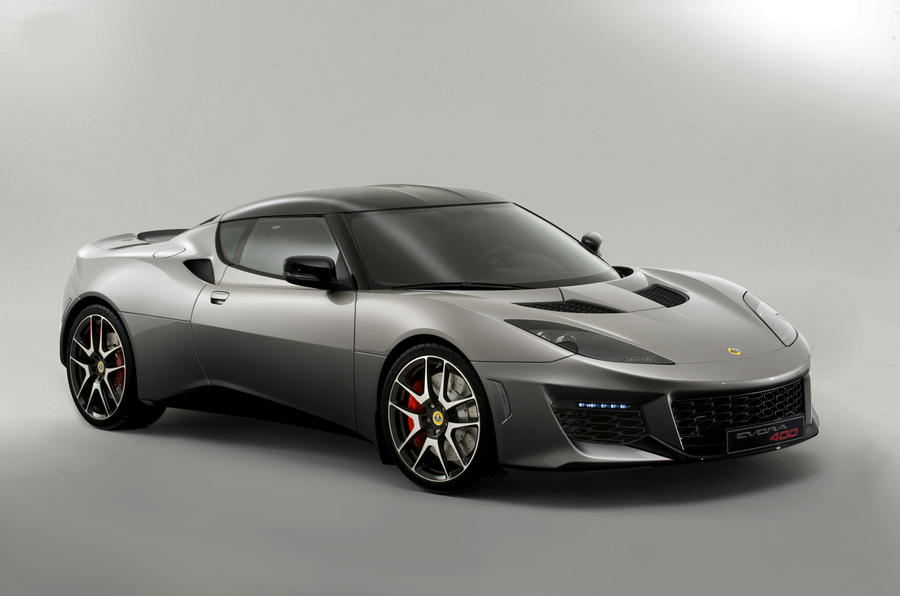
- All new supercar from Lotus
- Fastest and most powerful production Lotus ever
- Lighter and more efficient than before
The new Lotus Evora 400 is the latest pure and focused supercar from Lotus, combining high performance with the legendary Lotus benchmark handling. It is faster and dynamically more capable than the previous Lotus Evora leading to greater agility and a more involving drive.
Maximum speed is 186 mph (300 km/h) and acceleration 0-60 mph is just 4.1 seconds (0-100 km/h in 4.2 seconds). This enables the new Lotus Evora 400 to lap the challenging test track at the Lotus Headquarters in Hethel, Norfolk, a scintillating SIX seconds faster than the previous model.
Over two thirds of the Lotus Evora 400 is new, including its supercharged and charge-cooled mid-mounted 3.5-litre V6 engine producing 400 horsepower and 410 Nm of torque. A new aluminium chassis incorporates a new interior and the lightweight composite body has changed significantly both front and rear.
Following the core values of the company, not only is the new Lotus Evora 400 faster than the previous model, it is also 22 kg lighter, achieved through careful and clever design and attention to detail. This weight reduction is even more impressive considering that the supercar has more power and a higher standard specification than before.
In describing the remit for the new Lotus Evora 400, Jean-Marc Gales, Chief Executive Officer for Group Lotus plc, states, “A requirement for all Lotus cars is to be a benchmark for handling, to be the quickest car from A to B and to provide the driver with a pure and involving driving experience. The Evora 400 is the fastest road-going Lotus that we have ever produced, possessing performance that can only be matched by cars costing significantly more. It delivers supercar looks allied to supercar performance.”
Jean-Marc Gales continues, “We have always said that to make a car better, you must make it faster and lighter. We have achieved this, of course, but we didn’t stop there, as the considerable number of changes in the interior, chassis, engine and body design have warranted emphatically, the title of a new Lotus Evora.
“Our dealer network stands at 168 worldwide, which is still growing to reach 200 dealers by the end of 2015, while our sales volumes have increased by over 50% in the last 10 months. The new Lotus Evora 400 will make its mark as a significant milestone in the history of Lotus.
Looking to the future, the Lotus Evora 400 will remain core to our product line up for many years to come, with more exciting derivatives planned within the next few years.”
The new Lotus Evora 400 will enter production for European markets in the summer and deliveries will commence in August this year. North American markets will receive the Evora 400 as a 2016 model year presentation in the Autumn.
Combined production for all Lotus models, the Elise, Exige and Evora, will increase to 70 cars per week by September 2015 and an additional 150 highly skilled operators and craftsmen and women will be recruited in the next four months to accommodate this rise in production.
Prices will be announced closer to the on-sale date.
The Lotus Evora 400 in more detail:
- Fastest production Lotus ever, laps Hethel SIX seconds faster than previous model
- Aerodynamic downforce of 32 kg at 150 mph (242 km/h)
Engine power has been increased from that of the Evora S; a respected 345 hp (350 PS; 257.3 kW) to 400 hp (406 PS; 298.3 kW) at 7,000rpm. The supercharger fitment ensures strong bottom-end torque and the figure has also been increased to 302 lbs ft (410 Nm) achieved between 3,500 to 6,500 rpm. This translates into even more strident acceleration for a 0-60 mph time of just 4.1 seconds (0-100 kph in 4.2 seconds).
Traction slip thresholds (‘Drive‘, ‘Sport’ and ‘Race’ settings) can be altered via a driver-selectable switch, which allows the driver enhanced vehicle control before intervention is required. Both ‘Sport’ and ‘Race’ settings increase throttle responsiveness.
Its top speed of 186 mph (300 km/h) propels the Evora 400 to the upper segment of supercar performance expectations. The benchmark lap time at the Lotus Test Track at Hethel, has been slashed by a phenomenal SIX seconds due to higher engine power, revised spring and damper settings, a Limited Slip Differential (LSD) and a downforce figure of 32 kg (70 lbs) at 150 mph (242 km/h).
This downforce equates to 12 kg, 26 lbs front; 20 kg, 44 lbs rear, achieved by the Evora 400’s flat-floor, lightweight composite rear diffuser, three-element rear wing and airflow management strategy.
Despite the luxury fittings and equipment expected of a modern supercar, Lotus remains true to its lightweight, dynamic remit and the new Evora 400 tips the scales (unladen) at just 1,415 kgs (3,119 lbs; auto: 1,419 kg, 3,128 lbs), which amounts to a reduction of 22 kg, or 48 lbs (automatic option: 23 kg / 50lbs) from the outgoing Evora model.
- Limited Slip Differential (LSD) as standard for the manual transmission
- Supercharged and charge-cooled 3.5-litre V6 engine produces more power and torque
The new Lotus Evora 400 is powered by a 3.5-litre V6 engine but with a new supercharger, water-to-air charge-cooler and engine management system. Its power output has increased by 16% from 345 hp (350 PS / 257 kW) to 400 hp (406 PS / 298 kW). Torque has increased from 400 Nm / 295 lbs ft to 410 Nm / 302 lbs ft with maximum torque available from 3500 rpm to 6500 rpm.
The power increase of 55 hp comes from supercharger enhancements (volumetric capacity has increased from 1.32 L/rpm to 1.74 L/rpm), the application of a new charge-cooler and engine management upgrades.
While meeting legal pass-by and race track requirements for NVH, sonic changes have been made to the post-cat exhaust system. It features revised muffler internals and a switch that can be driver activated, which allows the exhaust to flow more freely, reducing back pressure under higher engine loads and where conditions allow. A by-product is an unique supercar soundtrack through the three-inches wider, central exiting exhaust pipe.
New engine mounts, which are 5.6 kg lighter than in the previous Lotus Evora, and a revised rear sub-frame have enabled better engine control and improved vehicle dynamics.
A number of manual gearbox enhancements have greatly improved shift quality including a new clutch disc and a low inertia flywheel that ensure swift and tactile gearchanges. For the automatic transmission option, a new shift strategy has been developed, with gearchanges made using the lightweight aluminium paddles mounted to the steering wheel.
For the manual version, a Torsen-type limited slip differential (LSD) has been fitted as standard to the rear axle, which gives a more involving drive and better traction, to produce better lap times.
An additional benefit arising from the improved efficiency is a reduction in CO2 exhaust emissions from 229 g/km to 225 g/km (automatic: 220 g/km down from 224 g/km), which equates to a lower tax band in many markets (subject to Type Approval).
- Lightweight cast and forged wheel options
- New, larger and more powerful brakes
Braking comes from new, more powerful, two-piece, cross-drilled and ventilated brake discs, which are 370 x 32 mm front and 350 x 30 mm rear diameters (previous Evora: 350 x 32 mm front and 332 x 26 mm rear).
Finally, lightweight forged aluminium wheels, 19” on the front and 20” on the rear, are 3.3 kg lighter than the forged wheels on the previous Evora and are now shod with Michelin Pilot Super Sport tyres (235/35x19 91Y front; 285/30x20 99Y rear), which not only increase vehicle stability and grip levels but also enhance the overall quality of the class-leading dynamics package.
The new Evora 400 exudes a visual appeal that is perfectly in line with its supercar status
New front end:
- Bold, purposeful front end and bumper design that incorporates larger cooling apertures and attractive daytime running lamps
New rear end
- New rear bumper, lightweight composite rear diffuser and three-element rear wing
- Two new lighter weight wheel designs (both forged and cast options)
- New door mirror design
The overall effect is of a car with a more aggressive stance, that appears lower, wider and more planted on the road, despite no increase in width compared with the previous Evora. The overall length has increased by 35 mm (1.4 inches) to 4394 mm (173 inches).
The approach angle has been reduced from 11.5 degrees to 10 degrees to aid aerodynamic downforce.
Lotus Head of Design, Russell Carr, was adamant about providing the new Evora 400 with an unique signature.
“We were certain that a more focused and purposeful frontal aspect was essential for a modern supercar,”he outlines. “However, we were also sure that to alter greatly the profile of the recognisable, award-winning, mid-engined Evora design would have been wrong intrinsically.
“Our ambition was to create a high quality innovative design. This was significantly assisted by an integrated digital design process that allows us to translate computer data rapidly into physical models, using our state-of-the-art milling and 3-D printing facilities.”
The front of the car features an evolution of the traditional ‘Lotus mouth’ that balances perfectly the needs for both form and function. The large side intakes not only give the car more road presence but also fulfil the technical requirements to cool the 400 hp engine and increase aerodynamic downforce.
At the rear, a wide and powerful look is combined resourcefully with aerodynamic efficiency.Sharp corner features maximise the width perception and give clean airflow separation. The distinctive three-element wing and new lightweight composite rear diffuser contribute to the impressive 32 kg of downforce at 150 mph.
While there is no increase in frontal area of the Evora 400 (at 1.91m²), thesmall increase in Cd, from 0.33 to 0.35, is due largely to the cooling requirements driven by the huge increase in engine power. However the aerodynamic downforce is greatly increased – it is approximately double that of the previous Lotus Evora at any speed. For example, at 150 mph the downforce is 32 kg (12 kg on the front and 20 kg on the rear) for the Evora 400. The previous Evora S generated 6 kg front and 10 kg on the rear.
- New and revised interior
- Improved cabin occupant entry and exit
A comprehensive round of changes has resulted in an all new interior for the Lotus Evora 400. Designed elegantly and functionally to be both lightweight and of high quality, the interior is a perfect match for the striking exterior of the car.
The high-tech aluminium bonded and extruded chassis has been redesigned to improve both entry to and exit from the new Lotus Evora 400 cockpit. The sills are 43 mm per side narrower and 56mm lower than the previous Evora. The substantial changes to the chassis have been achieved without degradation of either torsional stiffness, which remains at a rigid 27,000 Nm / degree, or bending stiffness of the chassis.
Ingress, egress and cockpit space are further improved with the introduction of higher quality, lighter weight and narrower door inner panels.
All new front seats are lighter (by 3 kg each) and provide greater support for both driver and front passenger. As an option, rear passengers are also catered for, with the rear seats being 280 mm wider than the previous Lotus Evora; weight has been reduced in the rear seats by 3.4 kg.
As a hand-crafted sports car, the bespoke feel is carried across three new trim levels, including trim upgrades in full Alcantara, or Scottish leather, with each featuring specific trim detailing. Apart from the materials used, the new door casings, centre console and more space in the rear support a determined approach to improve both accessibility into and egress from the car‘s cabin.
Both comfort and ergonomics have been improved dramatically, with a new HVAC system that provides greater airflow and operator control, within an all-new dashboard layout.
As befits a driver orientated car, the cabin features a lightweight forged magnesium steering wheel with a red race-inspired position stripe and a revised instrument cluster that possesses simple clear dials (white on black graphics). Switchgear haptics and ergonomics have also been improved significantly, the latter through location to the upper-central dashboard and,for the first time, a new engine start-stop button has been fitted to the Lotus Evora 400.
A high-end in-car entertainment system is standard, with the latest, lightweight and slim-line door speakers being fitted within the new door casings, while A-pillar incorporated tweeters improve the sound reproduction quality.
- Hand built at Hethel, England
- High quality and efficient manufacturing process
The new Lotus Evora 400 will be manufactured at the Lotus Headquarters in Hethel, Norfolk. Three hundred trained and highly skilled operators and craftsmen and women (rising to 450 in the next four months) assemble the cars by hand and every car built is road tested. Huge strides have been made to improve efficiency over the last few months resulting in a 10% reduction in the build cycle time.
Weight reductions have come from all over the car primarily through attention to detail. It is the Lotus approach – brackets designed precisely, correct material selection and, wherever possible, a reliance on multi-functionality. All Lotus staff at Hethel are given the opportunity to contribute to reducing the weight of each Lotus model within the Lotus ‘Lightweight Laboratory’, where every component is scrutinised to determine where “lightness can be added”.
To accommodate the expected worldwide demand for the new Lotus Evora 400, total production of Lotus cars is planned to increase to 70 cars per week by September 2015. Current build volumes are around 45 cars per week.
- Global expansion of dealer network
Lotus has 168 dealers globally at present: 14 in the UK, 49 in Mainland Europe, 49 in North America, 20 in Japan, 8 in China and 24 in other markets. Since May 2014, 30 new dealers have been recruited and it is planned to further increase the Lotus dealer network to 200 dealers by the end of 2015.
Lotus remains agile in its thoughts, actions and its products. Thanks to a dedicated, skilled and enthusiastic workforce, it is able to maximise its potential at every stage of its operations. The substantial structural and material changes made to create the exciting new Evora 400 underpin the company’s intrinsic aims of lightness, super-efficiency, high performance and purity of driving pleasure.
Jean-Marc Gales states: “Our ten month sales figures showed a volume increase of over 50%, with the majority of markets increasing sales over the previous year. The new Lotus Evora 400 joins the Elise range, with the new S Cup grabbing the recent motoring media headlines, and the Exige S, enhanced with an exciting new automatic option, sharing the growth in numbers. Our strategy is being borne out.
“Wework to maintain the lightness, purity and performance of our products as, at Lotus, we love our cars and we know that our customers do too. The Lotus Evora 400 is a pinnacle of achievement but we shall continue to aim higher in the months and years to come.”