Purpose

I will try my best to provide detailed info on various cars and what is like to live with them, I have already produced a few for Jaguar-car-forums, I will do my best to be unbiased, but it will be hard for some cars. I will re-produce press releases and copy from other motoring news.
Showing posts with label fifty Years. Show all posts

Tuesday, 16 August 2016

On 17 August 1966, the Volvo 144 was launched and it became the first Volvo to break the million unit barrier.

On 17 August 1966, the Volvo 144 was presented in the midst of an ongoing manhunt. With this new model series, Volvo could develop into a considerably bigger car maker. In eight years, no fewer than 1.25 million cars were produced – creating Volvo’s first million seller.
Almost four hundred journalists were in attendance at the Lorensberg function rooms in central Gothenburg on 17 August 1966. The new Volvo 144 was to be presented, unveiled by raising a dividing wall behind which three pre-series models of the new Swedish car were waiting. 
Rumours about Volvo’s new model had been circulating for several years and what the press now finally got to see was an austere and modern vehicle. Parallel to the unveiling in Gothenburg, the new model was also revealed in Oslo, Copenhagen and Helsinki.

The cars used at the press show in Gothenburg had been lifted into the premises the evening before by crane, hidden in large wooden crates. Naturally, the entire procedure was supposed to be as discreet as possible, but this proved difficult since a major manhunt was underway to catch two police killers. 
A nationwide alert had been issued and as the wooden crates were being lifted into the function rooms, the police received a tip-off that both fugitives may have been in the audience at the adjacent cinema, which had to be evacuated.
Back in June 1960, Volvo’s management – with CEO Gunnar Engellau at the helm – made the final decision on the basic directive for the new car. The P660, as the project was designated, was to be larger than the Amazon, but of the same weight and price class. 
It was to fulfil strict safety requirements and comfortably carry four or five people. Moreover, the car was to have the same wheelbase as its predecessors, the PV 544 and the Amazon. 
Unlike when the Amazon was developed, several different chassis versions were planned from the start.
With the 140 series, Volvo introduced a naming scheme in which the first digit designated the model series, the second digit the number of cylinders and the third digit the number of doors.
Mass production of the 144 started two days after the presentation, on 19 August 1966. In 1967 the two-door 142 was launched, and in 1968 production of the 145 estate began. A closely related model was the 164, which was launched as the 1969 model. 
It shared many chassis components with the 140 series, but had a 10 cm longer wheelbase and a longer front to fit the straight six-cylinder B30 engine. Yet another chassis version was launched in 1970. 
This was the spacious load-carrying Volvo 145 Express, on which the roof was raised from the B pillar and back.
Chief Designer Jan Wilsgaard was also the man behind the Amazon’s elegant lines and, despite the differences, likenesses can be seen between the models. There was a strong desire for a grille design reminiscent of the Amazon’s. 
The shoulder that widened the doors below the side windows was also similar to that on the Amazon, although on the 144 this feature was even more pronounced. Like the Amazon, the 142 and the 144 had vertical tail lights.
The 140 series was well suited to the ideals of the 1960s, giving precedence to function. It had a spacious interior and large windows. Scandinavian design, with its clean and simple lines, is a popular approach today and the 140 series is a prime example of its expression.
The 140 series entailed several important advances in both passive and active safety. The chassis was extremely resilient to twisting and was fitted with crumple zones and a protective roll cage. 
The brake system was advanced with disc brakes both front and rear together with a dual-circuit system with twin hydraulic circuits at the front. 
This provided a three-way partitioning of the circuits, so that if one circuit failed both front brakes and one rear brake would still function. 
What’s more, there were reducing valves to prevent the wheels locking during heavy braking, a solution first employed by Volvo. A split steering column and a dashboard with a collision-protected frame were other safety features. 
Later, the 140 series was also fitted with headrests, retractable seat belts and seat belt reminders as standard.
The Volvo 140 series had a conventional design with a front-mounted engine and rear-wheel drive. Initially, the series employed the tried and tested 1.8-litre four-cylinder B18 engine from the Amazon, producing 75 hp DIN – or 96 hp DIN with twin carburettors. 
The 1969 model had the 2-litre B20 engine, producing 82 hp and 100 hp DIN respectively. As of the 1971 model, there were also versions with electronically controlled fuel injection, producing 120 hp DIN.
When production of the 142, the 144 and the 145 came to an end in the summer of 1974, 1,251,371 cars had rolled off the production line. The model series became the company's first million seller and helped further Volvo’s position as an international player. 
The legacy of the 140 series is, however, greater than this, stretching all the way to 1993. Its replacement, the Volvo 240, borrowed much from the 140 series chassis and went on to become Volvo’s most mass produced model, with some 2.8 million cars in 19 years.

Thursday, 9 June 2016

McLaren to showcase over 50 years of experience and race winning know how to this years Goodwood Festival of Speed.

  • Track-only McLaren 570S Sprint to make global dynamic debut
  • Examples of the three tier McLaren model Series to take to the famous Goodwood Hill run
  • McLaren to honour key motorsport milestones in Indy 500, Formula 1™ and Can-Am
McLaren Automotive will return to the Goodwood Festival of Speed this summer celebrating race wins and titles spanning more than five decades. McLaren will honour the drivers and championships where the team has claimed the top step of the podium, in the ultimate expression of ‘Full Throttle – The Endless Pursuit of Power’
McLaren House will once again return to the lawns of the Goodwood Estate, with iconic racers displayed alongside the full range of modern-day McLaren models in the Sports Series, Super Series and Ultimate Series. 
The broad selection of models, spanning more than 50 years of the McLaren name, will be the most extensive display of McLaren models ever showcased, including the new 570GT.

As in previous years, McLaren will also be present in the Supercar Paddock with models from each of the three tier range. 
The recently announced track-only 570S Sprint will make its global dynamic debut on the famous Goodwood Hill alongside the 570S CoupĂ© from the Sports Series, while the 50th anniversary of the Can Am championship will be celebrated by the 650S Can Am by MSO, joined by the sold-out 675LT Spider representing the Super Series. 
The McLaren P1™ GTR completes the line-up. As the most powerful McLaren ever built, the Ultimate Series model is the true reflection of an endless pursuit of power.
The 2016 season is a key anniversary for motorsport, and McLaren in particular. milestones of note include the 50th anniversary of the Can-Am series, the 100th running of the Indy 500, 40 years since British racing legend James Hunt’s dramatic Formula 1™ title and 30 years since Alain Prost claimed his second world title. 
The results – each a major achievement in its own right – have contributed to the rich tapestry of racing history, and forms part of the heritage of the most successful team in global motorsport.
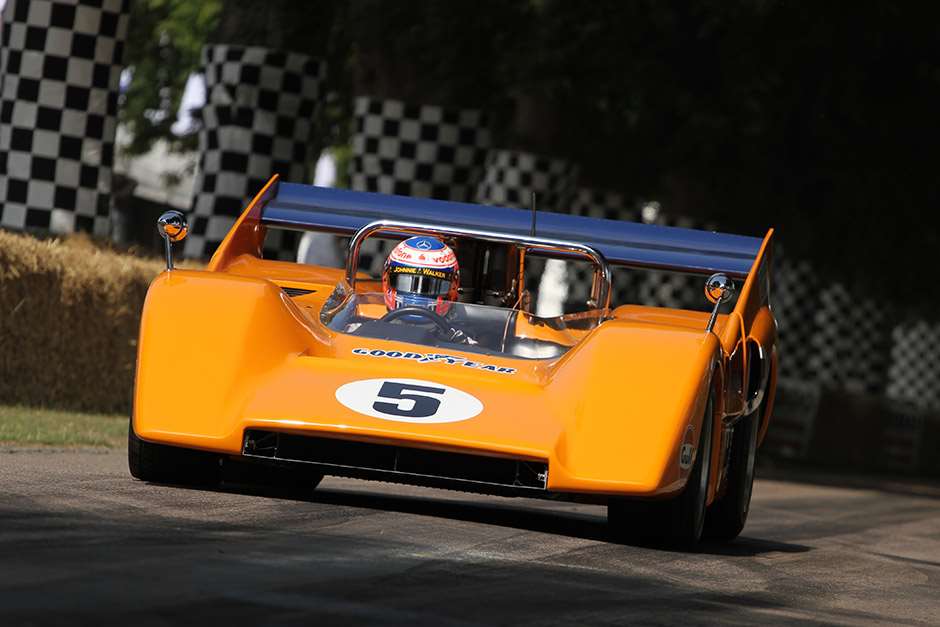
The brutal McLaren M8D from the 1970 season, finished in iconic McLaren Orange heritage livery, celebrates the 50th anniversary of the no-holds-barred Can Am series of the 1960s-70s. 
Revered as the ultimate test of engineering and bravery, the series established McLaren as the team to beat, claiming five back-to-back championships led by New Zealand-born racer and team-founder Bruce McLaren.
2016 marks the 100th running of the Indy 500, a race which McLaren has been victorious at on three separate occasions. The debut for McLaren at the famous ‘Brickyard’ was with the Gordon Coppuck-designed M15 in 1970. 
The design used the single seater Can-Am sports car experience in chassis layout and conception, winning the prestigious designer’s award for engineering excellence.
Representing 50 years since McLaren entered the Formula 1™ championship is the MP4-2C from the championship-winning 1986 season. Driven by Alain Prost and Keke Rosberg, the MP4-2C is the final iteration of the most successful chassis ever raced in Formula 1™. During 1986, Prost claimed four race victories on his way to his second Drivers’ Championship title.

Sunday, 15 February 2015

AUDI hits the Two Million milestone in the UK after 50 years.

Fifty years after its first domestic delivery Audi UK has registered an A3 Sportback plug-in hybrid as its two-millionth car sale
  • First Audi model codenamed F103 reached the UK in 1965, when the brand sold just 32 cars
  • Two millionth car sold by the UK importer is an A3 Sportback e-tron plug-in hybrid
  • Sales success achieved through more than two decades of strong and virtually unbroken growth –  2014 was no exception with a record 158,987 sales
When just 32 cars bearing the four rings found homes in the UK in 1965, it would have seemed improbable that an incredible two million more would follow, but this major milestone has today been reached by Audi UK almost fifty years later.

The first four-ringed car sold to a UK customer was a ‘compact executive’ in a model range of just one, internally codenamed the F103 and publicly known simply as ‘The Audi’. It was to be the springboard for a range that in 2015 numbers some 51 model types ranging from subcompact city cars to ten-cylinder supercars, and which has recently welcomed the A3 Sportback e-tron, the brand’s first ever plug-in hybrid and the two millionth car to be handed over to a UK customer.  


As parent company Audi AG edges ever closer to selling two million cars globally in a single year – around 1,741,000 cars were delivered to customers worldwide in 2014 – its UK importer has just cumulatively broken through the two million barrier buoyed by more than two decades of recession-resistant sales strength, during which time its trajectory has been upward in all but three years. From a base of just 14,344 cars in 1991, the brand exceeded 100,000 annual sales for the first time in 2007, and in 2014 posted a total of 158,987 deliveries. 

Director of Audi UK AndrĂ© Konsbruck marked the momentous occasion by saying: “It’s hugely gratifying for the team in the UK to reach this significant milestone in the brand’s history in the UK, but it’s the contributory figures lying behind the headline number which really speak volumes about our recent past and our future aspirations. 

Domestically the brand has risen from humble beginnings in the Sixties to become the leader in the premium segment, and the last two decades have delivered virtually constant, and in all but three years record-breaking, growth. These are really robust foundations on which we plan to build consistently and substantially with the help of an ever expanding portfolio of models.”

Ingolstadt born and bred

‘The Audi’ which projected the green shoots of this abundant growth was built by Auto Union AG, the conglomerate whose emblem contained a ring representing each of its four constituent companies Audi, DKW, Horch and Wanderer. 

It was assembled at the company’s Ingolstadt plant in Bavaria, Germany, which remains the headquarters of the modern day Audi brand to this day, and it was the first car to leave the production line with a four-stroke engine rather than the more commonplace two-stroke design. In terms of horsepower, the 1700cc engine produced 72PS, a fraction of the 570PS available in the most powerful production Audi to head the current range – the limited edition R8 LMX. 

Priced at £160,000 OTR, its 5.2-litre V10 powerplant is capable of propelling the supercar to 62mph in just 3.4 seconds and on to a top speed of 198mph.

Available as a two-door ‘coupĂ©’, four-door saloon or estate, ‘The Audi’ was essentially the precursor to the Audi 80 and 90, which went on to form the conceptual basis of the A4, the compact executive saloon which sparked a revolution for the Audi brand in 1995 and began to decisively cement its position as a fully fledged member of the premium sector establishment.

Two million cars further down the line, the model that has posted the milestone for Audi UK combines a conventional 1.4-litre TFSI petrol engine with an electric motor to deliver the potential for up to 176mpg with CO2 emissions of just 37g/km.

The latest electric plug-in hybrid variant of the Audi A3, which was crowned World Car of the Year in 2014, can run exclusively on electric power for up to 31 miles at speeds of up to 80mph, or can be powered by petrol combustion alone. When the two power sources are combined, an overall operating range of up to 584 miles is possible. The battery powering the electric motor can be charged by plugging the A3 Sportback e-tron into a home wallbox for as little as two hours and fifteen minutes.