Five-door prologue Avant concept builds on future brand design foundations laid by the prologue coupé concept
- New interpretation of Audi Avant philosophy
- Groundbreaking infotainment architecture and entertainment concept
- High-performance hybrid drive with 455 PS and 750 Nm (553.2 lb-ft) of torque
A design with dynamic elegance and the latest high end technologies: Audi is presenting the new prologue Avant show car at the Geneva Motor Show, which gives another glimpse into the future of Audi design just four months after the premium manufacturer showed its visionary Audi prologue coupé concept at the LA Auto Show.
The Audi prologue Avant combines dynamics, form and function in a perfect synthesis. It brings progressive technology, lightweight construction and permanent all-wheel drive quattro together. The large five-door car with its stretched roof and extremely flat D-pillars combines power and flowing elegance, and its design reflects these Audi quattro genes.
At a glance, the new show car can be recognised to be an Audi – with its athletic build, taut surfaces and sharp edges. The Audi prologue Avant picks up on the tradition of the extraordinary design and space concepts, for example, of the proto Avant from 1982, and re-interprets this design. With a length of 5.11 metres, a wheelbase of 3.04 metres, a width of 1.97 metres and a height of 1.4 metres, the Audi prologue Avant is a little larger than the two-door coupé Audi prologue. Four individual seats, four doors and a large tailgate round off the concept.
“With our show car for Geneva, we now translate the design language of the Audi prologue into a new, dynamic and stretched form. We are merging it with a concept of high variability,” says Board Member for Technical Development, Prof. Dr. Ulrich Hackenberg. “The Audi prologue Avant is progressive, emotion-filled and versatile, it reflects Audi’s technological competence and quality claim perfectly.”
Wide and flat: the front
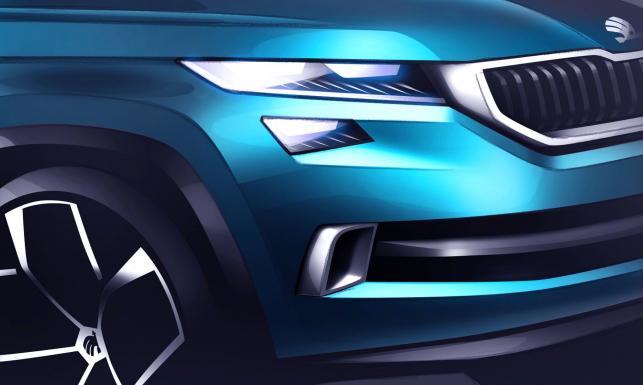
The Singleframe grille organically integrated into the car body dominates the show car’s low front. It is positioned lower and is designed much wider than in current production models. Its cross ribs made from brushed aluminium present a new variant of the e-tron look, providing a closed visual appearance.
Towards the sides, they are slightly bent and forked.
The headlamps underline the character of the show car – lightweight, dynamic and elegant. Shaped like wide, flat wedges, the headlamps are located with their tips above the Singleframe. They present the high-resolution Matrix Laser technology – the latest light innovation by Audi opens up new opportunities in design and technology. The light is decomposed into a high number of tiny pixels, resulting in virtually unlimited distribution possibilities.
The upper and side edges of the characteristic air inlets are accentuated using additional light guides which in combination with daytime driving light give the Audi prologue Avant a new light signature.
Strong flow: the side view
The side view of the show car conveys an athletic effect, conveyed by extremely flat D-pillars. Its proportions emphasise the front and the rear wheel alike – and give an indication of the Audi quattro genes.
The wide, folded-out shoulders above the four wheels are inspired by the “blisters” of the Audi proto quattro dating back to the eighties. However, they were not just added on top with separate contours but have been smoothly integrated into the architecture. The shoulders swing smoothly over the wheels. The front shoulder carries on the edge of the bonnet, thus making it appear even longer. The long rear door emphasises the luxury class character of the show car.
The wheel houses are strongly vaulting out and carry wide wheel mirrors, thus visually reducing the metal volume of the flanks. They surround the mighty 22-inch wheels carrying size 285/30 tyres. Their five arms with the edged, sharp-angled spokes present a further development of today’s rotor design.
The dark blue paintcoat in fusion blue underlines the elegance of the show car in a subtle way.
The outside rear-view mirrors are small sculptures made from aluminium, the window channel strips unostentatiously integrate the sensor surfaces towards the door opening. As soon as the driver touches the illuminated surfaces, electric motors will open the handle-less doors.
A frame made from polished and matt aluminium surrounds the side windows. The rear wings of the show car accommodate the charge socket for electric charging on the left side, the fuel filler flap for diesel fuel on the right side. By the press of a button in the interior, the cover flaps will open electrically, retracting into the body.
Dynamic: the rear
The flowing rear moving in strongly on the side is one of the most attractive views of the show car. The flatly arranged D-pillars sweep elegantly into the rear body shoulder which forms the edge of the luggage compartment lid and surrounds the entire rear section. The rear section itself is leaning forward in the direction of travel like a yacht – pushing off the car before it even starts moving.
The rear lamp strip runs across the full width of the car, thus combining the LED rear lamps.
They consist of 3D glass which has a sculptural effect. At their bottom end, the rear light draws a wavy contour. Deep inside the lamps lies the brake light – when it becomes active, it appears to approach the viewer. The different design levels and the change between two-dimensional and three-dimensional effects give the rear lamps an entirely new dynamic.
As a logical continuation of the side sills, a distinctive apron completes the rear section towards the bottom. On either side it integrates flat horizontally split openings with a wedge-shaped cut. The exhaust gas of the TDI engine comes out through the upper openings, and the struts immediately below are evocative of the Singleframe grille – this solution symbolises the e-tron concept of the show car: combustion engine and electric motor in one car.
“With the Audi prologue, the prototype meter of our new design language, we have clearly pointed the way in aesthetics. Now we are going one step further by presenting a concept which combines aesthetics, dynamics and function in a fascinating way,” describes Marc Lichte, Head of Design at Audi. “The progressive body design expresses our technological competence and reveals the values which render our brand unique: sportiness, high-quality, progressiveness.”
Elegant experience: the interior
The luxurious interior is kept in dark shades. Here as well, the show car offers a new experience: The straight-lined architecture forms one whole with its display and control concept.
The consistent front of the dashboard is composed of three touch displays. Moreover, the driver and up to three passengers can establish a digital communication via two OLED-displays made from organic LEDs. The extremely slim, detachable OLED displays in the rear – a spin-off of the Audi tablet from the new Audi Q7 – provide passengers with on-demand information and entertainment.
The spacious interior of the Audi prologue Avant has the character of a luxurious lounge.
Sinewy taut, calmly flowing lines and slender geometric bodies convey a feeling of expanse, lightness and tranquility. The long centre console with its pass-through also appears to hover, as do the slender front seats, whose rails are mounted on the tunnel and side sills.
The instrument panel stretches horizontally from one side to the other, thus creating a wide impression in the interior. It lowers itself towards the driver and the co-driver on two levels. The upper level, like a roof, lies over the Audi virtual cockpit future and the wide air vents. It forms part of the wrap‑around encompassing the interior and luggage compartment like a horizon.
Both rear passengers can enjoy individual seats with a spacious ambience.
All of the interior details demonstrate Audi’s high-quality design and uncompromising claim. A perforated trim panel covers the air vent; it moves down as soon as the air conditioning is set higher. The newly designed flat shift‑by‑wire selector lever for the eight-speed tiptronic is smoothly integrated in the centre console.
Three-part display: the instrument panel
The elegant design architecture of the Audi prologue Avant show car blends in with a game-changing, new display and control concept enabling digital interaction between the driver and his passengers. Across its full width, the front of the dashboard is designed as a display surface which integrates three touch displays.
Large aluminium frames surround the two driver-faced displays left and right of the steering wheel. The left one serves to control the assist functions, the right one is for multimedia management.
The front passenger faces a widescreen display that is integrated into the full surface of the instrument panel; it is used to configure entertainment features individually and conveniently.
With a wiping movement, the front passenger can send media content such as music playlists to the right driver display or navigation data to the Audi virtual cockpit behind the steering wheel.
On the console of the centre tunnel, there is another display for text entry, air conditioning and infotainment designed for the driver. It consists primarily of an extremely thin, bendable OLED film (OLED: organic light emitting diodes), and it displays extremely sharp images that are rich in contrast. When inactive, the OLED display is in a flat retracted position; as soon as the vehicle is started, it moves up at an angle. The curved display ensures a constant ergonomic distance to the driver’s hand, their wrist calmly resting on the eight-speed tiptronic selector lever.
Within the driver’s field of view lies the Audi virtual cockpit future. High-resolution displays and three mirrors generate a virtual visual stage with three levels. In the navigation view, for instance, the first level presents information that is important for driving; levels two and three generate the depth effect in the cockpit. Thanks to this staggered approach, information is structured better and is easier to grasp. According to driving style, content and colours will change in the Audi virtual cockpit future, for instance, when the display changes to sport mode.
Comfort and entertainment in the rear provided by OLED technology
The rear passengers in the Audi prologue Avant use a flexible OLED display integrated in the centre console which due to its bendable structure adapts its angle to the rear seat backrests’ angle of inclination. Using this display, settings such as seat adjustment, climate control, audio/video and ambient values can be controlled in the back of the car. Moreover, passengers can exchange data with the driver.
When inactive, the OLED display lies flat in the centre console. As soon as rear passengers get into the car, it moves up at an angle. As with the OLED display in the front of the car, the curved display in the rear also ensures a constant and ergonomically ideal distance to the passenger’s hand.
When the audio system is active, a sound spoiler moves out of the rear wheelhouse panellings, homogenously distributing music in the interior in high-end quality.
The two Audi tablets mounted to the backrests of the front seats – also with OLED technology - are highly slender and slightly curved. They can be unclipped and then be operated outside of the car.
From the moment of getting into the Audi prologue Avant, the driver and the passengers can experience first-class comfort. The “butler” – an innovative, intelligent software program – identifies them based on their smartphones and adjusts the seats and climate control system according to their preferences. The system also makes suggestions for music and route planning based on the owner’s preferences. Mobile phones can be placed in the two Easy Slot systems integrated in the centre tunnel console. There they are linked up with the vehicle infotainment system and inductively charged.
Authentic: materials and colours
Colours and materials in the Audi prologue Avant emphasise the impression of comfort and elegance. The upper instrument panel is coloured in lifestyle blue, the bottom instrument panel, the seats and the carpet are designed in elegant sarder brown.
In the interior, aluminium trim elements add powerful visual highlights. The spokes of the steering wheel, the frames of the driver displays, the door inserts and the mountings and switches of the seats are made from that material. On the wrap-around, the doors and the centre tunnel console, they create a contrast with the panels out of open-pore, dark ash wood veneer.
Various surfaces such as the seats, dashboard and centre tunnel console are upholstered with the very natural Unikat leather. A generously dimensioned strip of Alcantara leather leads the eyes from the door inserts over the armrests back and into the luggage compartment. Artfully designed perforations in the seat centre line are evocative of the Singleframe grille bars.
Very close to series production: the technology
The plug-in hybrid drive of the Audi prologue Avant is almost identical to the powertrain in the Audi Q7 e-tron quattro which will be launched in summer 2015. The 3.0 TDI engine installed in the Audi prologue Avant outputs a maximum of 353 PS, and a powerful electric motor integrated in the eight-speed tiptronic contributes up to 100 kW. System output is 455 PS, while system torque is 750 Nm (553.2 lb-ft).
The eight-speed tiptronic directs engine power to the quattro permanent all-wheel drive ensuring superior drive characteristics in any situation.
The show car accelerates from 0 to 62 mph in 5.1 seconds. Its top speed is limited to 155 mph.
The Audi prologue Avant is capable of returning up to 176mpg combined according to the NEDC standard for plug-in hybrid vehicles – corresponding to 43 grams of carbon emissions per kilometre. The lithium-ion battery pack in the rear storing 14.1 kWh of energy gives the car a range of 33.6 miles in pure electric drive mode.
With its AWC (Audi wireless charging) technology which Audi is developing for series production, the battery can also be charged inductively. AWC technology provides energy from a floor plate which is connected to the power grid and which can be embedded on or into the asphalt. This plate integrates a primary coil and an inverter (AC/AC converter). When active, this coil induces a magnetic field of alternating current. On the basis of state-of-the-art technology, Audi uses 3.6 kW of power as provided by a wall socket with a maximum of 16 amps of charging current.
Comfort and athleticism combined: the chassis
The chassis of the Audi prologue Avant is also packed with high-end series production technology. The adaptive air suspension sport – an air suspension system with controlled damping – offers a wide spread between smooth power transmission and tight handling. Front and rear axles are lightweight five‑arm wishbone constructions. The 20-inch brake discs are made from carbon fibre ceramics.
The dynamic all-wheel-drive steering system resolves the classic conflict between dynamic handling and stability. The system combines a dynamic transmission steering system on the front axle with an additional steering system for the rear wheels where an electric motor actuates two tie rods.
When the driver steers at low to moderate speeds, the rear wheels turn up to five degrees in the opposite direction of the front wheels. This gives the responsiveness of the car a further boost and reduces its turning circle. At higher speeds, the Audi prologue Avant handles swerving very calmly and with superior reliability: in such a manoeuvre, the rear wheels turn in the same direction as the front wheels.
New approach for Audi Avant at Geneva – The Audi prologue Avant will be unveiled next week at the 2015 Geneva Motor Show, showcasing pioneering infotainment technology and hybrid quattro performance wrapped in a slender five-door body that reinterprets the prologue show car originally shown in Los Angeles.