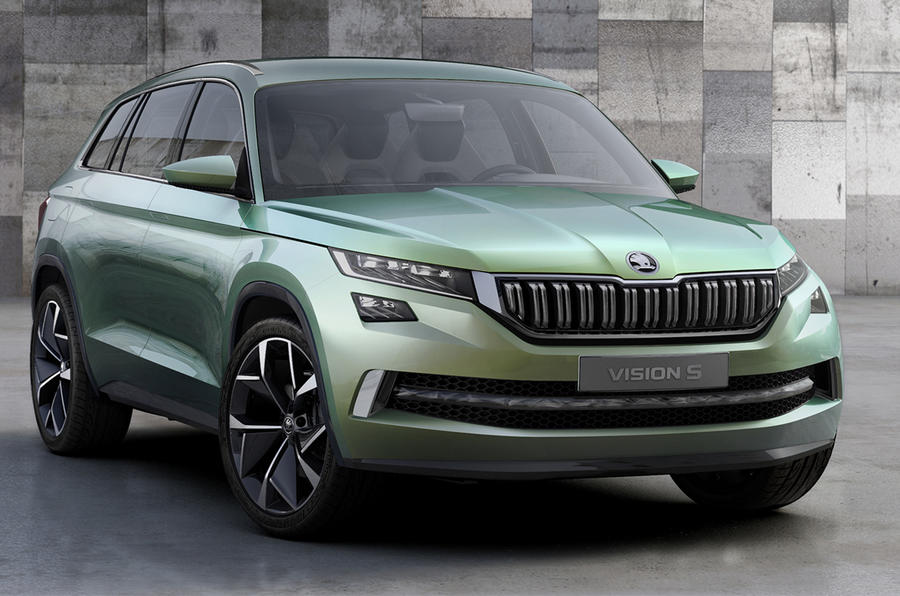
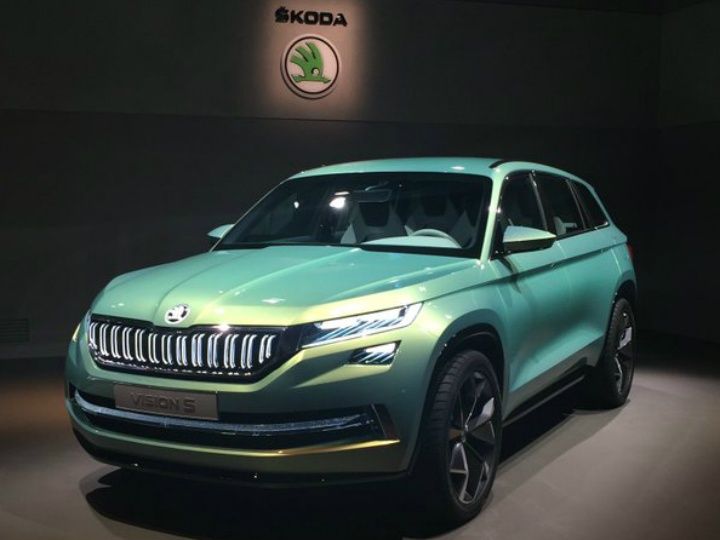
- The ŠKODA VisionS concept car gives an insight into future SUV models
- Expressive, emotive design with a high level of creative precision
- Overall package: 4.70 metres long, large interior, three rows of seats
- ŠKODA’s concept car is a plug-in hybrid
- ŠKODA ‘Simply Clever’: new operating concept with large displays
- Wide range of infotainment and top-level connectivity features
- In future, ŠKODA will further expand its expertise in the area of automated driving
ŠKODA is taking the next step in the brand’s model campaign: in the coming years, the Czech car manufacturer will be gradually expanding its offering in the SUV segment.
The ŠKODA VisionS concept car gives an insight into the future SUV above the Yeti, which will be presented in the second half of 2016. Besides the future SUV design language, the show car reveals the most important technological innovations that ŠKODA will be placing an emphasis on in the coming years.
“Our brand continues to develop at a rapid pace,” said ŠKODA CEO Bernhard Maier. “With the Yeti, ŠKODA has already made a big statement in the compact SUV segment. Our extensive 4×4 expertise is now feeding into an SUV production model above the Yeti. In terms of design, overall package and everyday practicality, the ŠKODA VisionS already provides an insight into our new SUV.
The show car also exhibits a variety of future technological advances that are becoming more and more important to our customers and therefore to ŠKODA. This is why we are also working on areas such as electromobility, automated driving and the comprehensive networking of car, driver and passengers with their environment.”
The ŠKODA VisionS: setting off into the future
Over the course of its growth campaign, ŠKODA has already extensively updated its model range, expanded into important segments and greatly increased its international market presence. With the future production model above the ŠKODA Yeti, which will be presented in the second half of 2016, ŠKODA will announce its aim to demonstrate the brand’s expertise in all important vehicle segments. The technological prowess and distinctive design language that ŠKODA has developed are now passing over into the brand’s SUV models – with maximum benefits for ŠKODA customers, as always.
In addition to the brand’s proven functionality and new emotive quality, there is now also an increased focus on the use of technological innovations: the VisionS show car features plug-in hybrid drive, a drive system similar to those that will be used in future production cars. Furthermore, ŠKODA is also working on a purely electric drive system.
In terms of connectivity, the ŠKODA VisionS is also pointing the way: the comprehensive networking of car, driver and passengers will make driving a car even safer, as well as providing a more comfortable and confident ride.
Automated driving is another future concept for the brand. Today, drivers of ŠKODA models already enjoy the benefits of systems such as Traffic Jam Assist and Front Assist with integrated City Emergency Brake, which increase safety and comfort. In the future, extending the range of driver assistance systems will play a key role in the brand’s innovation strategy – up to automated driving.
The ŠKODAVisionS: the overall package
With a length of 4.70 metres, a 2.79-metre wheelbase, a width of 1.91 metres and a height of 1.68 metres, the ŠKODA VisionS is a real presence on the road. Based on Volkswagen Group’s modular transverse matrix (MQB), this is the first ŠKODA with six seats spread over three rows.
The interior is ‘democratic’: every person in the car enjoys first-class comfort – the driver as well as the five passengers. There is plenty of head, leg and elbow room for two adults in each of the first two rows of seats. The third row is designed for a further two people.
Depending on the position of the seats, the boot has a capacity of up to 460 l, and is effortless to load thanks to its flat floor, low loading sill and high-lifting tailgate. ‘Simply Clever’ features such as bag hooks make using the ŠKODA VisionS easy and enjoyable.
The exterior design: emotive yet robust
Two years ago, also at the Geneva Motor Show, ŠKODA presented the VisionC design study and thereby its new design style that underlines the brand’s emotive strength: the Fabia and Superb were the first production cars in this style. ŠKODA is now applying its modern design to the SUV segment. “
The VisionS is designed in an expressive, attractive and dynamic way; the design has a balance – typical for ŠKODA – of rationality and aesthetics,” said ŠKODA Head of Design Jozef Kabaň. “The lines of the ŠKODA VisionS have evidently been inspired by the tradition of Bohemian crystal glass art and a touch of cubism: all sections are precise, sharp and clean-cut.
On the strikingly contoured surfaces, the distinctive play of light and shade creates strong effects that are emphasised even further by the colour Iceland Green.”
Just by looking at the front of the ŠKODA VisionS, the brand’s design identity is clearly visible. Double horizontal lines symbolise protection and strength. The bonnet is extensively sculptured; the edges, that provide the structure, lead to the large, prominently positioned brand logo.
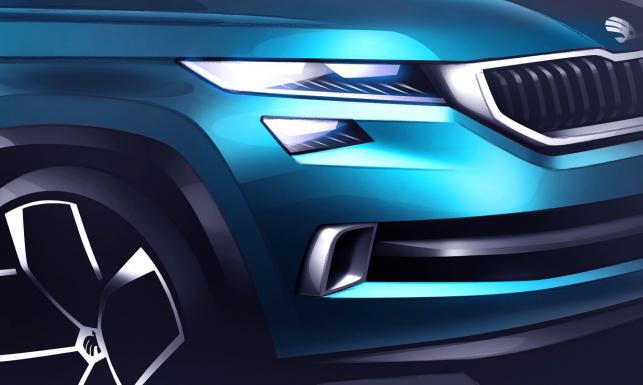
The wide, trapezoid ŠKODA grille with upright struts shape the face together with the four flat, raked, highly-set headlights – their LED technology will shortly go into series production.
There are four lighting units in each of the upper headlights for high and low beam; their reflectors give the impression that they were the eyelashes of a human eye. The signature daytime running lights complete the main headlights; the lower units provide the fog lights.
The headlights as well as the brand logo and the vertical struts in the grille are characterised by crystalline design features – also a ŠKODA design tribute to Czech glassmakers.
The side view also illustrates the show car’s robust SUV character. The sharply drawn and greatly recessed tornado line starts at the upper lighting units and stretches across the powerful bodywork.
The wheel arches, framed by wide angular trims; the elegant upper shoulder contour forms a deep waisting across the door sills. The sloping roofline and the tapered rear end make the show car appear as if it were accelerating even when stationary. The long wheelbase alludes to a large interior.
The rear of the ŠKODA VisionS is sculpturally shaped. The number plate recess tapers rearwards; a powerful diffuser inset, which surrounds the large, elliptical exhaust pipes, provides the SUV show car with a strong visual stance on the road. The rear window, underneath a long spoiler, is kept narrow and sporty, without compromising the view through the back.
The ŠKODA brand logo and the raked LED rear lights sit below the rear window. Their lenses,made from dynamic and multifaceted cut crystal glass, integrate small spoiler lips, which improve the outline and aerodynamic flow. The headlights feature LED units.
The ŠKODA-typical C-shape starts with the rear lights and continues to the flat reflectors positioned within the rear bumper.
Interior: transparent and neat
Bright, transparent and spacious – the exterior’s clearly structured and streamlined high-quality design continues in the interior. In line with the brand’s design criteria, the concept car’s interior has a ‘democratic’ character: equal priority is given to all occupants. The space is divided symmetrically.
The second screen in the ŠKODA show car is a novelty for the brand: the straight instrument panel is designed for the front seat passenger as well as for the driver. At its front, the two large, flat 16-inch displays stand out as striking geometrical objects. Vertically positioned air outlets surround the displays.
Totally in line with the brand’s Simply Clever motto, ŠKODA is working intensively on practical, user-friendly operating concepts for future production cars. ŠKODA’s VisionS concept car is providing a first glimpse into what the future conveys in this regard.
All occupants have their own display, each of which can be operated in the simplest of manners. Information is purposefully processed for driver and passengers, and access to the infotainment is optimised for each participant. In the coming years, ŠKODA will introduce freely programmable multifunction displays in its production cars; at the same time, the brand is also working on the use of voice and gesture commands.
A third display is located in the centre console of the ŠKODA VisionS; the displays for the passengers in the second and third row of seats can be found in the head rests. A Phone Box is integrated into every door, where the passengers’ smartphones can be charged inductively; each individual can access their personal settings and the smartphone’s data and information, using their own display.
Fine, light-grey Nappa leather with dark-blue leather patterns combined with Ultrasuede emphasise the interior’s classy look. Dark blue dominates the upper regions; seat covers and armrests come in light grey. The logo on the steering wheel hub, parts of the centre console and the sculptured trim strips in the doors are made from hand-cut Czech crystal glass. The ambient lighting in the interior provides effective highlights; there’s a choice of ten different colours.
ŠKODA is electrifying: the plug-in-hybrid ŠKODA VisionS
ŠKODA is working at full speed to launch electric production cars: in future, a plug-in-hybrid engine will be available, followed shortly afterwards by a purely electrically powered engine.
The ŠKODA VisionS provides a glimpse into the Czech manufacturer’s electric future: with a power output of 165 kW (225 PS), the show car accelerates from zero to 100 km/h in 7.4 seconds and has a top speed of almost 200 km/h. 1.9 litres of petrol is all the car needs to travel 100 km (45 g CO2/km). The ŠKODA VisionS can cover up to 50 km on electric mode alone, and travels up to 1,000 km with both systems combined.
The petrol engine is a 1.4 TSI with 115 kW (156 PS) and 250 Nm of torque. It works alongside an e-motor that provides 40 kW of continuous power and a peak torque of 220 Nm. It is integrated with the engine’s six-speed DSG which transfers the power to the front wheels.
A second electric motor with up to 85 kW and 270 Nm of torque drives the rear axle. It works independently from the front-wheel drive, meaning the show car has clever four-wheel drive, which requires no mechanical coupling.
An intelligent management system controls integration of engine and both motors – always aiming for maximum efficiency. The driver of the ŠKODA VisionS can choose between five different operating modes, ranging from purely Electric up to Charge mode. E-mode means pure electric drive, where the high-torque e-motor positioned on the rear axle carries out all the work.
In Hybrid mode, the different drive systems work together in various ways depending on requirements – should, for instance, energy be recuperated, the front e-motor will be the generator. When accelerating fast, in Hybrid Sport mode, the 1.4 TSI engine cooperates with both the front and the rear electric motors.
It works in a similar way when the hybrid management system deems all-wheel-drive mode to be sensible: then, the petrol engine at the front and the e-motor at the rear are utilised, for example on slippery surfaces or on light off-road terrain.
In Charge mode, the battery is recharged, using the electric motor at the front. Recharging is possible both whilst driving and when stationary. All relevant information is shown on the driver’s digital display.
A liquid-cooled lithium-ion battery, storing 12.4 kWh of energy, is mounted in the crash protection area in front of the rear axle. It contributes to the favourable weight distribution between front and rear axles and to the low centre of gravity of the ŠKODA VisionS.
Stationary recharging is carried out using a socket. In addition, the brand is also working on contactless, inductive recharging for the use in future production cars. For this, a charger plate will transfer energy from the grid to the car.
The chassis: safe journeys at all time
Travelling in the ŠKODA VisionS is safe and nimble on all types of roads, and the car also easily negotiates off-road terrain. The 21-inch wheels feature 275/40 tyres. The five-spoke wheel design is aerodynamically inspired.
Many components of the MacPherson strut front suspension have been manufactured from aluminium, the elaborately designed four-link rear axle absorbs longitudinal and transverse forces independently from one another.
The progressive steering has increased steering lock and yet is more responsive. The adaptive Dynamic Chassis Control (DCC) controls the tasks of the shock absorbers, and allows the driver to select the desired driving mode – Standard, Comfort or Sport – to suit their individual preferences.
Upgraded connectivity: ŠKODA goes online
The comprehensive networking of car, driver and passengers will provide ŠKODA customers with an even safer and more comfortable ride in the future. For this purpose, ŠKODA is working intensively on new, versatile connectivity features, which will provide access to even more information as well as contribute to even better entertainment and yet again greater safety.
The ŠKODA VisionS is also pointing the way with regards to connectivity: in addition to an individual display and headphones, every passenger has a smartphone compartment with SmartLink function as well as inductive charging at their disposal.
Using the car network, all ŠKODA VisionS passengers can send data – such as route suggestions or playlists – to the driver and communicate with each other at their convenience. The internet connection uses the superfast LTE standard; the passengers’ mobile devices are connected through a WLAN hotspot.
In the future, new connectivity solutions could, for example, extend to areas such as personalised car settings for the driver and passengers. Playlists, auxiliary heating, and navigation destinations, for instance, could be programmed prior to the journey and the electric range could also be checked.
A digital key on a mobile phone or smartwatch could be used to open the car. The route planner could also suggest routes based on the driver’s preferences; information on traffic and weather could also be customised.
It is even conceivable that future ŠKODA models could notify one another of recognised danger areas such as broken-down vehicles or black ice. Connectivity solutions like these can greatly improve driving comfort and safety once again.