Purpose

I will try my best to provide detailed info on various cars and what is like to live with them, I have already produced a few for Jaguar-car-forums, I will do my best to be unbiased, but it will be hard for some cars. I will re-produce press releases and copy from other motoring news.
Showing posts with label 2019. Show all posts

Monday, 7 August 2017

Volvo, from 2019, will end cars that have only an internal combustion engine.

Volvo Cars, the premium car maker, has announced that every Volvo it launches from 2019 will have an electric motor, marking the historic end of cars that have only an internal combustion engine (ICE) and placing electrification at the core of its future business. 
The announcement represents one of the most significant moves by any car maker to embrace electrification, and highlights how, over a century after the invention of the internal combustion engine, electrification is paving the way for a new chapter in automotive history. 
“This is about the customer,” said Håkan Samuelsson, President and Chief Executive of Volvo Cars. “People increasingly demand electrified cars, and we want to respond to our customers’ current and future needs. You can now pick and choose whichever electrified Volvo you wish.” 
Volvo Cars will introduce a portfolio of electrified cars across its model range, embracing fully electric cars, plug-in hybrid cars and mild-hybrid cars. 
It will launch five fully electric cars between 2019 and 2021, three of which will be Volvo models and two of which will be high-performance electrified cars from Polestar, Volvo Cars’ performance car arm. Full details of these models will be announced at a later date.
These five cars will be supplemented by a range of petrol and diesel plug-in hybrid and mild-hybrid 48-volt options on all models, representing one of the broadest electrified car offerings of any car maker. 
This means that there will in future be no Volvo cars without an electric motor, as pure ICE cars are gradually phased out and replaced by ICE cars that are enhanced with electrified options. 
“This announcement marks the end of the solely combustion engine-powered car,” said Mr Samuelsson. “Volvo Cars has stated that it plans to have sold a total of 1m electrified cars by 2025. When we said it we meant it. This is how we are going to do it.” 
The announcement underlines Volvo Cars’ commitment to minimising its environmental impact and making the cities of the future cleaner. Volvo Cars is focused on reducing the carbon emissions of both its products as well as its operations. It aims to have climate-neutral manufacturing operations by 2025. 
The decision also follows this month’s announcement that Volvo Cars will turn Polestar into a new separately branded electrified global high-performance car company. Thomas Ingenlath, Senior Vice President Design at Volvo Cars, will lead Polestar as Chief Executive Officer. 

Wednesday, 26 April 2017

Volvo Cars, the premium car maker, will build its first fully electric car in China.

Volvo Cars, the premium car maker, will build its first fully electric car in China, the company announced today at Auto Shanghai in China. 
The all-new model will be based on Volvo’s Compact Modular Architecture (CMA) for smaller cars, and will be available for sale in 2019 and exported globally from China, Volvo said. 
The decision to make its first electric car in China highlights the central role China will play in Volvo’s electrified future and underlines China’s growing sophistication as a manufacturing centre for the automotive industry. 
“Volvo Cars fully supports the Chinese government’s call for cleaner air as outlined in the latest five-year plan. It is fully in-line with our own core values of environmental care, quality and safety,” said Håkan Samuelsson, chief executive of Volvo Cars. “We believe that electrification is the answer to sustainable mobility.” 

China is the world’s largest sales market for electrified cars, and has ambitious targets to expand sales of fully electric and hybrid cars in order to address congestion and air-quality issues in its cities. 
Volvo has a commitment to sell a total of 1m electrified scars – including fully electric cars and hybrids – by 2025. It is developing a fully electric car on its Scalable Product Architecture (SPA) as well. The Swedish company also plans to offer plug-in hybrid versions of every model. 
Volvo has three manufacturing facilities in China: in Daqing, which makes its 90 series cars; Chengdu, which makes its 60 series cars; and Luqiao, which will make its 40 series cars.

Saturday, 22 April 2017

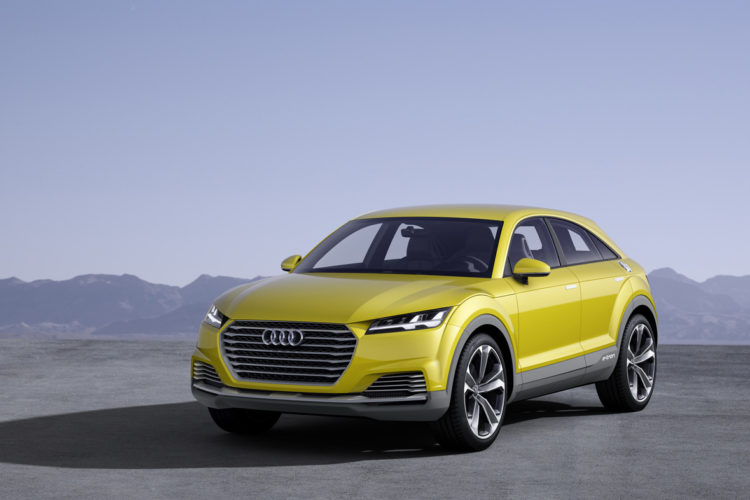
Audi to add two new Q models the Q4 and flagship Q8 Crossover SUV.

  • Production of the Audi Q8 crossover SUV to start in Bratislava in 2018
  • Audi Q4 compact utility vehicle from Győr as of 2019
  • Board of Management Member for Production Prof. Dr. Hubert Waltl: “Increased competitiveness in the SUV segment” 
Audi is to expand its portfolio with two new Q models and has announced where they will be built: Production of the Audi Q8 will start in Bratislava (Slovakia) in 2018 and the first Audi Q4 will drive off the assembly line in Győr (Hungary) in 2019.
“We will integrate two completely new Q‑models into the existing production network and will thus increase our competitiveness in an extremely important segment,” stated Audi’s Board of Management Member for Production and Logistics, Prof. Dr. Hubert Waltl.
With the Audi Q8, the brand will open up a new segment for its top-end models. The premium SUV in a coupe style combines great spaciousness with emotive design and offers the latest technologies in assistance and infotainment systems. 
Audi will produce the model in Bratislava as of 2018. The Audi Q7 has already been produced at the Slovakian plant since 2005. Meanwhile, the second generation of the large SUV is in production there, as an S version and as the Q7 e-tron plug-in hybrid.
In 2019, production of the Audi Q4 will start at Audi Hungaria in Győr. With this model, the brand is entering the segment of compact utility vehicles (CUVs). Featuring a typical coupe-style silhouette, the Audi Q4 will be positioned between the Audi Q3 and Q5. And as of 2018, Audi Hungaria will also be responsible for production of the Audi Q3 compact SUV, which until then will continue to be produced in Martorell, Spain.

Saturday, 20 August 2016

USA - Ford announces that the All-New GT will get an extension in production for another two years.

  • Ford Performance will offer the all-new Ford GT for two additional production years, bringing the production commitment of the carbon fibre supercar to a total of four years
  • Potential customers who already applied to purchase Ford GT will only need to update their request when the next application window reopens in early 2018
  • Additional production supports Ford Performance decision to race Ford GT in both IMSA and World Endurance Championship (WEC) series for four years
Ford Performance is adding two more years of production for the all-new carbon fibre Ford GT supercar. The announcement comes on the heels of letters sent to potential customers notifying them of their application status to purchase one of their own, with more than 500 of those coming from the UK alone
The additional production supports the decision by Ford Performance to race Ford GT in both IMSA and World Endurance Championship (WEC) series events for four years, extending through to the 2019 season.

“While we can’t build enough Ford GTs for everyone who has applied, we are going to produce additional vehicles in an effort to satisfy more of our most loyal Ford ambassadors,” says Dave Pericak, global director, Ford Performance. “We want to keep Ford GT exclusive, but at the same time we know how vital this customer is to our brand.”
Year three of production will support applicants who were placed on the waiting list; previously deferred applicants and those who missed the initial application window will be served by production year four. The application process for fourth-year production will reopen in early 2018. Those who already applied to own the car will only need to update their request.
“Ford GT has racing in its blood,” says Raj Nair, Ford executive vice president, product development, and chief technical officer. “The road car and race car will live on, side-by-side, for the next four years – providing ample opportunity to test and prove innovative new technologies both on and off the track.”

Wednesday, 11 November 2015

USA - Toyota & Lexus to build the RAV4 & RX in the US and Canada from 2019 at Woodstock & Cambridge Plants

Toyota announced today that it will produce RAV4 vehicles in its Cambridge North Assembly plant starting in 2019. With Lexus RX in Cambridge, and Toyota RAV4 in Woodstock and Cambridge, Toyota Motor Manufacturing Canada (TMMC) will become a North American hub for sport utility vehicles. The company also announced that it will be adding hybrid RAV4 production.

The RAV4 and Lexus RX are 2016 Model Year, and are not to be confused 
with the stated 2019 versions, which may or may not be the same, or similar.


“The RAV4 and the RAV4 hybrid are great products for TMMC,” commented Toyota Motor North America Chief Executive Officer Jim Lentz. “RAV4 is a leader in the fastest growing segment of the North American auto industry. We forecast that the segment will continue to demonstrate strong growth with the RAV4 being a major player.” Mr. Lentz also explained that “producing additional RAV4s, a more upscale, more complex, higher content vehicle, fits well with TMMC’s well-earned reputation for quality.”  

To accommodate the change, the Cambridge North Plant will receive significant new investment, including the introduction of Toyota’s New Global Architecture (TNGA). TNGA is an innovative, integrated approach to developing and building vehicles, involving new production equipment and new processes. 

TMMC President, Brian Krinock explained that “with a new platform and the latest technology, TMMC will have the flexibility to respond to the evolving needs of the automotive marketplace.” He also said that “bringing TNGA to Canada will propel us to the next generation of automotive manufacturing and provide the basis for our longstanding commitment to employment stability.” Mr. Krinock also observed that “when we implement this project in 2019, we will have been making vehicles in Canada for thirty years. This investment will revitalize our plant and create the foundation for our future success.”
 
Toyota Motor Manufacturing Canada Inc. manufactures the Toyota Corolla, RAV4, Lexus RX 350 and RX 450h vehicles and is the first plant outside of Japan to build a Lexus vehicle. The company employs more than 8,000 Team Members at three manufacturing plants in Ontario, Canada.

Tuesday, 20 October 2015

Volvo to have every model within it's range as part of a new range of Plug In Hybrids and a full Hybrid by 2019.

Volvo Cars, the premium car maker, has announced one of the automotive industry’s most comprehensive electrification strategies in which plug-in hybrids will be introduced across its entire range. It will develop an entirely new range of electrified smaller cars and build a fully electric car for sale by 2019.
As part of this new strategy, the Swedish car company said it expects electrified vehicles to account for up to 10 per cent of total car sales in the medium term.

The first element of the new electrification strategy involves the introduction of plug-in hybrid versions of its 90 series and 60 series larger cars, based on the company’s new Scalable Product Architecture. This process has already begun with the launch of the T8 Twin Engine All-Wheel Drive plug-in hybrid version of its new XC90 SUV and will continue with plug-in hybrid versions of the new S90 premium sedan and other forthcoming models.
Volvo Cars will also broaden the range of plug-in hybrid cars it offers with the introduction of a new front-wheel drive Twin Engine variant.
The Swedish car maker will further deepen its product offering with the introduction of an entirely new range of smaller 40 series cars based on its newly-developed Compact Modular Architecture (CMA), which, like SPA, has been designed from the outset for electrification. This makes Volvo Car Group one of very few car makers in the world with two brand new vehicle architectures designed to support both plug-in and pure electric powertrain configurations.
Lastly, Volvo Cars has confirmed that it will build an all-electric car for sale by 2019. Further details of this planned model will be released at a later date.
Håkan Samuelsson, President and CEO of Volvo Cars, said: “We believe that the time has come for electrified cars to cease being a niche technology and enter the mainstream. We are confident that in two years’ time, 10 per cent of Volvo’s global sales will be electrified cars.”
Volvo Cars believes that plug-in hybrid cars offer customers the best combination of efficiency, range and convenience.
For example, Volvo Cars’ XC90 T8 Twin Engine is one of the cleanest and most powerful 7-seater SUV on the market, delivering over 407 horsepower equivalent and just 49 g/km CO2, plus a pure electric range of 43 km, an industry leading 2.1 l/100 km in fuel economy and reaching 100 km/h in just 5.6 seconds.
This combination of power, efficiency and environmental friendliness will be the hall marks of all of Volvo Cars’ forthcoming electrified models.
“We have learned a lot about how people use cars with electrification thanks to our current product offer,” said Dr Peter Mertens, Senior Vice President for Research and Development. “Our research has shown that people are driving our Twin Engine cars in electric mode around 50 per cent of the time, meaning our plug-in hybrids already offer a real alternative to conventional powertrain systems.”
“With around 40 years of experience in the field of electrification, Volvo Cars has learned a lot about battery management along the way, delivering the best range per kilowatt hour in the industry. We have come to a point where the cost versus benefit calculation for electrification is now almost positive. Battery technology has improved, costs are going down, and public acceptance of electrification is no longer a question,” Dr Mertens added.