Purpose

I will try my best to provide detailed info on various cars and what is like to live with them, I have already produced a few for Jaguar-car-forums, I will do my best to be unbiased, but it will be hard for some cars. I will re-produce press releases and copy from other motoring news.
Showing posts with label 25mpg. Show all posts

Sunday, 9 October 2016

USA - The new 10 Speed auto mated to the 3.5 litre Ecoboost engine gives more power and better fuel consumption.

  • Thanks to its all-new 3.5-liter EcoBoost® engine paired exclusively with the first volume-production 10-speed automatic transmission available from any automaker, 2017 Ford F-150 sees improvement in all three EPA fuel economy label estimates – city, highway and combined ratings – by 1 mpg over 2016 F-150; 4x4 model improves by 2 mpg combined
  • Second-generation 3.5-liter EcoBoost V6 produces 375 horsepower and segment-best 470 lb.-ft. of torque – a gain of 10 horsepower and 50 lb.-ft. over first-generation engine
  • Advanced 10-speed automatic transmission enables improvements in performance and efficiency, as well as increased towing and hauling control
  • Ford has sold more than 1 million EcoBoost F-150 trucks in the United States since 2011
Ford, America’s truck leader, continues its relentless pace of innovation and performance, helping customers get better mileage out of each gallon of gas in the 2017 Ford F-150. Thanks to the all-new 3.5-liter EcoBoost® V6 engine mated to the first volume-production 10-speed automatic transmission, EPA-estimated city, highway and combined fuel economy increase 1 mpg, with the combined rating for 2017 F-150 4x4 up 2 mpg.
Model
City
Highway
Combined
2017 Ford F-150 4x2
18 mpg
25 mpg
21 mpg
2016 Ford F-150 4x2
17 mpg
24 mpg
20 mpg


2017 Ford F-150 4x4
17 mpg
23 mpg
20 mpg
2016 Ford F-150 4x4
16 mpg
22 mpg
18 mpg
In addition, F-150 customers benefit from improved acceleration, performance and refinement delivered by the 3.5-liter EcoBoost and state-of-the-art 10-speed automatic transmission. This new powertrain combination provides better low-end and peak performance, which is ideal for hauling heavy payloads and towing heavy trailers.

All-new 3.5-liter EcoBoost V6

This second-generation 3.5-liter EcoBoost engine delivers 50 lb.-ft. more peak torque compared with the first-generation 3.5-liter EcoBoost, for a segment-best 470 lb.-ft. – beating all diesel- and gasoline-powered competitors including V8 engines with nearly twice the displacement. Horsepower jumps 10 over the previous version, for a total of 375 horsepower.

The all-new 3.5-liter EcoBoost leverages the best attributes of the first-generation design – power, reliability and efficiency – improving in almost every aspect. This includes a new twin-port and direct-injection fuel strategy, lighter and stronger crank and valvetrain components, redesigned twin turbocharger with electronic wastegate, and redesigned valvetrain and variable-displacement oil pump.
The all-new 3.5-liter EcoBoost builds on the success of the 2.7-liter EcoBoost and first-generation 3.5-liter EcoBoost – which account for approximately 60 percent of F-150 sales. F-150 remains the only truck in its segment to offer a twin-turbocharged gasoline engine. With 1 million-plus Ford EcoBoost-equipped trucks on the road, F-150 owners will save more than 110 million gallons of gas over the next year while out-hauling the competition.
First volume-production 10-speed automatic

The all-new 10-speed automatic transmission available for 2017 F-150 4x2 and 4x4 models optimizes engine power and torque ranges, with closer ratios between gears and patented hydraulic controls.

Smarter shift logic helps customers tow with improved confidence using tow/haul mode. All-new adaptive shift-scheduling algorithms monitor more than a dozen powertrain and driver control signals in real time – ensuring the right gear at the right time for an engaging driving experience, including in sport mode. In addition, a unique high-speed one-way clutch allows for non-sequential shifting.
Weight savings play a key role in improved shifting performance. The 10-speed gearbox – the first from Ford not to employ cast-iron components – uses advanced materials and alloys. An integrated torque converter/turbine clutch helps shave more than two pounds, while reducing the packaging footprint.

Wednesday, 18 November 2015

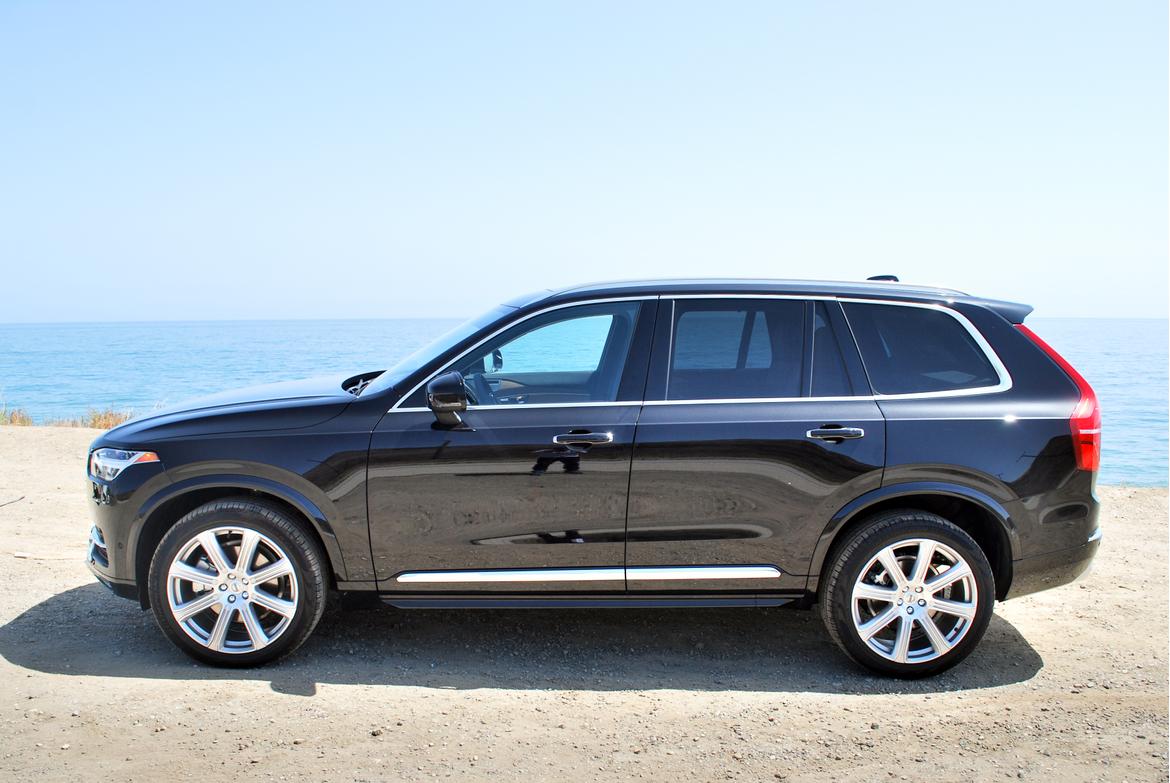
USA - The Volvo XC90 takes the Motor Trend SUV Of The Year for the Second Time, and well deserved it is too.

The Volvo XC90 has been named Motor Trend’s SUV of the Year for the second time.
Developed from the ground up on Volvo’s unique Scalable Product Architecture (SPA), with a 316 horsepower, supercharged and turbocharged Drive-E engine featuring an EPA rating of 25 mpg highway. 
A tablet-like Sensus control system, and understated Scandinavian design, the all-new 2016 XC90 sets a new standard for the luxury SUV segment. 

With its full suite of IntelliSafe features and two more world firsts for safety, the all-new Volvo XC90 is also the safest Volvo ever.
“Everyone at Volvo Cars is exceptionally proud to win the Motor Trend SUV of the Year award,” said Lex Kerssemakers, president and CEO of Volvo Cars of North America. “The all-new XC90 is a strong indicator of things to come at Volvo.”
Kerssemakers accepted the iconic Golden Calipers trophy at an award ceremony tonight near Motor Trend’soffices in El Segundo, California.
When it was introduced in 2002, the original XC90 won Motor Trend’s SUV of the Year as it redefined the seven-passenger SUV segment.
Motor Trend's Sport/Utility of the Year is not a comparison test, and is only open to all-new or substantially upgraded vehicles that have gone on sale in the 12 months from November 1 of the previous year.
To judge contenders for the award, Motor Trend's editorial staff conducted an exhaustive three-phase testing process. Phase one includes a full tech check and weigh-in, then full track testing to establish baseline data for acceleration, braking, and handling. 
Phase two involves three days of road loops offering a range of road surfaces and traffic conditions to evaluate ride and handling, engine and transmission smoothness and responsiveness, wind and road noise, and ergonomics. 
An off-road section tests traction, stability, and braking control systems. In the third phase, the judges debate and deliberate. The judging criteria include the following categories:
Design Advancement - well-executed exterior and interior styling; innovative vehicle packaging; good selection and use of materials.

Engineering Excellence - total vehicle concept and execution; clever solutions to packaging, manufacturing and dynamics issues; cost-effective tech that benefits the consumer.

Performance of Intended Function - how well the vehicle does the job its planners, designers, and engineers intended it to do.
Efficiency - low fuel consumption and carbon footprint, relative to the vehicle's competitive set.

Safety - a vehicle's ability to help the driver avoid a crash, as well as the secondary safety measures that protect its occupants from harm during a crash.

Value - competitive price and equipment levels, measured against those of vehicles in the same market segment.

Sunday, 7 December 2014

The Ram1500 EcoDiesel wins Esquire Truck of the Year.


Esquire magazine has named the Ram 1500 EcoDiesel, America’s most fuel-efficient pickup, its Truck of the Year. The announcement is highlighted in Esquire’s December issue.
 
Esquire’s editors consider all potential truck models in the U.S. market, balancing attributes with conventional touchstones that outline what makes a great truck, such as efficiency, functionality, versatility, safety, value and style.
 
“Recognition from Esquire magazine is proof that pickups have found their way into a variety of lifestyles,” said Bob Hegbloom, President and CEO—Ram Truck Brand. “In such a competitive market, we are thrilled to earn a ‘Truck of the Year’ title from Esquire. The Ram 1500 delivers with a winning combination of best-in-class fuel economy and capability and going forward, Ram will continue to set the pace with the best trucks in their segments.”


The EcoDiesel-powered Ram 1500 earned a 28 mpg rating from the U.S. Environmental Protection Agency (EPA), the best highway-cycle test result ever achieved by a full-size, half-ton pickup. It also exceeds the EPA highway rating for the top-ranked small pickup. The previous half-ton fuel efficiency record was set by the Ram 1500 with the available 3.6-liter Pentastar V-6 gasoline engine at 25 mpg highway.
 
“This is where the truck tide turns: a full-sized American pickup with a just-big-enough diesel V-6—the only one of its kind,” Esquire magazine noted. “You get the fuel economy of a small engine, the pulling power of a larger one and the grumble of a working-class diesel.”

Ram 1500—the most recognizable pickup on the road—delivers best-in-class fuel economy with a truckload of pioneering, fuel-saving systems and first-in-segment technologies: TorqueFlite eight-speed automatic transmission, stop-start system, thermal management system, pulse-width modulation and active aerodynamics, including grille shutters and air suspension. The Ram 1500 delivers an outstanding combination of best-in-class fuel efficiency, unsurpassed torque and a surplus of towing capability.
 
Ram truck offers models designed for a wide range of buyers, including outdoorsmen, tradesmen, first-time buyers and ranchers. Laramie, Laramie Longhorn and Laramie Limited trims are designed to meet the high expectations of affluent pickup truck buyers looking to combine capability with sophistication. Featuring premium materials, such as full-leather seating, real wood interior components and modish design, Ram offers a refined luxury alternative uncommon in pickups.

Tuesday, 27 May 2014

USA _ Chevy makes Stop/Start standard on 2015 Impala 2.5L ECOTEC.

Stop/start technology will be standard on the 2015 Impala base 2.5-liter ECOTEC® engine, an addition that improves the vehicle’s city fuel economy by nearly 5 percent, or one mile per gallon.
The Impala comes standard with a four-cylinder engine, which currently accounts for more than 30 percent of Impala retail sales. It offers customers higher mpg city ratings and a more affordable entry price into the segment than six-cylinder competitors.
Stop/start shuts down the engine in certain driving conditions to reduce fuel consumption. The technology is becoming more prevalent worldwide. A recent report from Navigant Research predicted worldwide sales of vehicles with stop/start technology will grow from 8.8 million in 2013 to 55.4 million in 2022.

The 2.5L Impala with stop/start yields an EPA-estimated fuel economy of 22 mpg city, 31 for the highway and 25 combined. The Impala with the 3.6L V-6 engine will not include stop/start technology.
The Impala becomes the second vehicle in Chevrolet’s U.S. lineup to feature stop/start technology, following the segment-first standard inclusion in the 2014 Malibu introduced late last year. The technology helps improve the Malibu’s city fuel economy by 14 percent.
Chevrolet engineers developed the stop/start in the Impala from extensive experience with GM’s eAssistsystem and the accompanying algorithms that allow engines to engage and disengage subtly.
“Stop/start system customer research indicates they want the engine to start up as quickly and smoothly as possible after a stop,” said Mark Meyers, Chevrolet Global Vehicle Performance manager.
During the development of this technology, a team of software engineers was created. The Center for Excellence focuses on advancing stop/start technology and making its operation seamless to the customer.
A big challenge for the team was overcoming “change-of-mind events,” instances in which the driver begins to stop, but then quickly accelerates. The algorithms adapt the system so the starter can fire even if the engine did not fully shut off.
The smart software also prevents the system from engaging if the car does not reach 6 mph since its last start, a welcome feature in stop-and-go-driving conditions. The system also considers cabin temperature, humidity, battery charge and other factors when deciding if the engine should come to a stop.
Hardware revisions also have been made. The noise and vibration team worked closely with drivetrain engineers to revise motor mounts to provide the greatest isolation possible from the cabin. Additionally, the team included a larger heavy-duty starter motor to assist with the additional ignition cycles.
The 2015 Impala goes on sale this summer with a suggested starting price of $27,735 for the 4-cylinder LS model, and $30,960 for the 6-cylinder LT model. These include an $825 destination charge, but exclude tax, title, license and dealer fees.
For the 2015 model year, the Impala will be available with two powertrains, a standard 2.5L engine with stop/start, and a premium 3.6L six-cylinder engine.