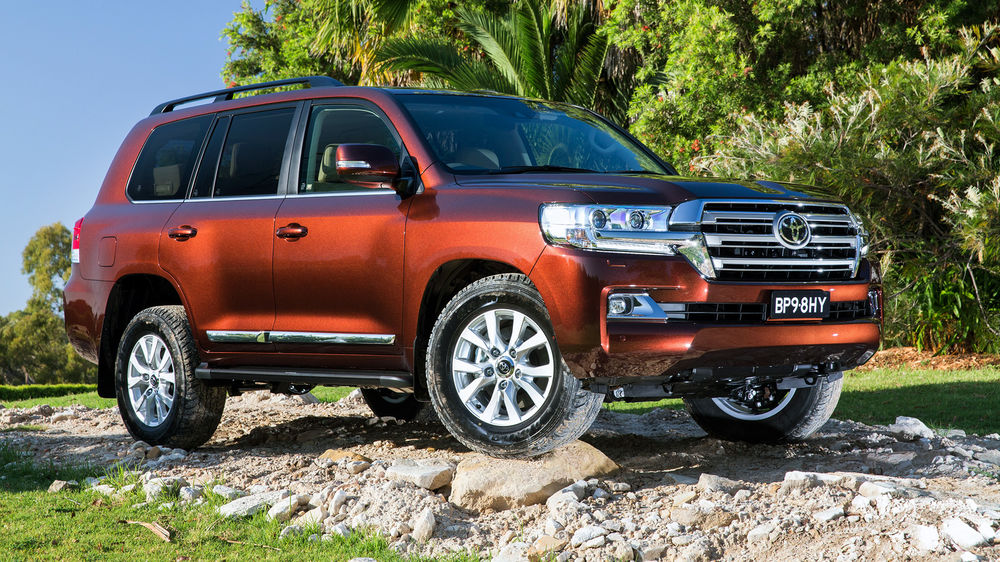
The utilitarian go-anywhere 1957 Land Cruiser was among the first Toyota vehicles sold in the United States. Since its American market introduction six decades ago, the Land Cruiser has evolved into one of the most luxurious full-capability SUVs extant. And what of its go-anywhere attitude? It’s still got plenty of it.
It is this inimitable blend of premium appointments and uncanny off-road aptitude that has made the Land Cruiser an immensely versatile machine that’s adored by its loyal and discerning customers the world over.
Handsome Enough for the Valet Queue, Roomy Enough for Eight
The Land Cruiser’s iconic appearance received a number of updates last model year, with the bumper, grille, projector-beam LED low and high beam headlights, headlight cleaners, and integrated Land Cruiser logo, all contributing to the new design signature.
The hood’s distinctive power bulges serve to illustrate the V8’s 381-horsepower strength. Teamed to that power plant is Toyota’s 8-speed Electronically Controlled Automatic Transmission with intelligence (ECT-i), which helps enhance acceleration.
Emphasizing both style and safety are the Land Cruiser’s taillights with light-pipe design and LED brake lights. Full-width chrome molding accents the rear bumper. A chrome body side molding embossed with the Land Cruiser logo and 18-inch alloy wheels accentuate the Land Cruiser’s muscular profile.
Once again, the Toyota Land Cruiser comes in one version: fully equipped and with seating for eight. There are no factory options, and really, none are needed.
For 2017, semi-aniline perforated leather is available in the customer’s choice of black or Terra (brown). Black interior and Terra interiors are accented by Deep Wood trim. The high-quality materials complement a center console redesign that shows a more cohesive appearance and more intuitive controls.
The luxurious new steering wheel is heated as before, and also integrates switches for the multi-information display, Dynamic Radar Cruise Control, and Toyota Safety Sense-P system.
Towing Like a Champ
Whether carrying a full load of passengers and their luggage, or pulling a trailer, the Land Cruiser can easily handle the task with its 381-horsepower 5.7-liter DOHC V8 engine. Equipped with Variable Valve Timing with intelligence (VVT-i), the aluminum eight-cylinder produces 401 lb.-ft. of torque at 3,600 rpm. Its 8-speed automatic transmission allows manual control when needed, such as when descending steep inclines.
Those who tow will be especially pleased with an engine that produces 90 percent of its peak torque at a low 2,200 rpm. And the Land Cruiser can tow: the standard Trailer Towing Package equips it to pull a trailer up to 8,100 pounds.
The hardware needed for towing is all there, including an engine oil cooler, as well as a connector and sub-wiring harness that facilitate a trailer-brake controller. Trailer Sway Control uses Vehicle Stability Control (VSC) to help counteract trailer sway, helping to make towing a more relaxed proposition.
Built to Take It, Whatever “It” Is
The Land Cruiser’s rugged body-on-frame construction makes extensive use of high-strength steel – especially in the A-, B-, C-, and D-pillars, and rocker area – and provides a solid on-road driving feel.
Offering the comfort of a luxury sedan in everyday driving, the Land Cruiser is always ready and able to tackle off-pavement and trail driving, making out-of-the-way vacation cabins seem less out of the way.
Its suspension design combines proven trail capability with advanced control technology. Key to the Land Cruiser’s off-pavement competence is suspension articulation, facilitated by long wheel travel.
And the suspension has some high-tech hydraulic help. Hardcore off-road drivers will, when necessary, disembark their vehicles to disconnect the suspension stabilizer bars in order to increase wheel articulation.
That’s a tough and dirty job, and it can impair on-road handling if the bars are left disconnected.
Fortunately, such dirty work is completely unnecessary in the Toyota Land Cruiser. Its Kinetic Dynamic Suspension System (KDSS) hydraulically adjusts the lean resistance provided by the stabilizer bars, reducing it for off-road driving to help minimize any tendency for wheel lift.
On pavement, where stabilizer bar function is beneficial for agility and safe control, KDSS enables the bars’ ability to work conventionally to help reduce body lean by as much as 50 percent. The system operates hydraulically, without the need for complex electronics.
Some additional Land Cruiser tidbits: It has a 32-degree approach angle and 24-degree departure angle, plus, a 27.5-inch fording depth. Skid plates help to protect the front suspension, radiator, fuel tank, and transfer case.
Full-Time 4WD, Aided by Advanced Control Systems
Four-wheel drive is a given in a full-capability SUV, but not all 4WD systems are equal. The Land Cruiser’s full-time 4WD system uses a TORSEN® limited-slip locking center differential to distribute torque 40:60 front-to-rear. Should wheel slippage occur, the differential can direct more torque to the wheels with the best grip. Active Traction control (A-TRAC) employs both brake and throttle intervention to help control wheel spin. Vehicle Stability Control (VSC) helps maintain directional control during cornering.
Off-road drivers know that a 2-speed transfer case with low-range is a must for tackling steep inclines and particularly difficult trails. That’s why the Land Cruiser has one, and it, too, does not work alone. The Land Cruiser’s Multi-terrain Select system allows the driver to match wheel slip control to the surface and driving conditions.
Multi-terrain Select allows more-than-normal wheel slip in loose terrain, such as mud and sand, to help the Land Cruiser keep moving without digging itself in. The Mogul setting is effective for traversing extremely uneven terrain, such as V-ditches, slopes, and ridges; wheel slip is minimized and the system acts more like a limited slip differential.
Land Cruiser also features an enhanced Multi-Terrain Monitor with selectable front, side or rear views with near 360-degree visibility and five-second front undercarriage projected path video playback.
Low-range is also vital for crawling along at a slow, safe speed over challenging terrain. With the transfer case shifted into low range, the Land Cruiser’s CRAWL Control regulates engine speed and output, along with braking force, to propel the vehicle forward or reverse at one of five driver-selectable low-speed settings. CRAWL Control, when engaged, allows the driver to focus on steering without also having to modulate the throttle or brake pedals.
Two more systems help out on trails. Downhill Assist Control (DAC) can augment the low-range ratio’s low-speed descending ability by helping to hold the vehicle to a target speed with minimal driver intervention. Hill-start Assist Control (HAC) helps prevent nerve-wracking roll-back when stopping and then starting again on a steep incline or slippery surface.
Because trails are usually not as comfortably wide as highway lanes, the Land Cruiser comes equipped with Off-Road Turn Assist. The system tightens the turning radius by applying slight brake pressure to the inside rear wheel, creating a pivot effect. Big P285/60 R18 mud-and-snow tires on 18 x 8.0-inch aluminum alloy wheels help give the Land Cruiser exemplary grip in all conditions.
With a tire that size, you’d want the reassurance of having a full-size spare, and it’s standard on Land Cruiser. And you’ll always know it’s ready because the direct individual tire pressure monitor system also monitors the spare.
Of course, all of the Land Cruiser’s impressive 4WD hardware and chassis control technology also help take the slip out of slippery weather in everyday driving.
The Sophisticate’s Cabin
Land Cruiser treats its driver and passengers to the best in modern luxury, requiring no options or packages to add premium luxury. The very long list of standard amenities includes perforated leather trim, heated and ventilated front seats and a heated steering wheel with power tilt and telescoping with memory.
The list keeps going: Smart Key keyless entry with push-button start; anti-theft security system with engine immobilizer; power moonroof; auto-dimming rearview and side mirrors; HomeLink® universal garage-door/gate opening system, and much more.
The Land Cruiser’s four-zone automatic climate control system provides a comfortable environment for all onboard. Its 7-level blower control circulates heated or cooled air via 28 air vents located throughout the cabin, and a micro-dust and pollen filter helps keep that air clean. When it’s cold outside, the Land Cruiser’s auxiliary Positive Temperature Coefficient heater warms the cabin quickly using an electrically heated ceramic element, similar to a household space heater.
The Land Cruiser driver faces a panel of bright Optitron instrument gauges, and a Multi-Information Display shows gear selection, odometer, tripmeter, fuel consumption, individual tire pressures and cruising range.
The Multi-Information Display also monitors parking assist, steering wheel angle, Multi-Terrain Select including Crawl Control, Dynamic Cruise Control adjustment information, TSS P pre-collision warning alarm adjustment, Lane Departure Alert and sway warning. The center console integrates a cooler box, USB port, and cup holders.
Luxury permeates all three rows. The middle row seats are also trimmed in perforated leather and feature multi-stage heating and abrasion-resistant seatback material. The 40/20/20 split seat is built for comfort and convenience. It’s got a recline feature, and a one-touch tumble mechanism makes it easy for passengers to enter and exit the third row.
When you need to maximize room for either passengers or cargo, the middle row seats also slide forward and aft 4.1 inches. The third row are 50/50 split fold-down leather trimmed with folding headrests with abrasion resistant seatback materials, which seats three occupants. With the middle and third rows folded, the Land Cruiser provides 81.7 cubic feet of cargo space.
Top-of-Line JBL® Synthesis Premium Audio with Entune®
It only makes sense that the Land Cruiser, Toyota’s flagship sport-utility, is outfitted with JBL’s premium multimedia technology. Called Entune™ Premium JBL® Audio with Integrated Navigation system, its 14 speakers create a veritable concert hall on wheels, playing music from an AM/FM CD player with MP3/WMA playback capability; SiriusXM® All Access Satellite Radio (includes three-month complimentary trial subscription); HD Radio™ with iTunes® Tagging; USB port with iPod® connectivity and control; and audio streaming via Bluetooth®. The latter also provides hands-free phone capability and phone book access.
Split screen capability allows navigation and audio screens to be displayed simultaneously. With advanced voice recognition, the driver can speak simple commands to control the unit. Apple iPhone users can also access standard Siri® Eyes Free mode for added versatility. Rear passengers can enjoy a rear-seat DVD entertainment system featuring two individual 11.6-inch display monitors, RCA jacks, and separate HDMI input for individual playback.
The Toyota Entune App Suite is a collection of popular mobile applications and subscription-free data services. Once a smartphone is paired to the vehicle using Bluetooth or a USB cable, Entune apps are operated using the vehicle’s controls or, for some services, by voice recognition. Entune offers apps for Destination Search, Facebook Places, iHeartRadio, MovieTickets.com, OpenTable®, Pandora®, Yelp®, and Slacker Radio. Standard Qi wireless phone charging (for compatible devices) means one less cable to tote.
Innovative Toyota Safety
The Land Cruiser is among numerous Toyota’s having the innovative and highly advanced Toyota Safety Sense™ P driver-assist technology as standard. Using millimeter-wave radar and a monocular camera sensor designed to detect a preceding pedestrian, a preceding vehicle, and visible lane markers in the surrounding area, TSS-P can help the driver identify obstacles and automatically apply braking if necessary to help mitigate or avoid collisions in certain conditions. TSS-P includes the Pre-Collision System with Pedestrian Detection function; Lane Departure Alert; Dynamic Radar Cruise Control; and Automatic High Beams.
In addition, the 2017 Land Cruiser can help the driver avoid hazards with its Blind Spot Monitor and Rear Cross Traffic Alert. The backup camera offers added visibility and can also be useful to aid trailer hitching and maneuvering.
In the spring of 2016, Toyota committed to making automatic emergency braking standard on nearly all models by the end of 2017 (2018 Model Year). This decision will place Toyota four years ahead of the model-year 2022 industry target announced by the National Highway Traffic Safety Administration (NHTSA) and Insurance Institute for Highway Safety (IIHS).
Connectivity gives drivers and passengers more choices for information and entertainment, and it also provides added peace of mind. Using onboard cellular technology, independent of the driver’s phone, Toyota’s Safety Connect™ offers Automatic Collision Notification, Stolen Vehicle Location, Emergency Assistance Button (SOS), and enhanced Roadside Assistance, which adds GPS data to the already-included Toyota roadside service. One-year of Safety Connect service is included, and subscription packages are available after that.
Safety, too, comes from an array of technologies that make up the STAR Safety System™ that’s standard on all Toyotas. The Land Cruiser multi-terrain anti-lock braking system (ABS) automatically selects the optimal ABS profile to provide the most suitable brake force for on- and off-road driving surfaces. Electronic Brake-force Distribution (EBD) balances braking forces between the front and rear brakes, and Brake Assist (BA) provides auxiliary force to assist the driver during emergency braking.
All eight seating positions have three-point seatbelts, and Land Cruiser features 10 airbags: driver and front passenger Advanced Airbag System; driver and front passenger knee airbags; driver and front passenger seat-mounted side airbags, second-row outboard seat-mounted side airbags and three-row roll-sensing side curtain airbags.
Active headrests on the driver and front passenger seats move up and forward almost instantly in the event of certain rear-end collisions to help reduce the distance between the occupant's head and the headrest. The advanced seatbelt system is designed to retract the front seatbelts when the brakes are suddenly applied or when the VSC system detects tire slippage.
Limited Warranty and ToyotaCare
Toyota’s 36-month/36,000 mile basic new-vehicle warranty applies to all components other than normal wear and maintenance items. Additional 60-month warranties cover the powertrain for 60,000 miles and corrosion with no mileage limitation. Toyota dealers have complete details on the limited warranty.
The Land Cruiser also comes standard with ToyotaCare, a complimentary plan covering normal factory-scheduled maintenance and 24-hour roadside assistance for two years or 25,000 miles, whichever comes first.