Purpose

I will try my best to provide detailed info on various cars and what is like to live with them, I have already produced a few for Jaguar-car-forums, I will do my best to be unbiased, but it will be hard for some cars. I will re-produce press releases and copy from other motoring news.
Showing posts with label back in the race. Show all posts

Wednesday, 6 April 2016

Back in the Race is now Push to Pass as the PSA Group looks further ahead to increase income, limit expenditure.

Push to Pass" plan for the 2016-2021 period aims to meet customers' mobility needs by anticipating changes in car usage patterns. Driven by evolving customer expectations, the plan will transform the company in order to unleash its full potential, capitalising also on the efficiency, operational excellence and agility demonstrated during the "Back in the Race" plan.

Based on frugal R&D expenditure and rigorous control over production costs as well as fixed costs, the plan raises the bar for the PSA Group's sustainable performance by setting the following objectives:
  • Reach an average 4% automotive recurring operating margin in 2016-2018, and target 6% by 2021.
  • Deliver 10% Group revenue growth by 20181 vs 2015, and target additional 15% by 20211.
To achieve these targets, the company is adapting its business model and will create more value by optimising its existing customer base, while also expanding it through digitalisation and multi-brand offers in after-sales, leasing, used cars, mobility services and fleet management. Selected venture capital investments will also enhance the company’s portfolio of mobility solutions.
Growth of the strong and well-differentiated Peugeot, Citroën and DS brands will be supported by:
  • High-quality products and services, basis for the brands' pricing power.
  • A product blitz, built on 26 passenger cars and 8 light commercial vehicles, including a 1 ton pick-up, leading to the launch of “one new car, per region, per brand and per year”.
  • A rich and sharp core technology strategy, notably shaped by the launch of 7 plug-in hybrids and 4 electric vehicles, and the deployment of the connected and autonomous vehicle programme.
The plan will help to ensure profitable growth in all the regions where the Group operates.
"Push to Pass" represents a first step towards the achievement of the Group's vision to be: “a great global carmaker with cutting edge efficiency and the preferred mobility providerworldwide for lifetime customer relationship"
PSA also announces a dividend policy from 2016 financial year based on a 25% payout ratio.
Commenting on the presentation of the “Push to Pass” plan, Carlos Tavares, Chairman of the Managing Board said: "Based on our financial reconstruction, we will launch a global product and technology offensive. Now more agile, we are ready to shift paradigms by anticipating changes in car usage patterns. Our digital transformation will make the PSA Group a company connected to its customers. With “Push to Pass”, we will ensure PSA profitable organic growth."

Thursday, 30 July 2015

PSA Group announces more growth in, income, profits and sales, and expect it to get better too.

"Our first-half results are very positive but we need to review them on a full-year basis," said Carlos Tavares, Chairman of the PSA Peugeot Citroën Managing Board. "In this unstable international environment, the company and its staff – whom I thank wholeheartedly – must all be focused on the full execution of the “Back in the Race” plan in order to secure the Group's recovery."
Consolidated net revenue represented €28,904 million in the first half of 2015, up 6.9% vs 2014. The Automotive Division reported revenue of €19,409 million, a year-on-year rise of 4.3% driven by the increase in net prices, a positive product mix and a favourable currency impact.

Consolidated Recurring Operating Income amounted to €1,424 million, versus €387 million in first-half 2014. Most of the growth came from the Automotive Division, with a €968 million improvement due to a favourable business environment contributing for nearly a third, and the combined impact of cost saving and positive product mix effects - reflecting the success of recent vehicle launches and the pricing power policy.
The Automotive Division's pro forma recurring operating income, which includes 50% of the results of Chinese joint ventures, was up €1,065 million1 to €1,193 million.
Non-recurring operating income and expenses resulted in a net expense of €342 million in the first half of the year, primarily due to restructuring costs incurred by the Automotive Division.
Financial income and expenses represented a net expense of €336 million compared with €344 million in first-half 2014.
Net income for the period came to €720 million, up €762 million year-on-year.
Banque PSA Finance reported recurring operating income of €294 million2, a rise of €122 million on first-half 2014. Further to the February 2015 agreement with Santander Consumer Finance, two joint ventures – one in France, the other in the United Kingdom – are already operational. As a result, the Group is benefiting from some of the most competitive refinancing conditions in the market.
Faurecia's recurring operating income amounted to €424 million, a year-on-year increase of 36.3%.
Free cash flow of manufacturing and sales companies amounted to €2,792 million, driven by an improvement in the cash flow from operations, seasonal changes in working capital requirement (up €932 million over the period due to high production in Europe in May-June 2015) and dividends paid from DPCA and Banque PSA Finance during the first half.
Excluding €321 million restructuring expenses and €331 million exceptional income, operating free cash flow for the period came to €2,782 million.
Total inventory at end-June 2015, including independent dealers, stood at 391,000 vehicles, 16,000 fewer than at end-June 2014.
The manufacturing and sales companies’ net financial position at 30 June 2015 was a positive €3,562 million, up €3,014 million vs 31 December 2014. Aside from free cash flow generation, the improvement was notably attributable to the exercise of stock warrants for a total of €120 million.
Market Outlook
In 2015 the Group expects automotive demand to expand by 6% in Europe and approximately 3% in China but to contract by around 15% in Latin America and 35% in Russia.
Operational Outlook
The Group aims to generate operating free cash flow of around €2 billion over the period 2015-2017. It is also targeting an operating margin3 of 2% in 2018 for the Automotive division, with the objective of reaching 5% over the period of the next medium-term plan, covering 2019-2023.
  1. On first-half 2014, restated following the application of IFRS 5
  2. 100% of the results of Banque PSA Finance. In the financial statements of PSA Peugeot Citroën , the two joint ventures are consolidated at equity, and the other businesses covered by the Santander agreement are declassified under ‘Net result from operationsto be continued in partnership’.
  3. Recurring operating income relating to the Automotive Division’s revenue

Thursday, 18 June 2015

Citroen CEO, Linda Jackson, Hints that the Mehari Fun car could make a comeback !

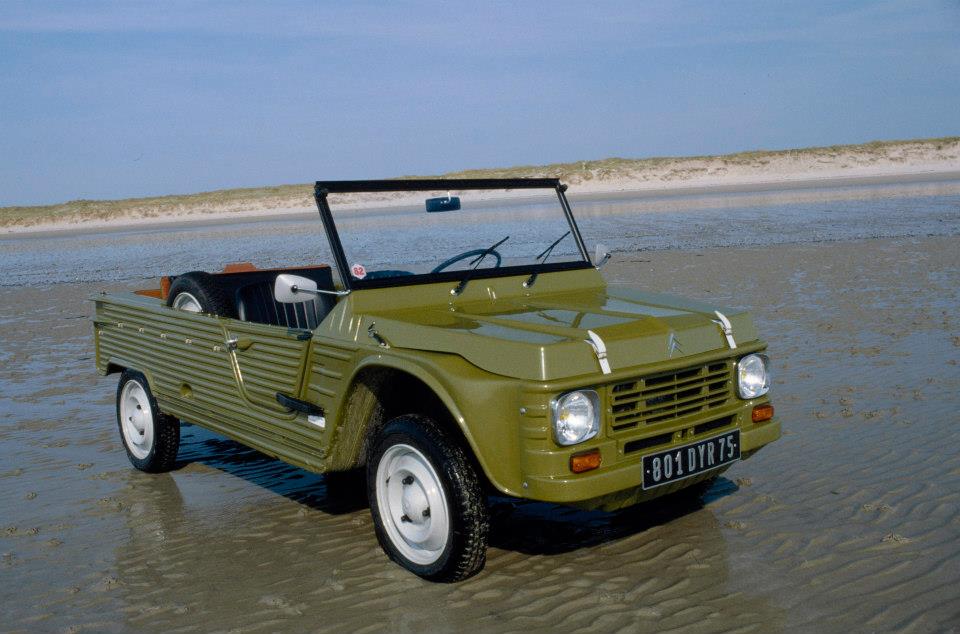
Citroen is considering a revival of its iconic Mehari lightweight utility car to help give the brand a “fun” image, CEO Linda Jackson said.
Citroen built 150,000 units of the open-sided, canvas-roofed Mehari between 1968 and 1987. The car had a diverse customer base. It was used as a beach buggy by holidaymakers and by farmers to get around their fields. Its thermoplastic body also made it light enough for the French army to drop the car attached to a parachute from an airplane.

Jackson said Citroen’s new brand positioning is about selling cars that are fun and give people a happy feeling. “Maybe there is a place for the Mehari. It’s something we are considering,” Jackson told the Automotive News Europe Congress here on June 10.
PSA/Peugeot-Citroen CEO Carlos Tavares wants to reduce the number of cars sold by the company as part of his turnaround strategy for the automaker. His Back in the Race business plan includes reducing the Citroen lineup to seven core models by 2022, down from 14 now.

Jackson said the future core models would be “silhouettes” from which different variants could be produced so a modern Mehari could be developed as a variant of a future subcompact car.
The Mahari was based on the 2CV, another Citroen car that has iconic status. Jackson said the 2CV will not be revived. “The 2CV had its day," she said, "but that's not now."
Nick Gibbs

Friday, 27 March 2015

PSA may achieve targeted goals ahead of schedule after rejoining stock market CAC-40

PSA/Peugeot-Citroen could reach its main recovery goal early, its chief financial officer, Jean-Baptiste de Chatillon, said today, as the French carmaker's shares rejoined the benchmark CAC-40 index after a two-and-a-half-year absence.
PSA will "go after the 2 percent operating margin objective as soon as possible," de Chatillon said, before ringing the opening bell at the stock exchange in Paris.

A weaker euro and cheaper raw materials constitute "a more favorable alignment of the planets" than was assumed when PSA pledged last year to restore auto-division profitability to a 2 percent margin by 2018, the finance chief said.
CEO Carlos Tavares has since begun cutting inventory, production costs and the group's model lineup as part of his Back in the Race turnaround plan aimed at hitting the operating margin target.
Spiraling losses at the automaker led to a 3 billion euro ($3.31 billion) bailout last year, in which the French government and Chinese state-controlled carmaker Dongfeng took matching 14 percent stakes in the company.
Last month, PSA reported that in 2014 it posted an annual operating profit, its first in three years.
European sales at the automaker rose 1.1 percent in February to 107,992, according to industry body ACEA.
Greater ambition
But PSA’s shares sank 4.7 percent last week after a March 17 investor day at the company's main research and development center outside Paris, with some analysts saying the market expected greater ambition.
"In a bull market it seems people quickly come to expect bigger and bolder and faster and higher," Bernstein analyst Max Warburton said. "But we mustn't forget that PSA has only been out of intensive care for a short while."
The shares were down a further 1.6 percent at 15.54 euros less than three hours after PSA's return to the CAC-40, which had been announced on March 5

Tuesday, 24 February 2015

Peugeot-Citroen-DS are definitely Back in the Race, with best results for some time..

PSA Peugeot Citroën 'Back in the Race'

€2.2 billion of operating Free Cash Flow in 2014, the Group is net debt free

  • €53.6 billion in revenue for the year1
  • Recurring Operating Income of €905 million, up €1.3 billion, from a loss of €-364 million in 2013
  • Favourable swing attributable to the Automotive division, which ended the year with recurring operating income at €63 million, up €1.1 billion from a loss of -€1,039 million in 2013
"Our 2014 results show evidence that the process of rebuilding the Group's financial fundamentals is underway," said Carlos Tavares, Chairman of the PSA Peugeot Citroën Managing Board. "By generating €2.2 billion in operating Free Cash Flow2 during the year, and becoming net debt free, we are ahead of our reconstruction plan. I would like to thank all of our teams for their achievements in a sometimes difficult environment. More than ever, we remain focused on fully meeting our objectives and achieving a 2% operating margin for the Automotive division."


Consolidated net revenue came to €53,607 million in 2014, up 1% over 2013. Automotive division revenue dipped 0.9% to €36,085 million, with favourable changes in the product mix and in prices offsetting a very negative currency effect.


The Group ended the year with a Recurring Operating Income ok €905 million, representing a positive swing of €1,269 million from a loss of -€364 million in 2013. The Automotive division reported Recurring Operating Income of €63 million in 2014, up €1,102 million from a loss of €1,039 million the year before. The return to profit was attributable to the positive product and price mix resulting from the success of recent launches by the brands and from the pricing power policy. It was also supported by further reductions in fixed costs.

Including its pro forma share of the 2014 income of the DPCA and CAPSA joint ventures, the Division's recurring operating income came to €366 million, an improvement of €1,246 million over the previous year.

Non-recurring operating income and expenses represented a net expense of -€682 million, primarily due to restructuring costs incurred by the Automotive division.

Financial income and expenses represented a net financial expense of -€763 million compared with- €664 million in 2013, with the year-on-year change corresponding mainly to the non-recurring gain realised in 2013 on the sale of BNP Paribas shares.


The Group's net loss eased to -€555 million in 2014 up €1,672 million from -€2,227 million the year before.

Banque PSA Finance's recurring operating income came to €337 million, a decline of -€31 million year-on-year that was due to changes in the Bank's refinancing situation. In February 2015, the first two joint ventures with Santander Consumer Finance were launched, one in France and the other in the United Kingdom. These new entities will enable Banque PSA Finance to offer competitive interest rates to customers of the Peugeot, Citroën and DS brands while at the same time improving its margins. The start-up of operations by these new ventures also enabled Banque PSA Finance to announce that it would no longer be using the French State's guarantee for its future bond issues.

Faurecia's recurring operating income amounted to €673 million, up 25% on 2013.
Free cash flow of manufacturing and sales companies for the year amounted to €1,792 million, lifted by the improvement in funds from operations and working capital requirement (up €1,752 million over the period) thanks mainly to the inventory reduction action plans and supply chain optimisation. Excluding restructuring costs of €583 million and net non-recurring income of €193 million (mainly corresponding to gains on sales of property assets), operating Free Cash Flow was a positive €2,182 million.

Total inventory, including independent dealers, stood at 339,100 vehicles at 31 December 2014, down 44,800 units from end-2013.
The manufacturing and sales companies' net financial position at 31 December 2014 was a positive €548 million,versus a negative €4,181 million at the previous year-end, reflecting the €2,995-million proceeds from the April and May 2014 share issues as well as the increase in Free Cash Flow.


As the rebuilding of the Group's financial fundamentals is not achieved, no dividend payment will be proposed for the financial year 2014.

Outlook


In 2015, PSA Peugeot Citroën expects to see automotive demand increase by a modest 1% in Europe and by approximately 7% in China, but decline by some 10% in Latin America and by around 30% in Russia.

The Group aims to generate operating free cash flow of around €2 billion over the period 2015-2017. It is also targeting an operating margin3 of 2% in 2018 for the Automotive division, with the objective of reaching 5% over the period of the next medium-term plan, covering 2019-2023.

Friday, 24 October 2014

PSA Peugeot Citroen sees sales increments in most markets, with hope for more improvement.

  • Worldwide unit sales up 5.4%, driven by strong increases in China (+44.4%) and Europe (+7%).
  •  Automotive Division revenues of €8 billion, supported by successful launches and a young 3.4 year average age of the range.
  •  Automotive Division pro forma revenues1  including sales in China, up strongly by 2.7% to €9.1 billion.
  •  All Back in the Race plan levers in action.

In the third quarter of 2014, sales of assembled vehicles rose by 5.4% to 643,598 units from the prior-year period. Growth was significant in Europe (+7%) and very strong in Asia (+44.4%). Unit sales decreased in other regions, impacted in particular by a sharp decline in demand.
The European market expanded by 5.8% over the period, with certain countries experiencing strong growth (United Kingdom +7.6%, Spain +16.9%, Italy +5.3% and Germany +4.5%) and the French market that was almost stable (+0.5%).
In this environment, PSA Peugeot Citroën unit sales rose by 7% (o/w +8.7% in France) and market share of the Group in Europe held steady at 11.8%2 (down 0.1 point) by the end of September compared to the prior-year period. The Group pursued its pricing power policy for the three brands, Peugeot, Citroën and DS.

In Asia, unit sales rose by a robust 44.4%, lifted by the recent launches of the Peugeot 301, 2008 and 408,  the Citroën C-Elysée and C4L and the start-up of the DS brand with the DS 5, DS 5 LS and DS 6. The increase in unit sales greatly exceeded the market’s growth of 8% in China, and the Group’s market share widened by 0.7 point compared with the same period in 2013 to 4.4%2.
In Latin America and Eurasia, unit sales declined by 38.2% and 62.4%, respectively. The market in both regions contracted noticeably, by 10.4% and 23.8%. The Group pursued its Back in the Race action plans - in particular, these plans focus on rationalising fixed costs and adjusting the line-up - with the goal of returning to breakeven in 2017.
In the Middle East and Africa and the India-Pacific region, the decline in PSA Peugeot Citroën’s key markets pushed down unit sales by 11.3% and 10.5%, respectively. These markets represent future opportunities for the Group.
In the third quarter of 2014, Group revenues totalled €12,296 million, a 1.6% rise over the prior-year period. Automotive Division revenues, excluding Chinese joint ventures contribution, edged back by 0.8% from third-quarter 2013 to €7,971 million, with revenues related to new car activity declining by 1.3% as the positive product mix and price effects only partially offset the negative volume and currency effects. Pro forma Automotive Division revenues1 including our share in Chinese JVs amounted to €9,085 million, reflecting the very strong increase in revenues in China.
Faurecia reported revenues up 6.5%, to €4,386 million in the third quarter.
Banque PSA Finance‘s revenues are down 2% to €438 million in the third quarter.
At 30 September 2014, total inventory, including independent dealers, stood at 393,000 vehicles, down 15,000 units from the prior-year period. This performance confirms the Automotive Division’s good inventory management.
During the third quarter, all Back in the Race action plan levers are in action, with continued initiatives to reduce inventories and optimise working capital requirement, maintain Automotive Division CAPEX and R&D between 7 and 8% of revenues, differentiate the positioning the brands and improve their price positioning.
The Group is pursuing its global core model strategy, focusing on profitable growth worldwide, its positioning in attractive technologies. Competitiveness improves, notably in Europe, along with increased savings and improved product costs. Lastly, the partnership agreement between Banque PSA Finance and Santander is moving forward, with regulatory approvals ongoing. This partnership will help the Bank regain its competitiveness in Europe.
 Commenting on the publication of the third-quarter results, Carlos Tavares, Chairman of the Managing Board, declared: “I would like to thank all our employees for their deep commitment to the Back in the Race plan. All levers are now activated and first results are visible. Nonetheless, the road back to a full recovery is still long and we should remain collectively focused on execution”.

Outlook

In 2014, PSA Peugeot Citroën expects to see automotive demand increase by around 4 to 5 % in Europe and by approximately 10% in China, but decline by some 10% in Latin America and around 15% in Russia3.
It is aiming to deliver recurring positive Group operating free cash flow4  by 2016 at the latest, and an aggregate €2 billion in Group operating free cash flow over the 2016-2018 period. It is also targeting an operating margin5  of 2% in 2018 in the Automotive Division, with the objective of reaching 5% over the period of the next medium-term plan, covering 2019-2023.
-------------------------
1Automotive Division revenues including the contribution (50%) of Chinese joint ventures DPCA and CAPSA. Automotive Division revenues totalled €7,971 million at 30 September 2014, down 0.8% on the prior-year period.
2Market share for the nine months to 30 September 2014.
3This compares with an estimated increase of 3% in Europe at 31 July 2014 and estimated declines of 5% at 31 March 2014 and 10% at 30 June 2014 in Russia, and of 7% in Latin America at end-June.
4Free cash flow excluding exceptional and restructuring items.

5Recurring operating income/(loss) as a percentage of revenues..

Sunday, 19 October 2014

Peugeot to build fourth plant in China to boost output beyond one million per annum.

DPCA laid the cornerstone for its fourth plant in Chengdu, China today to support its sales growth in China.
Attending the ceremony alongside Carlos Tavares, Chairman of the Managing Board of PSA Peugeot Citroën, and Xu Ping, Chairman of Dongfeng Motors, were Grégoire Olivier, Executive Vice President Asia of PSA Peugeot Citroën, Liu Wei Dong, Deputy General Manager of Dongfeng Motors, Jean Mouro, Executive Vice President of DPCA, Qiu Xian Dong, General Manager of DPCA and representatives of Sichuan province and the city of Chengdu.
With total capacity of 360,000 vehicles a year at full ramp-up, DPCA’s fourth plant will build Dongfeng Citroën, Dongfeng Peugeot and Dongfeng Fengshen-badged vehicles, primarily for the SUV and MPV segments. The first car is scheduled to roll off the line in late 2016.

DPCA’s current production base comprises three plants in Wuhan,which are running on two shifts for total potential capacity of 750,000 units a year. With the fourth plant, production capacity will be lifted to more than one million units a year in 2016. This is a major step towards meeting the Back in the Race plan’s objective of selling one million Peugeot and Citroën vehicles in China in 2017.
Last 28 March, Dongfeng and PSA Peugeot Citroën signed a global strategic partnership with the objective of selling 1.5 million vehicles by 2020.
In the first nine months of 2014, DPCA sold 518,000 vehicles in China, an increase of 30% in a market up 11%. DPCA’s full-year objective is to sell more than 700,000 vehicles in China.
Commenting on the ceremony, Carlos Tavares declared:“Construction of the Chengdu plant is a key step in PSA’s development in China, which is the Group’s largest market. This plant will allow DPCA to keep pace with its fantastic sales growth.Our joint venture is expected to sell more than 700,000 vehicles in 2014.”

Monday, 14 April 2014

PSA to halve lineup in push for 2% margins by 2018

PSA/Peugeot-Citroen outlined plans to cut its model lineup by almost half and to turn Citroen's DS unit into a separate brand in a bid to restore the automotive division’s profit.
By 2018 the carmaking unit’s operating margin will amount to 2 percent of sales, with the figure rising to 5 percent in the 2019-2023 period, CEO Carlos Tavares said today in his strategic review of the Paris-based automaker. 

Tavares, 55, became head of PSA at the end of March to guide a reorganization after cumulative net losses exceeded 7.5 billion euros ($10.4 billion) in the past two and a half years.
PSA said today that the strategy hinges on reducing the number of models to 26 vehicles from 45, as well as a push into markets outside Europe, funded in part by bringing in Chinese partner Dongfeng Motor Corp. and the French state as investors alongside the Peugeot founding family.
"The group will continue to reposition the three brands, while clarifying their lineups," PSA said in a statement. Scaling back the range of models will allow the company to "improve market coverage and improve margins by targeting the most profitable segments." 

The DS nameplate, revived five years ago as a higher-priced small-car range, will get its own separate management team amid an "aggressive" push into China. The brand will sell six vehicles by 2022.
PSA said it is reorganizing sales operations, and reiterating a target to triple Chinese deliveries in partnership with Dongfeng by 2020, along with restoring profit in Russian and Latin American businesses.
"What we're going to stop is a mindset where in order to cover fixed costs, we're going to sell cars at a loss," Tavares said today on a conference call with analysts. "The profit culture is something that we need to put ahead of everything else."

Spending on research and development will average 7 percent to 8 percent of revenue in the next three years, Tavares said today on a conference call. PSA is targeting 2 billion euros in operating free cash flow in 2016 through 2018, the company said.
'Minimum requirement'
Erich Hauser, a London-based automotive analyst at International Strategy & Investment Group, said: "It seems to be the minimum requirement, but it’s a start. When you run a big ship like this, you can’t expect to turn it around in a few years."
Dongfeng and France will each contribute about half the money for a 3 billion-euro capital increase planned by PSA in exchange for 14 percent stakes apiece, according to an agreement reached in February. The family’s ownership will drop to 14 percent from the current 25.5 percent, ending their control of the 118-year-old carmaker. 

Tavares joined PSA in January from French rival Renault, where he was chief operating officer, to succeed Philippe Varin as CEO. The business plan puts Tavares’s stamp on the carmaker’s revival after Varin, 61, arranged to bring in the outside investors and started developing upscale models for the Peugeot brand.
Varin introduced Citroen’s premium DS vehicles in 2009, taking the name from an iconic model produced from 1955 to 1975.
“What’s really interesting is that Tavares is clearly taking a leaf out of Renault’s Drive the Change plan,” International Strategy’s Hauser said. “It’s very similar: in the very near term, it’s about fixing cash and in the longer run, it’s about returning to profitability.”
PSA was among the carmakers hardest hit as industrywide European auto sales contracted over six years to a two-decade low, with the company’s market share narrowing to 10.9 percent in 2013 from 12.8 percent in 2007.
Job cuts
Varin set a target about four years ago for PSA to generate 50 percent of its deliveries outside Europe by 2015.
Varin responded by starting a cutback of 11,200 jobs in France, or 17 percent of its work force in the country, shutting a plant near Paris last year and bringing out new models, such as the 2008 small SUV, to revive demand.
The proportion of PSA’s non-European sales increased last year to 42 percent, with China accounting for 20 percent of the total, from 38 percent in 2012.